Art as Therapy
Gross
July 18, 2014
“It appears your fine motor skills on your right side and your gross motor skills on your left have been affected,” he informed me after assuring me the CT Scan didn’t reveal hemorrhaging in the brain. “Spend this week painting and reading, and we will reevaluate one week at a time. Oh, and do simple math. Nothing much. Balancing your check book, things like that.”
I didn’t wish to inform him I NEVER balanced my checkbook, but I realized laying out the unfinished canvas project from last year’s cross-country bike trip would be the perfect mathematical challenge. “Time to tackle it,” I silently resigned myself.
As I had attempted to walk across his office, heel to toe in roadside sobriety test fashion, my left foot dragged perceptibly, and I stumbled. I knew his insistence upon my not driving my new Fiat was a necessary evil, and I also understood it may be awhile before I could safely return to the airport.
Art as therapy. Writing, painting and doodling have always been exactly that: my way of expressing myself when I couldn’t seem to find voice to my thoughts, emotions and desires.

As an insomniac, the endless hours of sleep have been refreshing. Not the nightmare-infused sleep I normally avoid, but the dead, thoughtless sleep of illness—and lots of it.
“I don’t want you taking more than two naps per day,” he added, stating that I would also have to somehow awaken myself in the middle of the night.
“That’s what my girl does best,” I laughed, assuring him that she disturbs me at least once throughout the night with her panting insistence on a fresh bowl of water. Oddly, though, I managed to even sleep through that, as well as the restless pacing she usually does about the same time my internal clock goes off somewhere before the next nightmare begins.
As I clutched the paintbrush in my hand that had been strengthened by the heavy bags I wield at the airport, my forearm began to ache. I had covered about 1/3 of my 11 X 6’ spread of canvases, a feat that should have been easy. It wasn’t that my muscles weren’t in top condition; my fine motor skills, those the doctor had noted were less responsive, were well, exactly that: unresponsive.
The first few lines I drew on the sheet of paper representing the canvases that lay strewn across the garage were excruciatingly painful, predicting the frustration I would have as I struggled to distinguish the ½ inch from the 1 inch marks on the ruler, foreshadowing the annoying ache I felt on the left side of my brain as I established what would serve as the ground-line for the series. The result: a confusing mass of scribbles intersected by sharp grey lines.
Years of technique gone in a single moment of carelessness by my coworker who had lowered the belt loader onto my head as I reached for the fallen bag. The diagnosis: mild concussion. Somehow seems an empty one when compared with other diagnoses I have heard some of my friends report: cancer; inoperable brain tumor; unidentified infection; debilitating muscle spasms. Only traumatic brain injury.
No, I am not angry with him. I understand it is an opportunity to relearn old skills, perhaps this time without the poor habits that had infused my work in the past.
Each incident, each lesson in life becomes a new step toward further exploration of self as well as appreciation for others who have undergone a challenge, those who successfully emerge victorious on the other side. No, not necessarily cured. Just determined to strive toward becoming a more fulfilled, more sympathetic person. Those who have experienced their own “trial by fire.”
“I love you,” I wrote to my best friend, who had shifted her emphasis from dancer to phenomenological theorist after sustaining an injury that may have ended her career as performer.
I glance back at my sketch, pick up the stick of chalky pastel, and start again.
One foot in front of the other, just as it was last year. Just as it always is. But this time, rather than being a physical struggle, it is mental resolve to regain that which has been lost.
“Perhaps this will be known as your fuzzy period,” he joked. Lines blurred between imagination, reality and injury: past, present and future. Isn’t that what the essence of life is all about?
Fuzzy
July 24, 2014
“Do you remember when the photo was taken?” I asked him.
Since my injury, he has reached out on a number of occasions. Friends and family both have rallied, offering not just well wishes, but also by challenging me and stimulating me, encouraging me to remember.
After he answered, I provided as many details as possible, exercising my memory, recounting specific moments before and after the picture had been snapped.
“Details. They are the essence of an effective personal narrative,” I instructed my incoming freshman students the first week of their college English Composition class.
It isn’t without coincidence that a beginning writer’s first assignment comprises personal narrative. Stories of ourselves and our own experiences shape who we are and who we will become. Nothing is more frightening than facing the potential loss of those stories.

I’ve encountered both physical and emotional setbacks, rebuilding my physical stamina following a torn ACL that left me in a wheelchair for a few months to debilitating moments in which I had been diagnosed as pre-verbal because of emotional meltdowns. Yet I’ve never faced the possibility of being unable to reason, unable to recall events, even if these cognitive processes manifest themself internally. I always had an internal dialogue, a private, logical sequence of thoughts by which I was able to fight my way back into who I perceived myself as being, a process I now struggle to possess.
The nausea associated with movement has begun to fade, but the ache that comes with cogent thought remains. As an insomniac relishing the ability to sleep, I am now instructed to use my mind rather than sleep too often.
And the new car, the first vehicle I have owned in four years, sits idly on the road per doctor’s mandated “no driving.” Irony at its best.
“Have you noted any changes in smell?” he asked during our last appointment.
“No, but the first glass of orange juice I had following the concussion was the best I have ever had!” I exclaimed, adding, “I also feel pain more intensely. Those aches that come with aging seem to be far more acute than they were a week ago.”
“Odd, isn’t it, how the brain controls everything we perceive, everything we feel?” he noted.
“You move slowly,” my son observed over dinner. He and I hadn’t seen one another for a few months, his easy criticism typical of the candid conversations we have always shared with one another. Sometimes it takes distance from an object to allow for critical assessment, and he had been quick to note the difference in my speech and measured, deliberate gait.
“Chris was right,” my daughter noted as she watched me hurdle over the gate, a shortcut we almost always take to avoid wrangling the escaped girls back into the fence that both of them could easily clear themselves. The young, agile Min-Pin peeked over the closed gate, balancing on her muscular haunches while my big old girl effortlessly peered over the top, barking behind us.
We had all noted their compliance to stay within their own boundaries on a number of occasions, particularly recently when the only thing confining them into their familiar space was a wobbly, poorly erected wire enclosure.
A neighbor, angry with her husband, had recently plowed into the permanent fence, tearing out several feet in the process, snapping the plastic uprights as effectively as she had ripped apart her bumper and steering column.
A few days after the crash, tired of taking the girls on a leash as they took care of business, my niece and I late one night constructed a makeshift barricade using the light of our cell phones and a small rock as our only tools. The girls’ own body weight and energy could easily have uprooted the temporary barrier constraining them. The enclosure is held precariously upright by a few hastily buried posts.
On several occasions, we have all stood outside of the fence—both the permanent and the more recently, rapidly constructed replacement—enticing the girls to see if their determination to join us would lead to their flight. No amount of inducement elicited said response, so we rest assured that they are comfortable enough within their secure space to remain in their own yard.
“Did you know the gate was open?” my niece asked as I emerged from the house yesterday. I had spent the day working in the yard with little to show for my slow, measured movement. The gate had been secure as far as I knew. She added, “Apparently they stepped out to visit with a passing neighbor then came back into the yard.”
Devotion and loyalty at its best. Or worst.
How often do we ourselves imitate their behavior, allowing ourselves to be confined within a specific emotional, physical or mental space, resting contentedly within a particularly comfortable place? As feeling, reasoning, sentient beings it is the moments in which familiar barricades fall that allow us to look beyond the parameters which too often we have ourselves erected to keep us from reaching beyond our own perceived boundaries.
Do the details of our personal narrative confine, serving as tools wherewith we construct our own limitations? Or do we push beyond the borders of self- perception toward our own re-creation?
I pat each one of the girls on their heads and call them in for their nightly “snick,” swallow down my medication with a glass of orange juice to quell the pain and head to bed.
“One Step at a Time”
July 26, 2014
“I want you to start physical therapy,” he casually threw over his shoulder while typing out the summary of our last visit.
It was the third time I had failed what I have come to identify as the concussive roadside test.
“Place one foot in front of the other, heel to toe,” he instructed me, as he stood beside me with his hands in a guarded position, ready to catch me should I stumble. “Take it slowly, one step at a time.”
The right foot responds well, but the left foot hesitates to do what once came so naturally. And the moment I feel his bracing, cautious hands on my arm, I am faced with the realization that I have failed.
Although he had mentioned physical therapy as a possibility with the first appointment, I hadn’t really given it much thought. Then again, the pain was so excruciating, I wasn’t giving anything thought too much at all.

His offhand referral jolted me: physical therapy meant I was broken and needed fixed. At least the inner dialogue has returned, but I don’t usually like what the voice is telling me.
“Apparently you’re not as hard headed as we thought,” my ex jokingly texted me after learning of the next step toward recovery.
“It took an hydraulic lift to prove otherwise,” I playfully retorted, never adding, “But what about my ability to think cogently or type without the screen being punctuated by red squiggly lines?”
The unasked question remains unanswered. Although the physical therapists may be able to teach me to walk and move in an “unguarded fashion,” as the doctor had described it, but will I really ever confidently speak without those pauses people have noted? Will I ever be able to type out words without the page being filled with red or green squiggly lines?
“What are you going to do over the next few weeks?” my niece asked after hearing the outcome of my latest appointment.
I pointed behind me at the canvases I had purchased with the gift card she gave me for Christmas. “Finish these,” I replied.
“Headache, dizziness, nausea, loss of memory, irritability, depression, change in personality…” I interrupted her before she could continue reading the list of potential prolonged symptoms.
“I have read them. Perhaps because I am aware of them, I am better prepared to guard against them,” I informed cursorily her, realizing immediately that my tone had been uncharacteristically sharp.
The reminders that I have undergone a change, that I am “broken” appear all too frequently.
Art as therapy? I can barely paint my toenails without having them look like a preschooler applied the polish! And each time I doze, the last things I look at are the unfinished canvases stacked beside me.
“Final question,” the anonymous voice on the other side of the phone asked me as we concluded the recorded workman’s compensation claim. “What are your hobbies?”
“I am an artist,” I responded. “I taught art and English Composition for ten years before taking the job at the airport.”
Silence. Perhaps she noted the defensive sharpness in my voice, masking my frustration.
“Thank you,” she finally responded, adding, “If there is anything else we need, I will let you know.”
“I am jealous of those who do a sketch a day,” an online correspondent, a fellow art teacher noted, attaching a picture of her recent work.
A sketch a day. An easy assignment stepping toward mastery.
Looking Past the Boundaries: Remembering Details While Reshaping the Definitive Self
In-Seine-ity
July 28, 2014
“You asked me a very pointed question a few days ago regarding the European influences that led up to the World Wars. We had a wonderful discussion regarding the Franco-Prussian War and the economic turmoil that prepared Germany for Hitler’s fascism. What was the question?” I meant to ask.
The conversation had included snippets from my favorite lecture discussing the alliance between Russia and France, the period which yielded the overly ornate bridge spanning Paris’ Seine, Pont Alexandre III.
Instead, when I heard the recorded message followed by a high-pitched beep on his answering machine, I went blank, informing him that I had an important question but had immediately forgotten it, adding, “Aren’t you glad you have a sister who is suffering with a concussion?”
My memory is about as disjunctive as my vision, skipping from one point to another, momentarily blurring, then returning to clarity. The same troubling pattern I experience while attempting to speak.
The visual fractures occur with bright light or intensively high-pitched noises, highly problematic while driving or listening to classical music that is punctuated with violin concertos or flute sonatas.
The mental fractures are the ones that remain most troubling.
“You’re going to have to get back on your bike and ride home,” he shouted to me over his shoulder as he rode away from me.
My legs were once again covered with blood, staining my socks red.
I hastily brushed the loose gravel from my wound, not taking the time to brush my tears from my eyes, knowing that the blurred vision that always accompanies tears would dissipate as quickly as the blood would clot in Colorado’s dry air once I started pedaling again.
“Is that ‘Pomp and Circumstance’?” my niece asked one evening shortly after I arrived in Colorado.
She and I had slipped easily into a routine, eating dinner in her aviary with her sun conures sitting on her shoulder, picking finically at her food while our girls eagerly, jealously eyed their freedom from the floor, anxiously awaiting any crumbs they were sure to drop.
“Yes,” I sheepishly replied. “It is one of my favorite pieces. I keep it on my iTunes as a reminder that I actually possess three degrees, hoping that someday I will eventually be able to return to a position as instructor.”
“You’ll be surprised how many of us have degrees,” the former high school history teacher informed me as we stood in the parking lot at the airport.
He had earned his Master’s of Education with a thesis centered on rural education.
Like me, he had spent most of his career teaching. His position had been eliminated when the small K-12 school where he taught lost its budget and had been absorbed into a larger district located 40 miles away.
For his students, it meant awaking before dawn to catch their bus for the long commute.
For him, it meant floating from one job to the next, first taking positions in business, then, like me, eventually landing a blue-collar job because even the recruiters for the businesses dismissed him with the pat answer we have all heard: “You are over-qualified for the position.”
His years serving his rural community not just as educator but as girls volleyball coach meant nothing to the larger school districts, especially since his higher degree and lengthy experience bumped him into a higher wage bracket.
He simply couldn’t compete in the bigger markets against the fresh-faced, eager young graduates emerging from the colleges, degree in hand and willing to take a low salary.
We are victims of our own success to an extent, taking the local children, nurturing them to maturity, showing them that they, too, could leave their low-income situation, earn a college degree and become successful members of society.
Little did we realize we were training those who would eventually supplant us.

“Don’t you think that’s a waste of your degree?” she pompously asked, after I informed her I wished to return to teach at a community college once I left the School of the Art Institute of Chicago.
I lowered my eyes, not to hide my shame but to hide my indignation. The inner-dialogue had a quick reply; “What makes you think that the community college students are any less worthy of a well-trained teacher than any other student?” I felt like shouting.
I had learned my lesson, though.
As an older student, I often spoke my mind, but lately I had realized the reason younger students were more likely to be favored was often because they DIDN’T speak their minds.
“That will change soon enough,” I learned to remind myself as quickly as I had learned to lower my eyes rather than shoot off the quick retort.
“Ms. So-and-So would like to cordially invite you to” the stiff, expensively printed commencement announcements once read. Now the invitations are less formal, usually in the form of an FB event created and shared with all my former student’s contacts.
I love the change, and I cherish the fact that I am still in touch with so many of them through social media, a bridge spanning one academic generation to the next.
But the reality remains: with each announcement, I am that much further from finding employment within my field.
Yet another reality remains: my former students’ successes reminds me of my own success as educator.
They serve as reflection of my own triumph. And a foreshadowing of my own failure.
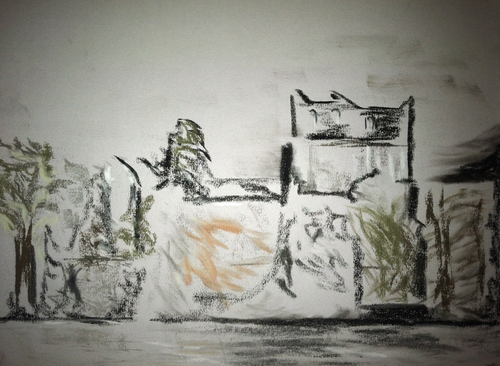
My fingers—stained with shades of grey, blue and yellow from my favorite artists’ soft pastels that are no longer being manufactured—ache from today’s sketch, the art that serves as physical therapy.
“You’re going to have to get back on your bike and ride home…”
My brother’s shouted voice echoes back to me across time.
Filters
October 18, 2014
The autumn warmth seeps through my sweater as soft jazz slips smoothly across the concrete. Long shadows creep alongside the sleek, obscure voice that is nearly lost in the roar of traffic.
The dying cricket slowly chirps, choosing to sing with the smoky jazz rather than repeat the tempo of the speeding cars. He’s had his summer’s fling and no longer frantically calls to his mate, but serenades simply for his own self-satisfaction.
No filters.
Each sound serves its two-fold purpose, capturing my attention and mirroring the self-fulfilling existence of the cricket. Noise for Noise’s Sake.
“Fever…”
The lyrics were once familiar enough to possess meaning.
“Fever when you hold me tight.”
Words, emotions and memories as obscure and purposeless as the cricket’s lackadaisical, self-satisfied chirp.
“You need to purchase a planner, “ she instructed me at the close of our last session. “I use a weekly one with enough space to write a few notes alongside my appointments. You are working your brain too hard trying to remember everything.”
“Dance, dance, dance!”
“What about shopping?” the other therapist asked.
I respond with a far-away glance.
“Your face gives you away,” she notes, making a few hasty scribbles on the blank sheet of paper.
My life, my reactions, my balance, my memories, my words transposed into her own, bright blue, indecipherable blotches on a white page. Rorschach tests representing my identity.
“I may choose a slightly different style of planner than yours,” I tell the cognitive therapist. “Something with a bit more space where I may write or draw.”
“It will be larger and heavier,” she responds, cautioning me she doesn’t want it to overburden me, a subtle reminder that I am to carry it with me everywhere I go.
“I want you to journal daily,” I instructed my Developmental English students. “Purchase something as small or as large as you’d like, but something you will carry with you wherever you go. Words on paper. For now, that’s all that matters, even if all you are able to write for the day is a shopping list.”
“I am a photographer,” I defiantly reply. “I am accustomed to carrying extra weight.”

The sound of an instrument I once could identify dances along with a piano, echoing its slow rhythm while a dog barks from another nearby table.
No filters.
“I can tell by your face you struggle with shopping,” she notes, adding, “Most patients do. Too much to filter.”
I reach for another tissue, ruefully smiling, knowing my tears serve as an answer.
The bike ride along the path motivates me since the prospect of a planner doesn’t. Cool weather, brilliant hues, crunching leaves combining into a sensory poem set to the motion of my tires, an easy autumnal sound contrasting sharply with the dizzying shrillness of the bookstore with conversations shouted through impenetrably high caverns of stacked books.
No filters.
The yellow leaves shimmer in the sunlight, loosely hung upon the branches to which they tightly clung throughout the spring and summer of their short lives. A fallen comrade skirts across the concrete, scratching its claws as the breeze effortlessly carries it toward the path of its destruction into the oncoming, rushing cars.
I leaf through the planners, clinging to the softness of the familiar Moleskin, the legendary patent claiming to be the favored notebooks of Hemingway.
Somewhere in a box left behind in a different chapter of my life is a stack of them. Moleskins, some empty, most possessing hastily scribbled notes from lectures, books and museums, thoughts that are now firmly, inaccessibly locked somewhere in my brain by a single blow.
“The additional space in my larger planner,” I inform her, “will allow me—no, encourage me—too practice my longhand writing skills.” The tears begin to fall again as I recall the pain of re-teaching myself how to make circles.
“Fifteen-month,” “weekly,” “large,” “lined,” the Moleskin planner description boasts. I carry it wearily from the rack, heavy hearted, knowing that even during the last few months of earning my Master’s degree—while conducting my research, writing and rewriting my thesis, attending classes and keeping appointments—the planner I purchased had become extra weight, an unnecessary item lost in a zipped pocket of my over-stuffed computer bag.
“You’re a day early. I wasn’t prepared to see you,” she chided me, half apologetic, half critical.
I grasp the Moleskin planner tightly, resentfully in my hand and wend my way further down the bookstore’s overstocked aisle, looking, longing for the unlined, undated blank pages of other journals.
The soft leather warms my leg. The jazz streams through my brain, as I reach for my jacket, realizing the autumn sun no longer caresses my shoulders.
Four unlined, undated pencil and eraser smeared pages later, I place my new soft leather-bound journal in my bag, mount my bicycle, and follow my own long shadow back home again.
The Coup
October 23, 2014
“Your injury is known as a ‘coup-contrecoup’,” she casually informed me as I struggled to record the outcome of the battery of tests she had administered over the past several appointments.
My mind immediately jumped back to my favorite lecture, my favorite period of art marked by rebelling citizens fighting aristocrats who were entirely out of touch with their day to day menial existence, those tumultuous late Eighteenth through Nineteenth Centuries which gave birth to artists Jean-Jacques David, Giroux, Millet, Degas, Monet, Dore, Manet; composers Beethoven, Wagner, Chopin and Stravinsky, as well as a string of others that my brain no longer conjures…images, names, dates, battles, concertos and exiles which literally have slip my mind.
“I finally understand the phrase, ‘overdoing it’,” I explained to my physical therapist, ticking off a short summary of the mental, social, physical and emotional strains from the previous day that rendered me incapable of executing the simple tasks in which she had just instructed me.
The intense two hours I spend with them exhaust me, and I have learned to laugh at the numerous boxes of tissue strategically placed throughout the rehabilitation center.
A quick search of frontal lobe functions yielded the following list: “Executive functioning and judgments, Emotional response and stability, Language usage, Personality, Word associations and meaning.”
For me, self-directed laughter quickly follows upon the heels of a bout of tears, those unfamiliar objects that too often trace a path down my cheeks since the injury.
“Coup: a sudden, violent, and illegal seizure of power from a government,” a simple Google search yields.
The words “sudden, violent…seizure” elicit those dreaded, seemingly inescapable salty drops. Again.
For those who know me best, to learn that my brain has executed its own coup would not be surprising since I have always been known for my independent, rebellious nature. That I am unable to actively engage in my own “Executive Processes” carried out by my damaged frontal lobe remains as equally ironic since I have likewise always scorned any hint of imposed positions of leadership.
Every ounce of my smallish frame exudes unconventionality, and up to this point in my life, I exalted in my own defiance.
The diagnoses emerge slowly, and with each new revelation have come a new symptom or two.
“Your vestibular crystals are at least still intact,” she reported after removing the goggles from my eyes that from my perspective had magnified my eyebrows, highlighting a grey one I had previously not noted. “That means we won’t have to reposition them but will have to retrain your brain to interpret the signals your inner ear canals are sending.”
Opening lines of communication then. One of my fortes, right up there with submitting to executive orders. Joy.
She continued introducing me to the battery of visual tracking exercises, instructing me to always focus on the purple she printed on a card, reminding me to remain cognizant of my symptoms. “As if I could do otherwise,” I comically noted, adding, “Hm…the ‘box’ has a lovely purple shadow the closer I hold it to my chest.”
“What do you mean?” she asked.
After explaining that the word on the card, “BOX,” appears to have a shadow when placed in my lower central field of vision, she quickly informed me, “That’s a symptom,” adding it is “double vision.”
“Leave it to me,” I chuckled, “to always see outside the box.”
“I want you to begin reintegrating yourself into social settings,” the cognitive therapist instructed me. “The process may be easier if you wear earplugs. You know, the squishy ones that some people wear so they are able to sleep better?”
“The kind we are required to wear on the tarmac?” I retorted.
“Oh…yes,” she awkwardly noted, adding, “Perhaps earbuds playing familiar classical music or soft jazz might work better.”
“Coup: a notable or successful stroke or move.”
“Hold on for just a minute,” I tell him. “I am using my earbuds for the first time.”
After squeezing the mic, I am startled by strains of Beethoven. Although I am unable to identify which symphony, I ask, “Is that your music or mine?” recalling his love for the composer.
“What music?” he asks, as tears of frustration begin to well up in my eyes.
“I don’t know. I can’t remember,” I respond. He frequently challenges me, asking me to recall the minutia that once shaped our lives.
“It must be yours,” he notes, adding, “Sometimes when you plug in earbuds, iTunes will automatically launch.”
I quickly direct my gaze toward my mic, hoping he hadn’t noticed my all-too frequent tears, attempting to focus on the double-visioned “Y” resting against my chest, and then fumbling with my keyboard to pull up iTunes so we may continue our conversation without Beethoven’s accompaniment.
My favorite Humanities lecture somehow incorporated Beethoven’s music and personal letters, comparing them with the art from the time period that had been wrought with political rebellion, an ethos of strengthened sense of individuality and heightened spirituality. But now, even when I look back at my lecture notes, I am unable to recall the correlation, cursing myself for not clearly delineating my thoughts or clearly communicating my intentions.
“Though still in bed, my thoughts go out to you…now and then joyfully, then sadly, waiting to learn whether or not fate will hear us – I can live only wholly with you or not at all,” Beethoven wrote to his lover on July 7, 1812. “Yes, I am resolved to wander so long away from you until I can fly to your arms and say that I am really at home with you, and can send my soul enwrapped in you into the land of spirits,” he continued, further entreating, “Oh God, why must one be parted from one whom one so loves. And yet my life…is now a wretched life – Your love makes me at once the happiest and the unhappiest.” He concluded, “At my age I need a steady, quiet life – can that be so in our connection?”
“Remember when we watched a movie together, making sure we pushed ‘play’ at exactly the same moment?” I ask. “Perhaps we may be able to do that with music.”
“Too much work,” he replies.
This time it is my turn to challenge him. “Which movie was it?” I ask, hiding the fact that I didn’t recall either.
That’s the pleasure of growing old with a friend. There comes a point when both parties, for whatever reason, begin forgetting what were once the important details upon which any relationship has been built.
“We both forget much,” I laugh, playfully adding, “Why do we even bother having these conversations?”
“You realize that’s all is it, right? You are only holding onto what is comfortable, what is familiar,” he insists.
“So much of what was once familiar is gone,” I wryly think to myself, again fighting the tears. “No, it’s much more than that,” I argue aloud, suddenly content that he chooses to seamlessly shift to another subject.
“You’ll be able to find a quiet corner in which to sit wherever you go. Don’t forget to use your planner to record things like what you’ve eaten, what time you’ve fallen asleep, what social engagements you’ve had, things like that. They all impact how well you are able to respond to different stimuli,” my physical therapist suggested.
I hastily jot down a few notes in my journal, realizing the warm autumnal afternoon sun has again begun to set on another day. As I walked with my girl, punctually following the schedule I had set for myself that day, I realized I had once again forgotten to eat lunch, so I had stopped for an early dinner. I remove an earbud from my ear long enough to thank the waitress, and head back, passively following my girl, absentmindedly listening to strains I was able to identify as Beethoven’s.
Something in the music’s swell strikes a chord of familiarity, stirring a faded memory. “Oh, yes. It was ‘Immortal Beloved’,” I inform no one as I head into the sunset.
“Forever thine
forever mine
forever us.”
Touch
November 04, 2014
“Stay still, TG,” she hissed. “Every time you move, you wake me up again.”
When my mother first began working overnights at the local diner after I entered kindergarten, she would stack books or crayons and a coloring book on the bed beside her when I would arrive home from my half day at school.
“Watch,” my brother told me, comforting me when he found me crying because I had colored every page in my coloring book. “Take a plain white scrap of paper and make your own coloring book page. Just draw one long line with the black crayon. Let it loop over itself again and again, then connect it back to your starting point. Then color each section a different color. It’s much better than a coloring book anyway because it is your own, not someone else’s picture.”
By consoling me, he taught me to create my own lines, my own contours, my own design.
I had likewise as independently learned to speak through reading, so by the time I was three, I avidly devoured books, losing myself in stories for hours.
Even though I had discovered words early, I spoke infrequently, content to squander away my hours in written words rather than those spoken, learning my overly formal sentence construction from books rather than casual conversation, mimicking the Romantic, flowing sentence structure of the Brothers Grimm or Hans Christian Anderson, and adopting the truncated speech patterns of Charlie Brown’s friends from my other favorite reading material, “Peanuts.”
The noise of the turning page or the motion of my reaching for another crayon disturbed her, so even these activities quickly ceased, and I learned to remain perfectly still beside her, matching my breathing rhythm with hers, deathly still, losing myself in my own imagination, watching fairy-like motes of dust float through the room in the late afternoon autumn sunshine softly filtering through the nearby window.
“You’ll have to lie as still as possible for twelve to fifteen minutes,” he assured me.
“My sister is a blockhead,” he declared each time he introduced me to a friend. “No, seriously, feel the top of her head,” a feat easily, playfully executed because of my unusually short stature. I would obligingly, laughingly lower my head so my new acquaintance could freely access the sharp angle located on the top, back part of my skull.
They would quickly withdraw their hand after locating the distinctive, square shaped head as my brother and I would exchange glances, break out in simultaneous laughter, reveling in my freakishness.
“Hey, look!” my brother exclaimed while flipping through a compilation of Charles Schulz cartoons. “Lucy calls Charlie Brown a blockhead every time he falls for her football trick,” he exclaimed, pointing to the strip in which Charlie, bereft of a football helmet, lies sprawled on the field after exerting all his energy in a vain attempt to kick Lucy’s proffered, then hastily withdrawn football. “Only difference is,” my brother reminded me, “Charlie has a perfectly round head, unlike you!”
“Take a few deep breaths before we begin,” he further instructed before adding, “I will lower this helmet-shaped guard. Don’t worry. It won’t actually touch you.”
The deep breath I take is one of relief, not preparation for the enclosed space of the MRI.
“You are wearing a helmet when you ride your bike, aren’t you?” my niece critically asked when I proudly shared with her my soft green leather journal.
“Well, no, I can’t seem to bring myself to having anything touch my head,” I responded, recounting how when the physical therapist first touched my head, it seemingly spun in her hands while frustrated, frightened tears streamed down my face.
Seeing my tears, she had quickly withdrawn her hands, and I immediately replaced them with my own, a gesture she identified as “grounding,” assuring me, “Almost all TBI patients do it. It seems to stop the spinning.”
I took a few deep breaths to take me back to my baseline, which on a scale of 0 to 10 usually perches around 6, our way of gauging how dizzy I am before beginning the various cognitive or physical exercises.
“If your level is higher than 6 at the beginning of the day, don’t push yourself, and don’t let it soar any higher than .5 or 1 point at the most. If you do, you’ll find yourself curled in a ball in a darkened room,” she reminded me. “Let me take you to those higher levels, but don’t go there yourself.”
“Twist them toward your nose as you insert them,” the technician informed me, noting my struggle to put the squishy earplugs into my ears.
“Oh, I know how to insert them,” I laughed, adding, “but this is the first time I have done it since my last day at the airport.”
As the machine began rolling me into the cavernous tunnel, I found myself breathing to the rhythmic whirl of magnets circling my head.
A few minutes later, I emerged into the warm Colorado, holding 96 images that reveal the odd shape of my head.
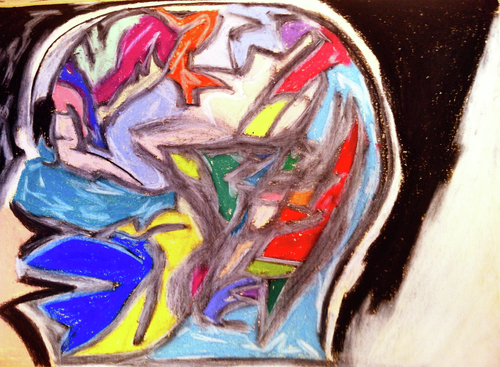
“You should paint a self portrait of your brain” a childhood friend encouraged me after I mentioned I had proof that yes, indeed, I DID have a brain. “That way we can all see what is on your mind.”
“Oh,” I replied, “No one wants to see what is on my mind!” knowing that very little, really, remains there.
“Kiss her, you blockhead,” an exasperated Sally yells at her brother in the animated version of “You’re a Good Man, Charlie Brown.” The little red-headed girl had finally revealed her feelings to Charlie Brown, kissed him on the cheek, and walked away, embarrassed by her own forwardness.
“Don’t you trust anyone anymore, Charlie Brown?” Lucy cajoles him. “Has your mind become so darkened with mistrust that you’ve lost your ability to believe in people?”
And he falls for her trick again….
With my newfound phobia of being touched, my fear may leave me figuratively lying flat on my back, alone, staring at the dust motes floating in the autumn sky, silently screaming, “AAAAAUUUGGGHHHH. Oh, good grief. I fell for it again.”
Smudged
November 11, 2014
I smiled at the smudge running from the tip of her forehead to the tip of her nose, the one that perfectly illustrated her point. “What?” she grimaced, noticing how close to the edge of laughter I was.
“Nothing,” I responded, knowing she always felt as self-conscious of her image as she did her art.

She had been the best, most realistic artist I have ever had the pleasure of meeting, her style lost in the abstract images most popular in her crowded art classes.
We passed hours together, singing loudly, laughing raucously, loving freely under the gaze of her brilliant blue morning glories that engulfed a decaying wagon wheel, “a gift for a friend, though I will probably never give it to her,” she absently declared, glancing at it harshly above her ever-present sketch book.
Under her tutelage, I learned to love the smell of linseed oil, to embrace the ineffable presence of dust or smears of paint, to mimic the way a quick but gentle stroke of the brush or hand could blend otherwise unblendable mediums.
Following the spontaneous, high-heeled onslaught of pinecones stingingly thrown at one another, we clamored back into the convertible, top down, music blasting. We hugged the curves tightly, speeding through the straightaways to rapidly reach the next challenge of the mountainous hairpin arcs that split through the pines on each side of the canyon.
Heaven.
One of those peculiarly poignantly sublime moments in which one could’t help but think, “I want it to be like this the moment I meet my death,” a fleeting thought accompanied by Pink Floyd soundtrack exploding from the speakers in the back seat.
“My grandmother attended the Institute one semester,” she explained, adding that after her grandfather died young, her grandmother had used her education as a springboard for her career, “Catering to the overly wealthy homeowners sparingly sprinkled across Denver” following the Depression.
“You’d better begin making art,” she sternly commanded as I walked out of the room, sensing that somehow I wouldn’t get the job she had posted as office administrator.
“She hired someone with more experience,” my niece informed me after I had received the letter of rejection. Somehow managing classrooms, academic advising, and walking the tight rope of administrative bureaucracy didn’t translate well to office management.
“Here they are!” he triumphantly exclaimed as he picked up another handful of soot. He opened his little hand, revealing two vehicles, blackened by fire with slightly melted wheels. From the ashes, we started yet another collection of cars, those tiny steel things for which we spent hours building kingdoms in the sand.
Charts
November 11, 2014
“How would you deal with a president of an organization who has chosen to extract himself so thoroughly that he remains only a figurehead with a title?” he asked.
“Remember whom you are asking,” I reminded him, adding that throughout my life I had balked against untoward expressions of authority.
“No, that’s specifically why I am asking you to ponder the circumstances,” he explained, chuckling mischievously.
“Hey, teachers, leave them kids alone.”
When the first subtle sounds of a helicopter emerged from the fifteen-foot-tall black monoliths positioned around the all-purpose room serving over 1,000 students as P.E. classroom, band room and cafeteria, a simultaneous, boisterous cheer would erupt. The gymnasium floor was reserved for our championship basketball team, whose lineup included a budding Blair Rasmussen and his equally tall and talented brother.
The lyrics repeatedly blared loudly from the cafeteria speakers, becoming an angry motto for an entire generation of rebellious high school students.

“Is anybody out there?”
“What do you do your first day of school?” a young teacher asked on the art teacher’s forum.
“Establish the rules and seating chart,” one responded.
“Begin introducing elements of art,” another wrote.
“Have the students draw a quick self-portrait,” another responded.
“I introduce my favorite song, Pink Floyd’s ‘The Wall,’ explaining it is my theme for life. I then encourage them to bring their own favorite ‘poems’ set to music so we may begin a cross-curricular exploration of word and image.”
“I have become comfortably numb….When I was a child, I caught a fleeting glimpse….I turned to look, but it was gone….The child is grown. The dream is gone.”
“TG, go wash your hands. You are covered in soot,” she growled.
My brother and I had been sifting through the incinerator in the alley behind our house, searching for the toys she had me carry out to the fire while my older siblings were at school. “Yes, throw in Terry as well,” she demanded, as I clutched the foam, terry lined tiger to my chest while tears streamed silently down my cheeks.
“Metal doesn’t burn,” my brother insisted as he sifted through the ashes. “Bet they are still in here somewhere,” he defiantly added. “We bought them with our own allowance. If I find them, I will share.”
“So you thought you might like to go to the show. To feel the warmth…and space cadet glow. They sent us along as a surrogate band. We’re going to find out where you fans really stand. There’s one in the spotlight, he don’t look right to me. Get him up against the wall.”
“Charcoal is one of the more difficult mediums to use,” she explained as she tediously, meticulously applied the shading to her portrait of yet another rock and roll star she would add to her burgeoning, overstuffed portfolio. “It tends to go places you don’t want it to go. You don’t control it. You manage it,” she added as she glanced over her sketchpad.
Tossed
November 12, 2014
“When you write, picture your audience, and frame your essay with your readers in mind,” my freshman English composition teacher told us.
After grading our first essays, he pulled two of us aside, asking to meet with him independently to further develop our narrative voices. “I don’t like teaching upper level composition courses,” he informed us, adding, “I prefer essays that are less structured, more expressive. Neither of you need the grammatical instruction your peers need, so our meetings will concentrate more on stylistic elements contained within the rhetorical framework of the assignments.”
Although I would later to go on to teach his courses once he retired, adding the advanced formal thesis of the upper level course to my dossier, like him, my first love remained with the five shorter essays in which students could develop their own narrative voice within the loosely structured parameters, the same loose, narrative parameters of self-expression I nurtured in my art students.

“Draw from your passion, the feelings of love you embrace within your own selves,” I encouraged them.
Lessons taught, but often rarely internalized.
“How do you spell ‘premier’?” I demanded of her, frustrated that my butchered attempt yielded “no suggestions found” on my phone’s spell check feature.
“Wait. What?!” she exclaimed. “How many times did you count me down for spelling in your class? You did get hit hard, didn’t you?” she joked.
That’s the joy of teaching Higher Ed: your students easily slip into friendship once the professional relationship has ended, and this evening a former student and I had just enjoyed the premier of a documentary a friend of hers had produced.
She and I had both been tossed about over the past few years, blowing our separate ways, now facing one another after a prolonged absence, sporting nearly exactly the same style of glasses and bright red shirts designed to reveal just enough but not too much. After laughing and hugging, we had picked up exactly where we had left off, somewhere between our rural town where we had raised our children and the adventures that had brought us close without ever touching.
“Yes, I know. Time to teach myself a few lessons, I suppose,” I responded, quickly fighting the usual stinging of the eyes that accompanied my frequent frustration.
“Mother taught us well how to guard our emotions,” my sister wryly noted when I warned her that I now cried much more freely than I ever had before. “Throughout the years, I have learned tears aren’t always a bad thing,” she comfortingly added, smiling through her own tears as she greeted me for the first time in over two years.
Sequencing. Jumping from one topic to another. Inability to concentrate.
Difficult pills to swallow for someone who had always been hyper vigilant, obsessively organized.
“I gave him my motto, ‘I’m not bad, I’m just drawn that way’,” she told me after we had passed a few hours together.
“You’d be fun to draw,” I told her while viewing a few of her latest photos. “I’m afraid I’d do it badly. I’d Picasso the hell out of you, but that would leave you torn and fragmented. Your beauty deserves to remain whole.”
“I look better abstract,” she smiled quickly in response. “Leaves more to the imagination!”
“Or the wrecking ball,” I ruefully added.
“I give my unconditional approval,” she replied.
“I am sure that’s what many of Picasso’s models said, but he was good. I just admittedly can’t draw a human form if my life depended upon it,” I argued.
“Soooo draw what you see… In your heart… Mind’s eye,” her voice echoed back to her former instructor across the years that had never truly served to separate us.
“Very good job, one of the better jobs you have done to let me know how you feel,” he noted after reading one of my long-winded, poetic manifestos.
“Perhaps the hit on the head has knocked some sense into you,” my brother playfully asserted.
Perhaps it has.Tossed
November 12, 2014
“When you write, picture your audience, and frame your essay with your readers in mind” my freshman English composition teacher told us.
After grading our first essays, he pulled two of us aside, asking to meet with him independently to further develop our narrative voices. “I don’t like teaching upper level composition courses,” he informed us, adding, “I prefer essays that are less structured, more expressive. Neither of you need the grammatical instruction your peers need, so our meetings will concentrate more on stylistic elements contained within the rhetorical framework of the assignments.”
Although I would later to go on to teach his courses once he retired, adding the advanced formal thesis of the upper level course to my dossier, like him, my first love remained with the five shorter essays in which students could develop their own narrative voice within the loosely structured parameters, the same loose, narrative parameters of self-expression I nurtured in my art students.
“Draw from your passion, the feelings of love you embrace within your own selves,” I encouraged them.
Lessons taught, but often rarely internalized.
“How do you spell ‘premier’?” I demanded of her, frustrated that my butchered attempt yielded “no suggestions found” on my phone’s spell check feature.
“Wait. What?!” she exclaimed. “How many times did you count me down for spelling in your class? You did get hit hard, didn’t you?” she joked.
That’s the joy of teaching Higher Ed: your students easily slip into friendship once the professional relationship has ended, and this evening a former student and I had just enjoyed the premier of a documentary a friend of hers had produced.
She and I had both been tossed about over the past few years, blowing our separate ways, now facing one another after a prolonged absence, sporting nearly exactly the same style of glasses and bright red shirts designed to reveal just enough but not too much. After laughing and hugging, we had picked up exactly where we had left off, somewhere between our rural town where we had raised our children and the adventures that had brought us close without ever touching.
“Yes, I know. Time to teach myself a few lessons, I suppose,” I responded, quickly fighting the usual stinging of the eyes that accompanied my frequent frustration.
“Mother taught us well how to guard our emotions,” my sister wryly noted when I warned her that I now cried much more freely than I ever had before. “Throughout the years, I have learned tears aren’t always a bad thing,” she comfortingly added, smiling through her own tears as she greeted me for the first time in over two years.
Sequencing. Jumping from one topic to another. Inability to concentrate.
Difficult pills to swallow for someone who had always been hyper vigilant, obsessively organized.
“I gave him my motto, ‘I’m not bad, I’m just drawn that way’,” she told me after we had passed a few hours together.
“You’d be fun to draw,” I told her while viewing a few of her latest photos. “I’m afraid I’d do it badly. I’d Picasso the hell out of you, but that would leave you torn and fragmented. Your beauty deserves to remain whole.”
“I look better abstract,” she smiled quickly in response. “Leaves more to the imagination!”
“Or the wrecking ball,” I ruefully added.
“I give my unconditional approval,” she replied.
“I am sure that’s what many of Picasso’s models said, but he was good. I just admittedly can’t draw a human form if my life depended upon it,” I argued.
“Soooo draw what you see… In your heart… Mind’s eye,” her voice echoed back to her former instructor across the years that had never truly served to separate us.
“Very good job, one of the better jobs you have done to let me know how you feel,” he noted after reading one of my long-winded, poetic manifestos.
“Perhaps the hit on the head has knocked some sense into you,” my brother playfully asserted.
Perhaps it has.
Resolution
November 19, 2014
“How are the on-line exercises coming along?” she asked at the outset of our last session.
My assigned cognitive rehabilitation following a TBI entails a number of simple, quick computer-based games in which patients are able to track their progress, including their performance based upon how they compare with other people their age.
“I have improved. I rather enjoy the visual exercises, including the ones where I match the shapes that look like puzzle pieces. It reminds me of my childhood, but I believe I would still prefer to work a real jigsaw puzzle,” I responded. “I continue playing Words with Friends, and I am enjoying the ‘Pop Words’ app you recently recommended. Do you happen to know any similar apps for math?”
“I have a whole book of math worksheets,” she informed me, reaching for a well-worn workbook on her shelf. By the tattered cover, I assumed a number of her cognitive patients had likewise complained of losing their ability to compute.
“Do you know a good website with math puzzles?” I had asked a former colleague a few days earlier. “Something simple, fun, yet not too childish, emphasizing the very most basic skills.” In my recent world consisting primarily of artists who scorned numbers, it seemed natural to turn to a community college instructor for potential adult-level basic math sources.
“I don’t know of any offhand, although if you Google math skills you will probably find one you like,” he responded, adding his search had yielded ixl Math, which looked, according to his assessment, “decent.”
I clicked on the site, wondering to which level my skills may have declined, disheartened to realize that after clicking through the upper elementary ones I felt overwhelmed, then further resolving the search would probably be easier if I started at the lowest level, kindergarten.
I rushed through the simple questions as quickly as possible, challenging myself, confident I could at least skip to the first grade set. After I responded to 50 simple addition problems, I glanced at my score. I was sitting at 68%, a failing grade according to my old English Composition syllabus.
I shut my laptop resolutely, a gesture I have learned when faced with the too-frequent feeling of frustration.
As she watched the tears well up in my eyes when I first glimpsed toward the three-column addition and subtraction problems filling the simplest pages in her workbook, she quickly began flipping through it to see what else she may have, adding, “I am afraid that is as simple as they come in this book,” suggesting I begin with the page on adding coins.
“No, because of the manipulatives, I seem to be fine counting change,” mentally adding that my skill had been tested since my workman’s comp won’t directly deposit my checks into my small town bank located four hours away. Consequently, since the injury, nearly every time I make a purchase I have to use cash.
“I will make basic addition and subtraction flash cards. Perhaps the manipulation of the cards themselves will help me redevelop my skills.” After all, I reasoned, I had successfully learned two foreign languages by writing out stack after stack of vocabulary terms.
“I would purchase them instead,” she quickly added, noting, “You won’t want to accidentally learn them incorrectly.”
I grimaced, though quickly acknowledged the accuracy of her suggestion. “I may as well also pick up multiplication and division cards,” I noted, jotting down a reminder in my ever-present planner.
“I would hold off on that a bit,” she cautioned, adding “Those skills are more taxing. You may find yourself frustrated.”
I obligingly crossed off multiplication and division cards from my shopping list.
“Jigsaw puzzle or Sudoku?” I texted my daughter from the bookstore while staring at brightly colored boxes of Legos, jigsaw puzzles, and pricey wooden blocks. I juggled two boxes of simple math flashcards in my hands, reminding myself not to slip them into my purse to clear my hands as I reached for my phone.
I had never been a big bag lady, reserving my larger handbags for three-day out of town trips instead. Since the injury, I have wrestled against an inclination to carry my wallet, my phone, my glasses or my planner in one hand, forgetting that I tote my large purse slung over my shoulder. Old habits die hard, but after one of the first days following my injury in which I left my wallet at each of the four checkout counters I had visited, I quickly acknowledged the sagacity of my cognitive therapist’s suggestion that I begin carrying a larger purse.
After five months, I have now trained myself to put whatever is in my hands back into my purse so I won’t leave it behind, but while shopping, that presents an additional fear of accidentally slipping a purchase into the oversized purse while walking through a store.
The problem is easily addressed in a grocery or discount store since I have trained myself to always use a shopping cart, even if my purchases consist of a gallon of milk and a tube of lip-gloss. But boutiques and bookstores seem to be less accommodating—an odd practice, since the lack of convenience may limit the number of purchases a single customer is likely to make.
“You should begin playing Sudoku, mom,” my daughter had encouraged me while she and her mathematic major boyfriend walked through a bookstore with me years ago. “I think you would enjoy it. You are flying to and from Chicago often enough that you would have plenty of time to play them while waiting in the airport or while on the flight.” As usual, she was right, and I purchased the same book for both of us, whipping through mine quicker than she and her boyfriend had been able to do, transitioning from “easy” to “challenging” to “mind-boggling” without really noting the progression, pleasantly surprised when she had noted how quickly I had filled the pages.
“Jigsaw. I am afraid the Sudoku may frustrate you,” she responded.
I frowned, realizing once again those voices outside of my own empty head were right, and resolutely reached for the cardboard box rather than the paper-back book filled with numbers.
Helpful TBI Link:
Using Tools
November 20, 2014
“How do you do that?” my daughter indignantly exclaimed when my youngest son picked up piece after piece and placed them directly where they belonged on the increasingly larger section of the puzzle he was forming in the bottom of the puzzle box.
“I had a great art history teacher who taught me to study color, hue, texture and shape,” he laughed, glancing at me, acknowledging that I had the pleasure and honor of teaching him and his friends at our community college.
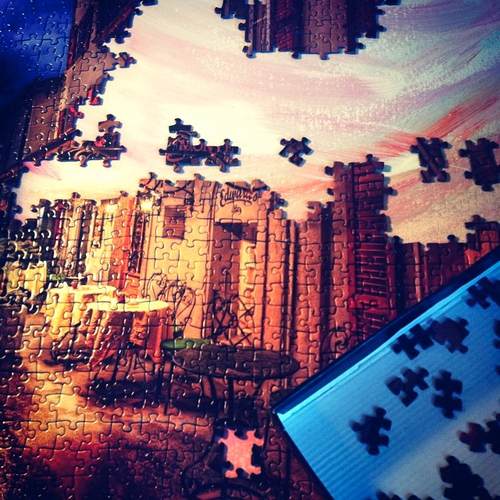
Together, they had selected a puzzle to help them through the last few stressful weeks of finals, and it stretched, unfinished, across the coffee table in the apartment they shared during my son’s last year at the University of Colorado.
Following the astrophysics graduation ceremony in which my son stood beside a soon to be retired star projector at Fiske planetarium, as a family we turned to tackle the bigger task of piecing together our fractured lives over the small cardboard shapes strewn in a series of boxes and casserole pans. We silently passed them back and forth, juggling the pieces, enjoying the companionship inherent in completing a common goal; anything ranging from assembling a tent, putting together a 1,000 piece Lego set to rebuilding our home piece by piece after our Christmas fire. Working together and playing games had always been our family’s favorite pastime.
“Ok, smart-ass, how are you going to get your 20 piece section onto the table?” she taunted.
“Oh, that’s easy,” he flippantly retorted. He knew his way as well through the kitchen as he did the tool shed, having spent years tagging along behind me as I shuffled through them myself. He had grown to be as avid of a DIYer as I was, and when he rose from the table, he emerged from the kitchen wielding a flat, large metal pancake turner, and proceeded to scoop up the disconnected puzzling mass and place it specifically where it perfectly attached to the connecting frame.
She shook her head in mocking disgust, and retreated in unspoken admiration to her corner of the puzzle.
“Use whatever tools are necessary to get the job done,” my college math instructor had informed us, understanding our reluctance. When I had returned to college, I was almost twenty years removed from my last high school math class, so I was relieved she allowed calculators. “As long as you understand basic math functions, there’s no reason not to use them,” she assured us. “And if you find yourself spending hours on a single assignment, understand you will have reached your learning threshold. Step away from your work, exercise a bit, and return. You will find you will think more clearly because you won’t be as frustrated.
“I want you to continue to develop the skill of writing under pressure,” my English Composition professor told us after our first few private sessions. “You will have to report to our regular class on the days I have assigned in-class compositions. It is too easy to rely upon grammar and spell check when composing on a computer. You need to know how to proofread and correct your own material since other instructors have you write in-class, time restricted essay exams.”
We exchanged glances, chuckled, and showed him page after page of hand-written material we had jotted, torn apart, scribbled through, and later shared as we had prepared our 3-5 page, neatly typed compositions.
Fearful of his scorn, she and I had met separately to critique one another’s work, piecing together our submitted essays from pages of brainstorming, writing, rewriting, and still unsure of our first attempt at appeasing “No-A Conway.” The hours we had devoted to a single assignment served to illustrate how vital that skill would be for both of us.
“Traumatic Brain Injuries,” the article states, “affect Executive Functions of the brain.” Frontal Lobe injuries manifest themselves in a number of ways, including impaired social judgment and an inability to assess or correct one’s own work.
“Your word retrieval seems intact,” my cognitive therapist assured me after I handed her a stack of papers, each one filled with synonyms, antonyms and homonyms. “I see few erasures, so it appears you didn’t have many errors.” I dashed my hand across my eyes, at once relieved yet still frustrated, explaining how I had struggled to spell the words correctly, using my computer to as a spell checker, transcribing the word once I was certain of its correct spelling. “I am wont to push myself a bit,” I explained resolutely.
“Your writing is as lucid and compelling as ever,” my beloved undergrad English mentor assured me when I reported my injury. The words, though appreciated, stung. Although since the injury I write frequently, my rough drafts remain riddled with red and green squiggly lines, indicating I am entirely reliant upon tools to execute my craft.
Piece by Piece
November, 2014
As a team, we had been working furiously against the deadline, arriving at the museum late in the afternoon and working far later than I should have because of my injury. In spite of the looming deadline, we worked well together, continuing to share in light-hearted banter, but I could tell by this point the designer of Macky had become frustrated by my inability to follow directions. I smiled in return, picked up the three containers of 1 x ’s and returned to the hallway to continue the same tedious task I had tackled throughout the week.
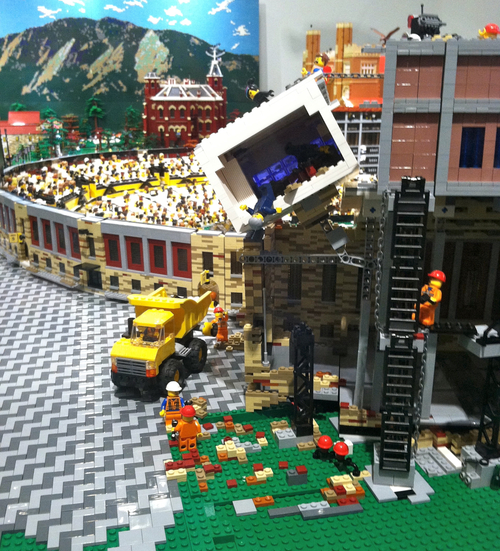
“I am glad you are volunteering,” my cognitive therapist told me, informing me that volunteer work, while allowing me to socialize, would pose less stress than a contractual or waged position would entail.
“How are the Legos coming along?” my physical therapist asked, cautioning me to be aware of my symptoms.
“For the most part, I am spending time in an isolated hallway while constructing the smaller segments that will be used for the larger components of the installation,” I informed her, with a measure of resentment and resignation creeping into my voice.
“Don’t worry, mom,” my daughter said as she watched the project design manager show us how to assemble the smaller component. “I will show you where the pieces go in a minute.”
“We have attracted 901 visitors and still have a half hour to go before closing,” the head of the Heritage Association informed us as we watched the next group walk up toward the Legos installation on opening day. “Our goal to attract the next generation of students has been accomplished,” she added, triumphantly. “We have capitalized well upon the crowd heading toward Macky for the annual performance of the Nutcracker.”
“I am glad you like the game,” my youngest son said, after we had played a few rounds. He and I had spent the evening decorating his Christmas tree, each holding a wi controller, vying our way through Mario’s latest version of Rainbow Road. “It brings back the good times we used to have playing it after the Christmas Eve house fire.”
“Recent studies indicate cognitive skills acquired while playing video games increase active though processes,” his girlfriend added as the characters she and I had created threw turtle shells at one another while speeding down a virtual road of brightly colored blocks. The light from the Christmas tree sparkled brightly in the mirror placed behind the big screen television they had purchased a few years before, casting a warm glow that blended into a colorful yet relaxing blur of auditory and visual stimulation.
“Are you ok to drive?” he asked at the end of the evening, hugging me before I gingerly lowered myself into my car.
“Yes,” I responded, realizing how subtly the roles we assume in the game of life have shifted.
Helpful TBI Link:
http://www.brainline.org/content/multimedia.php?id=7053
Sugar Plums
November 28, 2014
“Where does this piece go?” he asked me, holding up a metal part of the newly assembled bike that glistened in the soft light cast by the nearby Christmas tree.
“Hell if I know. I guess we’ll find out if it was tomorrow on the pilot ride around the block” I responded, laughing in part because we had put off all the wrapping and assembling once again well into the late night hours of Christmas Eve.
Although neither of us wanted our children to grow up in a world wrought with visions of sugar-plum fairies, fair princesses or marching tin soldiers, we unknowingly, actively perpetrate the fiction of Santa Clause, postponing most of our Christmas gift wrapping to the late hours following our four hour round trip to and from the nearest city available to purchase toys.
The first few Christmases we shared in this manner were magically illuminated by the sheer pleasure of watching their faces brighten as they opened their packages on Christmas morning, unveiling the latest Lego set or bicycle. But the last few years of our time together as a family were marked more by the adherence to traditions long since forgotten yet enacted by routine.
We tediously wrapped each stocking stuffer, even down to single packages of gum from a larger cellophane-enclosed variety pack. Traditions designed to prolong the excitement of Christmas cheer that served at times to irritate more than delight.
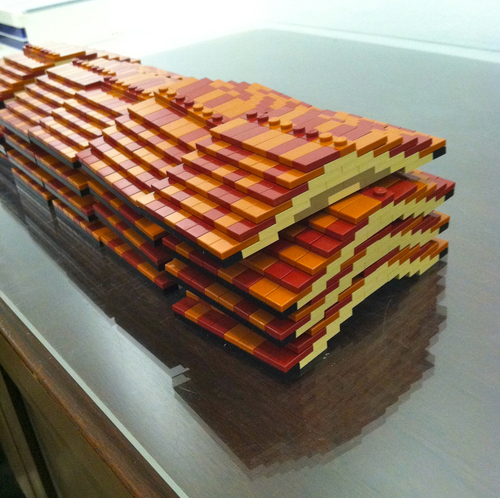
“I can only handle the tedium, the smaller segments,” I informed the designer of the building we were constructing for the installation commissioned by University of Colorado Heritage Association.
After showing me how to construct a few pieces, he looked at me with impatience and suggested I return to the 3 x 6 segments I had been assembling throughout the week. “It’s ok,” he sighed placatingly. “Since this is a support beam, I will do it. I am almost finished anyway.”
Faltering Steps
December 7, 2014
“You seem to have regressed with your balance,” she noted, frowning as she scribbled a few notes on a page after flipping through my ever-growing file.
Each month, at the end of my prescribed therapy and specialist appointments, my progress is re-evaluated. We had noted a slight improvement in my ability to twist my neck in what had originally seemed to be circus-like contortions and in my visual tracking, but as I stood with my eyes closed on a soft surface, I felt my physical therapist’s guarding hands softly thumping against my back and chest as I wavered back and forth.
Discouraged, I sat back onto the firm examination table, as the perpetual tears welled up in my eyes again.
Toward the outset of autumn, I had the pleasure of riding my bike several miles a day after having passed my former physical therapist’s test of being able to stand on one foot for a minute at a time, a skill in which I had prided myself while learning Tae Kwon Do.
Returning to my bike after my injury as a means to continue developing my balance was a reward I had worked hard to earn, but not something I expected to lose once learned.
“We haven’t worked much on your balance. We have concentrated more upon your tracking and mobility,” she added with a tone of consolation.
The tears continued to flow as my mind flashed back to the simple lessons in addition and subtraction I have now begun to undertake.
“Practice standing with your feet in tandem, first with your eyes open, then eventually with your eyes closed,” she instructed as she handed me yet another sheet of paper delineating the various exercises I would have to include in my daily routine. “If necessary, hold onto a firm surface for support with just a few fingers barely touching to provide a sense of grounding. Always challenge yourself. If one exercise is too easy, add an additional component, but always listen to what your symptoms are warning you to do.”
After explaining that by the end of the summer I was able to stand on a single foot even while watering plants, I asked, “Am I going to have to continue re-learning each lesson repeatedly?” with frustration and anger seeping into my voice.
“For now, yes,” she responded, adding with a note of hope, “You may not have to once you are further along in the healing process.”
“How is the healing coming along?” my sister-in-law asked at Thanksgiving. I’d been warned by my therapists the movement at the table, the stress of preparing food, and the various sounds associated with family gatherings may prove to be taxing.
I glanced up at the video feed of orchestrated music overhead to swallow the ever-present lump in my throat. She had visited with me briefly early in the summer when I first began the healing process, but even though I am living with her daughter, she received very few progress reports.
After swallowing a few times, assuring myself that I could control the tears, I returned her gaze, explaining that I had recently undertaken the challenge of kindergarten math flash cards, laughingly adding it would be awhile before I could make sense of the college art history lectures I had delivered for nine years in our dusty Southeastern Colorado community before shifting gears and moving to Chicago to complete my Master’s Degree at the Art Institute.
“I am a bit taxed,” my nephew explained after I asked him how his project for the University of Colorado Heritage Foundation was proceeding. He and his companions had received the commission about the same time I had sustained my injury. He had been frazzled but excited when we had met shortly afterward as I volunteered my assistance, but he had not contacted me throughout the remainder of the summer.
I had lost myself in hours of therapy, and when I saw him at Thanksgiving, I realized he had lost himself in his overwhelming commission. My daughter and I once again offered to help, and this time, he took us up on the offer.
“Look,” I exclaimed while scrutinizing the details of the collaborative installation that sprawled across eight tables, “You’ve even included a dog eating leftover pizza,” adding that my girl loved walking across campus on a Sunday morning, pillaging for whatever leftover items she could devour before I caught her digging through yet another discarded pile of refuse.
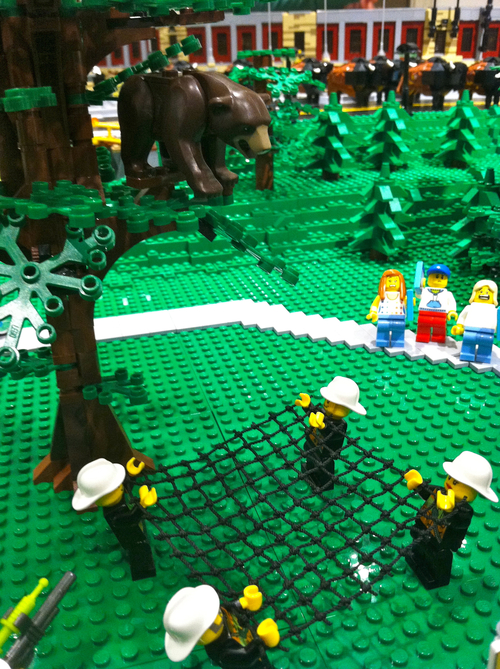
All the vignettes were there: Boulder’s famed bear caught while falling from a tree, the outdoor Shakespeare Festival, the overcrowded bike racks outside Macky Auditorium, and even a prospector celebrating the birth of the University toward the end of the Colorado Gold Rush. Details celebrating the rich history of my alma mater. Walking visually through the Lego reproduction reminded me of lessons forgotten in the haze of the concussion.
“Help myself to remember new information by connecting it to old information, personal life experiences and knowledge I already have,” the instructions provided during one of my latest therapy sessions states. “That should be easy to remember,” I noted during the session. “As educator, I encouraged my students to link knew knowledge to life experiences and build upon older lessons. I am glad,” I added, “I have my teaching skills to help assist me as I learn to navigate my way through my injury.”
Every step in life leads to a specific destination, even if the steps along the journey at times may seem to falter.
Another TBI Blog:
http://www.brainline.org/content/2015/01/when-you-least-expect-it.html
Cards and Castles
December 30, 2014
“The pieces of your life seem to be falling together perfectly,” my brother-in-law quietly observed as he watched me struggle to shuffle the cards.
Every family gathering entails long hours sitting around the dining room table, bantering while throwing down cards in a rousing game of canasta.
I smiled ruefully as he added, “If your injury had occurred anywhere other than work, you wouldn’t have received the excellent medical care, you wouldn’t have had an income, and you wouldn’t have had an opportunity to dedicate yourself to your art as you have the past few months.”
As my fingers fumbled with the task which I once enjoyed almost as much as the game itself, I thought, “If I hadn’t been working the job I had taken, I wouldn’t have been injured,” adding silently, “And never mind the income is not even half what I was making at my low-paying job because of a technicality the insurance providers have capitalized upon.”
Even though the too-long hours of post-Christmas activities were exhausting, I still pushed myself to engage in the traditional activities, knowing I would pay for it later. My two year old niece and I shared naps, and, on those nights when I pushed myself too hard, early bed times. I made up a few more hours by sleeping in while the rest of the family ate breakfast. The skipped meal was well worth indulging in the light-hearted banter around the table throughout the evening.
“Who wants the chore of pairing with me?” I asked, knowing that because of my inability to concentrate, I would be more inclined to play a losing hand than ever.
“I will,” my sis volunteered, and at the same time offered to play two hands so my brother-in-law would also have a partner, also balancing her usual job of scorekeeping, shuffling, and, at the end of the game, sorting. I admired her ability to multi-task, the same skill set she had used to build her remarkably successful career in project management.
“Be prepared to lose,” I warned her, adding, “I will be unable to tally our cards at the end of each hand, much less try to keep track of what you are discarding. You’ll also have to frequently remind me of the rules as we play,” I offered to everyone gathered around the table, a statement proven true each time I believed I had the right number of cards to “lay down” the first round, a task my brother-in-law would aid in to prevent any sort of “table talk” between me and my partner.
Each evening (except one, when I was far too exhausted to walk, much less play a round of cards following a trip to a crowded mall), she would have one winning hand—the one she was playing with her husband—and one losing hand—the one she was playing with me.
In spite of the daily loss, the games served as yet another opportunity to practice basic math, and by the time the holidays were over, I boasted the ability to at least count by tens even though counting by fives remained too challenging for my basic arithmetic skill set.
“As I have reminded you, we have a year of healing. Your attitude seems upbeat,” my doctor observed once I compared the constant vertigo to an amusement park without the cost of the overpriced ticket.
“I’ve learned every new experience is an opportunity for growth, for development, and throughout my life, I have loved learning,” I responded, wryly adding, “I just never quite expected the simple skills of addition and walking would be among those lessons.”
“Just keep following the exercises your therapists provide for you,” he reminded me before leaving the office.
“You know you aren’t supposed to begin working the rest of the puzzle until we have found all the edge pieces,” he scolded me. “Mom won’t let us help if she catches you doing that.”
I frowned my response, dutifully tearing apart the section I had placed together, pieces that naturally fell together because I easily identified the similarities in texture, shape and color. Following her strict rules regarding jigsaw puzzles—or anything else, for that matter—never came easily for me, but because I feared the consequences—always too harsh for the crime committed—I begrudgingly complied.
As children, we had few toys, instead entertaining ourselves with whatever grown-up pleasures we had on hand, ranging from hours watching dust motes fall upon the spinning of the vinyl classical music as it played, perusing through discarded encyclopedias supplied by a kind neighbor, arranging rocks in my father’s garden, or passing hours piecing together 1000 piece jigsaw puzzles, gifts from the same kind neighbor. Each activity had specific limitation to which we must strictly comply.
The jigsaw puzzles were usually reserved for Christmas vacation, holding a special place of their own on a card table in the crowded living room where all eight of us children would gather around at one point or another. We first were instructed to rifle through the pieces to find those with a straight edge. We weren’t allowed to take any other piece out of the puzzle box unless it comprised the border.
After the picture—castles with moats, street side cafes, dense wooded forests, barns in green fields, whatever picturesque scene had been donated by our kind neighbor—had been framed, we then tediously separated the pieces by color, regardless of hue, tossing them pell-mell into bowls, arguing, upon occasion, over whether or not a particular piece was primarily blue sky or green hill. Only once the obsessive sorting was finished were we allowed to begin piecing together the rest of the puzzle.
The separation process seemingly took a lifetime, and in retrospect, I can’t help but wonder whether or not the steps were specified to fill those otherwise too-common empty hours.
“Amazing how much easier this is when I don’t have to follow anyone else’s rules,” I told him, diverting myself from our conversation by placing pieces here and there while he continued whatever strand we had left off from a few days ago. Throughout the healing process, I have his familiar voice to distract me as I place together the jumbled pieces.
I had begun rifling through the pieces to find those with the straight edges, but rather than handling each piece twice or three times, I took the strategy we used at the airport. “Don’t touch any piece of luggage more than once. Pick it up and put it specifically where it belongs without placing it anywhere else.”
Rather than randomly flipping through the pieces, I had begun methodically placing them right side up on whatever flat surface I had available, which, as artist, meant the paint-smeared, unfinished canvases I have lining the wall where I sleep. Random splashes of color somehow made the puzzle pieces shape, texture and hue pop, and long before I had completed the border, I had begun piecing large portions together, interspersing rapid placements of the pieces with quick flips through my math flashcards.
My training as photographer, artist and art historian paid off handsomely. My ability to identify specific architectural elements, my ability to quickly identify nuances in hues and textures, my ability to notice soft or sharp focus in a frame made the job easy.
What used to take eight of us day after day took me only a few hours.
Non-compliance to the rules, as well as drawing upon those previously learned skills, tools I brought to the table, has, I remind myself, made the process quicker and easier.
Yet putting together the pieces, playing games alone, following the guidelines provided by my therapists to fulfill yet another block of my recovery—bereft of familiar traditions, laughter and banter—somehow just isn’t the same.
“No,” I quietly remind myself. “On this journey, you are not alone.” The injury has taught me that real wealth is found in the memories created and nurtured with friends and family, those scattered pieces of my life that may again eventually come together. Cards and Castles
Of Crushes and Crutches
January 15, 2014
They once kept me awake at night, carelessly tumbling, silently screaming, ceaselessly crying.
The drugged sleep has silenced them, at least long enough to allow me to attempt to heal. If only I were, then perhaps I wouldn’t miss them so deeply, those tormenting phrases bouncing unheard, unheeded.
Words.
I lose myself in them as they wrap around me like the comforting arms of a friend, a parent, a lover.
“You’ve read Edith Wharton?” he exclaimed after our first class. I glanced down, a bit ashamed by what my mother had often chided me for doing. She had been aware of the hours my younger self had lost to page after page of fairy tales.
As I grew older, the fairy tales eventually transformed into fantasy series by Baum, L’Engle and Flemming, wisely guiding me through Oz, Wrinkled Time, or chasing villains in a literary vehicle with a Bang.
“Bond is supposed to be mysterious, tough, rugged. Not a deeply troubled, reluctant hero chased by Post Traumatic Stress Disorder created ghosts,” he argued.
He had called numerous times, but lately I hadn’t been able to answer because of the equally numerous back-to-back doctors’ appointments. I missed the random flow of our conversations where we would easily jump from Nietzsche to Schopenhauer to Kierkegaard to St. Augustine. The wandering conversations that would remind me of my strolls along the Lakefront conducting research on Chicago’s monumental art.
Random interactions seemingly leading nowhere, yet purposeful in their content. As I find myself struggling sometimes to follow, I gently remind myself, “He wants me back, and he is fighting hard to get me.”
“The character and plots weren’t psychodramas that they became once the second-to-last, pretty-boy Double-O-7 assumed the role.”
We had grown up with the tougher Bond, the-rolling-down-a-cliff-grasping-the-nearest-object-to-ski-while-ripping-off-his-repurposed-jacket-to-sail-onto-a-nearby-island-into-the-arms-of-yet-another-beautiful-woman Bond. The too-driven-to-contemplate-driving-force-behind-his-actions Bond. The tough-guy-womanizing-shoot-to-kill-but-never-die-another-day Bond.
“Do you struggle to read?” my primary care physician asked while using only his index fingers to record my response.
“Yes,” I paused, fighting tears. “I attempted Dante, and well, it was daunting,” I joked, returning to the sense of humor I often relied upon to mask my emotions.
“Do you skip lines?” he added, while my brain skipped to those dreadful hours I had passed sitting at a keyboard resisting the urge to increase my always too-slow speed while using my index fingers for the quicker hunt-and-peck method.
I paused, clearing my head of the perpetual rabbits, responding, “No. I see the words. I am just unable to comprehend them,” while hastily wiping away the tears. He noticed the motion in his peripheral vision and looked up from his keyboard, so I added, “Dante is one of my favorites, and it hurts that I can’t understand him since I once made my living teaching students to analyze him.”
Rabbits. There they go again. I had the same professor for a number of classes, ranging from English Composition to Literature to Philosophy to Humanities, all centered around one thing. He introduced me to Dante, nurturing my love of words, those magical things that throughout my life had led me from personal Inferno into analytical Paradise.
“Put down that book,” she yelled after discovering I hadn’t done my chores, while I responded, “I’m coming.” It became a common chorus chanted on many occasions, a frustrated mother and an even more frustrated teenager. They sustained me, protected me, consoled me.
“You struggle with your conjugations,” a friend noted when I asked her if she had observed a change in my writing. “And your word choice isn’t as strong as it once was,” she added.
As an author, I valued her criticism, as she, in the past, had valued mine. I had read her work, writing endorsements of her prose characterized by free-flowing narration, punctuated with humor. But her words, though extended in kindness, wounded.
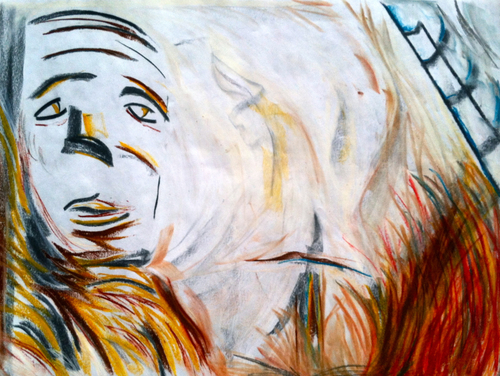
“What is the difference between the words ‘Crutch’ and ‘Crush?” my cognitive therapist asked, encouraging me to identify the different sounds.
The combination impacted me like a heavy weight, and the only sound I could hear was the sentence I had formed in my own head, “I have to use a crutch because I have been crushed.”
My response was only to shake my head and cry.
After a pause, I was able to explain my tears, and she said, quite business-like, “You are being treated for Post Traumatic Stress Disorder, correct?”
“No” I hesitatingly responded, knowing that yet another therapist would be added to my long list of specialists.
“How is your breathing?” she asked when I entered her office. The day, warm enough for me to enjoy the sunshine with my convertible top down as I dashed through the quickly melting snow, had rapidly descended from heaven to hell.
“Google led me astray,” I grimaced, “and I became quite lost on my way here.”
She jumped upon it as a metaphor for my healing as a journey. “As an artist,” she explained, “You have an advantage. The injury has damaged your analytical and social processes, but your pre-evolutionary brain is still intact. It is this area of your brain which houses creativity.”
As we further explored the direction biofeedback would take me, she noted that if I had a thought that spun too many times through my head, writing the words would help me. “Become your own hero,” she encouraged. “Write your own epic. Chose which avenues you travel, and let your body express the language of your subconscious mind.”
I scowled, begrudgingly acknowledging that my analytical self had disappeared entirely with the concussion, as had my command of the English language as I once knew it.
I have come to understand that for now, I will have to filter most stimuli through artistic expression.
“Always think of what you want,” she admonished me as I was leaving, adding, “And don’t forget to breathe.”
Semantics
January 26, 2015
“Did I use the term correctly?” she asked when I entered her office. “I wrote, ‘She is an artist with sculpture as her medium’ on my intake report.”
“That was a point frequently discussed at the Institute,” I laughingly responded. “One professor explained that mediums conduct séances. Artists use media.”
I believe this differentiation is what ails art today. It is too often no longer visionary. We concentrate on the tangible, plastic media we use, often ignoring the intangible energetic forces outside ourselves. We become technicians, practitioners of art, encouraging our students to replicate rather than create.
Artists throughout history have almost always lived a life on the fringe of societal norms, “seeing” everyday objects through a transformative eye.
Leonardo Da Vinci wrote, “There are three classes of people: those who see, those who see when they are shown, those who do not see.” For him, the process of “seeing” transcended perception. He stated that reality itself was best observed in an object’s shadow: “Shadow is the obstruction of light,” further explaining that shadows defined and clarified solid shapes, creating boundaries between reality and perception wherein the object itself would be contained.
Da Vinci pointed out that objects are “ill-understood unless they are shown against a background of a different tone from themselves.” It is only within the illusory world of shadows that we ourselves are defined, delineated from objects outside ourselves.
Metaphorically, an actual object is shaped and contained within the liminal, sensory threshold between reality and perception, those indefinable, fleeting grey areas that separate object from the space it momentarily, transitorily inhabits. Within the shadow, reality is reversed, mirrored, reflected, shortened, enlarged. And if air is visible, as it is in foggy terrain, an object’s shadow appears in a three dimensional space.
Artists, through their media, interpret this intermediary, perceptual space. To an extent, then, artists, through their media, become mediums, interpreting perceived reality through sensory observations.
“Photography and acrylic,” I quickly answered, smiling.
After a pause, I added, “Although I have done primarily just charcoal, graphite and pastel lately. My balance is bad enough without looking at life through a lens,” I laughed, adding with a touch of sadness, “A few weeks after the injury, I did the background for my planned 24 canvas series based upon my bicycle ride from Chicago to Colorado.” I continued as my voice trailed, “My muscles in my right hand and arm hurt so much I learned I could barely grip a paint brush, so I haven’t picked up the brush to paint a canvas since the injury.”
The moment I spoke those words, I realized, by my own definition, I could no longer practice my art.
I rubbed my thumb on my right hand, a gesture she noted. “My hand still hurts, but the pain is inconsistent.” I explained that immediately following my injury I struggled to hold a pen or pencil and couldn’t write clearly, then reached for my ever-growing therapy notebook to show her my latest scrawl.
“I am struggling again to hold a pencil,” not willing to add that I preferred using graphite because it is easily erased, whereas pen is much less forgiving. Nor willing to admit that my hand was sore because I had attempted to return to my media.
With each new therapist, I have to reintroduce myself, and the answer to their usual question, “What do you do with your free time?” is always the same.
“I am an artist.”
Even though I have earned my degree from the second best art school in the nation according to US New and World Report, before the injury, I never considered myself to be an artist. An art educator, yes, but never an artist. Other than the thousands of shots I have taken of public art, architecture and the art I have seen in museums across the world to augment my lectures, I had used my mediums for self-exploration and expression.
Her face brightened, and I proceeded to answer her next question, “What is your medium?”
I continued my explanation, masking my own horror of realization, admitting for the first time that I hadn’t picked up a paintbrush to create in over seven months, hiding my pain and frustration behind a string of words. “My first physical therapist told me that because I am using my muscles differently as new neurological pathways are established, my muscles may be sore for awhile,” also realizing that seven months is a long time to suffer from occasional sore muscles while the neurons learn new pathways.
At the conclusion of my meandering explanation describing my art practice, she watched me struggle to grasp a pencil to jot a few notes in my notebook, challenging, “You realize sore muscles are hormonal,” adding that if I had damaged my thyroid glands in the accident, I would have also experienced other symptoms.

“Throughout your appointment today, you have skipped from subject to subject,” he quietly observed. “You had a list you wanted to discuss, but I don’t think you ever returned to the first item we began discussing.”
“I don’t even remember what the first item was,” I laughed while glancing down at the list I had recorded in my notebook.
“Exactly my point,” he noted, adding, “You are struggling with your attention. I want to prescribe Adderall to help you concentrate.”
I frowned, reminding him that I prefer to approach problems with natural solutions rather than medication, hesitatingly adding, “My lack of concentration seems to be a common observation with my therapists as well.”
In the back of my foggy brain, echoes of my own lectures returned to me when I informed my students that many great artists would have been diagnosed by modern physicians and psychiatrists and medicated, a point, I also added, that may have resulted in very little artistic output.
My first point during my appointment, I realized later, was that a number of the specialists I have seen recently suggested my thyroid glands might have sustained injury by the blow as well, explaining that they are located in the same area of my neck that my physical therapist has been working on for months. If my frontal lobe has been affected by the concussion because of the coup-contra-coup TBI, it is possible that the unprotected glands in the front of my neck may likewise have been injured.
When I first suggested the damage to my thyroid, explaining that I am unable to regulate my temperature at night, have had increased weight gain and have experienced increased hot flashes, his response was curt: “Thyroid issues also may be genetic. Your symptoms point toward hypothyroidism, but I doubt we could prove it was specifically a result of your injury since the pituitary gland is located in the center of your brain and your MRI doesn’t show any damage in that area.”
I sighed resolutely, knowing that even though I had none of these symptoms prior to my concussion, arguing a simple point was moot, especially since I am unable to sustain a thought for long, much less express it verbally.
Baseboards and Ladders
January 27, 2015
“You explained to him the extent of your symptoms, didn’t you?” she asked after I told her he was unwilling to explore the potential issues with my thyroid. When I first mentioned my inability to regulate my temperature, I explained to her that I would lie awake at night under a down comforter and two layers of blankets shivering, unable to sleep because I was too cold.
“No, I guess not,” I added, realizing that I hated admitting the extent of my struggle.

“Denial,” I said, after completing the exercise delineating why I had failed to ask my daughter a series of questions regarding iTunes and Siri, compensatory strategies suggested to aid my memory.
Compensatory strategies, I realized, also demanded I admit I needed help.
These strategies range anywhere from the planner I so carefully chose last autumn to post-it notes stuck on every possible surface around my home to stars stuck in odd places reminding me to practice my brief biofeedback exercises. And the list goes on and on, tools to help me remember to do everything from turn off the stove once I am finished cooking to feeding the animals or taking my medication.
What once was a clutter free, meticulously kempt space is now scattered with anything from keys to reading glasses to cell phone to oversized bag containing notebooks, different colors of pens, planners and wallet (though I did somehow manage to lose a pair of glasses and my driver’s license in spite of the bag.)
“I have been helping my daughter with her remodel,” I explained, further describing the work my family had done following our Christmas Eve fire years ago, which entailed rebuilding our home from the frame inward since it had been nearly entirely gutted by the damage. I had the experience to help my daughter with her remodel, and she had the youth and determination.
“Today is the first time I have really seen it,” my daughter noted as I stumbled while dusting her bed frame. After several weeks of work, she was finally moving into her new home.
Throughout the process, I had watched her with mingled admiration and frustration as she followed my instructions, bringing new life to her Victorian home in Denver’s Grant Street Historic District, wishing all along I could help her more, but pleased as a parent that she has worked so hard to attain her goal. Every time I spent time with her, I saw echoes of myself when I was young, poignant reminders that I had been supplanted.
“Do not go gentle into the night,” the poet invoked his father as he grew older.
“I can’t use a ladder, and if I am having a bad day with my symptoms, I won’t be able to use a step stool either,” I explained when she first asked me to help with her remodel.
“That’s fine. There is plenty of baseboard trim in the house, and you always were able to keep a steady enough hand to avoid using masking tape or an edger. It is the artist in you.”
I didn’t confess to her that I had stopped painting entirely because my muscles in my hand seemed atrophied since the injury, hoping that the simple exercise of lying prostrate on the floor while painting straight white and grey lines would perhaps serve to redirect the damaged neurological pathways.
It appeared painting all the lines of grey and white, those definitive colors defining Da Vinci’s liminal space, had served to create nearly incapacitating pain and its accompanying increased weakness in my hand.
“I see her often, but I keep forgetting to ask her for help,” I replied when my cognitive therapist asked me whether or not I had asked my daughter to assist me with Siri, a compensatory strategy intended to help me keep track of my thoughts throughout the day.
The moment I had spoken the words, I identified the root problem, the reason I kept forgetting to ask.
I hate admitting I need help. I hate that I am perpetually lost in the dizzying fog of my concussion.
I refuse to admit that I am, indeed, disabled.
Chicken Soup
February 24, 2015
“How are your Compensatory Strategies coming along?” she asked at the beginning of our appointment.
Several weeks had passed since we had seen one another. Workman’s Comp had neither approved nor declined my prescription for Physical and Speech Therapy, so I had attempted to continue a few of the exercises on my own, but the longer I went without seeing either of them, the more my speech slurred, the more I stumbled, and the weaker and more painful my hand had become. I was relieved to be back, and the perpetual tears welled up in my eyes.
“You need to go rest, Jeannie” she insisted as I sat, withdrawn, on the floor near the cabinet while the rest of the family sorted through years of accumulated kitchenware and appliances.
She was the only person left in my life who still called me by my childhood name, and the word always sounded like a soft embrace, a reminder of how it felt to feel her warm lips against my cheek every time I stopped by for a too infrequent visit.
The only married couple who had shown me day to day what true love looks like had been separated, temporarily, by his passing. She had been diagnosed with terminal cancer 30 years ago, five years after he had retired from his blue-collar job at my hometown’s steel mill.
We never expected him to be the first to go.
“We spent every minute together for the past 35 years,” she tearfully explained after I hugged her, expressing my condolences. “I will miss him,” she added, resolutely.
“He always wanted me to clean out the kitchen cabinets,” she explained as she watched from a dining room chair, her recently fractured foot resting on her nearby walker. “I never got around to it,” she added, her voice trailing softly.
“You spent every moment you could with him since his retirement. That’s a much better way to have spent your time,” I quickly reassured her.
“Going to garage sales and auctions was our hobby,” she explained, half apologetic that her kitchen was stalked with antiques dating back to her grandmother’s era. She had inherited her family’s cast iron skillets, ceramic mixing bowls, crystal, table linens and hand-crocheted afghans, adding to her inheritance every Saturday morning as she and Charles walked from one garage sale to another, hand in hand, shuffling through remnants, preserving mementos, memories and traditions when other families chose to discard them.
“Do you know what that is?” she asked when I held up a tool that resembled a miniature plow.
“Of course,” I responded, excitedly, “I make homemade noodles for my chicken soup, but I cut each one by hand!”
“My grandmother made her own noodles all the time,” she said, explaining how when she would come home from school she would find noodles drying everywhere in the kitchen, “including,” she added, “the backs of the kitchen chairs!”
With nearly every object we touched, she could tell us the story, the use, and often could describe in detail the person who had once used the tool. “I wish we had videotaped your stories, grandma,” my niece exclaimed as she sat at her feet, covered in centuries-old linens.
As we sorted through the heirlooms, she looked at me and insisted, “Jeannie, choose an afghan for yourself. You are as much of a part of this family as the other girls.” I smiled, modestly reaching for the small pastel square that was in the “non-heirloom” pile intended to be donated, knowing that although the story of this particular piece was unknown since it had been a garage sale find, I carried away the touch of an unidentified artist who had shared his or her craft with another family.
The banter was light, unlike a house in mourning. The time spent following the funeral was a celebration of love and life, not just a memorial to the beloved deceased. “I believe you have a few years worth of tea,” I had informed her after sorting through her drawer designated for beverages.
“Then I will have to hold on long enough to be able to drink it all,” she responded.
“In that case, we will have to buy more tea!” I exclaimed, laughing.
Although my sister had been the lucky one to marry into the family by marrying the couple’s oldest son, when she became part of it, by default, her little sister did as well. And while I nurtured my friendship with their youngest daughter while we were still in grade school, I secretly hoped to be lucky enough to snag one of the younger brothers for my own.
“Stand still, Jeannie, and this rock will splash your face.” As usual, I was gullible enough to fall for it. By this point, I was almost a senior in high school, and she was going to be a sophomore. Her brothers had all married, so that hope was gone, but our friendship continued. As we played that hot summer day at the city’s newly opened swimming spot at the reservoir, we exchanged a few harmless splashes, tossing small stones at one another.
After one of her turns, I quickly jerked my head aside, my mouth tasting of the iron rich rocks that several generations of families had built their careers upon. I knew she had thrown a bit too hard, striking me instead of the water in front of my face.
“Are you OK?” I heard her exclaim, while I responded with laughter. Her horrified face spoke volumes as the horror increased with my smile. From her expression, I knew the extra chunk in my mouth wasn’t just crumbled rock; it also contained a large portion of my front tooth.
The remainder of the summer I spent in the dentist’s chair rather than at the new swimming hole, but thereafter, any time I catch a glimpse of my marred smile in a mirror, I know I am, in part, smiling at her.
“I would like to get to know you before we begin,” the funeral director stated as we gathered around the conference table. Funeral plans. Always the most difficult task for the family following a death.
As each family member introduced themselves, I struggled with what words I would say once they got around to me. She was surrounded by love, the way her life had been lived throughout its entirety, something which at once I celebrated and envied.
“She’s my adopted daughter,” I heard her say, realizing I had been lost in my own thoughts so thoroughly I hadn’t noticed we had made it so my end of the table.
For once, I knew my loss of words and my tears were an expression of grief, not a symptom of my TBI. With tears streaming down my face, my only response was my crooked smile.
Two Step
February 27, 2015
“I can do it by myself,” the child exclaimed as she climbed the steps up the slide located in the playground across the street.
I had watched several generations of children zip down the slide through the huge picture window, including my own, smiling upon reflection that the first time I kissed my childhood sweetheart, we were looking at the Big Dipper in this same park.
Throughout the long week, the sound of children’s laughter refreshed and renewed us all as we at times fought back tears, at times laughed as a great uncle showed two generations of children to pop wheelies on the recently emptied wheelchair.
A few months prior to his death, we had convened in the same location to celebrate the lovers’ lives with a joyous weekend of banquets, cake, and more shared family time as they looked back on their 60 years together.
“I am afraid this will be the last time we see them together,” one of the daughters-in-law whispered to me while we were huddled in the kitchen to escape the noise.
Even though we were celebrating their lives together, you could see he had withdrawn a bit, making the party more of a celebration of her life with him rather than a life they would continue to live together. There was just something about his demeanor indicating he knew he was nearly finished struggling with his faltering heart.
Odd how life, and death, are like that. Sometimes we just are able to sense when the transition time from one to the other is upon us.
“Do you find yourself crying often?” she asked as I wiped the tears away.
We had just attempted to have me follow a few simple instructions, and the tears that always fell when I became frustrated had once again welled up in my eyes. She was my second speech therapist, so she hadn’t seen the initial outpouring each time I was faced with a new task I was unable to successfully execute.
She reached for my file, which is growing thicker and thicker, to flip toward the back to look for whatever notes she may have missed when she initially took me on as patient. I slowly added, “Not as much as I once did. I have grown to understand that the tears are a healthy way of mourning that which I have lost.”
The past few weeks had been arduous. In addition to dealing with the recent death, my right hand had grown increasingly weak, reverting back to what it had been for the first few weeks following the injury in which I had struggled to grasp a pen, or anything else for that matter.
After noting the brace I was wearing, she had done a few basic tests, including looking inside my mouth. She acutely observed the flaccidity of the right side of my tongue and proceeded to have me perform a number of simple maneuvering exercises, noting that my slurred speech may, in part, have been caused by the lack of muscular response on the right side of my mouth, which corresponded with my lack of strength in my right hand.
“You may want to point this out to your doctor,” she warned me, adding, “Since you were struck on the left side of your head, it makes sense that you may have lost muscular control on your right side.”
“She is right,” he said after doing a few simple strength tests to all my right limbs. “Your entire right side is weak. Your MRI is normal, but do you remember why we wanted to do it in the first place?” he asked.
“I had complained of numbness in my tongue,” I frowned.
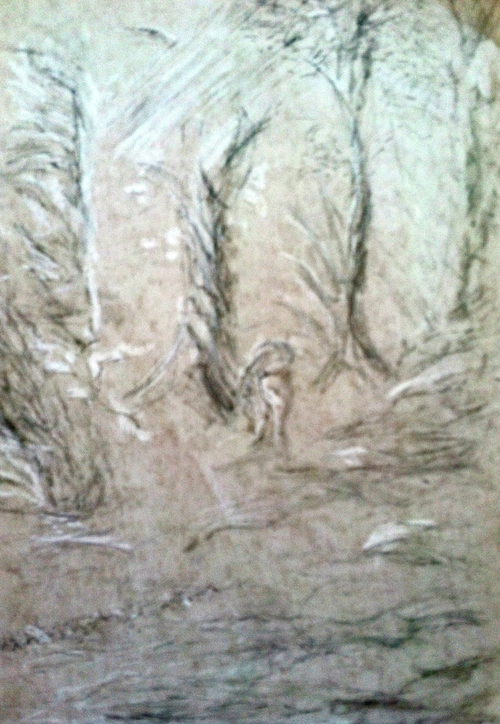
“Yep,” he confirmed as he wrote out a prescript to a neurologist. “He will probably want you to undergo a few tests,” he informed me as he handed me yet another slip of paper.
I walked out of his office, noting that I would need to add yet another name to the long list of specialists I have compiled.
We had noted from the outset of my injury that my right fine motor skills had been affected, but we were so busy concentrating on improving my balance enough for me to walk and drive initially that we had failed to track the continued weakness. And, in the same way that I had earlier discovered that my balance had to be a perpetual exercise, apparently the same was true of my right motor skills, and the month long cessation in physical therapy had brought the ever present weakness to the forefront.
The loss of strength, the death, the discovery of my inability to comprehend simple directions were just a few on a quickly growing list.
A visit to yet another specialist yielded a hope that contact lenses would eliminate the dizziness in my upper left field of vision. I had been elated to discover that yes, they did, but devastated when I realized that they also yielded a dangerous loss of depth perception in my right field, a discovery driven home again and again as I tripped over objects or ducked around others that were a safe distance from me.
One symptom seemingly cured as another one had been added.
Two steps forward, five back.
“We have followed you with every step of your journey,” he assured me when I had hugged them both on a quick, spontaneous trip last summer. “You’ve gone from travelling the country through the slowest means, your bicycle, to doing it the fastest way possible through flying. We read every blog you post.”
I had hopped the quick twenty-minute flight from Denver to Pueblo last summer just to visit them, the last trip, as it turns out, I was able to make before sustaining my injury.
I smiled, knowing the two of them had followed me not just through my bike trip or my recent flights, but throughout most of my life.
“Daddy, watch me,” she yelled over her shoulder as she climbed up the stairs of the slide once again. “You don’t even need to catch me anymore!” she exclaimed as she sped down the slide.
Independence. We all long for it. Yet deep down inside, we want someone with whom we are able to share our victories. Or even our defeats.
What’s Your Style?
Charles, you are missed. By all of us.
Shaping One’s Style: Fear
”[W]hat I call ‘my present’ has one foot in my past and another in my future. In my past…because ‘the moment in which I am speaking is already far from me’; in my future…because this moment is impending over the future: it is to the future that I am tending.”
Henri Bergson, 1908
Matter and Memory
Although artists should draw from their past experiences, Bergson is clear to note that one’s “past is essentially powerless.” The past, rather, is viewed through the camera lens of the immediacy of present, the process that “summons [an artist] to action….[W]e should endeavor in vain to characterize the memory of a past state unless we began by defining the…consciousness of present reality.” Artists young and old are familiar with Dali’s “Persistence of Memory,” which exemplifies the process of past being shaped and defined by present.
“You were always too quiet, too introverted for me,” my ex informed me when trying to explain in part why our lives had fallen apart. It was not the first time I would hear those words pertaining to my social interaction with others, nor would it be the last.
Yes, I am often oddly quiet, yet words are as integral to my life as images, fleetingly representing the memories, the impressions, the lingering ghosts of times past, those nearly forgotten people, places and events that have served to shape who I am and how I represent my world.
Yet too all often, words remain stuck in my mouth, floating through my brain, flooding into my thoughts on dark, lonely nights.
“Why don’t you ever ask the difficult questions?” he insisted.
When I grow weary of my own words, I reach for a book, losing myself in other’s words instead, enjoying the imagery painted by my favorite authors, descriptions of long-lost worlds, long-lost places, long-lost people.
Ghosts.
“Ssssshhhhh,” she hissed from the other side of the bed, “and stop moving before I give you a reason to make noise.”
The “reason,” appearing in any sentence, always meant pain.
My brother had started attending full-length school days as a first grader, and I was left at home, wandering alone through the normally over-crowded house. I hated the word “school,” even though I didn’t fully comprehend what it signified.
My eldest half-brother had left for ‘Nam, my eldest half-sister for college (an education that ended quickly because of a hasty, mid-semester marriage), and my youngest half-sister had married her childhood sweetheart weeks before he, too, had left for ‘Nam.
Only my mother’s “real” children (her word) remained at home, so the girls were no longer sharing a single bed in the basement as we did as soon as I was old enough to no longer sleep in a crib.
We were disbursed throughout the house, and as youngest, my brother and I shared a single wood-paneled room.
The yellow-brown warmth of the paneling still bore the shadows of what had once been a built-in bunk bed from which my brother had fallen a few months before. After “cracking his skull” and being admitted to the hospital for what seemed like several weeks, he returned home to a room with two twin beds placed side by side.
The only do-it-yourself project I remember sharing with my mother as a young child had been the destruction of the bunk bed, assisting her as she pulled it angrily piece by piece out of the beautiful wood paneling, leaving unfilled, gaping scars marking the time-worn, now bare wall.
Sleeping had always been difficult, even before he and I were allowed to share the same bedroom.
As the youngest, he and I were always the first to be spirited away to bed, and I would lie awake for hours listening to the voices of my older siblings, sometimes laughing, sometimes angry, but most often muted to hushed whispers, at the same time sometimes envying their age, sometimes deeply relieved I was no longer among those constrained by the ever-present tension that lingered in the hallways like ghosts.
After the voices had ceased, after I had counted the movement of my four older sisters as they would one by one file into bed, I would still yet lie awake, listening to the sound of the furnace or the settling “pops” skulking in every older home, listening for the furtive footsteps of whatever monster I knew lurked somewhere under my bed, under the stairwell or in the upstairs hallway, waiting for me to creep quietly, quickly, into the bathroom.
The monster was not one of my active childhood imagination, but the steely grip of my eldest brother as his hand would clamp over my nose and mouth, preventing me from making a sound while he inflicted pain upon my small body, preventing me at times even from breathing.
From him, I learned to hold all sorts of bodily fluids as tightly as possible, releasing them only when my small body could no longer contain them, sometimes soiling myself, resulting only in more pain, this time inflicted by my mother because she would have to do yet another load of laundry.
Before my younger brother had been whisked off to school leaving me to face the wrath of my mother alone, he and I had endured most interesting forms of chastisement, including once being tied together to our clothesline pole for chasing one another through the cool, freshly hung clothes rather than dutifully helping her snap dry the small undergarments I had just soiled.
Our laughter, our games, our constant motion became our defiance, allowing us to escape her smoldering anger, even at the risk of evoking its resultant pain.
And now, as I lay beside my mother, again “shooshed” into silence, I turned my back away from her, silent tears dropping onto the pillow, wrapped tightly around my head in my own childish attempt to muffle the sound of my breathing, taking slow breaths set to the rhythm of her own.
Silence came naturally. Breathing did not.
“If you ever tell anyone, I will kill you,” he threatened, forcing my breath from me with pain, not allowing me to take in another because of his cupped hand.
“Breathe, Rj, breathe,” he would have to remind me. He was the only one who ever allowed me to breathe, encouraging me to take in air at my own pace, never trying to steal it away, at the same time encouraging me without judgment to find my own words, my own style.
That year, once my brother had entered school full time, she had taken a night job as a waitress, explaining to my objecting father that she could sleep throughout the day now that I was the only one remaining at home, adding that I could quietly color or flip through books as she rested.
Throughout those long, lonely, fear-filled, tedious days, the box of crayons and stacks of books always remained closed, taunting me as I peered out from the crevice created by my clenched pillow. If I had ever attempted to reach for them, I would have met with an angry hiss issuing from the other side of the bed.
The fact that they were beside me was enough. I was familiar enough with their contents by this point to be able to see the images, hear the words, escape into the world the artists and authors had created. Their creativity became my solace.
Eventually, assured by their nearby presence, stilled and silenced by her wrath and after my child-sized lungs ached from pacing them to match her slow, sleep-induced ones, the voices in my head would finally grow quiet as well, and I would at last lose myself in sleep.
Shaping One’s Style: Grief
Bergson observes that as we attempt to recover a specific recollection, “we detach ourselves from the present,” a separation from our present reality, comparing the process to focusing a camera lens, a process in which the experience itself “takes on color.” Throughout the process, thought, the experience, though perceived and interpreted by recollection, always remains attached to the past.” The action of recollection of an experience is grounded in the past and is separated yet shapes current perception.
Separation doesn’t always result in romanticizing, though the separation still colors one’s life as indelibly as the sound of children’s laughter echoing on a warm afternoon breeze.
My mother’s wrath was simply more than I could bear, even as an adult. Or perhaps more accurately, becoming an adult and starting my own family at last gave me the courage to walk away from the angry growls and harsh lessons of the intimidating she-bear.
She loved shopping, which may have explained her compulsion to purge. She and I had grown increasingly alienated with each substantial loss in the family, whether it be relocating (which we did often), separation, or death. Her reaction, for whatever reason, had been to strike out angrily throughout the event, creating a false aura of malevolence surrounding the person or event that simply was unsubstantiated.
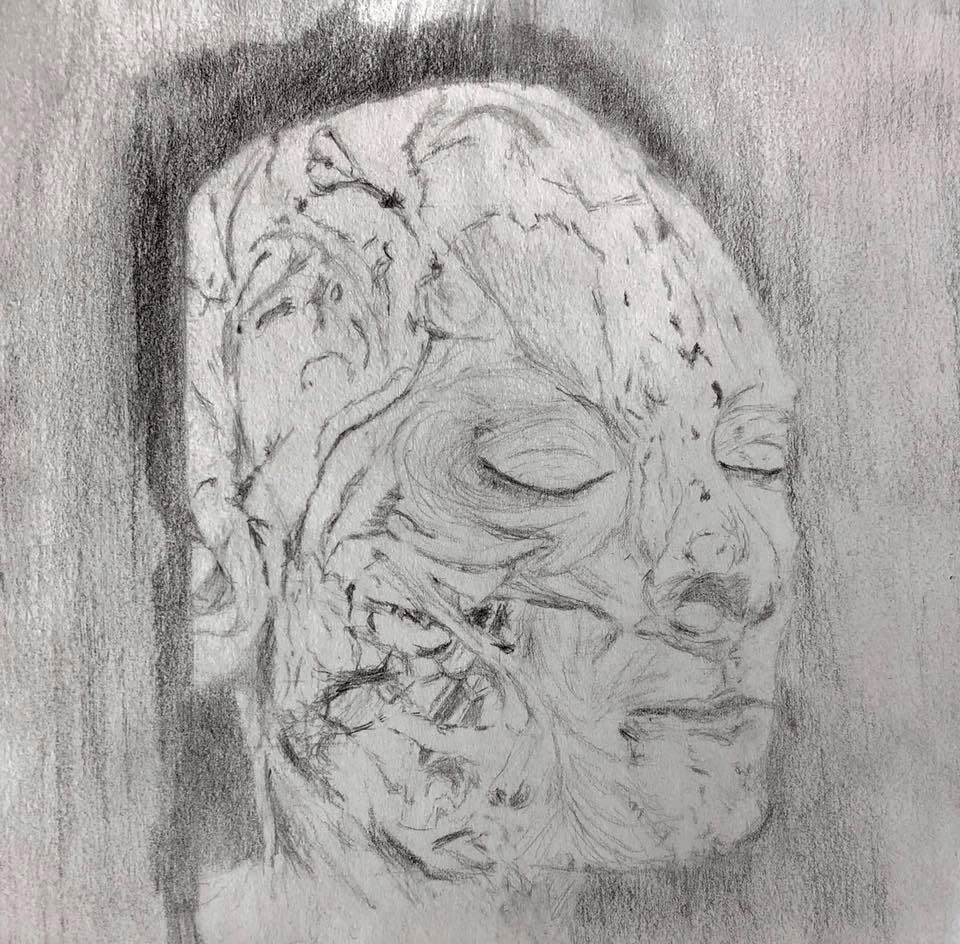
One cold February day in eighth grade, I came home from school to find her loading kitchen items in a box. Since we moved frequently alas by this point in my life the discovery came as no surprise. The circumstances surrounding this particular occasion, however, were, and her decision would serve as the first catalyst in what has become our permanent alienation.
She informed my brother and I, stone-faced as always, that she had been told our stepfather was still married to another woman. He was a polygamist, so she was leaving him. Barely considering the legal ramifications, her justification for separation was based solely upon scripture.
Throughout the next few months, rather than addressing the subject with him and silencing us as well, she began selecting items necessary to set up house in Colorado, surreptitiously mailing them to my sisters who lived in Colorado. She likewise surreptitiously skimmed off as much cash from the family budget as possible, stashing it in a coffee can.
Every few days, when my brother and I would come home from school, we found a few more boxes prepared to be lugged to the post office. As with all our chores, as we would walk to the post office with small wads of cash that smelled oddly of a two-day old pot of coffee, we would make a game of it, challenging one another with simple feats such as balancing the boxes on a single hand, carrying the load on our heads, or whatever we could do to relieve the mounting tension.
My stepfather, silenced over the years in the same way we had been, never noted or perhaps bothered to say anything about the increasingly empty apartment. Not surprising, for my mother’s inclination to purge by this point in their 3 ½ long marriage was equally not surprising. He would simply come home from his job as construction supervisor, curl up in his easy chair with his latest paper-back novel, and spend the remainder of the evening lost between the pages of the book, occasionally glimpsing over its cover with his twinkling, mischievous blue eyes to give me a smiling wink.
My brother and I had always found his company agreeable. When he and my mother first married, his laughter came as easily and brightly as the sparkles in his eyes, and he loved dancing, walking, fishing and smiling, doing each with a casual ease foreign to our tension-filled early childhood.
He lived simply, working long hours when the season permitted, contentedly owning two pairs of pants, a few shirts and a small pile of novels he always kept beside his chair. His passion, in addition to his novels and fishing poles, consisted of breeding fish, a distraction he nurtured most diligently when weather wouldn’t permit him to drown a worm at the end of a hook.
His simple lifestyle adapted well enough to my mother’s compulsion, and his easy-going demeanor sharply contrasted yet strangely complimented her perpetual angry tension.
With each move, he, too, would have to yield his tanks full of guppies and mollies, converting the glass aquariums to moving boxes, and upon entering whatever would serve as our next home, his first undertaking would be to refill the tanks, simultaneously filling the room with a quiet, soothing, bubbling hum of the filtration system in anticipation of his next trip to the neighborhood pet store.
Since his other family had never once interrupted our lives, my brother and I mumbled disgruntledly amongst ourselves against my mother’s perceived offence, fighting silently against yet another pending relocation.
He was a sophomore in high school, and he had received accolades for his prowess on his harmonica, a gift from our father, one of the few items he had been able to hold onto throughout the tumultuous years simply because it slipped easily into his shirt or jacket pocket undetected from my mother’s furious eradications of our material belongings.
For the first time since my mother had married my stepfather, we had remained enrolled in a single school throughout the year, moving only once but miraculously staying in the same school district.
Throughout middle school, his harmonica had served as sole consoling companion on our increasingly long walks through whatever neighborhood we happened to land in following our latest move. He would play melancholy, blues-based phrases, not songs really, just the wheezing, often mournful, sometimes angry and insistent breath-like sounds that served as soundtrack to our lives, accompanying our steps through Colorado’s dry fields littered with cactus and lizards, Texas’ metal-infused ghost-like abandoned oil fields, or Washington and Oregon’s fern-bathed, conifer-shaded paths.
As we would walk back from our post office pilgrimages, he would pull his harmonica out of his front pocket, playing a compositionless tune, sucking and exhaling air through the harmonica rather than his mouth or his nose as most ramblers do.
He literally breathed music, so it wasn’t surprising that the high school jazz teacher, discovering his talent, had entered him into a national competition.
My mother’s marital date of redemption, according to her strange, arbitrary schedule, was set for the day before Easter. The high school music competition was to be held the following week. He knew for months he would be unable to participate, yet optimistically held out hope that my mother’s wrath would wane and we would perhaps remain in Seattle, an optimism that somehow gave an odd lilt to his blues-infused riffs.
His hope remained firm until the day we purchased the airline tickets a week before our departure, and as we rode the bus returning from the airport smelling of day-old coffee, although he exhibited the deeply ingrained lesson of a tearless life, the furtive, frequent gestures toward his shirt pocket were the only outward signs of his grief.
A few years ago, as I visited with my brother, I noted the same recurring motion, a quick sweep of his hand across his chest. The gesture of grief has become an odd, nearly imperceptible tic he still frequently repeats even forty years later, although he now infrequently plays his harmonica. The instrument of his youth now remains wrapped in a deep blue velvet cloth, stored in a box, safely tucked into an unopened, dark, dusty dresser drawer.
Shaping One’s Style: Of Transience
Henri Bergson identifies three types of cognitive processes: “pure memory, memory-image, and perception…. Perception is never a mere contact of mind with the object present; it is impregnated with memory-images which complete it as they interest it. The memory-image, in its turn, partakes of the ‘pure memory’…and of the perception in which it tends to embody itself.” Bergson explains the three steps in which an artist takes an actual occurrence, an interaction with a real object. The experience and even the object itself gives birth to the creation of the memory-image, the bi-product resultant of the perception of the perceiver. Experience and memory are integral parts of the creative whole. “Pure memory…manifests itself only in the colored and living image which reveals it,” Bergson writes.
How does memory shape and color your creativity?
As I read, Tool plays quietly in the background…. “I know the pieces fit…”

Echoes of the concert I heard as I pedaled my first Chicago bike along the Lakeshore on my last evening so long ago…
Memory plunges me, shivering, into a world of ghosts long-since forgotten. Or at least on some days, that is what I attempt to convince myself.
Not long ago, as the sun set on yet another perfect autumn day in Colorado, children’s laughter wafted into my room on a warm, slight breeze that hinted of the colder temperatures accompanying the setting sun. For a moment, I believe I heard my brother’s laughter…not the stifled, grown-up, cynically tinged one we always adopt as we slip into adulthood, but the free, innocent one that tinkled through the air like glitter rather than shards of broken glass.
Odd, isn’t it, how well composed words and images are able to evoke aural, olfactory, tactile and gustatory memories? As the weather becomes cooler, advertisers inundate us, tempt us, seduce us with images of pumpkin-pie flavored lattes and fallen leaves, reminding us to celebrate the fecundity of life with their brands.
Autumn. The perfect time to be haunted by pungently scented spices composing the images, words and memories of seasons passed.
My father would have been one hundred this year. I envy his passing forty some odd years ago—quick and at the height of his life, old enough to have held his first few grandchildren, young enough to be vibrantly alive, able to have spent his last morning chopping wood for a needy church member.
Have I romanticized his life? Perhaps. Perhaps that is how one most frequently approaches the pain of loss: by evoking and elevating only the best memories of an event, a place, a person who is now seeming to be permanently lost, through whatever means, whether it be death, separation or miles too many to be easily traversed.
It is said ghosts linger in the liminal spaces just beyond human sensual perception, yet a soft breeze, a faint sound, a slight movement may subconsciously set in motion a series of memories, whereby we are able to conjure images of those from whom we have been separated.
Do they exists, these ghosts, or are they merely memories from which we are no longer able to exorcise ourselves?
Either way, today, as I listen to music, attuned to the sounds issuing from my laptop, aware of the warm sunshine beating through the glass window panes and mingling with the even warmer whir of my Mac’s fan, I remain remotely conscious of visual and tactile shadows cast by the cool sienna tile, soft purple blanket, deep blue wall and the rainbow of colors cascading from a nearby print perched on the floor just within my peripheral view.
I wait for the single “ping” indicating a solitary ghost, the one I seek most ardently, is as aware of me as I am of him.
Caught in the Undertow, “This ground is not the rock I thought it to be,” the mermaid screams angrily. Unkissed, unhuman, untransformed, she slips quietly back into the sea, her silvery scales turned to steely resolve…at least for the moment, perhaps for the day.
Time to extract myself from the endless, acrid search for monetary sustenance, remove myself from my eternal, bitter search for lost memories, the realms seemingly, torturously just beyond my grasp.
“Breathe in union…”
Time to lose myself in the sweet, colorful, tactile world of imagination that I myself am able to control, able to create….
“Unholy Baptism” gives way to “Flood”
“Here comes the water.
“All I knew and all I believed
Are crumbling images
That no longer comfort me.
I scramble to reach higher ground,
Some order and sanity,
Or something to comfort me.
“So I take what is mine, and hold what is mine,
Suffocate what is mine, and bury what’s mine.
Soon the water will come
And claim what is mine.
I must leave it behind,
And climb to a new place now.
“This ground is not the rock I thought it to be.
“Thought I was high, and free.
I thought I was there.
“Divine destiny
“I was wrong.
This changes everything.
“The water is rising up on me.
Thought the Son would come deliver me,
But the truth has come to punish me instead.
“The ground is breaking down right under me.
Cleanse and purge me
In the water.”
“Come, forgive thy people…” The strains of music change, and muted, slow, soft tones of Messiah penetrate my senses.
Lyrics by Tool, 1992
Shaping One’s Style: Melancholy
“For usually people resist as long as they can to dismiss the fool they harbor in their bosom, they resist to confess a major mistake or to admit a truth that makes them despair.”
~Johann Wolfgang von Goethe
1795-6
How does one’s individual trauma and unique narrative shape an artist’s style? As educator, I assign my students to journal, encouraging them to explore the aspects of their lives that have shaped their fears, their goals, their happiness, their despair: the motivating factors in their lives that shape who they are and who they become. Journaling isn’t merely writing one’s journey in words, but pictures, moments, memories.

“My most faithful and by far most entertaining bed partners have been dead white guys,” I often tell my friends when they ask me why I am still single.
It isn’t surprising that I have spent years searching for ghosts of the expatriates, nor is it surprising that my art is a reflection of their style. For the past 17 years, I have immersed myself in Romanticism through Modernism, spending much of my spare time lost in the bookbindings and margins of literature and art. For that matter, it is the same space I have occupied throughout most of my life.
As a dyslexic child searching for the means to overcome my violence-induced silence, fearing the wrath of my mother should I utter the incorrect formation for the simple words that fill a toddler’s world, “ama” instead of “mamma,” or “obble” rather than “bottle,” I turned to books, silently slamming my way through doors and hallways, throwing heavy books toward my siblings until they would indulge me by reading yet another story to keep my short temper at bay.
It is no wonder I had an imaginary friend with whom I would spend hours conversing, talking in an incomprehensible babble, strangely understood only by the church’s nursery attendant. This same imaginary friend quickly abandoned me when he, too, became recipient of my mother’s wrath.
One Saturday afternoon, as my father rested on the hard, saw-dust cushioned chrome and vinyl kitchen chairs that somehow years later would find their way into “retro” vintage shops, I walked up to him, maintaining the silence imposed upon me by threats of violence from my mother, and motioned him to bend down toward me with the universal index finger signal, “Come closer, please.”
He had just come in from working on the family station wagon, the same one that following the divorce would serve as makeshift tent for my brother and I when we would join him on his weekend fishing trips.
I remember two smells from my childhood fondly, both associated with Saturday morning treks with my father: the acidic, pungent smell of the corral where he would throw me barebacked and alone onto a beautiful white horse for a ride through Colorado’s dusty plains and the smell of spare car parts at Ed Williker’s junk yard.
Even before my parents’ divorce, Saturdays were always the same. My brother and I would do “manly work,” while my older sisters remained imprisoned in the house to fulfill their duties of house cleaning, laundry and dishes. While I loved helping my mother feed dripping wet clothes through the old-fashioned wringer or handing her clothes pins as she snapped the squished, flattened garments back into life before hanging them to dry on the clothes line or dreamt of one day creating beautiful fountains as I watched water cascading from one dish to the next, the persistent rash on my arm prevented me from satisfying the typical “womanly” duties assigned to my sisters.
Instead, I had to tag along with my brother and father, picking up the next used (recycled, vintage or sustainable) object for my father’s DIY mechanic, landscape or carpentry project.
On this particular Saturday, the three of us had picked up some greasy part from the junk yard, and my brother and I diligently handed my father tools from his heavy, immaculately organized tool box like nurses at a surgeon’s table. His single barked command, “Wrench, 5/8” or “Screwdriver, Phillips” would be met with the silent passing of the requested tool. I had spent the day basking in Colorado’s warm October sun, but as the sun began to set, the wind had picked up and the temperatures had plummeted. The bright floodlight over the hood of the car was enough to keep my taller brother warm as he peered into the dark recesses of the engine, spread cadaver-like before us. But when my father noted my shivering hand as I passed him the next tool, he barked, “Tee-gee, go in and help your mom fix dinner. It is too cold for you.”
I sheepishly obeyed, dragging my feet toward the kitchen, knowing I would rather face the wind and colder temperatures before the hot, boiling wrathful anger I would meet in the kitchen. The moment I stepped in, the door was slammed behind me, and a different sort of commands were shouted my direction, ones I could never seem to remember as vividly as I did when my father would ask for the tools of his trade. The shouted commands for “flour, salt, shortening, frying pan” never permeated my young psyche as thoroughly as those earlier requests issued from my father. I far preferred the dust and oil of the carport over the bleach and grease of the kitchen.
That evening, as I followed my mother’s commands, the same wind that had forced me indoors also kept blowing the back door open, and each time it did, my mother, cursing, would yell it back into a closed position with me serving as the instrument of its obedience. After what she identified as the “umpteenth time,” she added, “bolt it shut,” an action I had just completed when my father, too, unbeknownst to us, had also just completed his car-surgery.
As I turned the bolt, I happened to lock him out, and his reaction was more violent than the wind: he slammed the door wide open, breaking the deadbolt, throwing my tiny frame against the wall with his strength, leaving a door-handle sized lump on my forehead.
A few minutes later, as I was nursing my goose-egg sized bump, my imaginary friend fatefully (and fatally) suggested I retaliate. After my father leaned down toward me, I whispered in his ear, out of the critical hearing of my violent mother, “Blmblmblmb (my friend’s name, the sound I made by quickly shifting my tongue from one corner of my mouth to the other while mumbling my first spoken words, ‘obble’ and ‘ama’), told me to give you this,” and promptly slapped him in the face.
He was startled, not merely by my slap but also by the fact that I had broken my typical silence, and repeated what I had said. My mother reached for her favorite tool, the metal spatula, and promptly whipped me, adding, after enacting her wrathful fury upon my backside, “Give THAT to your friend.”
My imaginary friend never resurfaced, and the conversations I had with him ceased. Instead, I returned to my nearly non-verbal existence, dragging my heavy books from room to room, remaining silent other than the sound of the angry slams of closing doors and loud thumps as I would drop a book at the foot of my next sibling story-reader.
This and That
The Strength of Storytelling
“I hate reading the classics because they have too many boring details. I don’t give a rat’s ass about what color the carriage was in a Jane Austin novel,” the undergrad visual arts student complained at the beginning of the semester. He looked toward me and added, “The details in your essay work though because even your description of your family photo presents your older brother as a menacing, aggressive bird of prey ‘perched’ on the top step of the porch.”
My peer’s analysis served to be crucial. My instructor, well versed in Barthes’ criticism, hated my style, rife with personal narrative and detail, but because she valued the input of others in the class, she became more lenient. My style had been well received to the point of imitation by the others in her class. Highest form of compliment.
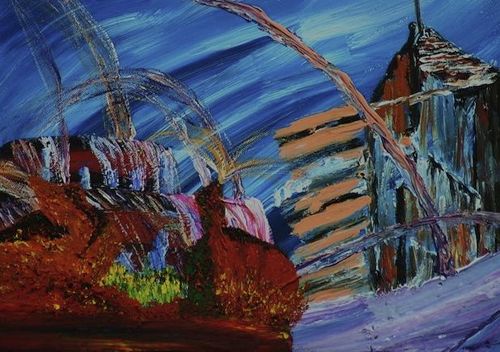
Theoretically, we are all too familiar with Barthes’ “Death of the author,” and by extension artist, which by default has spilled into the theory that even painting is dead.
When I first encountered his theory, in the margins of the text I scribbled, “I am an author. I am NOT dead.”
Yes, I am one of THOSE types of people who writes in my books, responding, reacting to what I read, actively engaging in the medieval scribe’s habit of adding personal glosses and illuminations to every manuscript I encounter.
I actively place myself onto the text with which I am engaged. Likewise, personal narrative in criticism, actively engaging in the critical endeavours, allows us to draw the details, the local color, of our everyday lives. Personal narrative: the style composing the crux of place-based education.
The art of creating a theoretical “Selfie.” Gregory Smith (2002) identifies place-based pedagogy as a curriculum built upon “cultural, natural, economic, and civic features and problems and opportunities encountered in [students’] own region” adding that by teaching from a student’s environment, “teachers can demonstrate the value of mastering knowledge and skills that might otherwise seem abstract or meaningless to students” (abstract). People engaged in their own surroundings and viewing them through the lens of their individual experiences will be more likely to assimilate newly learned concepts into everyday situations.
This adaptive skill set is essential to learning. Bigelow et al., (1994) points out that an academically rigorous democratic learning environment prepares students “not only to change the world but also to maneuver in the one that exists” (p. xi). Bigelow further notes that adapting skills acquired in the classroom to real-world situations is necessary because teachers ask students “to critique the world but then fail to encourage them to act, our classroom can degenerate into factories for cynicism” (p. xi). Personal, place-based narrative incorporated into a democratic setting in which each student feels his or her voice has value: a crucial element guarding against academic cynicism. Theory is impossible to apply unless it is assimilated through the lens of self-perception.
Why is it important to encourage readers or students to assimilate classroom lessons into their own narratives? David Stovall (2006) notes that a curriculum built upon critical pedagogy “includes a recognition and understanding of the world in which [we] live” (p. 249) He explains that those who have engaged with their world through experiential means will possess “the necessary foundation upon which to build the necessary strategies to address the issues at hand” (p. 249-50). As we explore our everyday surroundings and apply newly learned concepts by interpreting experiences through personal narrative, we will not only learn to appreciate our local neighborhoods, we also learn to evaluate ourselves and others, further developing our ability to become critical members of our community.
Incorporating our own narratives into both criticism and the classroom effectively engages students and readers alike. In his essay on learning styles, Abrahim Kazu (2009) notes, “…one of the most significant issues in learning to learn, or in becoming effective in the process of learning, is an individual’s taking the responsibility for his/her own learning” (p. 90). He adds that when “students take responsibility for their learning, they are at the center of the process and everything is under their control” (p. 90). When we incorporate our own narratives into our criticism or artistic self-expression, we begin to realize that we alone possess our individual experiences. We begin to control our own self-identities. Through the critical “Selfie,” we not only begin to realize how our own histories and cultures have not only shaped our own individuality, but we also begin to understand our integral place in the larger world around us.
As artists, teachers or critics who draw upon our own daily lives, we develop our narrative voices and record the local, national and global histories that shape our lives. Ferreira notes that students are empowered “through their own experience…becoming conscious of, and working to change their own social conditions” (p. 17). Likewise, as artists and critics, we must incorporate our own voices into our work.
Sorry Barthes. The author, artist – or painting, for that matter – will never die.
The Value of Trauma
Who among liberal arts educators, particularly those of us who are art historians, didn’t feel the blow when Obama dismissed the value of a liberal arts education? The playing field wasn’t a multi-million-dollar affair, but a flea-flicker toss of a comment made by our President. He offhandedly observed that machinists face better future prospects than art historians. [1] Sadly, the trend of minimizing the value not just of art history but of most liberal arts continues.
While letter writing and emailing may be a first step towards addressing our value as educators and students, we must also use the comment as a pass taking us toward the goal line of self-evaluation. As liberal arts educators and students, we are facing a difficult battle, which is precisely why it is important to evaluate the efficacy of learning and our place as the shapers of our own curriculum.

What is the outcome of narrative place-based curriculum, and why is it essential to our survival? By creating a place-based curriculum constructed in part from our own narratives, the key concepts students and instructors encounter transcend not just classroom concepts learned to meet a specific set of academic Standards or Outcomes. These guidelines, incorporated into narrative place-based education become more than concepts drawn from a text and applied to a specific place. They become enduring lessons integrated into one’s own life-long learning processes.
Throughout this crucial step toward understanding key concepts, students, as Dewhurst (2010) suggests, become critical participants who “construct knowledge, critically analyze…and take action in the world (p. 8). They become active members of their educational and local communities, participating in “collaborative problem-posing” critical analysis (p. 9). By incorporating narrative into the learning process, students and instructors personalize their sense of space, potentially engaging in learning that “is created with an express intension to challenge and change conditions of inequality or injustice” (p. 9). All members of academia become actively engaged in shaping their own space, thereby constructively creating their global impact in the world.
Dewhurst notes that critical learning “is not simply a meandering inquiry into the play of light or color across a page, but an inquiry motivated by a specific, purposeful desire to impact structures of injustice,” those restrictive hegemonic systems which have previously dictated interpretation of space (p. 9). Susan Cahan and Zoya Kocur (2010) add that conventional approaches to key concepts, those contained within the potentially restrictive measures of Standards or Outcomes, “reduce cultural artifact to empty forms devoid of historical or social significance” (p. 7). Merely applying key concepts to one’s local community would leave students with a vacuous approach to place, a “superficiality [that] is apparent to students, who rightly question why they should care about issues that appear to be fabricated simply for the purpose of classroom study” (p. 7). Rather than restrict students to mere analysis that, as Cahan and Kocur note, “tend to subsume [learned concepts] from every culture and context under narrow formal or technical concerns, which are themselves derived from European modernist aesthetic frameworks,” students, by creating their own interpretive narrative of place begin to shape the space that they inhabit, making both learning and space an integral part of their own lives (p. 7). After immersing themselves in the culture that shapes their landscapes, students will then take the next step and begin to shape their own space.
Cahan and Kocur predict that students who create their own sense of space within place will challenge “monolithic and homogenous views of history in the name of diverse, multiple, and heterogeneous perspectives” (p. 9). Students will reject “abstract, general and universal pronouncements in light of concrete, specific, and particular realities” (p. 9). Dewhurst adds that learning from a critical perspective requires students “to critically reflect on the purposes of their [education] and to match those with appropriate…tools, materials, and techniques” (p. 9). By incorporating both place and self into their learning processes, students and instructors alike transcend mere study of diverse cultures. They also begin shaping their own local places by appropriating their learning processes into their shared space.
Let’s return for a moment to the place-based education I referred to in my last blog. A student is thrust into a discomforting place, which from her own experiences may be alienating, frightening, intimidating, especially if she is from a rural area. Although since Baudelaire, Modernists have been fascinated with city as a landscape of hegemony, for this individual student the city as site of place-based learning is foreign and threatening. She is at risk of being subsumed by her surroundings. While this may pique a traumatic outpouring of creative energy, because she may not be able to incorporate self into this unfamiliar place, she is at risk of feeling helplessly overwhelmed by her surroundings. As a non-self-actualized learner, the best she may do is trudge through the exercises with a sense of despair, an act of learning that may lead to cynicism not just within the classroom but within her own life.
Admittedly, the city may be an overpowering place, and any daily commuter understands and recognizes the protective devices one adopts to adapt. Commuters, pressed physically against other commuters in positions normally associated with the most ultimately intimate acts, rarely make eye contact, rarely show emotions and lose themselves in their own electronic devices or distracting mediums of any sort, including intently staring at advertisements lining the train. Any means to avoid the intimacy which humans crave.
Thrusting a young student, or even at times a seasoned instructor, into this type of potentially traumatic learning environment is a bit like thrusting a commuter onto a crowded train: it necessitates self-protecting modes of survival rather than encouraging self-actualized learning. Allowing the student to step slowly toward a specific Post-modern perspective of the trauma of hegemonic space may be a more effective approach to place-based curriculum. If she is able to slowly assess the place by finding her own space, choosing a place within her community in which she may feel more comfortable by allowing her to explore realms outside of the confining place dictated by a specific assignment, she will be more likely to develop a sense of self-actualization.
Ganesh (2010) calls for “a student-centered model,” a curriculum “which draws on lived experience and links the richness of that experience to curricular material” (p. 22). By incorporating personal narrative and personal experience into the learning process, according to Ganesh, students will engage in “an ongoing examination of many categories we may take for granted—such as ‘American,’ ‘foreign,’ and ‘non-Western’,” those hegemonic norms that potentially daily shape who we perceive ourselves to be (p. 22). By creating student-centered curriculum built upon both narrative and place, students and educators critically engage in shaping global perspectives on a local level.
Yes, Mr. President, a Liberal Arts education does have value, although an accountant may not be able to measure it. And you yourself, as we all know from Nelson Mandela’s funeral, indulge in a ‘Selfie’ now and then. Why shouldn’t we value a student’s ability to engage in the same act of self-actualization, of positioning oneself within one’s own learning, indulging in an artistically-drawn theoretical ‘Selfie’? An education based within the liberal arts is an introduction to critical, life-long learning. Furthermore, by incorporating narrative into place-based curriculum, we learn the true value of liberal arts. It isn’t just about measurable Standards or Outcomes. Nor is it just about place. It is finding oneself within one’s own actualized space.
[1] For a well-written response to Obama’s statement, see http://the-toast.net/2014/02/04/in-defense-of-art-history/
The Vulnerable Observer
Why must a place-based curriculum be accompanied by personal narrative? Place-based learning isn’t enough by itself. Yes, students may be engaging with their local surroundings, but without personal narrative incorporated into their studies, their learning experience may still potentially remain that of pure classification and division, a rote application of learned concepts applied to a particular setting, albeit one with which they may be quite familiar. This process alone, if applied without inclusion of personal narrative, may quickly descend into isolationism.

A colleague of mine recently explained his approach to place-based curriculum. His students embarked upon exploration of their place, but he limited their movement to only a one-mile radius from campus. His reasoning behind the assignment superficially met place-based theoretical expectations. Yes, students immersed themselves entirely within their community through his various exercises. Yet to a certain extent, by setting such strict geographical boundaries on his students, he didn’t engender full self-actualization by allowing students to insert their own ‘Selfie’ into their work.
Since the school was located in the heart of a busy, concrete jungle, I argued that the rural student would not be able to fully incorporate her or his own cultural influence, whereas if the instructor had opened the parameters further, students would have been able to walk only a few miles before escaping into a space that was less populated and more akin to their own cultural experiences. Because he was unwilling to accommodate a student’s own narrative voice, he forced his students to participate in an activity that remained as foreign to them as perhaps a trip to a museum to view European Renaissance art would have been.
The project simply did not allow for diversity of individual expression, and students potentially had relied upon mere detached observation and classification for their research.
Classification has been the obsession with modernists since Diderot began ordering a compendium of French knowledge in his Encyclopedi ou dictionnnaire raisonne des sciences, des arts, et des métiers in 1751. While compiling the first encyclopedia, Diderot strove to “assemble the knowledge scattered over the face of the earth; to explain its general plan to the men with whom we live and to transmit it to the men who come after us” (In Willinsky, J., 1998, p. 72). The compilation itself was a result of the French ruling class desire to divide, order, and classify their growing empire. Diderot sought to define, explain, and map the quickly expanding horizons of western civilization, narrating the world through the interpretive voice of French aristocracy. An effective approach to education must transcend mere observation, classification and division.
Rather than adding to the still expanding encyclopedia of knowledge, students and instructors who incorporate their own narrative voices into their learning processes defy the cynical, cold, trite analytical perspective that too often suffocates academia.
In addition to grounding themselves in place, students and instructors must also incorporate their own voices, their own interpretation of their histories, culture, and community into their work. Those who are encouraged to develop their own narrative voices while applying newly learned concepts will be engaged in a critical process similar to what Kevin Tavin and Stephen B. Carpenter (2010) have described as a reconceptualized education that shifts “from traditional modes of…thinking toward a profoundly critical, historical, political and self-reflexive understanding of visual culture and social responsibility” by exploring their own narratives and histories which have shaped their lives (p. 245). Their learning processes will be an assimilation of narrative into analytical and personally relevant projects which will be transformative learning with “a variety of forms and actions,” final expressions that reflect their own personal narratives and likewise apply formally learned concepts (p. 245). By incorporating their own narrative into their observations, students and instructors alike will better assimilate the material they are processing, internalizing it, transforming it, and pro-actively (de)constructing it.
The narrative voice of student and instructor embodies cultural and socioeconomic diversity. Ruth Behar (1996) stresses the importance of narrative within academia, discussing the interplay between anthropological observation and vulnerability, declaring that the difference between cold analysis of an object and vulnerability is contained within personal narrative. She concludes, “Vulnerability is here to stay” (p. 33). She observes that too often academia avoids personal perspective within analysis, adding that although personal narrative has “gotten a foot inside the academy,” educators “don’t know whether we want to give it a seminar room, a lecture hall, or just a closet we can air out now and then” (p. 16). How often, for example, are students and instructors chided for including the personal pronoun “I” into their writing rather than utilizing the third person perspective? Behar, by contrast, notes the power of personal narrative stating that when “you write vulnerably, others respond vulnerably” (p. 16). Personal narrative serves to tear down the demarcating walls of the Ivory Tower, drawing in all community members through interactive participation.
Behar adds that by incorporating personal narrative into her work, she “has come to know others by knowing herself and…has come to know herself by knowing others” (p. 33). Her interaction within the space and with the people she observes is an integral part of her work, the interplay of both discovering herself and the place she occupies, in much the same way that Joan Didion uses narrative: “I write entirely to find out what I’m thinking, what I’m looking at, what I see and what it means” (p. 92). Through personal narrative, the process of observation is transformed into integrating and assimilating newly learned material into the very fabric of one’s own life and by extension into one’s own community.
Place-based personal narrative places the student into their own location, where they tell a story in sequential form, whether expressed in image, performance, video or word and by extension becomes transformative action within the location. Jerome Seymour Bruner (1996) explains the nature of narrative, noting that it transforms “the raw Trouble into a manageable Problem that can be handled with procedural muscle” (p. 99). Students, as they encounter hegemonic systems that have previously dictated their conception of space, through interpreting their place through personal narrative, will be able to transform problems into tangible, manageable form. Life’s experiences become the plastic medium through which each student and instructor may shape his or her community.
Like place-based pedagogy that is inherently multi-disciplinary and multi-sensory, Bruner points out that narrative is “a means to bring together the study of society, of human nature, of history, of literature and drama, even of law” so that people can cope “with human problems: with human transactions” (p. 99). Place-based narrative brings the issues home, if you will, and students confront their own space, their own sense of community, from a first-person perspective. Place-based curriculum coupled with narrative voice: inherently interactive, vibrantly alive, vibrantly vulnerable, vibrantly transformative. Effective, life-long learning at its best.
Battling the Academic Zombie
Place-based, narrative-driven democratic learning environment: a space in which we nurture our own story-telling capabilities in a student-driven, peer-assessed setting that embraces each culture represented within the shared space. The inherent multi-cultural, pluralistic emphasis likewise also engenders multiple learning modalities. Gruenewald summarizes the work of Woodhouse and Knapp (2000) who note that place-based education is both “inherently multidisciplinary” and “inherently experiential” thereby connecting “place with self and community” (p. 7). He explains that place-based curriculum does “not dismiss the importance of content and skills,” but adds that “the study of places can help increase student engagement and understanding through multidisciplinary, experiential, and intergenerational learning that is not only relevant but potentially contributes to the well-being of community life” (p. 7). Place-based education, because of its experiential and multidisciplinary nature integrates material into students’ day-to-day lives.

Knowledge comes to life and is a meaningful part of our daily activities. Place-based education is not merely experiential and multidisciplinary but transformative, transcending those socioeconomic demarcating lines that seemingly separate one generation from the next. Gruenewald points out that Woodhouse and Knapp (2000) note the politicized nature of community and space, “social constructions that often marginalize individuals, groups, as well as ecosystems” and that students “must identify and confront the ways that power works through places to limit the possibilities for human and non-human others” (p. 7). He notes that Sobel (1996) seeks “to create experiences where people can build relationships of care for places close to home” (p. 7). Place-based, narrative curriculum: bringing students home, establishing a sense of safety and security in which all participants are able to become more fully self-actualized within the learning environment.
As students interact with their communities through place-based curriculum, Sobel encourages them to explore the social constructions that have shaped their community, addressing the following questions: “Where in a community, for example, might students and teachers witness and develop forms of empathetic connection with other human beings? How might these connections lead to exploration, inquiry, and social action?” (In Gruenwald (2003b, p. 8). These are questions that both teacher and student must address, and by so doing, they will increase their communal interaction, disseminating a sense of exploratory socialization to their extended global community.
Place-based, narrative-driven democratic learning environment also naturally includes intergenerational interaction. Gruenewald notes that Bowers (2001) argues that critical, transformative pedagogy “must not be limited to rejecting and transforming dominant ideas; it also depends on recovering and renewing traditional, non-commodified cultural patterns such as mentoring and intergenerational relationships” (p. 9). Place-based curriculum is built upon individual cultures that nurture cross-generational instruction. Students learn their own unrecorded histories and traditions from their parents and grandparents, exploring their own narrative voices and sharing it with their peers in the process. Gruenewald concludes, “Developing a critical pedagogy of place means challenging each other to read the texts of our own lives and to ask constantly what needs to be transformed and what needs to be conserved” (p. 10).
Students and instructors alike, in the same way that in a democratic classroom they challenge and asses one anther, they challenge and assess the constructs that have shaped their communities, not merely learning a list of vocabulary terms and key concepts drawn from a classroom textbook.
Students and instructors who interact with the systems that have created their neighborhood assess how they may in the future construct these systems as active members of their community. Gruenewald adds that a place-based curriculum teaches to students to critically evaluate “the cultural, political, economic, and ecological dynamics of places whenever we talk about the purpose and practice of learning” (p. 11). A curriculum built upon place-based pedagogy increases students’ local cultural and political awareness. As students learn to “think globally,” they are better prepared to “act locally,” enthusiastically transforming their own communities.
How does place-based education create a sense of dialogue within the local community? Building a sense of community, as bell hooks (2003) notes is an integral part of critical, meaningful and transformative education, allowing students to “confront feelings of loss and restore [students’] sense of connection” (p. XV). She notes that in a transitory world, that while a sense of place may always be shifting, building a sense of community is imperative. Educators must “teach beyond the classroom setting” and open the “space of learning so that it can be more inclusive,” a practice “vital to maintaining democratic education both in the classroom and out” (p. 43). hooks adds that building a sense of community “requires vigilant awareness of the work we must continually do to undermine all the socialization that leads us to behave in ways that perpetuate domination” (p. 36). Too often students follow the lead of their instructors who hide behind the protective walls of the Ivory Tower of higher education. hooks argues that place-based education tears down these isolating walls, a process of local involvement that encourages students and educators to dig their feet into their local communities. Education transcends the isolationist walls, lending a sense of permanence to the typically transitory four-to-five-year span expended while pursuing one’s bachelor’s degree.
Although hooks and Gruenewald approach the concept of space from two different theoretical positions, their conclusions are essentially the same. [1] hooks places the onerous of the responsibility of undermining hegemonic forces that shape space on educators, but as Gruenewald (2003a) points out, a student engaged in place-based pedagogy shares the responsibility of identifying and addressing cultural and social domination through active engagement with their community. He notes that as students and educators become more conscious of place, “pedagogy becomes more relevant to the lived experience of students and teachers, and accountability is reconceptualized so that places matter to educators, students, and citizens in tangible ways” (p. 620). Instructors and students alike share the work of composing theoretical “Selfies” interacting, (re)conceptualizing and (re)constructing their local communities rather than transitorily passing through the space they momentarily occupy while earning their degree.
Students and instructors sharing their place-based, narrative-driven democratic learning environment are not cadaverous, zombie-like apparitions isolated in their Ivory Towers but self-actualized individuals proactively engaging in their own local communities.
[1] hooks’ approach is that of Critical Race Theory, whereas Gruenewald aligns himself more closely with a Foucaultian notion of space.
“Every Step You Take”: Past Transforming Future
“I wouldn’t take some of these courses if I were you,” my new education academic advisor warned me. When I first signed up for classes, I was determined to become an elementary teacher, encouraged down the path by my children’s first grade teacher who also happened to be the wife of the community college president. My advisor knew of my close relationship with her, and after a quick glance down my selected courses, she frowned, shot her eyes back up at me and quickly tried to steer me in a different direction. “You’ve chosen to take some of the harder classes we offer,” she countered, adding that I should perhaps start out a bit slower since I was a non-trad who had been out of school for a while.
I had signed up for a number of courses offered by “No-A-Conway,” including a Humanities class co-taught with the history chair, who was known for her dense, rigorous presentation of material. Their combined one page syllabus, rather than serving as a roadmap to the course, served as a roadmap to the world, traversing the history, philosophy, art and literature of humanity. Admittedly, the map led primarily through the steps trodden by the shapers of Western Civilization, only wandering eastward when European history transected the Silk Road.
The dreaded duo, as they were dubbed, served as guides along a path that opened us not just to Western Civilization, but wended its way back to our own experiences, explaining what the various symbols we encountered daily had meant in the past, which, in turn, shape our present. When we figuratively embarked upon the shores of Athens, for example, we learned that Nike’s swoosh mirrored Hellenistic sculptor Pythokritos’ Nike of Samothrace, symbolizing victory for athletes and soldiers throughout the ages.

By drawing out the way past influences our presence, this formidable pair of instructors addressed the pertinent question every student asks, “Why is the distant past relevant to me today,” even reminding the busy college athlete that each time they tighten their shoelaces, they are strapping on a piece of history which serves to carry them toward their next victory. Past symbol, even one derived from several millennia and a culture that has long since potentially slipped into obsolete history, becomes relevant to a student’s every day experience.
Engaging students to approach material from their own level is crucial in transformative education. Cahan and Kocur (2010) notes that when “the focus is shifted to issues and ideas that students truly care about and that are relevant within a larger-life world context, [learning] becomes a vital means of reflecting on the nature of society and social existence” (p. 7). They add that when students “are encouraged to bring their own existing knowledge and experiences into the learning process,” education emerges as a truly democratic process (p. 9). By engaging students with the material to be learned through their every day experiences, they acquire a better understanding of the components that serve to shape their own lives, thereby lending a feeling of empowerment which in turn leads them to shape and transform the lives of others.
When students approach education from merely analytical evaluations, even if they are studying it from a place-based perspective, they are likely to look at it from what Behar identifies as “the voyeuristic eye,” the same process Diderot used to compile his encyclopedia for the colonialist-driven French Empire. The object studied, therefore, remains that: mere potentially obsolete object in the hands of an empirical collector. Behar notes that by contrast, autobiography in the form of personal narrative “has emerged, for better or for worse, as the key form of storytelling in our time” (p. 26). She establishes that by incorporating first-person narrative into analysis, “life history and life story” merge “as a key form of approaching and transforming reality” (p. 27). By noting the history of Nike’s symbol, student athletes were able to better understand how their own “life story” merged with “life history,” transforming the lesson into tangible reality.
What are some of the most effective ways of bringing learning into a tangible, transformative process? Dewhurst (2010) proposes that students employ a number of “activities ranging from one-on-one questioning and collaborative information-gathering projects, to more conventional research techniques such as interviewing, literature analyses, and basic statistics” (p. 12). By approaching each subject through these varying perspective, students will engage in “inquiry that will result in richer understandings of the various structural (i.e. cultural, political, economic, etc.) factors” that have shaped hegemonic systems defining place (p. 12). Dewhurst also notes that in a critical classroom, educators “encourage learners to direct their own projects” (p. 10). Educators must reach students on their own level, encouraging them to explore the subject in a way that is “meaningful and rooted in [their] own lives” (p. 11). Rather that striving to answer the question regarding the relevance of past in their present lives, educators need to strive to encourage students to explore avenues which enliven the past through their students’ daily experiences.
By incorporating personal narrative into place-based education, students project self into space that may have previously only been occupied, defined, or possessed through hegemonic interpretation. They create an informed, critical theoretical ‘selfie.’ The Nike shoe, for example, which has become iconic symbol of corporate America, steps beyond the materiality itself and becomes a living part of history in the making. Object and history combine to transformatively shape the athlete’s perception as well as performance on their own home court.
As students incorporate both a sense of self and place into their learning experience, students will step outside of the confining walls of the classroom to interact with place. They will not merely analyze an object from an encyclopedic, didactically cold perspective. Not only will they learn to apply key concepts regarding their subject, those introduced into the classroom for the primary purpose of producing an “Outcome” that leads toward matriculation into a four-year institution, they will interact with their community, discovering the hidden beliefs, cultures, and unrecorded intergenerational histories that have shaped their local spaces. Additionally, they will identify the normalizing societal factors that have directed the hegemonic concepts of place, understanding how they, in turn, may begin to shape the landscape, the space, and the community in which they live. A simple glance down to their shoe, for example, may serve to reinforce how even the simplest step they take on their daily path of life has been shaped by a rich, historic past, and how they, in turn, may begin shaping the future.
An Anecdote on Un-Stifling Creativity
“Aren’t they stunning?” she asked as the gallery windowpane reflected our three images in the night. The artist’s brilliant, vibrant canvases always attracted my attention, and each time I would walk down Boulder’s Pearl Street Mall, I would stop to visit them much as I would my favorite paintings at the Art Institute of Chicago.
After sharing a brief, close analysis of the rain-drenched streets of New York captured on the canvas before us, she looked directly at me and asked, “You are an artist, aren’t you?”
“The School of Art Institute of Chicago seems to think so,” I laughed, adding that I was working on my Master’s degree in Art Education.
After congratulating me, she explained that she, too, was from Chicago and was an artist of sorts, a graphic designer who had attended art school years ago. One of her Boulder relatives was getting married, and like me, she and her companion always found themselves returning to the same gallery, rain or shine, to admire (and occasionally purchase) the canvases they offered.
“I can’t find paintings like this in Chicago,” she observed, adding that the pieces she encountered there were responses to theory that the artists had read rather than the other way around. “Artists should be shaping theory,” she posed, “not responding to it. It stifles their creativity.”
Admittedly, I had fallen into the same artistic rut. My admittance portfolio to the Institute had been a well-balanced nod to LGBTQ theory, a sprinkling of multiculturalism, with a cursory glance toward Bauhaus formalism: a perfect mirror of SAIC’s homepage. While there, everything I had created my first year—from pedagogical theory to art to photography—fit nicely into a niche that the professors had carved out for me. It took me 1200 miles distance from the classroom to realize I had lost my own artistic voice in my desire to incorporate SAIC’s fascination with Social Justice theory into my own work.
To be honest, it wasn’t my work at all. Somewhere along the fourteen-year path of creativity and analysis that I had travelled, I had lost my way.
The day I first met him he was so intimidating I mentally drew an imaginary rectangle on the chalkboard behind him, my way of fitting him within my own framework. I was an avid reader of anything I could grasp, ranging from classical literature to not-too trashy romance novels to mystery to action thriller. As he stood before us trying to initiate engagement in the Edith Wharton short story we had read together our first day in class, his vocabulary impressed me. I was familiar with many of the terms he brandished and was able to follow what had become a lecture rather than discussion because as freshman, we were all too afraid to speak.
Eventually, I warmed to the subject and set aside my fears, joining into what became a conversation between two friends with the jovial, humorous, easy exchange that would mark our professional and personal relationship we have nurtured over the past sixteen years.
Up to this point in my life, I had been a timid bookworm, infrequently contributing much to casual conversations for too many reasons to recount here. But he had engaged me. He had hooked me by appealing to my own personal experience, my love for books. Admittedly not all of us who shared the classroom shared my experience, but at one crucial moment, he drew us all into the fold.
We were a small class. No more than 12 of us huddled together to face “No-A-Conway.” After muddling our way through short stories (and receiving a “C” on my first exam, a personal conquest for me since I had miserably failed out of Bible College), the day we embarked into poetry, he came into class, and rather than assuming his predictable stance within my imaginary chalkboard rectangle, he bent over the desk and shook it as though testing its stability. Finding a wiggle, he tore a piece of paper from his yellow legal notepad, folded it into a small square, and slid it under the offending shorter, mal-adjusted table leg.
Rather than reaching for the lectern as he always did (a small transportable wooden box that he always had to set back upon the table since he was one of the few professors who still used one), he walked across the room and retrieved a chair instead.
I cringed inwardly, initially balking that he no longer would be contained within my chalkboard framework. As he sat, slightly hunched, slightly leaning with anticipation toward us and our collection of poetry, I followed his lead and began to relax as well, absorbing one of the most valuable pedagogical lessons I have ever learned.
Classroom management. It is one of the most difficult challenges of any educator’s job, not much different from adjusting a wobbly table. As he bent over in front of us checking the table’s stability (I can’t help but wonder if in his own mind he was alluding to Plato), he initially tried to fine-tune the screw attached to the caster, but found his adjustments didn’t provide the stability he needed. Rather than take the time to readjust all the other legs, though, he approached the task quickly and creatively adapting and adopting an old trick of the trade, one never mentioned in a user’s manual but found in diners across America: a hasty level constructed of the materials at hand. Bricolage at its very best in a classroom.
The first exam out of the way, and he had lived up to his stern reputation, assuring us that a “C” fell at the middle of the bell curve. I reminded myself that on a “C” was at the top of the hilly curve. If I pushed just a bit harder, I would be able to crest the hill and coast toward a lower point on the curve toward an “A.”
As he took his seat, stepping outside of my previously established framework, he began reading our first poem:
What lips my lips have kissed, and where, and why,
I have forgotten, and what arms have lain
Under my head till morning, but the rain
Is full of ghosts tonight, that tap and sigh
Upon the glass and listen for reply,
And in my heart there stirs a quiet pain
For unremembered lads that not again
Will turn to me at midnight with a cry.
Thus in winter stands the lonely tree,
Nor knows what birds have vanished one by one,
Yet knows its boughs more silent than before:
I cannot say what loves have come and gone,
I only know that summer sang in me
A little while, that in me sings no more.
His voice was deep, caressing, slightly lisping, slightly whispering the lines as though they were directed toward a lover’s ear.
Silence followed.
We were all taken aback at the glimpse of the man behind the professor who had intimidated us for the past five weeks. His sensitive reading of St. Vincent Millay’s poetry became a prayer from which we could hear his own ghosts, real or imagined, echoing through her lines.
He waited for a response, his typical way of nurturing the effective, uncomfortable silence that prods a student to break with the sound of his or her own voice. After a protracted pause, one girl suggested, “I think she may be writing about lost lovers, but since women during that time were likely to get married young and remained devoted house wives, that can’t be what this poem is about.”
He had taught us to consider all aspects of a work; intended audience, nuances contained within a title, date of publication, literary or historical allusions. Since the poem was published in an epoch “before” our current period, the student had made the assumption that the hook-up culture enjoyed by post ‘60’s sexual revolution was a pleasure in which only our era indulged.
“No, she was a product of the ‘Roaring Twenties’ a time marked by illegal alcohol, marijuana, gambling and wonton sex. St. Vincent Millay is, indeed, writing wistfully of her long lost lovers, so many that she is unable to distinguish one from another,” I added.
He looked at us, first her, then me, and smiled. It was the first time he had graced us with his heretofore-masked mischievous grin. “You are both right,” he assured us, adding, “Never forget this: every work of art should be approached with a dirty mind. We are, after all, humans whose existence is dependent upon one thing: sex.”
Hook-up culture at its very best. He had hooked us, every last one, by appealing to all of us based upon our single shared experience.
At that moment, as he had stepped out from behind his protective academic pedestal, outside of the framing into which I had comfortingly placed him, he created the equivalent of a theoretical ‘Selfie.’ He showed me the value of inserting one’s “I” into every lesson.
Shaping the Learning Landscape
As instructors and critics, when we rest contentedly behind our secure Ivory Tower walls, complacently reliant upon tritely coined phraseology, we alienate our students and readers, a pertinent and perplexing problem as liberal arts degrees fall further and further out of favor in American education. [1] hooks (2003) is critical of this disaffecting practice, noting that educators often employ an “agenda…where writing acceptable theory…often meant using inaccessible language and/or academic jargon,” language she describes as “simply not accessible” to students (p. xii). Jargon: the language that incites academic cynicism. The preventative measure: Narrative, place-based education in a democratic learning environment creating an easily accessible landscape of learning.
By escaping the confining walls of the classroom, Gruenewald (2003a) states that place-based education “aims to work against the isolation of schooling’s discourses and practices from the living world outside the increasingly placeless institution of schooling (p. 620). Stepping outside of theoretical jargon into the real world of one’s surrounding community becomes the key to an effective liberal arts education. He adds that place-based curriculum “aims to enlist teachers and students in the firsthand experience of local life and in the political process of understanding and shaping what happens there” (p. 620). Rather than being confined to dictatorial theoretical concepts and overly academic language, Gruenewald notes that place-based curriculum strengthens “the connections between education and the places where we, and others, live” (p. 620). When we step outside of the coined phrases and engage in true dialogue, students and instructors alike step toward self-actualized, fulfilling relationships within their community, the one that exists outside of the stultifying walls of the Ivory Tower.
How do students and instructors in a narrative, place-based democratic learning environment shape their local community? Gruenewald notes that a democratic approach to education is an integral part of developing a student sense of agency within community, posing that “from the perspective of democratic education, schools must provide opportunities for students to participate meaningfully in the process of place making, that is, in the process of shaping what our places will become” (p. 627). Within the classroom, students must engage in the democratic process of working together to devise their own strategies for learning by actively creating student-generated grading rubrics. They also must be responsible for fairly distributing the work among themselves and assessing one another on each member’s participation and production. The final product of a democratic classroom is created by collaborative consensus in which each student’s own narrative has been incorporated into the learning processes. By learning the empowerment intrinsic within the truly democratic classroom, by extension, the self-actualized learner (both instructor and student) will likewise effortlessly assume the leadership roles outside of the classroom, actively shaping the community in which they live.
Freedom in Creation
Participating in Democratic Learning Space at Chicago’s “Bean”
But learning must not take place merely within the classroom. The place-based curriculum must be designed to reach outside of the classroom walls, and projects must take place in spaces within the community as well. Gruenewald notes that by confining students into a classroom where they are unable to actively engage with their own community, educators limit the “possibilities for democracy…because it diverts the attention of citizen, educators, and students from the social, cultural, and political patterns involved in place making (p. 628). It is in these public spaces outside of the classroom where students and instructors will be able to cross the demarcating socioeconomic and generational lines, interacting with all members of the community, not merely their own academic peers.
By taking the students outside of the protective walls of the classroom and integrating them into the community, students in a narrative, place-based learning situation become emboldened, pro-active members within their surroundings. Gruenewald concludes that place-based curriculum broadens “what teachers and students are actually expected and empowered to do” (p. 642). He notes that rather than focusing “narrowly on student and school achievement,” those key concepts which typically confine all students to a rote knowledge base, “a place-conscious framework of accountability must begin to assess the places in which we (and others) live in relation to the kind of education that we provide and the pedagogical impact of places in and outside of school” (p. 642). As students engage with their community, they will begin recognizing the patterns that have shaped their community, and by utilizing their own narrative voices, they will record the stories and cultures that are too often overlooked. Rather than analyzing the world through the deadened jargon of traditional academia, those rote phrases which we too frequently turn, students will analyze their own spaces through a critical lens, looking for the obscure, previously unrecorded histories that have shaped their community.
Students empowered by a democratic educational space create their own place-based narrative, drawing inspiration for directing their own learning processes from either their own perspective or the perspective of a member of their local community. Gruenewald cites Casey (1996) who notes, “our experience of places is never precultral or presocial” (p. 626). He adds that our landscape is “mediated by culture, education and personal experience,” further noting that “places themselves are products of culture” (p. 626). Space, he observes, “is alive, pulsing with the beliefs, thoughts, and actions that shape who we are as people” (p. 628). Students immersed in place-based education, Gruenewald argues, perceive “the geographical relationship between people and places,” and their work “becomes the focus of critical social analysis” (p. 628). The students engaged in this pro-active learning environment escape the stifling, confining walls of academia’s Ivory Towers. By generating their own place-based narrative drawn from their own communities students will not only learn how their landscapes have shaped them, but how they, in turn, may shape their own landscapes.
“Physician, Heal Thyself”: The Power of the Theoretical ‘Selfie’
“I [paint, dance, draw, sculpt] write entirely to find out what I’m thinking, what I’m looking at, what I see and what it means”
Joan Didion (1976)
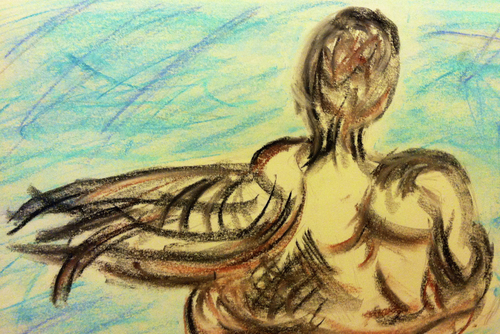
When we approach criticism or education, too often as educators we appear to be nothing more than lifeless cadavers, isolating ourselves behind the protective, stultifying walls of academia. By contrast, as artists, students and critics who draw upon our own experiences, our own communities, our own cultures, we step closer toward self-actualization, which in turn nurtures our ability to reach out to others.
One of the crucial steps toward realizing self in the classroom is creating a learning environment in which each student feels her or his own narrative is an integral part of their shared classroom experience. The more students are empowered within the democratic classroom, the more they will feel comfortable moving throughout the world outside of the classroom, first reveling in their abilities to apply newly learned concepts in daily interactions, then eventually reaching out to share their knowledge and experiences with others in their community.
As students assess and evaluate one another, an essential part of a truly democratic classroom, they engage in a pedagogy modeled upon Ferreira’s notion that education be a “process in which the projects, strategies, and tactics used are produced collectively by the participants themselves” (p. 19). Ferreira notes that students who interact with “important national and international socioeconomic, political and cultural issues” develop their own “projects, strategies and tactics,” tools which are “considered indispensible” not just in the classroom but also in daily interaction within their own communities (p. 23). By knowing they are able to control and direct their own educational processes, students develop the confidence necessary to reach out within their community, striving to make a difference outside the classroom in the same way that they discover to apply learned concepts within the non-academic world. They become actively occupied in life-long learning.
In addition to keenly becoming life-long learners and engaging more fully in their local communities, by implementing their own learning styles into their coursework, students will be better equipped to apply their own learning experiences, expressing their cultures and histories both in and out of the classroom setting. Kazu (2009) notes that students who have identified and are allowed to work within their own individual learning modalities likewise “will identify their aims…[and will] know what they want to learn and ‘how’” (p. 90). A student who pro-actively directs his or her own learning, as Kazu states, will posses an “awareness [that] will change their perspectives on learning new things” (p. 90). The student who employs his or her learning style in the classroom is better prepared to adapt to new learning situations, approaching each new task with a new and unique perspective.
This same principal must be extended to the instructor and critic as well. Too often, since Barthes, we hesitate to insert ourselves into our academic or critical work, relying upon a bank of coined, trite, overused terminology that only serves to further alienate our readers, turning us into academics who, though we are obsessed with studying our own navels, refuse to allow our readers to fully understand that it is specifically through that linty lens of self-reflection that we view our world.
As educators, we are instructed to encourage students to explore their own world and express themselves through their own narrative voice, yet as the “specialists” in our own fields, we hesitate to make that step toward our own self-actualization. As educators, we are frequently reminded of how important it is to bring our students onto a higher plane of self-awareness.
David A Gruenewald (2003b) notes the necessity of centering students within their own communities through place-based pedagogies, which “are needed so that the education of citizens might have some direct bearing on the well-being of the social and ecological places people actually inhabit” (p. 3). By grounding students in awareness of their own selves and own communities, as educators we teach students to be active, critical citizens within their own circles of influence. We consistently encourage them to develop their own narrative voice.
The process of developing our students’ individual voices is a vital part of teaching to a diversified classroom. Gruenewald adds that education of migrant students as well as interests in “issues of race, class, gender, and corporate hegemony have become central…to rural community life and education (p. 4, as analyzed by Lopez, Scribner, & Mahitivanichcha, 2001; Weyer, 2002). Gruenewald also points out that within the framework of Freire’s injunction that students read the world as texts, “students and teachers should ‘decode’…the images of their own concrete, situated experiences with the world” (p. 5). Inclusion of classroom discussions centralizing upon race, class and gender are important in rural and metropolitan classrooms alike.
As educators, we are comfortable with that notion, striving to teach our students to become active citizens in their local communities, yet too frequently, we ourselves as educators and critics are reluctant to view the world as a text that we actively, progressively continue to read ourselves. We become complacent with our own statuses as “specialist,” as “educator,” failing to continue our own processes of critical engagement within our own communities, something that Gruenewald warns us against by encouraging “students and teachers” [my emphasis] to enthusiastically interpret our surroundings.
In a classroom that highlights students’ awareness of global issues, Gruenewald states that place-based pedagogy provides “a challenging socio-ecological framework, a framework focused on cultural conflict in a multicultural, global society and attuned to…particular local places” (p. 6). Gruenewald (2003a) reiterates Apple (2001) and Burbules & Torres (2000) notion that “it is essential that educators and students develop an analysis of how [global economies] function through space, geography and social institutions” (p. 629). Students in a democratic classroom step towards not just self-actualization by developing their own narrative voices; additionally, they learn to apply the phrase, “Think globally; act locally,” internalizing it, thereby lending the phrase power that transcends mere cliché. Yet again, Gruenewald specifically includes educators in this process as well.
By actively engaging in our extended community and incorporating our own narrative voices rather than just merely losing ourselves in our research, our books, our theory, we as educators and critics step outside of those trite, coined cliché phrases that comprise the secure Ivy Towers in which we are wont to hide.
Creating the Intellectual Montage: Academic Mashables
Cherry picking. That’s what my former colleague called it, adding, “To avoid plagiarism, I remind students to tell me from which tree they pluck their fruit.”
Mel Brooks satirically referred to critics as an artist’s afterbirth, an interesting interpretation since many ancient cultures traditionally fed the warm mass to the new mother for strength and healing while it was still fresh from her own vagina.
Found art.
That’s what I believe composes literary and artistic criticism. Since Barthes declared the death of the author (and by extension artist), the trees from which we critics, authors and artists are able to harvest stylistic roses grafted onto cherry trees that produce grape vines wound tightly onto a glass arbor that in the end yield glimmering, glittery piecemeal mosaics that may be drawn from any potential source. A critic’s essay may be as varied as art itself, becoming verbal representations of acoustic-accompanied lyrics wedded with painted, concrete-infused canvas draped over a figure, captured in a high res photo then (re)produced on a 3D printer. Anything goes.
Perhaps it is from Brook’s representation of the critic that the Grand Marshall at my 2000 University of Colorado commencement derived his metaphor in which he forbade students from “Staring at our own belly buttons.” Encouraging us as literary critics to research our subject rather than allowing us to approach it from a New Criticism perspective, he insisted upon closely analyzing a work through its historical and cultural roots. For my own literary or artistic criticism thereafter, I adopted his approach, digging as deeply as possible into primary rather than secondary sources, but likewise embracing the concept that each student and critic approaches art and literature through the lens of their own personal experiences. As a result, conversational narrative and history become one in my own unique form of analysis. Remember, theoretically anything goes.
My own journey as critic has been likewise diverse. I dedicated five undergraduate years (struggling with rudimentary math while pursuing an extra degree) exploring Romantic influences on American literature, stumbling upon The Master in the process, writing over 300 pages on how European history, art and culture influenced Henry James, the most prolific author in American history.
He did it all, penning art and literary criticism from travels in Europe and America; composing short stories, novellas and novels featuring American heiresses lost in bad relationships while picturesquely adrift on Europe’s streets and canals; turning in his middle years to quick, profitable, publishable ghost stories to support his failed fascination with playwriting. Then, once international copyright laws finally allowed him to reclaim his pirated work, he mulled over his older writings, altering, prefacing, sometimes eviscerating his previously published material, churning it over and over again to produce a finished product which at times was unrecognizable from its original form.
The Master’s process—creating new pieces from his own literary Found Art, if you will—appears to be not much different than that of an artist who recycles her canvases over and over again.
Following my undergraduate work throughout the years I spent as art and literature instructor, I continued my inter-disciplinary humanities pedagogical research, reaching even further back in history, scouring journals and publications like an archeologist sifting through analyses of Ancient Cave Art to philosophies of Enlightenment, searching for stylistic links tracing the evolutionary parentage of art and literature that bore early Modernism.
After returning again and again to art and literature depicting Post-Revolutionary streets of Paris, through a series of unexpected events I landed abruptly at a School possessing one of the best Impressionist collections in America, somehow overlooking that this same Institute had just dedicated millions to constructing a new Modern Wing.
As procrastinator with dyslectic tendencies, I am, alas, all too familiar with the sociological phenomenon of arriving just slightly too late to be considered “fashionable” because I have held a map upside down and first headed the opposite direction than where I should have gone in the first place.
This same circumstance found me landing a bit late in my academic career. As a non-traditional student, I earned my first degree nearly two decades after my high school classmates did. Then, in typical dyslexic fashion, I launched headlong into a ten-year career as a higher education instructor before completing my second degree, eventually taking a circuitous, misdirected path which planted me in front of a bronze, tarnished pair of last century’s Lions, listening to the roar of the quickly passing traffic of Contemporary, staring longingly at the fading rear lights of the passing vehicle of Modernism, which had long since run over my beloved Impressionism.
Perched on the portico of the Institute, I stood, lost, bewildered, digital camera with a telephoto lens in hand, canvas tucked under my arm, while balancing a video camera on a pen-sized tripod, shooting and grabbing at any straws that the vortex of my procrastinating dyslexic confusion had sucked into what I considered to be the black hole of my precarious existence.
My new title: visual artist. My medium: multi-media, producing works which, in spite of the declaration that painting, too, is dead, often found themselves back in montage form on my acrylic canvases.
As I stood dumbfounded on the curb, nostalgically watching the fading lights of the vehicle Impressionism fade out of view, afraid to take a step lest I get pummeled by my younger Institute Contemporaries, when the moment came to grasp onto the fender of the older theoretical medium driven by Walter Benjamin, Father of Modernism, I hung on as tightly as possible, unsure—and uncaring, really—where the antique model may have taken me.

When Modernism’s Papa crept past on the seemingly too-busy thoroughfare running between the School and the Institute, I sighed with relief when I discovered he, too, remained fascinated by French Post-Revolutionary Paris.
My erstwhile chauffeur safely guided me through the precarious process of a producing a published thesis, earning me a degree to which I still dearly cling with a measure of cynical hope. Forgive me, then, if, as I launch into my hermeneutical exegesis, I linger in Benjamin’s nostalgic glance toward an older world as it moved toward the ravages of industrialism. Again, I welcome my reader to join me on my slow trek through Nineteenth-century Parisian Exhibitions and Arcades.
The Mourning Supplicant
She kneels, waiting, watching
For a sign from her master,
Her lover,
Her savior from blasphemy.
Slave, servant, friend, whore
For more years
She cares to remember.
Time reflected in images
Fading smiles
Memories of ecstasy.
The nightingale
Cries in the forest
Returning to the familiar
Again and again.
Across the bridge
Through the dark valley
Echoes the morning
Call to prayer.
Meditation, supplication,
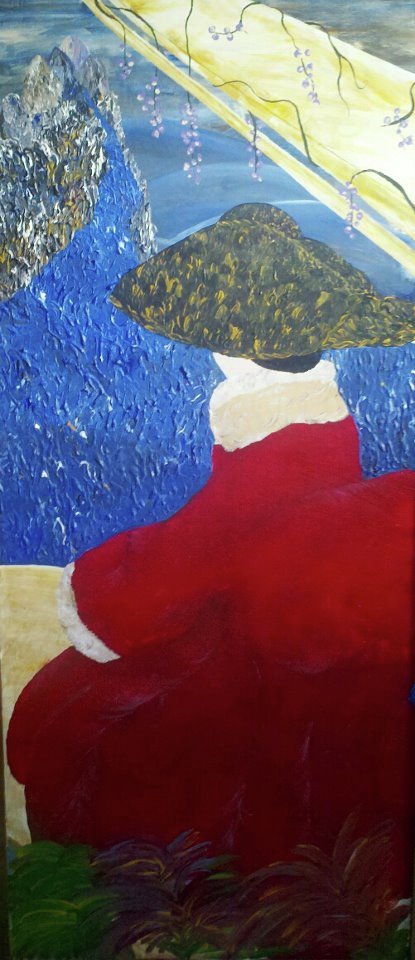
Transcendence
Rings from the distance.
She hasn’t strength
To heed the call
In the early light.
She silently waits
Unfulfilled promise:
Absence of yearning.
Absence of suffering.
Release from desire.
Peace
Breath
Life
Baptism
Immersion
Nirvana
 Roberta Molyneux