
Onward
The dark threatening clouds lowered;
The heavy bike fell harder
The River leans into the rock,
Carving, curling, twisting, tumbling;
A trail where beggar urchins dwell
Rhyding away the weak vermin.
Than the relentless pouring rain.
Water in the skull rises,
Seeping through forest, moss, and glen;
Enclosing, embracing, encompassing;
Inheritance: ever frozen!
Cold, wet, tired; still we pressed on.

Sisters dancing together in time,
Silent tears etching their faces;
Satan’s bow aimed at their hearts,
Guarding their brothers’ shining graves.
Determined the same way a
Market town, graveyard: hallowed ground
Slumbering near forested hills;
Three Lords supplanting the Ancient Ones
E’er awaiting their own demise.
Disfigured, hunched monarch

Led by two maidens and their cow dung,
Ancient bones were carried afar;
Borne by men married to malice,
Burning holy ones, their wives, their children!
Or a bent condemned witch

Children, Weep! Bear your tribute!
Wander the hill, after your flowers,
Plucked from meadows near the well;
Final Wulven Haven: Fallen!
Resolutely moves forward.
The inevitable journey;
All good and evil has been done,
Judging souls after their passing:
What shall be written on gravestones?
Searching longingly for love

Largest stronghold along the stones,
Twice man’s height, traversing the land
Sightless battlegods looming o’er
Ere seven rune rings united.
Or at least some acceptance,
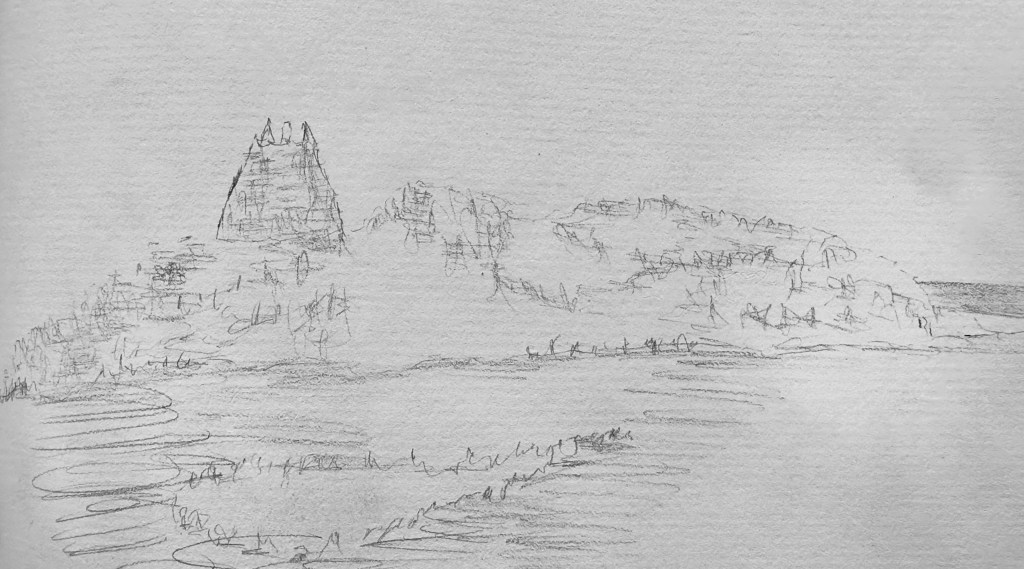
High beacon above the green vale
Spilling secrets along the path,
Protecting windswept sojourners;
Rest, all Ancients who linger here!
But, stumbling, discovering something
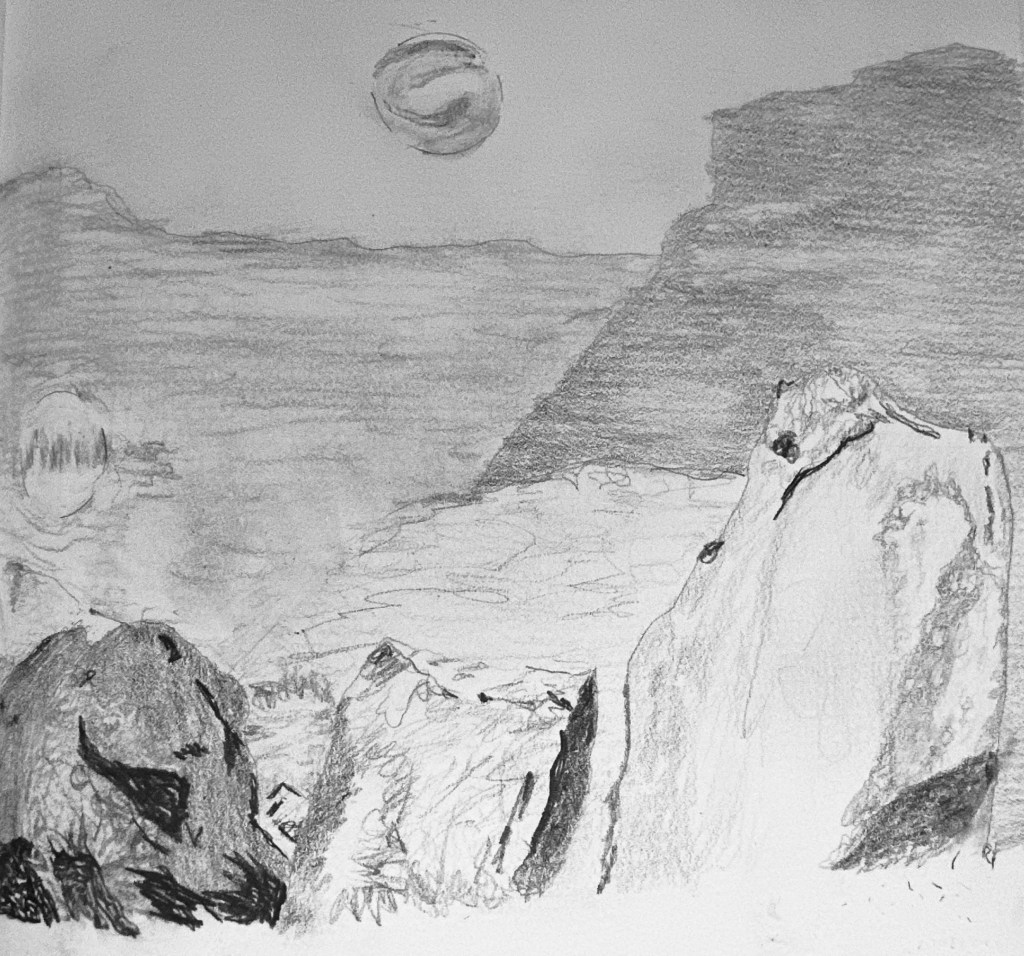
Most ancient of dismal circles,
Standing erect in seclusion,
Dark precipice of heath and moor:
Alight autumn’s divinations!
Far more grand and glorious:
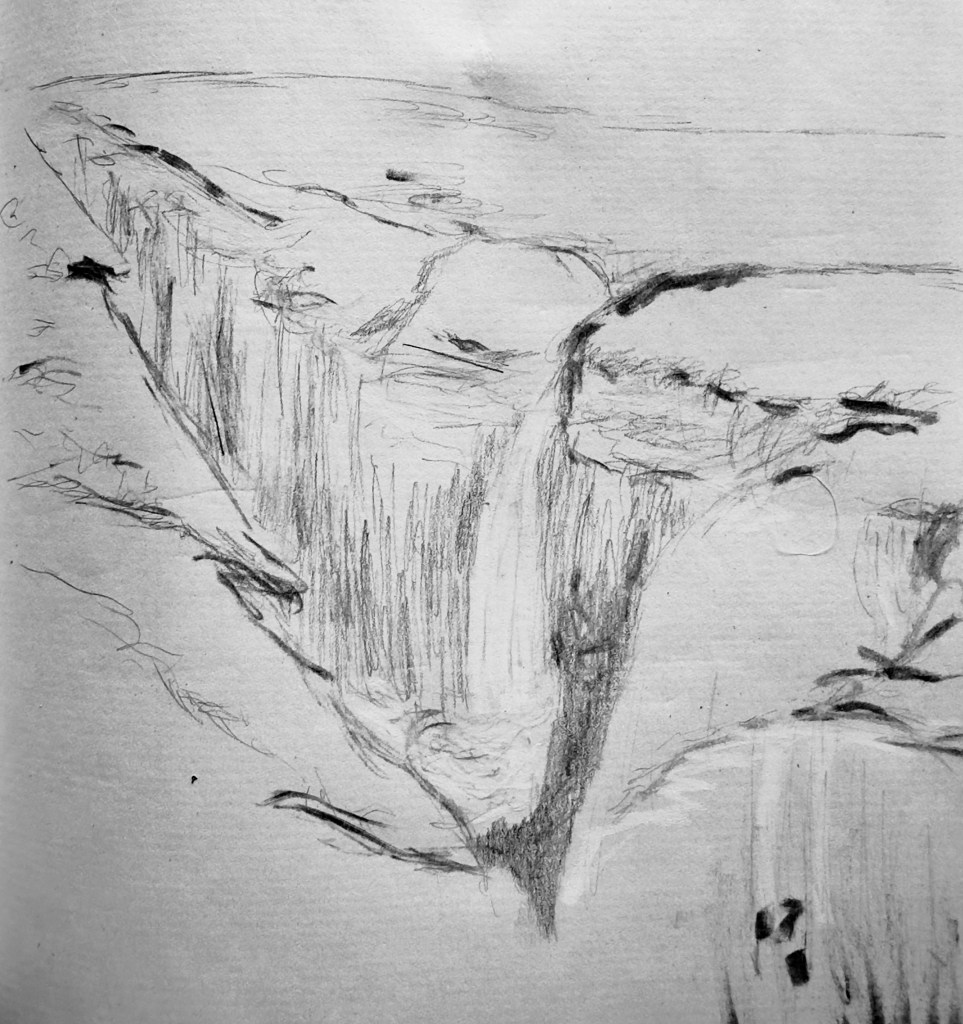
A cauldron boils that once was a cave,
Where roiling waters thrice appear;
In foggy mourning heed your step,
Lest your voice become mere whisper.
History, art, tradition, beauty.

Pity the king’s blind sons and daughters!
Cruelly forced to carry burdens.
Their birthright prudently hidden:
Patiently await, oh warriors!
Swaddled in the darkest cloak:

Arise from the lake, great keepers!
Four towers championing our gods,
Protecting, watching, nurturing
Embracing rituals of the people.
Perseverance. Independence.

Bathe in the pond of sacred force,
Wash away your pain and sorrow;
Silence, saddest Alkelda,
Cleanse for your journey on the morrow.
Strength. Self-reliance. Autonomy.
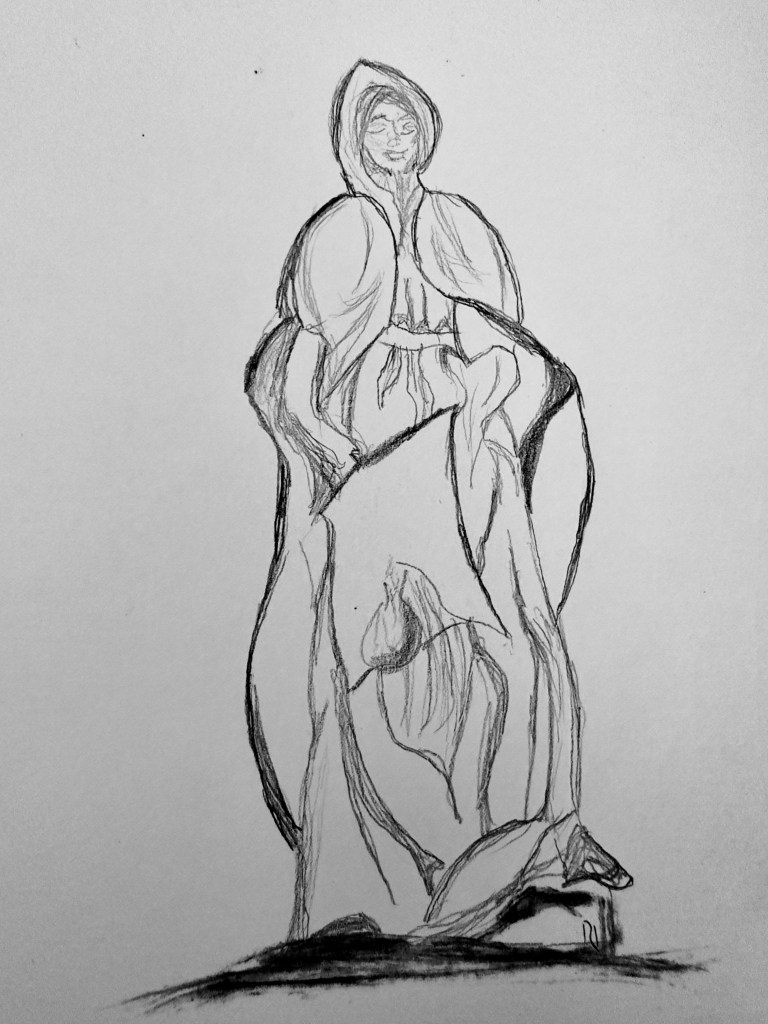
Protector, warrior, angel demon;
Patron of high-thon’d King:
Motherrood of Ælves and Wulves;
Wise Woman, Beneficent One!
We are stuttering, strutting,

Human, oxen, deer and auroch:
Blood stones ‘neath the ancient timber!
Archer and Bowman meet in the circle,
Where giants weave their wicked ways.
Disdained, slutty villains

Haltingly and fleetingly,
The Goddess Isis bends her knee,
Stubbornly refusing to reveal
Her deepest, darkest mystery.
Idling away our freedom
With deepest passion, pleasure.
iii
Mechanical Reproduction
Revolution: Barcelona (Reprise)
September 26, 2024
While working on my graduate degree at the School of the Art Institute of Chicago, I had observed that it takes the abject poverty of the transient alongside the obscene wealth of consumerist-driven cold capitalism to truly see, and truly comprehend, the need for Revolution. And it is best seen in the labyrinth of a city’s mass transit.
The sights and sounds one encounters on Barcelona’s train platform echo of the mournful wail of Charlie Parker’s plastic saxophone or the driving beat of Megadeath: the grating, irregular pounding of shouting passengers attempting to converse over the mingled clang of glass, steel, and electricity, the components of the city’s now sacred sites as they bustle about to worship their holy god of materialism.
Like many of the scholars in the United States who have recently found their programs defunded and have fled across the pond for greener pastures, Walter Benjamin had fled his beloved Germany to escape Hitler’s Third Reich. He and a group of scholars had attempted to cross into Spain to avoid capture, and as the troops descended upon the hotel in which Benjamin and his colleagues had taken shelter, he thrust his oeuvre into the hands of Thodor Adorno, compelling him to keep it safe, then took an envelope of morphine. His suicide, as well as the failed attempt of another exile, journalist Kosztler Atur, who was fleeing with him, distracted the Spanish officers intent upon seizing the group of Jewish exiles, allowing the others to flee safely into Lisbon.
Barcelona inhabitants abhor tourists, and for good reason. Their once affordable flats have all been purchased by developers and offered as luxurious Airbnb rentals. Too much of the lower middle class of a decade ago have now joined the throngs of gypsies, the lost souls relegated to the streets, panhandling in whatever way possible for a pittance of sustenance.
As we waited for the train that would never come because of delays further up the track from an uprising in one of the suburbs, I listened to the soft wails of a street musician and recalled portions of Benjamin’s essays. As she sang the blues, the light of the nearby “advertisements” and “the fiery pool reflecting it” created a phosphorescent glow around her. I watched as people rushed past her with their designer shopping bags and seven dollar paper cups of coffee as they peered into their bags for glimpses of those “few accessories…which cost lots of money because they are so quickly ruined,” assuring themselves that their treasures had survived the onslaught of the downpour. The expensive, sheer translucent bags broadcast to the world that they contained “the most lustrous and colorful of silks,” thereby sharing “the newest thing with” everyone else, serving as the commodity-seeker’s “triumph over the dead.”
Though I had not indulged in purchasing luxury items and had declined my daughter’s generous offers to purchase a number of trinkets, both useful and ornamental, my daughter’s pack had become slightly overstuffed, and she grasped a recently acquired beautiful oversized fur-lined, pink strappy bag that was also bulging, reminding me of my journey through Europe two decades earlier when I jostled through crowded streets and airports of Paris, Versailles, Monte Carlo, Assisi, Florence and Rome protecting a delightful plaster of Paris replica of Notre Dame’s gargoyle, his head peering out of my bag the way a New York commuter’s Maltese will do now that dogs are allowed on public transit.
As we rushed toward the next train that seemed as though it would perhaps allow us to make the connections to our return flight to London, I quickly flung the bungee cord shoulder strap of my bright blue, turquoise and yellow soccer ball onto my back and boarded the overly crowded, standing-room only train, thankful that I would soon be rejoining my whining soccer ball and my service wolf-dog in my 18 foot square space, the converted ambulance that has taken me on any number of adventures as I conduct research for my eighth novel, which is set primarily in the United States. Because my space is almost as limited as the dog trailer I had shared with my Great Pyrenees as we cycled 825 miles across America, my space, my home, remains delightfully devoid of the accoutrements of materialism that too often weigh heavily upon our society.

Well. Almost devoid of clutter. I’ve still hung onto a full bookshelf of research materials for my novels….and a favorite gargoyle or two.
After all, they provide protection.
Against the Wind: Púbol
September 25, 2024
It’s like flying.
I learned the joy of soaring downhill with barely nothing above or below at a very early age. But like most pleasures, the thrill gives way to fear with age.
My comfort speed is somewhere between 6 to 12 miles per hour.
But on my first long cycling tour from Chicago lakefront to Colorado, physics of the 86 pounds of my great girl taught me once again that braking while descending is not always a wise choice. Her weight pushed us, and the first time I attempted to brake, I could feel her trailer begin to jackknife. Lesson learned, or unlearned since aging had made me fearful.
She loved speed. She would poke her head out of the trailer and howl, her ears and long fur flapping in the wind.
Or she was as terrified as I was and I had to project joy onto her to overcome the fear.
On a smooth descent, I stand with my legs locked, bend over the handlebars slightly and let the wind rush around me. I call it my Titanic pose without some icky boy stabilizing me.
The landscape becomes a blur, markings on the road become an arrow, the wind is exhilarating.
Then she passed us. She was sitting back on the seat of her bicycle, both hands engaged in peeling a banana.
The app had warned us the hill of our last day would be daunting, one shared with professional cyclists training for races or the Olympics.
“We’ll need to pace ourselves with our batteries,” my daughter advised. “There’s a cafe where we can grab lunch and recharge our batteries before the hill.”
Traveling in a foreign country can be upending.
“I don’t think I will ever leave the country again,” he said after returning from a trip to Paris. “Riding public transit, the flight, the constant low roar of language I can’t understand.”
Deal breaker. Seriously.
The two most difficult cultural barriers of Spain were language and hours for dining.
At the foot of the hill, we encountered both.
My daughter and I with our Latin training can stumble our way through French, Spanish, Italian. But Catalonian is a unique assimilation of all three.
”Comida,” my daughter said, making a gesture of eating as she did.
A shake of the head was the singular response.
Not easily thwarted, she pointed to the battery she had brought into the bodega. “May we charge?” a question met with the same response.
Fear began fomenting in the pit of my stomach.
The man stepped away, and within a few seconds a younger man appeared, graciously pointing us to an outlet then leading us to a table where he handed us a menu.
We pointed to what we wanted, and he shook his head then pointed to the bottom of the menu written only in Catalonian.
Thank goodness Google translate works better than maps.
”In typical Spanish fashion, they stopped serving at ten this morning and won’t serve again until eight tonight,” she said.

Holding up two fingers, she simply said, “espresso et leche?”
When the older gentleman presented the black elixir sans leche, we smiled gratefully.
”Now to make one ounce of soul fuel last long enough to allow our batteries to refuel….”
As we waited, another patron, obviously a regular to the establishment, stepped to the counter and took a seat on the patio with his wife. A few moments later, a member of the waitstaff took two sandwiches and a bottle of wine to them, visited for a bit, and returned, offering a challenge in his eyes as he passed our table.
Some messages are clearly conveyed without a common language.
The entire staff gathered around a table across the bodega, smoking and splitting several bottles of wine. As time passed, their gazes, tones, gestures and laughter became increasingly rancorous. When the woman stood, looked directly toward us and bent over a chair while the older “gentleman” came behind her and began crudely thrusting his hips against her backside with his eyes locked onto us, we knew it was time to go, regardless of whether or not our batteries were sufficiently recharged to get us to the top of the mountain.
Walking up the hill, if necessary, was far better than staying.
She had sped past us on our ascent, head bowed, wheels speeding compared with our slow churning. Steph and I had just laughed at our own speed. “Well, we DO have packs that indicate we’ve been doing this for days. That should give us creds, right?” she asserted with obvious doubt in her voice.
”Absolutely. Besides, I have learned early not to feel self conscious because of criticism objecting to ANYTHING I do.”
When we ascended the last bit of the mountain, we stopped. “Pretty sure the woman with the banana will be one of the best things we will ever see,” she noted with a laugh. “And compared with ANY hill in the Rockies, that was nothing” she threw over her shoulder as we executed the final switchback into Girona where we rewarded ourselves with local gelato.
Isolationism for some, it appears, is like speed: one’s ability to adapt to whatever situation arises sadly does fade with age if one is unwilling to momentarily embrace the discomfort.
”Literature is strewn with the wreckage of those who have minded beyond reason the opinion of others.”
~Virginia Woolf, A Room of One’s Own
Is Anybody Out There: L’Estartit
September 25, 2024
“‘No one’, Pascal once said, ‘dies so poor that he does not leave something behind’. Surely it is the same with memories too—although these do not always find an heir. The novelist takes charge of this bequest, and seldom without profound melancholy.
~Walter Benjamin, Illuminations
The barrage of texts hit before sunrise.
We’d wanted to catch sunrise on the water hoping we could at least glean beauty if not warmth on our last day along the Mediterranean, especially since the cliffs at the edge of the beach village had been splendidly restlessly exquisite when we had stumbled upon them long after sunset.
I’ve no idea now what the context had been, but it had all the requisite qualities of an IRC: “Icky Relationship Conversation.” To silence them, I sent a single sunrise photo, with a succinct reminder it was the morning of the last leg of our journey, then resolutely slipped my phone into my pocket with the realization I had done it again.
Learning from my students has always been the most delightful part of my profession. Somewhere along the way, one of my students has become a social media influencer, a guru of all things relational, chiding both men and women alike for wasting time on narcissistic, emotionally abusive people.
“Narcissism is rampant in Christian ministry,” my brother, a retired military chaplain, frequently notes, a veracity I freely embrace.
Admittedly my record is not good, nurtured from the start by a highly egocentric parental figure, followed by a twenty-year marriage to someone whose family exhibits genetic narcissism.

At that moment, I understood I had done it again: dedicated far too many years of emotional energy sucked into the black hole of narcissism.
“He made you feel like you weren’t good enough to keep you from finding out that you were too good for him.”
~Treytyrell8
I’d put off writing, walking, hiking, even camping in some of the most pristine off-grid locations waiting for a text, a video chat, a sign that a particular “anybody” was “out there.” I’d struggled with my voice and content, wondering whether or not it would meet with one person’s approval. I’d shaped my life (again) hoping for a huge helping of acceptance, contenting myself with crumbs of barely insinuated flattery.
Yes, I am independent. Yes, I do enjoy my singleness. But as I mounted my bicycle for the last push back toward Girona, I truly did follow my daughter’s lead and vowed to henceforth embrace my identity, my beliefs, my strengths, knowing full well how often my weaknesses had restricted my own process of becoming.
I can only hope that my words, my writing, my memories, the odd collections of tangible and intangible materials and experiences not only shape my heirs, but anyone who happens to stumble upon them as they make their own treks through life. The barrage of texts hit before sunrise.
We’d wanted to catch sunrise on the water hoping we could at least glean beauty if not warmth on our last day along the Mediterranean, especially since the cliffs at the edge of the beach village had been splendidly restlessly exquisite when we had stumbled upon them long after sunset.
I’ve no idea now what the context had been, but it had all the requisite qualities of an IRC: “Icky Relationship Conversation.” To silence them, I sent a single sunrise photo, with a succinct reminder it was the morning of the last leg of our journey, then resolutely slipped my phone into my pocket with the realization I had done it again.
Learning from my students has always been the most delightful part of my profession. Somewhere along the way, one of my students has become a social media influencer, a guru of all things relational, chiding both men and women alike for wasting time on narcissistic, emotionally abusive people.
“Narcissism is rampant in Christian ministry,” my brother, a retired military chaplain, frequently notes, a veracity I freely embrace.
Admittedly my record is not good, nurtured from the start by a highly egocentric parental figure, followed by a twenty-year marriage to someone whose family exhibits genetic narcissism.
At that moment, I understood I had done it again: dedicated far too many years of emotional energy sucked into the black hole of narcissism.
“He made you feel like you weren’t good enough to keep you from finding out that you were too good for him.”
~Treytyrell8
I’d put off writing, walking, hiking, even camping in some of the most pristine off-grid locations waiting for a text, a video chat, a sign that a particular “anybody” was “out there.” I’d struggled with my voice and content, wondering whether or not it would meet with one person’s approval. I’d shaped my life (again) hoping for a huge helping of acceptance, contenting myself with crumbs of barely insinuated flattery.
Yes, I am independent. Yes, I do enjoy my singleness. But as I mounted my bicycle for the last push back toward Girona, I truly did follow my daughter’s lead and vowed to henceforth embrace my identity, my beliefs, my strengths, knowing full well how often my weaknesses had restricted my own process of becoming.
I can only hope that my words, my writing, my memories, the odd collections of tangible and intangible materials and experiences not only shape my heirs, but anyone who happens to stumble upon them as they make their own treks through life.
Be-atch Day: L’Estartit
September 24, 2024
“Every passion borders on the chaotic, but the collector’s passion borders on the chaos of memories…. The most profound enchantment for the collector is the locking of individual items within a magic circle in which they are fixed as the final thrill, the thrill of acquisition, passes over them. Everything remembered and thought, everything conscious, becomes the pedestal, the frame, the base, the lock of his property. The period, the region, the craftsmanship, the former ownership—for a collector the whole background of an item adds up to a magic encyclopedia whose quintessence is the fate of the object.”
~Walter Benjamin, Illuminations
We had the beach to ourselves, which under different circumstances, would have been bliss.
We’d dreamed of it for over a year.

Our tour promised two days along the Mediterranean, and our goal had been to relax along the beach after pushing through the Pyrenees.
Silly us. We should know better.
When we arrived at the gorgeous, white stuccoed hotel, the sky was as beautifully blue as the paint and tile that popped against the brilliant white.
The tour promised that the beach was only a few miles away from our lodging, an easy bicycle ride. But they failed to provide directions on their fabulous app that had safely guided us almost 100 miles.
So we turned to Google.
Depositing our saddlebags in our room and changing into our swimsuits only took a few minutes, and the sky was still brilliant blue.
Turn after turn after turn, an easy thing to do when Spain is spotted with roundabouts especially with Google telling me where to go, we made a slight detour when we stumbled across a quaint but HUGE market. We finally believed ourselves to be headed toward the beach, an interesting feat since there were no hills, just extraordinarily flat land giving no indication that we were losing elevation necessary to take us to sea level.
About a half mile from the beach according to our erstwhile guide, the sky darkened substantially.
Within seconds, we found ourselves racing past more bodegas, a smattering of alluring granjas, and a few bodegóns, pressing forward hoping the downpour would become less relentless by the time we reached the beach where we could settle into a chiringuito, a beach-side bar.
Nothing. Even the lifeguard stands were empty.
We stood huddled under my flimsy cloth jacket attempting to pull up Google.
The screen was as untenated as the beach.
Knowing my penchant for crashing electronics and distorting Google, my daughter looked at me, laughed, and stepped about ten feet away. In spite of the rain, she pointed, “That way,” and we trudged our useless E-bikes across the sticky, mooshy sand. And of course, as soon as we arrived at a welcoming, butane heated, canopied patio, the downpour ceased.
There are times when collecting memories calls for a pitcher of Spanish Sangria with a side of sizzling tapas.
On our way back, with half of our still lusciously wonderful pomegranate awaiting us in our hotel, I plucked a few fresh olives from a low hanging branch.
”Here,” I offered, thrusting it toward my daughter, who eagerly popped it into her mouth, then instantaneously spitting it back out.
”Oh, dear god,” she exclaimed. “What was that?”
Turns out olives fresh off the branch aren’t nearly as enchanting as pomegranates.
Day two of our Mediterranean adventure was much like day one, but at least the processed olives served with our tapas and sangria at the chiringuito will become a sublime collected culinary experience never to be forgotten. September 24, 2024
“Every passion borders on the chaotic, but the collector’s passion borders on the chaos of memories…. The most profound enchantment for the collector is the locking of individual items within a magic circle in which they are fixed as the final thrill, the thrill of acquisition, passes over them. Everything remembered and thought, everything conscious, becomes the pedestal, the frame, the base, the lock of his property. The period, the region, the craftsmanship, the former ownership—for a collector the whole background of an item adds up to a magic encyclopedia whose quintessence is the fate of the object.”
~Walter Benjamin, Illuminations
We had the beach to ourselves, which under different circumstances, would have been bliss.
We’d dreamed of it for over a year.
Our tour promised two days along the Mediterranean, and our goal had been to relax along the beach after pushing through the Pyrenees.
Silly us. We should know better.
When we arrived at the gorgeous, white stuccoed hotel, the sky was as beautifully blue as the paint and tile that popped against the brilliant white.
The tour promised that the beach was only a few miles away from our lodging, an easy bicycle ride. But they failed to provide directions on their fabulous app that had safely guided us almost 100 miles.
So we turned to Google.
Depositing our saddlebags in our room and changing into our swimsuits only took a few minutes, and the sky was still brilliant blue.
Turn after turn after turn, an easy thing to do when Spain is spotted with roundabouts especially with Google telling me where to go, we made a slight detour when we stumbled across a quaint but HUGE market. We finally believed ourselves to be headed toward the beach, an interesting feat since there were no hills, just extraordinarily flat land giving no indication that we were losing elevation necessary to take us to sea level.
About a half mile from the beach according to our erstwhile guide, the sky darkened substantially.
Within seconds, we found ourselves racing past more bodegas, a smattering of alluring granjas, and a few bodegóns, pressing forward hoping the downpour would become less relentless by the time we reached the beach where we could settle into a chiringuito, a beach-side bar.
Nothing. Even the lifeguard stands were empty.
We stood huddled under my flimsy cloth jacket attempting to pull up Google.
The screen was as untenated as the beach.
Knowing my penchant for crashing electronics and distorting Google, my daughter looked at me, laughed, and stepped about ten feet away. In spite of the rain, she pointed, “That way,” and we trudged our useless E-bikes across the sticky, mooshy sand. And of course, as soon as we arrived at a welcoming, butane heated, canopied patio, the downpour ceased.
There are times when collecting memories calls for a pitcher of Spanish Sangria with a side of sizzling tapas.
On our way back, with half of our still lusciously wonderful pomegranate awaiting us in our hotel, I plucked a few fresh olives from a low hanging branch.
”Here,” I offered, thrusting it toward my daughter, who eagerly popped it into her mouth, then instantaneously spitting it back out.
”Oh, dear god,” she exclaimed. “What was that?”
Turns out olives fresh off the branch aren’t nearly as enchanting as pomegranates.
Day two of our Mediterranean adventure was much like day one, but at least the processed olives served with our tapas and sangria at the chiringuito will become a sublime collected culinary experience never to be forgotten.
Strong Enough: Sant Pere Pescador
September 24, 2024
The edifice appeared on the horizon as soon as we had fully descended into the plains on our way toward the Mediterranean.
Hollywood is known for misleading viewers, and the castle on the hill, featured in the climactic scene in Kevin Costner’s version of Robin Hood, is located in Spain, not England.
A justifiable manipulation of reality. I had started my journey in Nottingham, and their castle, to be honest, really is not very intimidating, whereas the one overlooking the plain in Spain is.
Intentionally misleading an audience is an age-old trick. The edifice, visible across the entire Catalonian plains, was never completed. It loomed above the kingdom as a visible threat, a reminder of power, but an empty shell.

Not much different, really, than the Wizard’s Emerald City.
Yours. Mine. Ours.
Growing up as the youngest of eight children, by the time my mother reached me, she was thankfully over trying to create the perfect lady. Besides, she had wanted a boy, so when I began exhibiting independence and living up to my name, which was chosen from that of two of her brothers, tossing me outdoors seemed natural.
While she was the one who taught me to be strong, it was my brother and father who taught me which tools were what and how to use them. They were the ones who nurtured my passion for rocks, plants, insects, tinkering, camping and cycling (I am the only one of the combined six daughters who ever owned my own bicycle).
Living in the cramped quarters of 1000 square feet, we were known to take very long Sunday afternoon drives, which entailed open windows, dust, and careening around sharp mountain curves at high speeds.
In a lifetime before safety restraints, the eldest wrangled over the spot in the front bench seat between my mother and father. The losers then wrestled to fill the back seat, and the rest of us were tossed into the back of the station wagon, where we were jostled about like boulders tumbling down a mountain rockslide.
Once I was no longer jostled and confined into a cushioned seat with a seatbelt, throughout my life drivers have hated having me as a passenger. Not because I tell them what to do, but because at any given moment they are faced with two choices: pull over IMMEDIATELY when I request or wear vomit.
Motion sickness has always marked my travel experience, limiting access to things like busses, trains, boats and subways. Without the excess jostling I’d been exposed to in the first few years of my life, I have to always sit very still, facing the direction of travel, with my eyes directed only forward. I have ridden miles and miles through some of the most astounding scenery in the world and have been able to view very little of it.
The traumatic brain injury has for the most part reversed that. Place me on whatever kind of seat is available, but don’t you DARE jostle me or you will see me reduced to a stammering, screaming imbecile.
The first two and a half days of our ride through Spain had been perfect, in spite of the streaked backsides on the first day: challenging enough to be fun, scenic enough to be breathtaking, and I’d contentedly been a passive rider following the tire tread of my daughter, even when they included picturesquely, slowly, cautiously riding through a herd of sheep.
Then we turned, and it happened.
Most mothers never know the pleasure of admiring their adult children. They tend to always slip into matriarchal overdrive, which may or may not include helicopters.
For me, because of my vulnerability, that role has changed, and I have found my hero.
The hours following my hero on the paths, roads, switchbacks and steep hills seemed particularly easy to navigate, especially since my daughter is one of the only non-medical persons who has witnessed the full onslaught of my post traumatic stress disorder. Her ability to recognize the onset of symptoms allows me to fully relax knowing she will do whatever possible to prevent the full onslaught, and that should I slip into them in spite of her preventative measures, she will be able to help me reach the other side.
After only a few hundred feet of jostling, she looked back to check and immediately stopped.
“Let me lead,” I shouted succinctly as I pedaled past, my hands gripping the handlebars tightly.
While riding 800 miles through the Rocky Mountains at altitude to train for my trip, most of the miles had been on a dirt road specifically in anticipation of this moment: mountain biking type of terrain.
The jostling spread from my head to the tips of my fingers and toes, which had gone numb except for the cold fear gripping them. Bile built in my throat, threatening to mark the trail should the oddly maniacal speed had managed to make my daughter lose sight of me.
Since I had been passive tourist, I hadn’t bothered to activate the app telling us which paths to follow, so I had no idea where we were going. I just knew that I simply could not stop until we reached the next crossroads.
I have no idea how long we bumped along, nor what our top speed reached.
I just know that I simply could not stop or we would find ourselves working through breathing exercises with a fear so deeply embedded that we would have to walk an indeterminate distance.
After what seemed to be hours of excruciating torture, I realized through the fog in my head (belying the sunny countryside through which we traversed), the jostling had ceased. I stopped, and within moments, my hero pulled up beside me.
I reached to the ground and presented her with a fresh pomegranate that lay beside my front tire.
We laughed, and as we peeled back the bright red flesh, exposing the ruby seeds resting in the yellow tissue surrounding it, she admitted, “I am glad you stopped. That was even a bit intense for me!”
Post Traumatic Stress Disorder is difficult to define, difficult to diagnose since often only loved ones experience the onset, and one survivor of a specific trauma may be permanently marked while another one may walk away utterly unscathed. Alas, it is also difficult to treat. But once the mind has built an echo of the trauma, it always looms, a threat on a person’s horizon, a chimera of fear that may unexpectedly explode inside a patient’s head with the slightest provocation: a touch, a sound, a memory.
Now, whenever my daughter recognizes I am struggling with PTSD, she randomly inserts a single word into the situation.
And in the same way a hero is identified by the cape she wears, she has permanently commemorated our victory in Spain with a gorgeous tattoo featuring the luscious, propitious moment we happened to discover a wild pomegranate.
Fylgia Ear: Sant Pere Pescador
September 24, 2024
“When…one reads of a witch being ducked, of a woman possessed by devils, of a wise woman selling herbs, or even of a very remarkable man who had a mother, then I think we are on the track of a lost novelist, a suppressed poet, of some mute and inglorious Jane Austen, some Emily Brontë who dashed her brains out on the moor or mopped and mowed about the highways crazed with the torture that her gift had put her to.”
~Virginia Woolf, A Room of One’s Own
She soared along the field, her hands outstretched, seemingly soaring above the land reminiscent of Russel Crowe in Gladiator.
I watched with mingled jealousy, admiration and pride. She was executing a move I have been unable to conquer in spite of my 1450 plus cycle touring miles and the non-touring hours I have spent in a bicycle saddle.
“It’s easy,” my brother always would prod me, even when we were children. “Always pedal at a consistent speed and keep a steady, balanced posture.”
Nope. Not easy, but then again, I have always been the type of hiker or driver that will veer toward whatever I happen to be looking toward. The view of my surrounding world has always been limited to only that which is directly in front of me.
From the outset of our journey, my daughter took the lead, setting the speed, yet always careful she didn’t ride too far in front of me, always checking to see if we could perhaps go a bit faster before she would shift into a higher gear.
She’d spent her childhood watching her father ALWAYS walk at least ten feet in front of me. “I don’t feel comfortable riding ahead of you,” she said early along our journey, something I have heard from my youngest son as well.
She didn’t need to offer an explanation for her statement. I knew why. “But the trails are not wide enough for us to ride side by side.”
”True, and I also really don’t feel like being the one to try to follow the map,” I informed her, appreciative that I no longer had to constantly be checking the small screen that had led me, often unsuccessfully, across England.
And as mother, it gave me an opportunity to take numerous photos of one of my heroes.
“I couldn’t vote for a woman. They are…”

“…too weak.”
”…too emotional.”
”…too unpredictable.”
We heard it often in 2015 and again in 2019, usually from those who have been taught that women are weaker than men, women were the cause of the fall, a woman’s place is in the home.
My mother happened to be one of the strongest women I knew. She was an orphan housed in an orphanage, abandoned by an alcoholic mother when her father served to fight in World War II. When the war ended and her father returned home, she was retrieved from the orphanage specifically so she could raise her younger brothers.
On her way home from school one day, a classmate took her into a barn and raped her. She returned home the following morning, and when she did, her father kicked her out of the house. She was fifteen.
She called a boy she had known in the orphanage, and a few months later, she was a married woman.
Little is known of her life during that time, but since her death stories have circulated of how she and her teenage husband would hop trains to travel across the country, stealing clean clothes from clotheslines, eating food they pilfered from grocery stores.
She was nineteen when she gave birth to her first child, and by the time she was pregnant with her second child (according to most stories), her husband was in jail.
She married my father, who happened to be her brother-in-law, who was father to three other children. Together, they had three more, eight combined with birth years spreading across two decades.
She filed for divorce on my sixth birthday, and worked two full time and one part time jobs to support the five children she had birthed during the seventies when the feminist movement was gaining national momentum. Yet she despised the movement. She longed to live the life of a conformist to paternal, Bible-thumping conservatives, yet her life was nothing but conventional.
But she did everything she could to perpetrate the myths of chauvinistic conformity to an ideal she never knew, a hyper-focus on paternal ideals that shaped her daughters’ perceptions, for better or for worse.
We walked through the central plaza, an exercise I force my great white wolf to do hoping eventually she will become less terrified of my favorite city this side of the pond. I ADORE Santa Fe. My fear-motivated, sometimes unwieldy service dog does not.
Every time we pass through, I inflict a miserable trip into the plaza upon us, doing what my trainers call “doggie pushups,” which entails stopping and sitting every time she becomes distraught. Our first journey across the plaza took several hours.
We are now able to cross it in half the time after more than eight very gruelling visits.
”You look as though you could use a hug,” she said as she walked toward me.
I bristled a bit, knowing that when my poor girl is so filled with fear she trembles that she is most likely to exhibit unpredictable behavior, whether that entails aggression or bolting, neither of which produce positive results.
I sat on a bench, determined to work through the scenario without her dragging me along behind as she has done in the past.
The willowy, winsome woman, sensing my apprehension, continued to approach, talking in a soothing tone and thankfully not making eye contact with my girl, eventually positioning herself on the bench with us, but maintaining a comfortable distance.
”She is wolf,” our new acquaintance observed rather than asked.
”Yes, and very difficult to manage because of her fear,” I responded while holding tightly to her harness, which serves to keep me upright as long as she is focused on her job instead of her own internal demons.
Because she had lived with intense pain in her abdomen for the first five years of her life, she isn’t intrinsically food motivated, which presents an additional challenge. She lives only to please, and when she begins exhibiting fear, she recognizes I am displeased, so often we ride on a perpetual carousel in stressful situations.
As our new acquaintance continued talking, balancing her Native American hand drum on the side of her body away from us, my girl’s trembling subsided and she actually nuzzled my hand, requesting the treat for her ability to obey the command, “Settle.”
I breathed a sigh of relief. Yes, I did need a hug, but I knew we weren’t quite there yet.
We spent an hour visiting with one another, exchanging histories, experiences, and the story spun around to my books.
“As I researched my lineage, I learned there is a remarkably long string of systemic abusers. Not just of immediate family, but the type who perpetuated violence as conquerors and aristocrats who destroyed at worst, exploited at best,” I explained. “I long to connect with my ancestors, but how am I able to do so when they were monsters?” I queried.
Then it hit, and I winced.
In many ways, I had to start with my own mother, the one who had been the first to accuse me of being so evil I was possessed. The one who had taught her daughters to submit to toxic male dominance. The one who had inflicted numerous instances of physical and emotional abuse.
I reached down, patted the warm, white head beside me, and she looked at me with what at times is an irritating devotion, convicting me because too often I am impatient with her.
The woman beside us mirrored my gesture, hugged me, and whispered one word of wisdom before rising and walking away with her drum swaying on her hip while she beat out a slow cadence rhythmically echoing her receding step: “Forgiveness.”
Sometimes keeping one’s balance isn’t about strength, but about identifying your weaknesses and moving along at a steady pace.
Haters Gonna Hate: Besalú
September 23, 2024
“I would ask you to write all kinds of books, hesitating at no subject however trivial or however vast. By hook or by crook, I hope that you will possess yourselves of money enough to travel and to idle, to contemplate the future or the past of the world, to dream over books and loiter at street corners and let the line of thought dip into the stream.”
~Virginia Woolf, A Room of One’s Own
The titillating, energetic lilt of his accordion resonated over the roar of the assaulting jets, providing a delightful cadence for the echo of Woolf and Forster alike. He was a troubadour squeezing out the unspoken tale of Besalu: the unspoken lyrics of both Jews and Catalonians who had created the lovely city stretching below our secluded balcony.
The ancient stone bridge, featuring seven uneven arches and two towers, leads straight into the Jewish quarter, which possesses the only extant Jewish ritual cleansing pool, a mikvah: a clear reflection of the importance of the Jewish presence in the area during the Medieval period and served as a figurative transition from high Latin to vernacular as birthplace to thirteenth century poet and theoretician, Raimon Vidal Bezaudun. Compare his work to that of Dante, who helped Italy officially adopt the common language of the region. Raimon noted that “all people wish to listen to troubadour songs and to compose them, including Christians, Saracens, Jews, emperors, princes, kings, dukes, counts, viscounts, vavassours, knights, clerics, townsmen, and villenins.”
Raimon Vidal Bezuandun recognized the uniting power of language, music and storytelling, important aspects of preserving culture through oral conveyance, the essence of my historical fiction in which the women who marry into my family recreate the tales of the land through which they travel as well as that of previous generations, often conveyed through stories told around a campfire or hearth, a concept reflective of Woolf’s observation that “fiction is like a spider’s web, attached ever so lightly, perhaps, but still attached to life at all four corners.” I weave my ancestors into history when they are often nothing more than a name in a list of English Peers, an anonymous entity contributing to my genetic makeup, an echo from the past that may or may not be part of a Jungian concept of collective consciousness that has shaped my reality, my perceptions, my memory.
Storytelling on all levels is becoming a lost art. AI threatens authors, artists, actors and musicians alike, especially since the number one song on the charts is currently AI generated.

Instagram with its 800 character limit and the suggested blog/chapter length has become symptomatic of shorter attention spans.
Dance remix with its altered tempos feed nightclubs with small snippets of crowd pleasers, abbreviating hits to seconds rather than minutes of the original compositions.
Reels provide sound bytes of lawmakers, highlights of theatrical or musical performances, compress days or months of photographic or film footage into 30 second snippets.
To ask readers to immerse themselves into my novels may or may not be as futile as asking over-tasked students to read a Shakespearean play, or even a fourteen line sonnet. But I am aware that on many, many occasions I had successfully done exactly that: encouraged my budding scholars to first dip themselves into a few lines, then find they wanted to fully immerse themselves in a world created by others that momentarily transported them outside of their own experiences, their own perceptions, their own memories, allowing them to slip into one very real form of collective consciousness; that of a troubadour singing the stories seeping through the pages of literature.
I believe it is no coincidence that the unifying power of language through storytelling that emerged from the Dark Ages gave birth to scientific discoveries and humanitarian movements of the Renaissance and Enlightenment, a strong testament to the strength of the practitioners of the liberal arts.
I emerged from the assaulting jets of the jacuzzi refreshed and ready to explore Besalu’s bridge, fortification, grotto, and church, thankful again for my daughter, my guide, and the fabulously functional rental she had procured, allowing us to get lost in the remarkable, ancient beauty and history that surrounded us.
“So long as you write what you wish to write, that is all that matters; and whether it matters for ages or only for hours, nobody can say.”
~Virginia Woolf, A Room of One’s Own
New Generation: Besalú
September 23, 2024
“Life…is a public performance on the violin, in which you must learn the instrument as you go along.”
~E.M. Forester, Room with a View
For us on this particular day, our public performance was accompanied by an accordion.
Impressionist painters frequently depicted women of leisure elegantly garbed sitting separate from the crowd, confined on a wrought-iron railed balcony, raised on a pedestal above the hoi poloi of a bustling street.
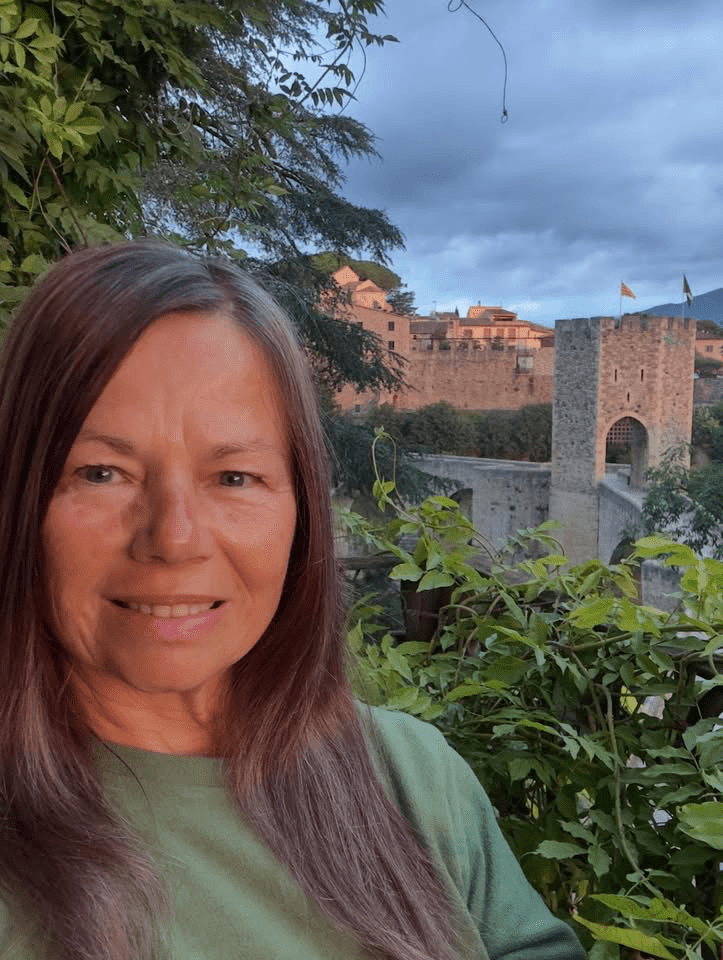
Isolated. Protected. Objectified. Jailed.
Granted, their position at the time was innovative. They were depicted in the transitory space between public and private spaces. Previously women had been confined like a Mona Lisa, a Madonna receiving the glorious news that she had been penetrated by a god against her will, a demure wife with head bent piously over a prayer book: contained in interior spaces with only glimpses of the outside world through a small window built into a very thick wall.
Besalu is astounding. While Castellfollet overlooked the passage through the Garrotxa volcanic mountains comprising this section of the Pyrenees, Besalu was the seat of the kingdom encompassing a far-reaching medieval kingdom.
Our hotel was located at the entrance to a twelfth century bridge fortified with two high towers bearing what I assumed to be the Catalonian banner. The historian in me would have at one time immediately turned to my iPhone to Google it, but the post-TBI brain simply appreciated the beauty for what it was.
The view from our wrought-iron enclosed balcony spread magnificently below while the hum from the jets of the jacuzzi tub my daughter was enjoying, the whir not quite loud enough to drown out the strains of the buckster’s accordion. Children with balloons, dogs on leashes, couples walking hand in hand, many still wearing the Sunday best: all transporting me to a different age.
The parade of fellow cyclists with their padded pants and clicking cleats crossing the spanse brought me back to a pleasant reality that we were women in the current era, free to come and go at will, free to strain our muscles in healthy activity, free to sit above the rabble wearing skin-tight riding shorts with our wool clad stocking feet resting unceremoniously on the chair in front of me, a relaxed, informal sprawl scorned by Henry James in the opening lines of his novel, The American.
My reverie was interrupted by my daughter, wrapped in a towel, warning me that the jacuzzi jets were strong enough to “assault one in places that normally shouldn’t be assaulted,” a phrase that may or may not have bespoke her approval of the experience.
I turned from my accordion player with a measure of reluctance and recounted Virginia Woolf’s words: “A woman must have money and a room of her own if she is to write fiction” from the essay read repeatedly in college courses emphasizing femmism, the same one that reminds readers that “The history of men’s opposition to women’s emancipation is more interesting perhaps than the story of that emancipation itself.”
Our own Room with a View.
As I lowered my body into the steaming hot “assaulting” jets, I relished how our journey across Europe would shape my voice, my fiction, and my emancipation from restrictive mores.
”Anything may happen when womanhood has ceased to be a protected occupation.”
Virginia Woolf, A Room of One’s Own
Photograph: Sant Ferriol
September 21, 2024
”There is no perception which is not full of memories. With the immediate and present data of our senses we mingle a thousand details out of our past experience. In most cases, these memories supplant our actual perceptions.”
~Henri Bergson, Matter and Memory
Layering is how learning happens. New perceptions mingle with old experiences, becoming embedded more thoroughly in our brain.
We sat out on the second day of our journey warm, well rested, refreshed: I was acutely aware of the sharp contrast between my frugal journeys and my daughter’s well curated, expensive tour.
The 36 miles we had traversed the previous day had been flawlessly easy compared with those I had traveled with Matilda, and in spite of the 31 miles with the altitude gain we were facing as we ascended deeper into the Pyrenees seemed inconsequential by comparison.
A trip to Europe wouldn’t be complete without a glimpse of a fortress sitting high upon a crag.
As we wound up the infrequently traveled mountain road with steep cutbacks, the clouds that had marked our previous day’s journey dispersed, yet wrapped the valleys spreading below us in gloriously picturesque horizons befitting a Romantic landscape canvas.
We stopped at what was the highest altitude of our ride through the Pyrenees, not from fatigue but because of the sheer awe-inspiring view. Both of us were grateful we were accustomed to the thin air of the Colorado Rockies. The ascent had seemed paltry for me, especially because the two weeks of wrestling Matilda following my intense 800 mile training at over 8000 foot altitude. The mere 2,850 foot elevation was nearly laughable since the app warned us the ascent may be difficult.
Yet we remained breathless.
She walked ahead with her camera, a sight that had brought me pleasure since she had first aspired to become a photojournalist in high school, a goal that had placed her on college and professional athletic sidelines, a study-abroad program in Indonesia, and in a number of lucrative scholarships. She has long since stepped beyond that goal, but her eye for photography remains firmly intact.
She stood overlooking the vista in much the same way as Friedrich’s Wanderer on the Sea of Fog: a solitary figure contemplating the mysterious beauty spreading below.

As we soared downhill after an hour of contemplative repose, our speed was nearly as exhilarating as the view we had just absorbed.
But only nearly.
The intoxicating beauty and heady descent surpassed any Romantic Era canvas I have ever admired and will remain forever firmly embedded in my memory.
Half way down toward our next destination, it appeared on the horizon, and it did not disappoint. An entire medieval city sat atop a volcanic formation. The “Castle of the Rock”: Castellfollet de la Roca.
“That is one of the stops they recommend for lunch,” she said as we shot the obligatory photos from afar, ones she had disdained because we were too far to get a clear shot.
“We have two choices. Continue relatively downhill to our next destination, which is only about 45 minutes away, or climb that extraordinarily steep hill. I am willing to do either,” she said with a tone belying her words. I am, after all, her mother and had heard it many, many times.
I looked longingly left toward the perched edifice, then right down the road we could take. Without a word, I climbed onto the bike saddle and began pedaling up the steep hill, fearing the worst, which would have entailed us walking our E-bikes half way up, delighted when we reached the top without a hiccup, a wonderful contrast to my experiences with Matilda!
The view wasn’t much from within the only small, family-owned restaurant we found open during midday Sunday siesta (which is NOT a myth in Catalonia). Well, unless the “view” included momentary glimpses of the swarthy, smiling, dancing young man wielding his magical implements over the massive brick oven.
The wizard’s sumptuous fare offered to us was sheer ambrosia from start to finish.
Perfectly apropos for our day among the clouds.
Whipped Cream: Olot
September 21, 2024
“My body…to exercise on other images a real influence, and, consequently, [is] to decide which step to take among several which are all materially possible…. Surrounding images…must display…the profit from which my body can gain from them…. I note that the size, shape, even the colour, of external objects is modified according as my body approaches or recedes from them; that the strength of an odour, the intensity of a sound, increases or diminishes with distance…. My horizon widens, the images which surround me seem to be painted upon a more uniform background and become to me more indifferent.
~Henri Bergson, Matter and Memory
We are sentient human beings, interpreting our world through our senses, recording snippets of information from our myriad of experiences, creating memories that may be flawed by our limited perception.

Travel broadens one’s horizon. Tastes, smells, textures, temperatures, images and sounds bombard us, yet not all become permanent records of any particular instant.
Bergson rightfully quantifies memories extracted from the images which bombard us in monetary terms: they are “profit.”
“If you ever travel to Europe,” my first humanities instructor told her students, “treat yourself to a cup of hot chocolate,” she informed us as we read the opening pages of Anna Karenina. She was illustrating the discrepancy from our own limited perception of indulgence, privilege and wealth as students occupying one of the poorest counties in America from the reality of Russian aristocrats in the novel.
Having been assured even by the English I had met across the countryside that the second leg of my journey through Spain would be fabulously warm compared with the freezing sleet I had unexpectedly encountered there, I had left most of my warm layers beside a trash bin in London.
Our first day in Spain had seen rain so torrential it filled the gutters and spilled onto sidewalks and shops. Our first day of our bicycle ride had found us splattered in mud that dripped down our helmets, jackets and backsides like brown streaks of sewage.
By the time we reached our first destination, we were shivering, dirty, cold. But the physical exertion of riding through the astounding beauty of the Pyrenees buoyed us, energized us, enlivened us. After washing away the grit, we were ready to explore Olot. Since I had left behind all my cold weather gear when I left London, I wrapped the bed runner around me like an oversized scarf and headed into the heart of a city that dates back to the seventh century.
The rain continued to fall, and warm shops glowing in the night beckoned to us. Famished, we stepped into a quaint, sumptuous pastelería, compelled by its array of delicate, decadent cakes and candies artfully displayed in ancient cabinetry as dark as the chocolate delectables.
You know how you should never step into a grocery store hungry? That applies to confectioneries twofold, and the counter began filling with our selected indulgences: fudge, cookies, sweetbreads. And as we began to pay, the sign touted the very object of desire my memories had long since shelved: the experience of European hot chocolate.
We sat on the cold stoop of a closed tourist trap spooning out generous portions of sweetness and listened to the peals of the eleventh century cathedral. The illuminated, freshly rain-baptized streets of Olot’s Nucli antic seemed to be a small corner of heaven.
Memories derived from our senses: sights, sounds, scents, textures and tastes from which our souls deeply will forever profit.
My Dog: Garrotxa Volcanic Zone
September 21, 2024
I carry her wherever I go.
Losing a fuzzy is the deepest pain I have ever experienced, and when my old girl, my sweet Great Pyrenees who had accompanied me on my 825 mile bicycle ride from Chicago’s Lake Shore Drive to the border of Colorado in 2013 could no longer stand, a quick progression from walking miles along the Boulder Creek Path in a matter of days, I knew it was time.
She had helped me earn my master’s degree from the School of the Art Institute of Chicago, walking hundreds of miles alongside me, waiting patiently while I took photographs, shot video, recorded interviews with passers-by.
She had helped me learn to walk again after sustaining my traumatic brain injury.
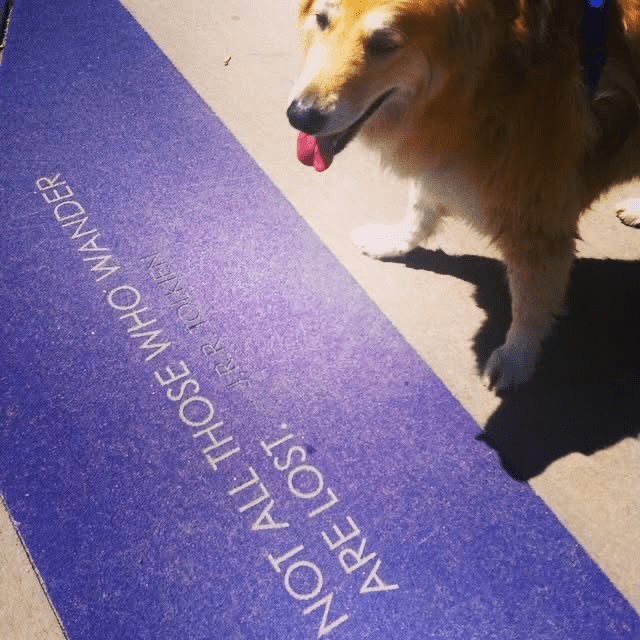
As we walked out of the vet, my daughter said for a moment she had feared I had gone with her.
She was my heart, my soul.
Before laying beside her on the floor of the room designed specifically for euthanization, I took off her harness because like me, she loved her freedom. She loved independence. She loved being stubborn, so much so that if she didn’t want to go a particular direction while we were walking, she would obstinately throw her 86 pounds onto the sidewalk and would refuse to budge unless I complied with her demand.
I wrapped my arm across her warm body, knowing within minutes it would turn cold, closed my eyes so I wouldn’t see the needle they would soon insert into her body, and literally couldn’t breathe.
The ordeal had been slow and awkward; she was stubborn even then, resisting the flow of the infusion, her heart beating even though all the solution in the bag had passed into her body.
My daughter described the horrifying process: her blood had flown back into the tube of the port while the veterinarian left the room to retrieve an additional bag of solution, details to which I had remained oblivious because I had been unable to do anything other than hold her warm body against mine as I spooned her.
She was larger than I was in many ways: her hips would rise above mine when we laid side by side, and if she stretched out fully, her feet would extend beyond mine. In every way, we “fit” together.
The vet left the room long before I was able to pull my arm off her cold body. I truly didn’t want to leave without her, the same way, I would later learn, she seemed to resist leaving without me.
When I retrieved her ashes a few days later, I was astounded by the weight of the box, and I know now that our ashes probably will be similar quantities.
My novels open with the moment when she and I are reunited as our ashes are tossed into a smouldering fire in a grove of aspen along the same wilderness where I once hiked with my infant children strapped to my back, the same location where I have known since those hikes where I want my ashes to be scattered.
When I set out on my journey across Europe, I wore three things around my neck: my sunflower lanyard identifying me as disabled, my “do not resuscitate” designation which clanged against her tags, and a small silver tree with a blue crystal in the center securing a few of her ashes.
It seemed appropriate that at least part of her would make my second epic cycling journey with me.
We were nearly finished with our first day of riding through the Great Pyrenees when we stopped at the delightful cafe located in Garrotxa Volcanic Zone Natural Park. Before hopping back onto the E-bike saddle, I made one last trip into the cafe to use the facilities, and that’s when I noticed the pendant was gone: somewhere along the way as we rode through the Pyrenees, she must have preferred a path we hadn’t taken and she had obstinately thrown the bit of her I had carried with me onto the ground.
Initially I grew as cold as I had on our last day together, but as she always did in her moments of infuriating obstinance, she elicited the indulgent laugh only a mother would find when embracing a child’s endearing flaw.
Still dizzy in spite of the humor, I shared the moment with my daughter, who also chuckled as we mounted our mud-covered bikes for the last push for the day along our designated trail.
Pigs: Olot
September 21, 2024
Both curses and blessings require a name be spoken.
In many cultures, names are given long after an infant is born and must reflect the nature of the child or the times in which they live, and naming day is a holy moment for babe and observers alike.
As we set off, and throughout the entire journey, the E-bikes we had rented remained nameless.
They happened to be so very perfect, no curses were necessary. And well, as far as blessings, some would actually have used the phrase, “We were so blessed” to have such a perfect pair.
“Oh, the weather you’ll encounter will be so much warmer. And drier,” my new friend from England had laughed when she learned the second half of my Eroupean E-bike tour would be in Spain.
”This is perfect,” my daughter shouted toward me as she led us along the gravel road. It was, indeed, a splendid start for our 425 mile route. But not for long.
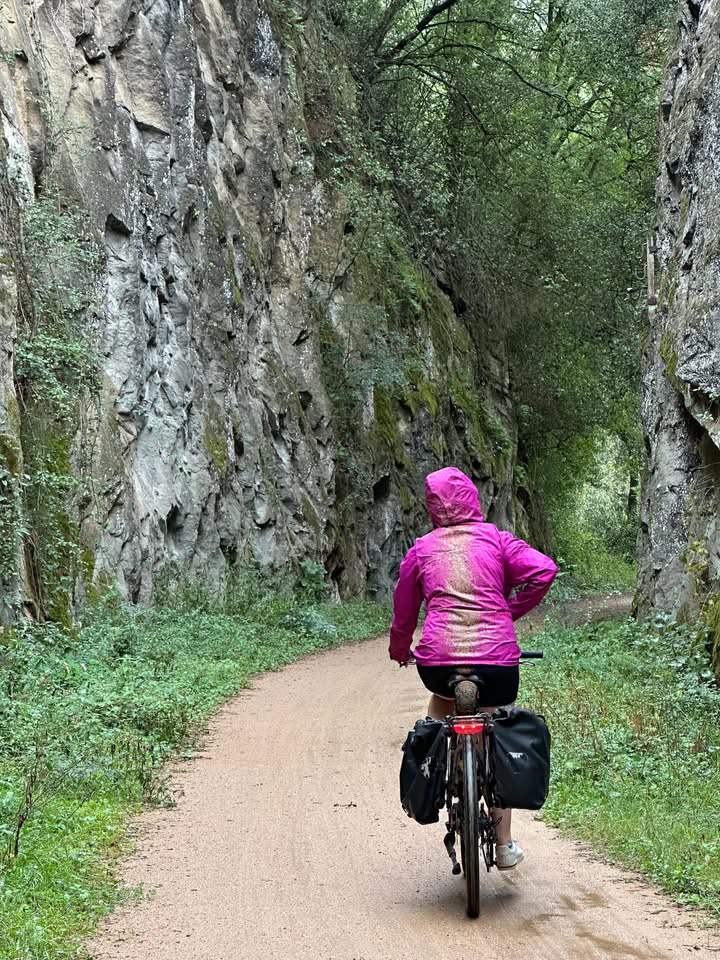
Although our cycles were perfect, the weather wasn’t.
As the mist began falling, we were still in high spirits.
Instead of taking almost a week to learn the gears and settings, it had taken us only a few minutes. Our E-bikes were light and well balanced, and within just a few miles we began averaging speeds I had only achieved going downhill with an out of control, brakeless Matilda.
The mountain range through which we would ride the next few days rose above the clouds like an awaiting nirvana as we rode from one picturesque village with bright red tiled roofs to another.
When we had at last hit the blanket of heavy clouds that had painted a picturesque landscape in the distance, we stopped for lunch.
Catalina is an odd cross between Spanish, French and Italian. And utterly foreign to either of us, but when the server brought out two plates of pig’s feet, we knew the universal head shake: “No, that’s not what we ordered.”
Food after a long ride always tastes marvelous, and our abundant serving of pure protein consisting of pork chops, eggs, and any other number of fantastic but unidentifiable meats buoyed us for what was to come: the Spanish Pyrenees.
Our repast may have kept us afloat, but it didn’t keep us dry after only a few minutes of relentless rain.
“The rain falls only on the plains in Spain,” a jumbled quote from one of the most despicably misogynistic films I’ve watched kept flooding my brain.
By the time we arrived at what the fancy app my daughter had downloaded from our bicycle rental shop had identified as a quaint, pleasant coffee shop where the proprietor speaks English, we were coated in Spanish mud from helmet to tire to toe.
We quickly ordered and stepped out of the pristinely clean establishment, finding a secluded spot on the patio nestled in a series of fern-covered extinct volcanoes while American pop played quietly in the background.
This time when the server brought us our midday steaming hot, black espresso, we didn’t have to waive aside an order of unwanted pig’s feet with our frightfully mud-blackened riding gloves.
Ships and Shame: Girona Cathedral
September 20, 2025
“Neither knows where the other goes or lives. We might have loved, and you knew this might be.”
~Baudelaire
My daughter and I rushed from one site to the next, following a map she had discovered on any number of apps she has running at any given time, those magical things throughout my journey around England I dare not delve into because I had no concept of data usage limits, wary even of trying to log into the WiFi at each location, fearing that I would encounter the same type of hidden fees I did while availing myself of a shower.
The Jewish Grotto. The museum dedicated to Medieval Architecture. The Roman Wall. The Cathedral. The shopping district. The Bridges.
Tourists are different from transients. They go in pairs or groups. They have purpose. They have plans.
But because they are isolated entities specifically intent upon consuming as much of the geographical area in which they travel, they never fully immerse in their surroundings and rarely have meaningful encounters with those they meet.
He knelt before me with one knee resting on the cool, green grass.
I sat upon one of my very low-slung camp chairs beside my wolf-dog with her ears pinned tightly against her head, the only indicator to an observant passerby that they were not observing a sweetly romantic proposal.
The perfect photo opportunity a street photographer would feel compelled to snap then later reveal to the couple that he possessed the capture of the moment and would kindly share it as a “gift” to the happy couple in exchange for a follow on social media.
His guitar sat in its case beside him, and if one were a careful observer, they would understand he wasn’t searching the ground for a dropped diamond, but instead was struggling to find the green pick he feared he had dropped in the grass.
No proposal. No romance. Nothing more than just a strummed song that had enough minor bridges it echoed slightly of Jimmy Page.
“Try stepping away from your writing,” she suggested, which was deeply ironic given the fact that she and I had earned our degree in English Lit together.
I’d explained I had hit a wall with both my novel and my memoirs. My thoughts would race endlessly throughout the night, but as soon as I would open my iPad, nothing.
“Yeah. Right,” I scoffed in return.
”No, don’t step away from writing, step away from your current projects. Here, I’ll send you a link that offers writing prompts,” she added.
Dutifully, I opened the links and began perusing a few of the suggestions, which, ironically, corresponded very specifically with any number of scenarios I have outlined in my eight novels. And if the prompts didn’t correspond with my novels, they corresponded with my memoirs.
I thanked her kindly for her suggestion, pointed out the conundrum, and began writing my memoirs and novels again.
Our conversations, though at times years pass without communicating at all, are always lively if not slightly heated at times.
She and I shared only one actual class together: French. Yet we ended up reading the same material on many occasions. Although I was pursuing a slightly different program for my second degree, Humanities, she was pursuing one in Fine Arts. Sometimes the same animal, but from a slightly different perspective. One is hands on art making with a sprinkling of theory, the other is theory with a sprinkling of art making.

I prefer theory.
It is clinical, cynical, critical. Perfectly ME.
That’s what I love about my transient lifestyle. Any time I introduce myself to others who share #vanlife, a simple “Rj” will suffice when, after an interlude lasting anywhere from fifteen minutes to five hours, we finally exchange names. We are transient enough to understand that whatever nickname we have adopted for either a day, a decade, or an eternity for the moment embodies everything about our personhood. For a moment, we connect, knowing that we must embrace the spontaneity, the passion, the connection we encounter because we will be highly unlikely to ever see one another again. And our professions change as quickly as our nicknames.
The Artist. The Author. The Botanist. The Philosopher. The Priestess. The Magician. The Musician.
The Butcher. The Baker. The Candlestick Maker.
And yes, given our current statuses, like those in the nursery rhyme, we are all knaves according to the voting majority in need of “involuntary lethal injections.”
No wonder we shift in and out of identities and professions as quickly as we do locations. And no wonder our art, our philosophy, our religion, our ethos is feared.
Grotesquery.
But we are rudimentary parts of society possessing the powerful freedom they long to suppress.
“The delight of a city-dweller is not so much love at first sight as love at last sight,” Benjamin observed regarding Baudelaire’s perception of the flâneur. The commonality was the concept of love viewed not as a moment rife with possibility and promise, but of opportunities acknowledged yet never pursued any further than a glance. The type of romance that opens Hemingway’s A Moveable Feast in which he spies a woman at the bar and without ever talking to her declares her to be his.
They pass one another in the night, like ships or airplanes; each only slightly aware of one another’s presence, a mere blip on a very overcrowded radar. The happenstance mutual encounter never acted upon but with a visceral spark recognized by both parties.
The only successful romance I may ever know is that of a flâneuse: one comprised of distantly alluring fantasy. Not hands on, but existing only in theoretical contexts. One that perfectly suits me as I continue dwelling in a series of deserts, towns and cities alike; always a cognizant, nonchalant, observant detective searching for the next story, the next memoir, the next unspoken dialogue waiting to be recorded in words upon the blank pages of my journals.
But my disconnected transience is a lifestyle with which I am deeply in love.
Runnin’ Outta Fools: Girona
September 20, 2025
”To be yourself in a world that is constantly trying to make you
something else is the greatest accomplishment.”
~Ralph Waldo Emerson
“Who are you?” the Faceless One insisted in The Game of Thrones.
”I am no one,” Arya replied, longing to belong.
After being attacked in a brutal assault staged ironically in Girona’s Jewish Quarter by the one who had been tasked to serve as her mentor throughout the process of learning to assume identities of the dead, Arya boldly declares her own personhood, citing her royal heritage alongside her own accomplishments.
She has become.
Every time I enter the vast stone recesses of what had once been sacred ground, I feel the tinge of regret that I senselessly allowed to be distracted from the tuggings of my heart when I felt compelled to take on the cloth, but as I sit writing with nothing but the sound of grasshoppers flying lazily, fighting against the overnight cold that will soon end their lives, I know I am, in many ways, living as much of a quiet sequestered life now as I would have if I had followed what I had perceived to be my calling.
But the longing remains.
“Perhaps the solitude of your current life is where you were meant to be,” she stated on the Desert Monastery page I follow.
Purpose and destiny. I’ve struggled with that most of my life, stubbornly believing there is “The One” out there for everyone, yet coming to peace with the possibility that is not the case for me.
“You are far too independent to ever be in a relationship.” I have heard that criticism almost as often as I have been accused of being evil. Perhaps to many, for a woman they are synonymous.
“Know thyself,” the threshold at Delphi instructs.
For a time, a short season, I did. No significant other, a career I loved, a future of which I had been utterly, overly confident.
And then I met with an hydraulic lift on a hot July afternoon.
The majority of Americans, it is said, are only one accident or illness away from homelessness. I am among those statistics.
After my injury as I began to emerge from the drug-induced haze, even before I became aware that I had lost my ability to read, I understood that my dependence was as ephemeral as my future. Both were lost at once. And my daughter had to step into the role of caregiver even before she had the chance to be married, to develop her own destiny.
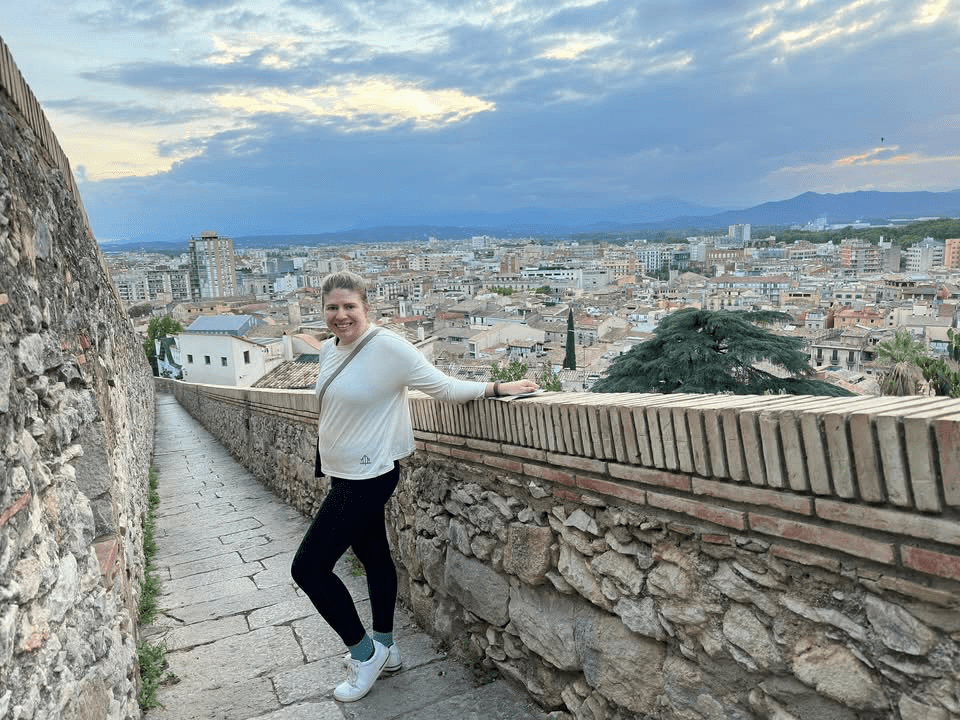
“To Thine Own Self Be True.”
”She just isn’t pretty enough.”
“She is too fat.”
”She’s too smart for her own good.”
”She dresses like a whore.”
”She is such a slut.”
”She is insatiable.”
They are the external voices a girl begins hearing even before she is able to speak herself.
The phrase, ”Oh, she is so beautiful,” is often uttered in a nursery.
Right alongside, “She’s such a chunk.”
And when she reaches for her first toy, “She’s so smart!”
Quickly a toddler is instructed, “Sit with your knees together when you are wearing a dress.”
”Keep that dime between your legs,” she is told as she approaches puberty.
”Women aren’t as sexualized as men,” we hear even from pop psychologists.
With so many societal perceptions hurled at a young girl, who ever has the opportunity to know oneself, much less be true?
Are we predestined to a particular fate, or should we, as Arya had done after battling her foe in Girona’s Jewish Quarter, be free to declare our own destiny?
As I followed my guide from one destination to the next in the waning light of Girona, for now I was relieved and thrilled to have a daughter confident enough to wander for miles in a town she had never visited, showing me marvelous bits of history and culture I would have never known without her help.
Independent, informed, decisive, knowledgeable, and strong. I couldn’t be any more proud of her and who she has become.
Start the Fire: Girona
September 20, 2025
We were the only occupants in the monastery, our footsteps echoing through the vast recesses of the nave, a reminder that the incredible edifices scattered everywhere across Europe were designed with two purposes: reverence and acoustics. Like many of its sister buildings, this one had been repurposed into a museum. We walked from exhibit to exhibit, and I absorbed absolutely nothing but the wonder of the architecture, which had at one point recently been filled with the accoutrements of Hollywood rather than the quiet whispers of the devout for whom it had originally been erected.
Girona had been revitalized by the influx of producers, cinematographers, goffs and actors. Even the Roman Wall now stretching for miles through the small town, a crumbling edifice before the Game of Thrones filming crews arrived, has been rebuilt, the safety features carefully, intricately hidden beneath the new but perfectly aged stonework. Everything had been touched, altered.
Walter Benjamin maintains that mechanical reproduction, whether through photography or film, separates art objects from its original ritualistic essence, yet the connotation remains. A head bowed in art whether from shame or prayer will always connote a measure of piety, whether it be represented in film as a momentary gesture of a villain plotting evil and looking at his hands as he cracks a lock on a safe or loads a cartridge into a gun, thereby alluding to his inherent guilt regarding his evil nature, or a venerated saint depicted on a wooden panel looking at a prayer book held in her lap.
Likewise, the lofty ceilings of the old abbey in Gerona converted into a museum, when depicted in Game of Thrones, became the backdrop for the god-like faceless man of Westeros. Yes, those same lofty pointed arches, originally designed by Romans for their basilicas where legislation and commerce was enacted with the approval of the god-descended Cæsars, eventually had been assimilated during the eleventh century by European kings who believed themselves to be appointed by God. And yes, the same architecture had eventually been adopted by universities, but only during the Renaissance as secular humanistic philosophy began rising to challenge concepts of sacred.
The same lofty design, always associated with god-like proceedings.
As Benjamin noted, reproduction of art through the mechanical lens of photography and film has taken the objects out of the hands of the church, but the separation of object from its original ritualistic aura may never be fully achieved. Society is perhaps too conditioned by centuries of tradition to ever fully change.
Likewise, racial, cultural and socioeconomic profiling, though never acceptable, has always been a prominent part of human civilization.
When Benjamin fled Germany, both he and his work were relatively unknown. Sure, he had successfully published a few critical articles in journals primarily consumed by academics who arguably have always been a bit too intent upon studying their own navels or the navels of equally erudite white men. He had even become a frequent lecturer and debater at the German Youth Movement meetings. He earned his doctorate and longed for a career in academia, but he didn’t have the financial means to do so; he had a short stint as an instructor at the University of Heidelberg, but his dream would never be fully realized in his lifetime, though his works now appear in numerous college and university syllabuses.
Benjamin, understanding the political turmoil mounting in Germany, fled to France, where in 1936 he penned “The Work of Art in the Age of Mechanical Reproduction,” a treatise recognizing the inherent political nature of art, arguing that mechanical reproduction would save art from being a useful tool in the hands of fascist regimes. As Jew, he would have been among those forced to don the six-pointed star when the fascists began separating and identifying different groups once the Nuremberg Laws were ratified on September 15, 1935.
Throughout European history, Jews were often confined to specific neighborhoods, whether through choice or legislation. They worshipped differently. They spoke differently. They conducted commerce differently. And the basic precept of Sabbath with its inherent laws regarding labor and worship encouraged isolation since they were allowed a limited number of steps one day of each week, so living near the tabernacles was highly practical, an isolationist lifestyle that made the onset of the Holocaust far too easy.
And because of their differences, they were despised.
During the late fifteenth century, Jews of the Spanish diaspora had been forced by King Ferdinand and Queen Isabella to take on the mantle of Christianity, forcing them to practice their traditions in secret.
This process has been repeated throughout history not just for Jews, but for Celtic Pagans, Vodou and Santería in the Caribbean and the Americas, Catholics across Protestant Europe, Protestants in Catholic Europe, Mayans among Catholic Spanish Conquistadors, Romani in Eastern Europe, Hijra in India. The identification of a specific class, race, religion who at one time may have been embraced or held in high esteem but who, under shifting political or religious movements suddenly became scorned. And history tells us how oppressed peoples use art to find solace and even safety: quilt blocks delineating safe houses, songs sings leading the way to freedom, nuanced paintings invoking revolution.
Mechanical reproduction has, indeed, separated art from its traditional domain, but not its power.
When my son was auditioning for acting school in NYC, as we walked into the Metropolitan Museum of Art, his gasp was audible. It certainly wasn’t the first time he’d stepped into a world-renown art museum. With me as his mother, he had endured (or even perhaps appreciated) the Art Institute of Chicago, Denver Art Museum and Georgia O’Keefe Museum. The gasp was because he had virtually fought terrorists in its halls that had been depicted so realistically he was able to guide me through the maze of exhibits to my favorite pieces without consulting the proffered brochure.

Video games, film, novels.
Fantasy, apocalyptic, action.
Whatever the genre, they are highly dependent upon accurate mechanical reproduction of art, whether depicted as ruins where treasures are to be found, where lost societies grapple with universal truth of what defines humanity, or where valuable objects are hidden to be protected: places and products of power, whether it be wielded for good or evil.
Is art powerful? Consider the controversy surrounding the rainbow colored crosswalk commemorating the slain patrons of Florida’s Pulse nightclub. That artistic expression has spilled into a federal directive that all governors remove what have been declared to be “distracting” hazards in spite of data stating that the brightly colored spaces have actually increased safety at otherwise dangerous intersections.
Power, indeed.
Powerful enough that political, spiritual, and economic leaders throughout the ages have done everything they possibly could to shape, control, and create it in their own image. Even if it does include pasting one’s mug on coins, the very thing that humans use in their daily survival transactions to artificially embed their likeness onto a magazine cover.
And artists likewise in all types of media hopefully will continue producing satirical representations of those hungry for power, regardless of the censorship or persecution they may encounter.
As our receding footsteps echoed through the pointed arches of the defunct abbey, I couldn’t help but wonder if we were being followed by any number of political or religious dissenters who had trod across the same stones we now walked.
If: Girona
September 20, 2024
72,000
That’s how many still images are in a fifty-minute television show.
If a picture is worth a thousand words, that means, well, that is maths far beyond what this broken TBI brain may conceive.
But let’s talk numbers for a minute or ten. When you watch a single episode of your favorite binging show, you devote 3,000 seconds of your life to it, which within each single second, you are inundated with at least 24 still images. That would be equivalent to 24,000 words.
No wonder today’s society would rather binge Netflix, HBO, Hulu or Showtime rather than read a book!
More maths. Streaming all eight seasons of Game of Thrones, for example, requires 4,214 minutes (thanks, Google), or 252,840 still images, or 252,840,000 words. In reality, the very long Game of Thrones novels are capped at only 297,727 words (thanks, Wiki). Since the average reader is capable of absorbing 238 words per minute, it would take someone approximately 1250 minutes to tackle the entire series of novels, or approximately 150-200 hours (I did not do that math; AI did, so don’t blame me if my numbers don’t add up). That means that the television series, which of course many fans report watching it anywhere from “a few times” to up to eight times (thanks, ChatGPT) has tentatively generated far more hours of absorption than the novels did. And for good reason since HBO, which vastly abbreviated the content of the books, has added so much more detail with imagery than what George R.R. Martin, or any other author, would ever dare attempt with words.
Any author who undertakes writing fiction has to weigh those statistics, especially since the “sweet spot” of words per average popular novel is capped at 70,000, a number, ironically, that corresponds closely with the still images contained within a single fifty-minute episode. So, by extension, if you have watched the entire series of HBO’s Game of Thrones, using the adage regarding pictures and words, you will have essentially absorbed the contents of 73 novels, not the five LONG novels that Martin has penned, especially since his longest, A Dance with Dragons, contains a mere 414,788 words (the length of six “sweet spot” novels).
“When do you know to end a chapter?” my sister asked when we were discussing my novels.
“When it is finished,” I responded, knowing that I had broken the cardinal “sweet spot” with the length of my first novel.
”A good blog entry has about 800 words,” my daughter advised me as I prepared for my #SummerofDiscontent journey from Chicago to the Colorado border (which ironically spanned 825 miles). Within a year following my first epic bicycle ride, my blogs had netted over 70K views.
I don’t follow that prescript, especially since the previous paragraphs trying to make a single point, that film is more popular than fiction for a reason, has spent over half my allotted 800 words. And my longer blogs here may explain why I haven’t garnered the same volume of hits. But I digress…
As I began writing my novels, #CompassOfKnives, I followed the suggested length for an “average” chapter in a novel, which corresponds with those contained in an 800 word blog. “You need to add more details,” my daughter suggested once she hit the third chapter of my book. “That’s what will draw a reader into your work.”
So as I revised my novel, I stopped counting words and concentrated on content, and my ride through England helped provide first-hand perceptions of the settings for my books.
Girona: a beautiful city of ancient walls, stunning chapels and a Cathedral, an otherworldly Jewish ghetto, beautiful bridges both aged and contemporary, a fascinating abbey converted into a museum, and the gateway to the Spanish Pyrenees mountain range.
Oh, and Girona is one of the primary sets for Game of Thrones. Hence my allusion to Martin (your Google search will save me about 800 more words).
Our train from Barcelona arrived some time in the afternoon, but because of the timelessness of Girona, our adherence to the hands on a clock seemed to disappear once we crossed through an amazingly old archway into a darkly lit garage to secure our rented e-bikes.

We had only what was left of the quickly waning day to eat and explore thousands of years of history.
As we travel, my daughter and I play a two-word tour game comparing one location to the next. “London or Paris?”
“Paris.”
”Paris or Barcelona?”
”Paris.”
”Paris or Girona?”
”Not a fair comparison since Girona is not as large as Paris,” my daughter noted, “though if we are talking towns, definitely Girona.”
This coming from a woman who in 2023 had slept in 192 hotels, flown 49 flights, taken 8 ferries, hiked 1 volcano and had visited 5 countries. In ONE year.
Girona is beyond description, though “delightful,” “beautiful,” “stunning,” “enchanting,” “magical,” “haunting,” and “mesmerizing” would be a great way to begin.
Perhaps watching a few seasons of Game of Thrones since film is far more detailed than fiction (or a travel memoir) would suffice.
And while you’re at it, follow me on FaceBook or Instagram where I am able to post more photos than this platform allows!
ii
Miles and Miles
Call On Me: Barcelona
September 19, 2024
Public Art. It ranges anywhere from monumental sculpture erected to commemorate a fallen hero to graffiti hastily scrawled upon a surface visible from a public space.
Often it is created by ordinary citizens for any number of reasons.
And it is powerful.
Barcelona possesses the most colorful streets I have ever had the pleasure of beholding. The brilliance Gaudí, Miró and Picasso birthed continues to spill into nearly every crevice, from brightly colored sculptures, architecture and murals to the shop windows calling out loudly to the despised tourists.
Some of the earliest works of art may have fallen into the category. The Prehistoric scrawls scattered in caves and upon rocks across the world were accessible to all (though arguably those contained in caves may have been restricted only to purveyors of whatever sacred rituals may have been conducted within the enclosed space, something only speculating theorists believe they know for certain).
I had spent much of my travel through England seeking the Bronze Age monuments erected specifically to convey a now lost purpose, but which, even in their historical obscurity, convey a single, silent message of power.
Earliest historic civilizations adorned both the interior and exterior space of palaces, places of legislation and temples alike with ornamentation to declare their power to all who beheld their kingdoms, utilizing both two and three dimensional art, creating such powerful dominions that historical eras are now defined by each kingdom’s distinctive style: Early, Middle and Late Egyptian; Ancient, Classical and Late Greek; Etruscan, Republic and Empire Roman; Early Christian; Early, High and Late Gothic; Early, High and Late Renaissance. You get the idea…
Pope Gregory I in the early seventh century proclaimed that images should be made specifically for instruction and edification of the illiterate, only to have images blackened two centuries later by iconoclasts who scorned ornamentation, a cycle repeated again and again throughout modern history.
Throughout the US, sculptures of Confederate Civil War generals sprang up beginning as early as 1870’s and continued to be erected throughout the entire Jim Crow Era, remaining smattered across the country as a subtle reminder of Pre-Antebellum oppression, many sculptures which had been removed during Obama and Biden administrations following the George Floyd protests but are now being considered for reinstallation.
When I packed a few suitcases and headed to Chicago to pursue my Master’s of Art in Art Education at the School of the Art Institute of Chicago, I had signed a lease in one of the high rises located less than a mile from the school. Because of my fear of heights, I had secured a studio with a fantastic view of the asphalt located one story below my window. But to me, it was a dream come true.
I had used my meager retirement to pay off the balance of my undergrad degrees, and had just enough left over to pay the application fee and the first deposit securing my place in the program. The federal school loan would cover tuition, and I had a freelance job producing content for an augmented reality app which yielded enough to cover rent and food.
A month into my first semester, the freelance gig ended.
I eked out the remaining year by working at the local Macy’s where I sold me-sized clothing in a department adjacent to a glorious Tiffany Dome. Not ideal since I was also carrying a full time load, but manageable. Yet when I handed in my key to my high rise and returned to Colorado the following spring with a Jeep loaded with the few items I had been able to cram into it, I fully intended not to return to complete my degree. I would find a job at a local community college with the requisite minimum 18 graduate credit hours necessary to teach.
My two youngest adult children had leased their own apartment, and they kindly allowed me sleeping space in the spare bathroom, which I shared with their two cats’ litterbox.
Not a single application netted a job, and by July, I was asked to return the cats’ bathroom to them. I left Colorado once again with nothing more than my suitcase, knowing that if I at least returned to SAIC, I could perhaps be empowered enough to secure another job with my relatively strong resume if my name had a few additional letters appended to it.
By Christmas, my dog (who had been brought to me by my ex when she had become utterly impossible to control and unresponsive) and I feasted on lentils. Not the most ideal food for an 86 pound canine, but sufficient enough to sustain her. Eventually, we discovered that packets of tuna were a wonderful, inexpensive source of protein, a discovery that has sustained me on many occasions since.
An art degree requires making art, and writing a master’s thesis requires hands-on research. But said art making supplies are NOT covered by federal loans, which is restricted only to tuition. So I turned to the only feasible possibility: conducting recorded interviews in art that was accessible to all; Chicago’s public art is abundant. And free.
My old fuzzy girl and I wandered the cold streets of Chicago using the same equipment I had used to produce content for the defunct augmented reality app: an old Canon camera my daughter had been gifted in high school which had video capacity and a small hand-held audio recorder asking people walking past public art what they perceived of it. Hands-on research with enough photos, video and audio to produce a ten minute piece of art. And a degree.
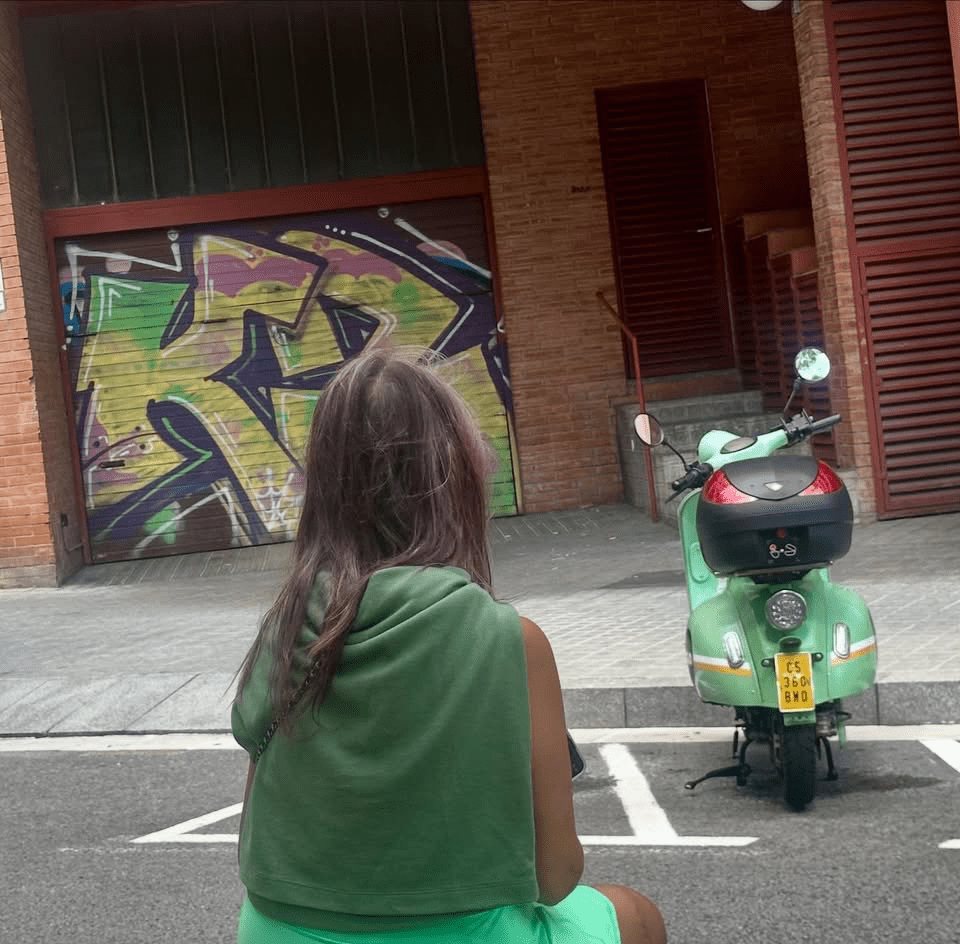
For a year, Public Art sustained me. No. It nurtured me. It distracted me and my very hungry girl from our growly tummies and gave me the extra four letters after my name.
And with those four letters, the camera, a computer, a down comforter, a few packets of tuna, a handful of acrylic paint tubes, a used bicycle from a rental company and a dog trailer, we set off on what became the adventure of our lives: our Summer of Discontent.
Public versus private: who truly possesses the streets and open spaces? Does Anish Kapoor have the right to all images taken of Chicago’s Cloud Gate since it sits in a public plaza? Whose art is it in public spaces: the government‘s, the artists or the people?
As homelessness across the world increases, legislating open space has become increasingly problematic. As of June 2021, it is illegal to erect a shelter on any public property in the city of Denver, an ordinance which paved the way for Democratic Mayor Michael Hancock to begin sweeping homeless encampments which entailed scraping the ground upon which they were residing with bulldozers early in the morning, causing sleeping homeless to scurry from their shelters as they watched their meager possessions being deposited into awaiting roll-off dumpsters. These types of traumatic sweeps, which were officially legalized by a 2024 SCOTUS decision, resulted in the death of an Atlanta citizen, Cornelius Taylor, in January 2025 when he failed to hear the encroaching heavy equipment moving through his encampment, not surprising since those who are unhoused often sleep near or under the busiest interstates across the country.
For four days I lived with a death sentence.
Not an officially sanctioned proposed by one of the most listened to voices in the United States.
“You really should watch it,” he encouraged me. “Just once. The Morning Show is informative, humorous and entertaining.”
My response will steadfastly remain the same. “Absolutely not.”
Entertainment. That’s part of the problem. Fox News isn’t news. When the network was first established, one of the first to break the power of the “big three” in the industry, they billed themselves as entertainment, not news. Somewhere over the past three decades, too many people have taken what has always been a Republican based network not just as news, but as gospel.
On September 10, 2025, the morning show host declared I should be euthanized. Or, as he put it, administered an “involuntary lethal injection.” Brian Kilmeade, without even so much as a moment of hesitation or a wince from the two other panelists on set, declared that “mentally ill homeless with a criminal record” deserved a death sentence. No due process (like far too many other people on American soil who are now considered “undesirables”).
Just “involuntary lethal injection.”
Three of my four lobes are permanently damaged from my traumatic brain injury: my cerebellum, which has affected my balance, motor control, spacial perception and vision; the left cerebrum, which has affected my speech, mathematic computation, emotional regulation, logic and reasoning, and right side motion; the prefrontal cortex, which has affected my memory, impulse control, and social regulation.
My traumatic brain injury, which included permanent damage to three vertebrae in my cervical spine, left me with a number of permanent disabilities: impaired vision, limited fine motor control, vertigo, limited spinal motion, loss of short term memory, and PTSD, to list a few. My combination of damaged cerebellum and spinal injury means I am unable to lift more than 25 pounds safely. My PTSD means when I am experiencing even low levels of stress, I struggle with word comprehension, word finding, and am no longer able to process information correctly nor respond to stimuli in a normal manner. My short-term memory loss means I will no longer be able to learn new tasks or information.
Because of my latter two disabilities, I am deemed to be mentally ill. I have been arrested for resisting arrest, a trumped up charge for which I had to plead “guilty” when my attorney bailed on me once he learned the judge and local law enforcement were intent upon changing my initial misdemeanor charge into something that could have resulted in a six month jail sentence (all because the cop believed I had scribbled on a ticket for driving with expired car tags when in reality I had just signed it with my normal scrawl). And I am homeless.
Check. Check. Check.
Involuntary lethal injection.
His words sent a very clear message.
Yes, Mr. Kilmeade has since retracted his statement, but it took him four days to do so, and the retraction came only after he and the network for which he works received pushback from the clip going viral. But the prevalent ethos remains, especially given that the administration had called up the National Guard in the nation’s capital tasked, in part, to conduct “sweeps” of homeless citizens, many of them veterans who for decades have actively lived in encampments outside of the Veterans Administration Building to protest the abhorrent benefits and medical conditions which persist regardless of which side is in charge.
As the concept of public space yields to that of private government domain, I can’t help but hope one of the single most effective forms of human expression remains powerful: public art.
Heal the World: Barcelona
September 19, 2024
”He that hath pity upon the poor lendeth unto the Lord; and that which he hath given will he pay him again.”
~Proverbs 19:17
“I am sorry,” my daughter said, “but the next available tickets are sometime in….let’s see,” she said, scrolling for quite some time, “late October, if I am not mistaken.”
She had asked months in advance what I wanted to see on my trip. I fully understood why she was able to pay for the second half of my journey. She possesses and amazingly acute, well organized and extremely focused mind. “ADHD,” she notes as an aside, “is rarely diagnosed in girls because it manifests itself differently.”
She had made a spreadsheet months in advance, listing hotels, restaurants, destinations, and google maps charting where we would walk and ride (all linkable). I had taken up her offer only on the day we walked over ten miles in London, and added a few “must see” in Brighton, relevant locations for my seventh novel in which Maria Fitzherbert writes a series of letters to her relatives in the United States. Other than that, I suggested we spend the time wandering the streets in each location just to discover the area on our own, an opportunity to immerse ourselves thoroughly in the locale, something that simply cannot happen while standing in hours-long queues with fellow American tourists.
Besides, living on a tight budget and knowing she was footing the bill had made me extraordinarily frugal. And I abhor being charged an entry fee into a Christian edifice built solely for the purpose of worshipping God, choosing instead to appreciate only the exterior. The modern-day ticket vendors would have been chased away by Christ with a whip!
After stumbling upon Gaudi the previous night, we decided that while in Barcelona, we should seek out more of his work. Park Güell and Basílica de la Sagrada Família, though, would remain inaccessible because tickets were impossible to acquire.
Many cross-generational immigrants, my family included, quickly step outside of their origins, neglecting the cultures from which they are most closely aligned. Antoni Gaudi was an exception, though his father disdained his ideology. Gaudi’s female progenitor had immigrated from France in the seventeenth century as a busker and by association would have been numbered among the reviled gypsies, embraced such extreme Catholicism he longed to be instrumental in building what I call a Second Chapter of Acts community: one organized around theocratic socialism. He would, if he were alive in America today, be considered a “radicalized liberal socialist,” something not usually mentioned cursorily in college art history texts, which too often emphasize form and function rather than delve too deeply into theory, that magical study which emphasizes the “why” behind the “what” of any subject.
Park Güell was never intended to be a public space, so the exorbitant ticket prices were not offensive. Gaudi’s crowning work, though, scheduled to be completed sometime next year, as a Basilica, which is specifically erected as a pilgrimage destination, should, as with any place of Christian worship per any number of citations contained within their sacred text, be free of admission fees.

A large number of Barcelona citizens, in addition to assaulting tourists by pelting them with water guns, have begun inhabiting vacant buildings. It boasts the largest community of squatters than any other city in the world.
Squatting. That’s essentially how England had been “settled” by the Romans, who would grant tracts of conquered land to centurions for their service. The second wave of squatters in the UK were the marauding Norse people, followed by the conquering Normans, which resulted in the merging of the Molyneux progenitor, Vivian, with the local clans people of Norse descent who had been inhabiting the area around Liverpool.
“To the victor goes the spoils,” the saying goes.
But in reality, it is squatting: claiming the conquered territory for oneself with the intent of tilling, building and protecting the land that had once belonged to someone else.
It is also the very premise upon which most of America’s West had been settled. “Forty acres and a mule” became the promise issued to newly freed slaves following the Civil War, a policy quickly retracted by Andrew Johnson, who went as far as demanding the property be returned to the white owner from whom the land had been taken. Individuals following the government’s “Go West, Young Man” and “Manifest Destiny” slogans had been offered 160 acres to anyone willing to occupy and farm it, resulting in over 270,000,000 acres being granted regardless of whatever claims the Indigenous Nations may have had on the land. The Homestead Act of 1862 opened a plethora of conflicts, exacerbated by railroad lines providing quick trans-continental transportation. The Indigenous Nations and tribes were pushed out of their sacred lands and onto reservations, an inhumane process which resulted in anywhere from 15,000 to 60,000, a number that may never be solidified because of inaccurate record keeping.
Vanlifers, though common throughout the UK and Europe, are as disdained there as they are in the US. We’ve chosen not to buy into capitalism, sometimes by choice, sometimes out of necessity. In my case, it is a combination of both. And I adore my lifestyle.
“Please make sure you mow the hill beside the driveway,” my ex told me one day. It was a small parcel of very steep grass separating my yard from the neighbor’s. When I first moved there, he had told me he would mow it because he liked it to be even with the rest of his yard. Since mowing for me was always a chore because my arm length isn’t commodious to a pulley system starter, especially since the ex insisted the 40 plus year old mower his grandfather had used in HIS yard was “a great mower,” I gladly rescinded the task. I understood why the neighbor would make the request since I rued undertaking it myself. “If he tends that section of the yard, at some point he will be able to legally claim it as his own,” an interesting perception since the neighbor rented and probably didn’t give two cents how far the property line extended.
So yes, the concept of squatting IS alive and well in the US. As a result, when I find dispersed camping on public land, rangers are always quick to remind me as I near the two-week limit rather than doing useful things like picking up the trash scattered by the weekend crowds. And yet under the forty-seventh president, on September 12, 2025, the Bureau of Land Management leased out more than 130,000 acres in Colorado alone while asking the National Guard to sweep Los Angeles and the nation’s capital of homeless encampments, threatening fines and imprisonment to any of the inhabitants for non-compliance.
We walked along the perimeter of Park Güell after pointing out to a concierge taking money beside a path, which in itself was somewhat questionable since the official website had mentioned no tours were available, that the public path we were on was outside of the fence and wound around one third of the hill.
The intensely devout and creatively genius Gaudí, as of 2025, has been declared “Beneficent,” but has not yet been venerated. Meanwhile, Pope Leo XIV has venerated a computer wiz, a move undoubtedly designed to reach the “digital natives,” those who have never lived without the existence of computers.
Yet the piety of Gaudí simply cannot be denied even when viewing the secular neighborhood he planned for Count Eusepi Güell; while very little of the intensely intricate piecemeal tiles decorating the space is visible from the perimeter, the three simple, unadorned stone crosses standing at the apex of the hill remain clearly visible. Christ, stripped of adornment and artifice is raised as a sacrifice for all humanity.
Redemption, grace, mercy, compassion, empathy, sympathy. Whatever your nomenclature, the message remains: it is something extended freely for all, not just those who are able to pay the price of admission.
My Way (Reprise): Barcelona
September 17, 2024
Lost in this mean world, jostled by the crowd, I am like a weary man whose eye, looking backwards, into the depth of the years, sees nothing but disillusion and bitterness, and before him nothing but a tempest which contains nothing new, neither instruction nor pain.
~Baudelaire
Nightfall on freshly cleansed city streets: utter magic.
”I am willing to research and arrange campsites for our bike ride,” I had offered my daughter when we had decided on our plan.
”Oh no. I’ve already contacted a bicycle touring company. They include hotels, e-bikes, breakfasts and a directional map. They also provide points of interest, historical summaries, and nearby restaurants along the route.”
Well then. I felt silly, given that I had spent literally MONTHS planning the England leg of my journey. But I also realized that my fixed budget would have never allowed such extravagance, especially since I was essentially touring England the same way I lived in the US: popping from one point to another, mapping my way based upon where campsites were located.
The hot shower after the downpour followed by a restful nap in a comfortable bed may or may not have justified my daughter’s expenditures.
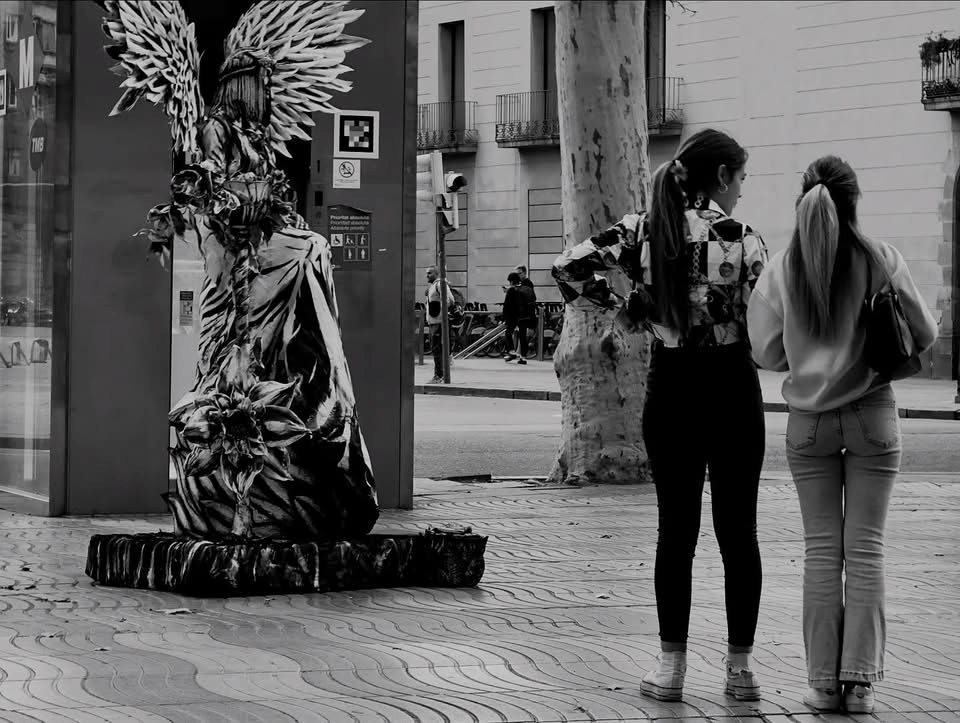
”Is this seriously the same city we ran through this afternoon?” she asked as we walked down a wide boulevard with inviting cafes sprawled between the lanes of sporadic traffic.
The black pavement and sidewalks, still drenched from the torrential rains, sparkled magically, reflecting long, brilliant streaks of red, blue and green on the small puddles, reflections of a bedazzling, lustrous reality creating an aura of surrealism: a reality superior to the luminosity of the lights themselves, an experience exclusive of human experience following the advent of modernity. The lights of nature, not even a flickering fire, could ever hope to shine as brilliantly as these luminous, nebulous images, allusive, ephemeral essences of which dreams or nightmares are made. The quintessential world of Miró, Picasso, Dali.
As we walked mile after mile with the rapid pace of a turtle through the streets of Barcelona, following first a laughing group of awkward, rebellious teenagers; a boisterous band of drunken footballers; then a quiet, aged couple: all indifferent, anonymous guides leading us aimlessly through sparkling avenues, where wesuddenly stumbled upon a single spectacle: Gaudi. He had accomplished in architecture what the puddles of rain had composed with light: bending, twisting columns, windows, doorways and balconies defying the laws of physics and gravity. Suspended matter outside of believable, conceivable space.
In the midst of the mist rising from the cool, drenched pavement into the sultry Spanish air, we discovered yet another slice of paradise: inexpensive yet ambrosious wine, tantalizing tapas and scrumptious paella. What a perfect way to leave behind the haunting chills and frustrations with which Barcelona had initially greeted us.
Thread: Barcelona
September 17, 2024
Her agile fingers reflected on the window of the train as I gazed out across the Spanish landscape. Since the pandemic, she always has any number of ongoing projects: woodworking, crochet, quilting, crossstitch, each for a different scenario. As we rode from Paris to Barcelona on a train exceeding 200 miles per hour, she concentrated on tatting, the one she reserves for travel because it fits nicely into a 3X5” bag.
There’s an invisible line drawn between craft and art. As I was growing up, “art” didn’t include dance, textile, printmaking, performance, music, photography, stonework or woodwork, and sadly that perception still remains prominent.
“Documents Por Artistes,” Eugène Atget’s shingle for his prints sold in his studio in the fifth arrondissement read. His work at the time, beautifully rendered dry-plate photographs taken across Paris, was rejected as art by critics. Printmaking was acknowledged as art during the Renaissance through the meticulous work of Albrecht Dürer. Woodworking wasn’t recognized until the twentieth century when George Nakashima received his accolades. Even the Parisian ballerinas depicted on Degas’s canvases remain relatively anonymous, though a search of famous ballet dancers now will reveal names from the seventeenth and eighteenth centuries. And it took Jackson Pollack to bring performative painting to the forefront.
My mother would sit quietly for hours concentrating on any number of “crafts,” diligently counting as she followed embroidery, crossstitch, crochet, tatting, knitting or cloth patterns, producing literally hundreds of embellished dish-drying cloths, dozens of quilts, and an undisclosed quantity of throw blankets designed with both one and two needles. In fact, during the last few days before succumbing to cancer, she continued pulling yarn through itself with her hook, producing a 4×5’ piece one sister quickly threw away following her death because she believed it to be a substandard example of my mother’s normally perfectly even stitch.
While walking through the exhibits at the School of the Art Institute of Chicago during my interview process, I was thrilled to see the emphasis on textile in any number of forms, including couture, needlework and other fiber arts, products that had previously been categorized as “craft,” the items exchanged like white elephant gifts during holidays that were produced by someone’s grandmother who was too poor to purchase “store bought” items. You know, the ones relegated to an old trunk stuffed away in a moth-ridden attic.
”Thread therapy,” my daughter calls it. A way to keep one’s mind distracted from things like refrigerated semi-trucks holding cadavers that lined the streets during the first few months of the pandemic. Or reports of “legal” immigrants being shipped to facilities in countries in which they have never resided. The news reports that eat at one’s soul so entirely that eventually you have to inure yourself when you are feeling overwhelmed and utterly incapable of doing anything to prevent the horrors surrounding you.
Desmond Tutu said, “If you are neutral in situations of injustice, you have chosen the side of the oppressor.”
Thread therapy isn’t taking a neutral stance. Thread therapy is what one does when one needs a respite from taking a stance. It is what one does after helping an immigrant complete the pages and pages of paperwork required to remain in a country in which they have lived and worked most of their lives. It is what one does when one finds oneself refreshing the FindMy app repeatedly when you have learned ICE raids have been conducted at schools, workplaces and courthouses when you know your adopted son and his family have all the correct paperwork but also speak Spanish as fluently as English and have helped both courts and employers alike with translation.
“You should have mentioned you are disabled when you first arrived,” the clerk at the DMV counter stated. I rarely use the benefits allowed me when I was declared to be disabled a few years following my injury. I have disabled tags, but I park in the shady parts of a parking lot, the ones usually located furthest from my destination because I also have to keep my vehicle cool for my service dog. I don’t mind the extra steps, but I also understand that there have been occasions when I a reeling from vertigo and have to take as few steps as possible. Or I need additional care navigating public transit.
This year, as always, the line was long, and the autumn temperatures have been higher than in the past, so as I stood waiting, I became anxious that the shade had not been enough. When the woman emerged to remind people of the new changes, “We cannot renew tags any longer. Please have your title and identification ready. If you need a driver’s license, this is not the correct location…”
Like a diligent student, I raised my hand to attract her attention. “I will answer any questions once you reach the check-in desk,” she noted the first time. An hour later and 15 degrees warmer, after she had given her speech, I blurted, “I am disabled. Last time I was here, I was told to mention it to speed the process.”
“We no longer offer that service,” she responded abruptly.
”Empathy,” a noted political activist recently observed, was “made-up, New Age term.”
”Empathy,” someone once noted, “is not a Biblical concept,” undoubtedly reflecting the ethos of the influencers with which they were most likely politically aligned.
”Empathy,” according to New Oxford Dictionary, is “the ability to understand and share the feelings of another,” and is an early 1900 term translated from the German term, “Einfülung,” which is derived from the Greek word, “Pathos,” a very Biblical concept.
I stood waiting for an additional 30 minutes, and when I reached the check-in desk, the woman apologized. “Yes, we do make considerations for disabled. But I am sorry, I was unable to say that with the crowd. Nowadays you never know how people will react,” she added sheepishly. “Next time, just come straight here. Avoid the line entirely,” she advised.
I thanked her on my way out five minutes later.
Navigating Barcelona public transit once we arrived was hellacious in spite of the numerous travel advisors who praised the system. My daughter and I have conquered Chicago’s El, New York’s subways, DC’s Metro, London’s Tube, and Paris’s RER. But Barcelona’s signage, with its ubiquitously pointing arrows, bested us. Or I should say “her,” because I wouldn’t even begin to navigate it after the nightmares I had experienced in England.
“Perhaps you are always dehydrated,” my sister had offered, attempting to explain away my random onsets of vertigo.
“I have never seen anyone drink as much as you do,” my daughter had observed at breakfast the first morning we were together. “Nor pee as often,” she added with laughter.
As we stood in a queue for yet another ticket line, I sheepishly said, “Um…do you see a bathroom sign anywhere?”
She is aware of my limitations and knows I am able to walk long distances, but not endure noisy crowds or overwhelming visual stimulation. As we stood in a queue for yet another ticket line, I sheepishly said, “Um…do you see a bathroom sign anywhere?”
“There,” she pointed, “but what if I am able to get the tickets we need before you return?” she challenged.
An hour and several entrances and exits through turnstiles each requiring us to pay an additional fare, she called it. “We’re only a few miles away from our hotel,” she said, and before she was even able to complete her thought, I headed toward the exit. Without making a stop at the bathroom, which had an equally long line.
”Uh…..I think it is going to rain,” I said, looking toward the sky. “Yep,” I added within seconds as the concrete became spotted with large, dark circles. “We can do this,” I offered, stepping into my “shmuffle” speed, a weird running gait that takes my post-morbid canter up to the “normal” walking speed of 3 miles per hour.
Rain and a full bladder are never a good mix.
”Wait. I can’t keep going,” I shouted, dashing under an eave to gain control. “Ok. We’re good,” I would add a few seconds later, a sequence repeated numerous times as we wove our way through the rain-drenched streets. “We could always buy an umbrella,” I kept offering as we dashed from one touristy shop to the next.
”No, we’re almost there,” she reassured me, offering at the same time to call an Uber, which elicited the same response from me. By the time we arrived at the hotel, we were drenched. And I had to dash up a flight of stairs to finally find relief. Still, in spite of the torrential downpour and full bladder, I knew that if I had remained in the Barcelona station any longer, I would have been unable to function for quite some time because I had been on the brink of yet another PTSD episode. I will take mile after mile in pouring rain with a full bladder over that any day.
Empathy, compassion, sensitivity, awareness, love. All of the adjectives come out of the simple prescript, “Love thy neighbor” that have become as blurred as the zooming Spanish landscape viewed from Europe’s HSR… No wonder we need to indulge in a bit of self-care through thread therapy.
Sitting At the Dock: Paris Seine
September 16, 2024
We dashed along the Quay speedily toward a single destination: a spur of the moment architectural cruise along the Seine. It pained me to rush past the vendors hawking used books, prints, art and vinyl as they have done for centuries, but as I wrestled with Phyrge with our baguette poking obtrusively above his tower, I knew I didn’t dare indulge in my impulse.
“Bella,” a woman gestured as we passed, waving her hand along her body, adding hastily spoken words we were unable to catch as we hurried along.
As we continued hastily toward the dock, my daughter exclaimed, “Your style just received praise from a Parisian woman!”
We’d managed to nail both conversation and style in a single day, astounding since I wore a hideously bright neon green skort covered with a periwinkle bohemian jacket, topped by the neon yellow beret and accessorized with my burlap Phryge bag and ecru sketchers.
“I snagged them,” my daughter informed me, “but we’ll miss sunset. The cruise begins at 9, so it will be a late night.” Her interwebs prowess allowed us to slow our pace, but the vendors had already begun securing their quaint wooden carts. Her acumen, though, also allowed us to return to another one of the thirty seven Parisian bridges spanning the Seine to snap a few more photos.
We arrived at the dock and indulged in our third espresso of the day, this time requesting decaf, which elicited a smirk of scorn. To assuage the ire of the garçon, she also requested champagne, which I watched her drink with envy. My motion sickness has always haunted me, so I dare not indulge in that desire either, especially since my traumatic brain injury doesn’t play well with alcohol.
When she and I had visited Paris years ago, I had begun throwing up as soon as the plane had landed, so while she and her classmates floated along the Seine at about the same time as our tour was booked, I had wandered aimlessly through the City of Light, stumbling upon a number of historic locations. Since I seek steeples, Paris, La Ville aux Cent Clochers, satiates my deepest longing, and my fascination with American author Dan Brown prickled my spine as I stumbled upon Église Saint-Sulpice, then ten minutes later upon Hemingway’s Les Deux Magots, a very Woody Allen Midnight in Paris experience years before he directed his film, which, when released, made me shelve the first novel I had ever written since I had never bothered to complete it, though the opening scene in which a disgruntled modern artist standing in the shadow of Notre Dame while clutching a rosary as she flings a cigarette into the Seine may yet weave its way into my pages yet.
A group of young adults approached the restaurant at the dock, their clamor entering the space long before they did. “American,” I said to myself before their discernable conversation disclosed my assumption to be true.
“Kids these days are so disrespectful,” I had heard years ago as a teacher, criticism that only evoked a sly smile from me. I had adored my students….all of them. The quiet “bookworm” huddled in the corner lost in whatever travels he or she encountered on the dog-eared novels and art theory books that they had gleaned from my shelves stocked with my personal library; to the misfit stoner jamming either rap or heavy metal; to the sassy students who had the courage to defy and question me when they disagreed with whatever material I happened to be presenting. Personalities that now grace the pages of my novels.
At some point or another throughout my own educational experience, I have embodied each of these students, and I never found the safe space I longed to create in any of the numerous classrooms I encountered during my highly transitory formative years. My classroom had been formulated around the theories of Locke, Rousseau, Mill and Dewey, later upcycled in the writings by bell hooks and Paulo Freire, works too many educators seem to have overlooked while working toward their own certification.
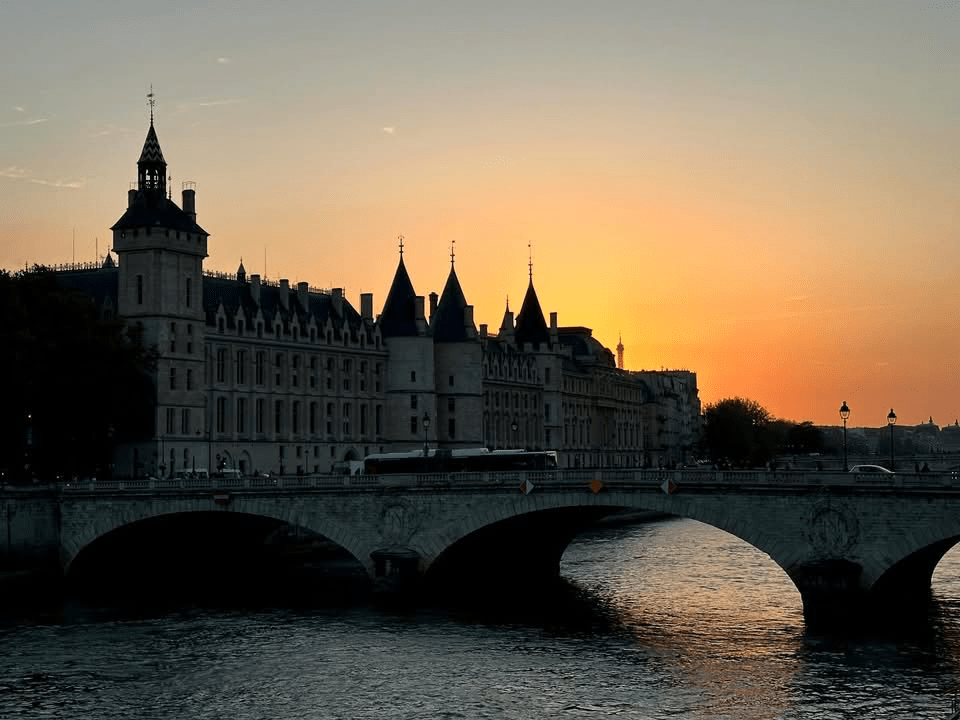
”I think you need to read Harry K. Wong,” my first administrator instructed me after only a week in the classroom. He had come across my students marching through the halls stepping in rhyme to “Twinkle, Twinkle,” the perfect way to internalize tercet cadence in poetry, a skill that would later bolster my students performances in the standardized testing.
I did. I read Wong. And I immediately disregarded every word he wrote. My classroom emphasis on multiple learning modalities meant I allowed students to hand in class notes that featured doodles rather than words, encouraged students to either pace or listen to music as they read, and even encouraged them to drink a specific beverage or wear a specific scent as they studied for an exam to encourage learning that stimulated all five of their senses. I embodied each one of the “types” of students often scorned by educators specifically because of my transitory lifestyle. I learned very early that learning is difficult when the hunger pangs strike, when you are worried about whether or not your older brother who would later serve a life sentence for sexual assault on a child would be the only one home to greet you after school, when your older siblings have gone missing because they ran away from the physical and emotional abuse, when you were unable to complete homework assignments because you couldn’t afford the materials required, when your thirteen year old best friend had just attempted suicide because she had been disgraced by the church for aborting a child her cousin had implanted in her.
Those are the outside noises that rumble far louder than the Charlie Brown teacher “wha-wha-wha-wha” droning that too often echoes through the sacred Ivy Towers of education.
As the Americans lined up at the bar, ordering their cheap beers, their vinegary wine, or their flat champagne, I smiled, knowing that a century earlier, two young Americans who had just failed college boisterously meandered the same quay, even riding a stolen tricycle under the Arc de Triomphe in a drunken escapade, but would later go on to pen some of the most beloved American “classics.”
My daughter and I floated down the Seine, quintessential tourists, in a city we both adore, thrilled as we gazed upon the scaffold-lined Gothic Cathedral, photographed the underbelly of a number of famous bridges, and “ooohed” and “aaahed” as we took a poorly composed selfie with the glow of Eiffel’s illuminated masterpiece emerging out of our heads like an antennae.
The long meander along a darkened quay smelling of piss and pollution well after midnight fueled our imagination and piqued our wont to wander.
No One’s Ever Gonna Keep Me Down: Paris Sunset
September 16, 2024
The charm of a Parisian sidewalk cafe has endured for centuries, and strolling along the Seine is a quintessentially Modern experience. Once we left St. Chapelle, we took advantage of the tour of Palaise du Justice and the Conciergerie, glorifying in the gory details of the Revolution, admiring the altar where Marie Antoinette muttered her final prayers before losing her head for suggesting cake.
We’d stopped at a delightful shop in the Second Aggrandizement and stocked up on the requisites: freshly baked bread, figs, dates, cheese, wine and chocolate, excited that since we were traveling by train, we wouldn’t have to worry about customs. As we walked next door to the cafe for our second round of espresso for the day and a delightfully decadent cupcake, my daughter looked at me and asked, “Did we really just do an entire transaction, complete with flirtatious repartee, in French?!”
She had studied it in high school, which was the reason we had traveled to Europe with her classmates when she was a senior, then added Latin in college. I had trudged through it in college, and like her, had added a dose of Latin as well.
We settled onto a bistro set with our goods with a side of a wonderful hour of people watching. We’d learned in Brighton one of the added perks of Molyneux Miles is an extra shot or two in the afternoon helps stay away throughout the evening. Extra calories and coffee: WIN WIN!
“I want you to walk at least thirty minutes each day and write a journal entry,” my Humanities instructor assigned us on our first day, a task so enjoyable she shaped my future assignments to my own students, my master’s thesis, and all of my published writings. Throughout the semester, she introduced us to Dorothy Wordsworth’s Journals as well as Baudelaire’s concept of the Modern Flauneur. “Unfortunately,” she added with a smiling grimace, “in spite of Dorothy joining her brother William and Samuel Coleridge on their long treks through the Lake District as well as their walk along Hadrian’s Wall, Baudelaire, harkening to the walks of the Romantic Poets, confined his concept of Modern people watching specifically to men.
A Flauneur is a dandy, a man of wealth who passes his hours leisurely, nonchalantly consuming human nature from a philosophical and artistic perspective. While I don’t fall into the first two categories, my millions Molyneux Miles have definitely yielded hours spent in the latter reverie.
“Who is your audience?” my daughter challenged as we sipped our espresso. She has agreed to be my first reader, a daunting task since my first novel, with its 348 pages, is the shortest of them all. She had served as my editor when we had worked together for an augmented reality app, a unique switch in roles given how often I had helped her with her writing assignments in elementary school. Initially, she had been apprehensive that her criticism would make me bristle, but after learning I am truly one who always enjoys learning, whether the lesson be taught by a student or one of my own children, she felt free to point out when I would slip into overly pedantic language or had made a simple but frequently repeated error with my punctuation. The switch in roles early in her own career, I believe, provided a comfortable albeit painful switch when she had become my primary caretaker after my injury, a role she still plays, but with less interaction.
”Even though that was one of the first things I would ask of my own students, to be honest, I have never had a specific audience as I write. Ever. While working in academia, as a non-trad student, I developed a rapport with my instructors, so I literally wrote as though I were carrying on a conversation with them,” I admitted sheepishly. “Anything I have done since then, I feel as though I just record conversations that occur in my own head,” I added.
”That should be your first step,” she responded, and I couldn’t help but smile to myself, identifying how she had echoed me in class.
In addition to having easy conversations, she and I also enjoy quiet gaps. After several minutes, I added, “Girls like you who have met with criticism for being ‘too opinionated’, ‘too strong’, ‘too stubborn’, or ‘too independent’.”
”Too broad,” she challenged, the pun lost somewhere in the serenity of the moment.
”Perhaps, but I want girls of all ages to understand, as you did when you were young,” I added, glancing affectionately toward her, “that strength, whether physical, mental, emotional or intellectual, is NOT detrimental, nor should it be the object of scorn. Too often women are made to feel inadequate because they are not inadequate enough for the men who wish to dominate them.”
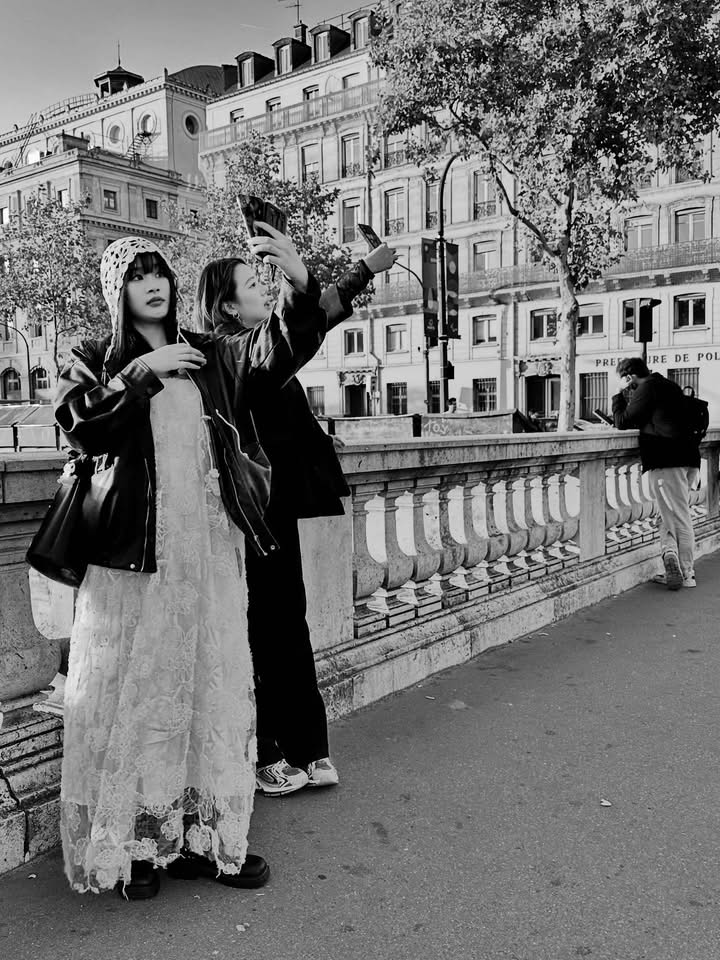
”Makes sense,” she responded.
”After learning of the witch trials, and what type of women had been castigated,” I added, “and knowing that at Pendle it had been their own relatives who had eked out the punishment, I knew exactly what kind of heroines I wanted to fill my pages.”
As she fell into silence again, I couldn’t help but wonder if the voices that had echoed across time, from her third grade principal to her substitute teacher in high school, the criticism offered to a young girl that may or may not still bear a few scars from their harsh words.
The Flauneuse: we finished consuming both culinary and philosophical repast, we began a slow meander along the Seine with our leftover fare tucked under our arms. As the paper bag sagged and tore, we quickly realized we would have to play tourist and purchase a tote from one of the street vendors. Since the Seine had recently been cleaned for the first time in centuries as Paris prepared to host the Olympics, our choice was easy: a bright red burlap with an equally bright Phryge standing proudly in front of Eiffel’s masterpiece. As an afterthought, I reached for an equally hideously bright yellow woolen beret, momentarily saddened that they didn’t offer a raspberry one. I slammed it on my head and stuffed our baguette, wine, chocolate and figs into the oversized tote.
Yes, we screamed “tourist,” but in a city lined with them, we were comfortable assuming the role, especially with the added buzz of knowing we had successfully made our transactions without seeming like we were among them.
While the sun began to paint the water gold, we crossed Pont de la Concorde with the echoes of “Liberté, égalité, fraternité” resounding along the stones repurposed from the Bastille, quite certain we had a glimpse of a few ghosts sporting their red phragerian caps, led by a bare-breasted woman weilding her tri-colored banner, spurring along the angry rioting mobs who had the courage to tear down the oppressive régime.
Viva la France! Viva la Révolution!
Winding Road: St. Chapelle, Paris
September 16, 2024
Sometimes life unfolds in the most unexpected ways.
I’ve explored Parisian cafes, markets and quays three times so far, and I fall deeper in love with it each time I go.
One of my favorite lessons as an art history and humanities instructor spanned the Gothic Era, specifically because of my love for stained glass, yet I hadn’t ever visited my favorite site, the ”little jewel box” of Paris, St. Chapelle. As we moved from London to Spain so I could continue my European E-bike tour, my daughter and I had less than 24 hours in the city, and we found ourselves standing in a queue for three hours anticipating the visit.
The couple standing in front of us, ironically, were from America, and happened to be a father/daughter combination. The daughter happily joined in conversation, explaining how she had brought her mother to the same site a few years ago, and that since her mother had recently died, she wanted to share the experience with her father as well. He stood apart, reticent and recalcitrant, expressing absolutely no excitement at the prospect of seeing one of the most remarkable works of architecture in the world.
”You know what they say about teachers,” he mocked when we first met. “Those who can’t….”
I have met with the words often, and I acknowledge the truth. We often “can’t” practice what we teach because we are so overwhelmed with preparing lesson plans and teaching the material we are unable to develop our skills on a practical level. Making art is challenging when ten hours each day are devoted to monitoring overly large classes, not to mention the hours each evening and weekend assessing the work of the students.
As a college instructor preparing art, humanities and English lessons, my days were long and arduous, and every time I would assign a new project, whether it be journaling, writing an essay, reading literature, or researching and creating art, I would cringe knowing that I required my students to do something I had not done for ages. Once I began teaching, I rarely had time to even read a novel, which is why when my college suggested campus-wide reads, I gladly took on yet another mantle, choosing books, both fiction and non-fiction, that I had not yet had the opportunity to read.
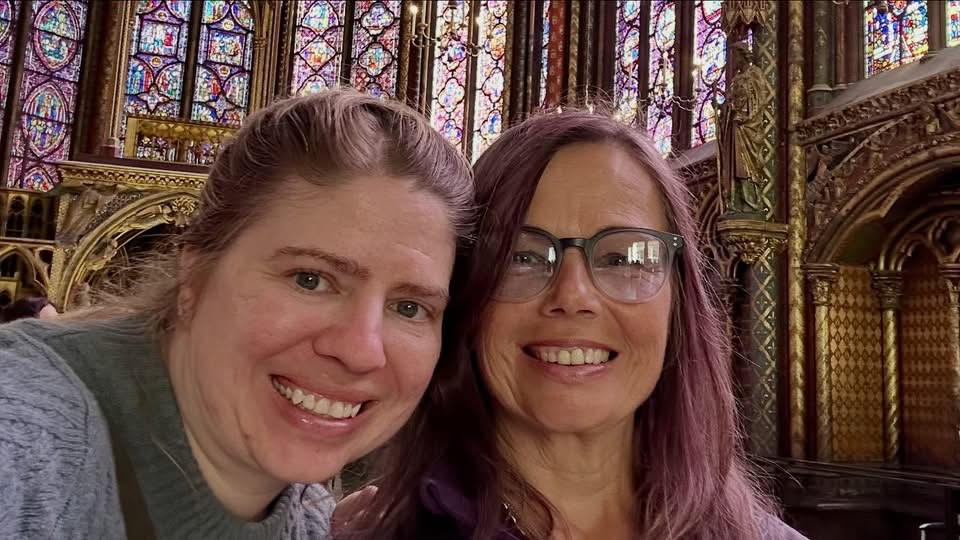
One of the “hobbies” I had listed on my resume down. Four more to go….
Aphorisms: pithy, short sayings conveying a universal truth. Social media is rife with them, except now they are called memes. And the universality of worms, knowledge, horses, covers and pennies arguably may no longer be relevant, especially since a recent decree by the US that one of them may no longer be minted.
What turned out to be my last year behind the lectern I vowed to revive all of my hobbies, and the time spent creating alongside my Art Appreciation students would unexpectedly become the art contained within the portfolio I submitted to the second most prestigious art school in the United States: School of the Art Institute of Chicago. Although I had begun the application process the summer before my last year in the lecture hall hoping to leave my position in exchange for a different title altogether, because my relationship had fallen apart, I hadn’t taken the opportunity to actually submit it. The week following Spring Break when I received notice that my position had been eliminated cemented my decision to finally press “send.”
For the past decade and a half, family vacations had been comprised of visiting the Windy City, usually for any number of reunions or church conferences attended by my husband. He united while my children and I wandered, walking mile after mile through the bustling streets and along the crowded lakefront. The first time my youngest son looked across the city from the heights of the Sears Tower, as a four year old in my arms because he had expressed fear of the vastness spreading below him, he whispered in my ear, “Mommy, someday I am going to make sure you can live here.” I knew from that moment on Chicago was my destiny, and a few years later when we visited the Art Institute, accidentally seeking the wrong back entrance when the front one was closed for some reason or another and we attempted to walk through the doors leading to the classroom side of the building, I vowed to include the Institute on my educational resume.
Chicago was mine by decree.
“A person susceptible to ‘wanderlust’ is not so much addicted to movement as committed to transformation.” — Pico Iyar
While earning my master’s degree there, we were introduced to a number of “new” educational approaches, including place-based learning, democratic classrooms, and TAB, teaching for artistic behaviors.
“I am glad you actually create,” a cohort told me after one of our presentations in which we shared a lesson plan unit accompanied by our own work of art based upon the lesson, “compared with any number of macaroni art we saw over the past few class periods.” She was correct, which given the prestige of the school was a bit astounding. But I also reminded her that I had been immersed so thoroughly in educating and had neglected my own art making that I had been shocked to be accepted into the program at all. Once I began teaching, I utterly overlooked the fact that I was an artist or author.
But since I had been an educator for over a decade, the “new” approaches in education were ones I had already employed in the classroom.
”Not all who wander are lost” — J.R. R. Tolkien
Keeping students engaged may be challenging, and approaching it from a rote perspective inevitably leads to failure. Involving exploration within a student’s surroundings, the basic tenet of place-based learning, encourages community involvement, creating a dialogue between students and those who share their surroundings, which our campus had enacted by inviting the community to participate in the campus-wide reading program. Additionally, my students often would explore the areas around campus to derive inspiration for their own art practices.
My novels, though, adhere more closely to the Romantic ethos, “Any where but here, any time but now,” and I wrestle with my decision to embark on eight novels which are a far cry from being “place-based” since six of eight of them are set outside of the country in which I have lived my entire life.
“The world is a book, and those who do not travel read only one page.” — St. Augustine
As my daughter and I gazed up at the glints of colored light passing through the jewel box surrounded by dour saints gazing upon the crowd with judgment, we understood the three hour wait had been worthwhile. Two of my three trips to the “City of Love” had been a specific result of being an educator: once conducting research for my theses at the University of Colorado and once as a chaperone with her classmates.
Although some may believe “those who teach, can’t,” I would respond, “those who teach, do.” And the doors, even the heavy ones revealing heavenly wonders, that are opened by education lead to immensely vast horizons.
”Live your life by a compass, not a clock.” — Stephen Covey
Easy: Brighton
September 15, 2024
The early morning sun was warm and welcoming, but not as welcome as the espresso.
“Brighton,” my daughter had warned me, “has a poor reputation. It is dirty, crime is high, and it is kitschy. But then again, England is still deeply enmeshed in aristocratic-based classicism, so who knows what it is really like.”
In truth, the seaside town has always been exactly that: a seaside tourist destination point that was far enough removed from the conservative, prying eyes of the aristocracy that my distant cousin, whose marriage would never be recognized by England’s governing body even though it had been consecrated by the Pope, felt quite at home, retaining her residence there long after her marriage to the Bonny Prince had crumbled. She loved him, in spite of his womanizing, in spite of his adherence to familial pressure, in spite of abandonment.
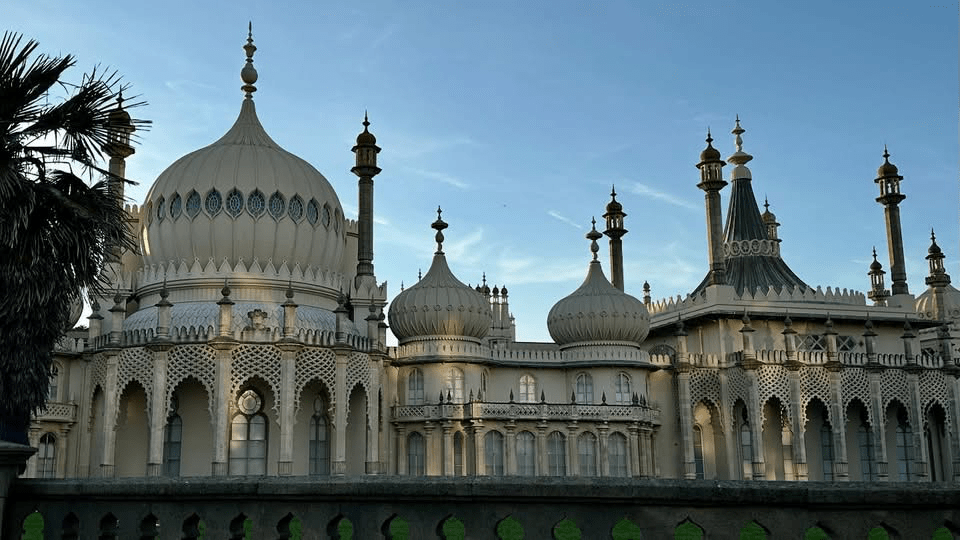
And, upon his deathbed, clutching the cameo of her face in profile and willing all of his earthly possessions to her, he declared his undying love for her.
Perfect scenario for a fairy tale, right off the pages of a Disney script. Or, in my case, the plot of my seventh historical novel.
He was a dandy, a hopeless narcissistic rake, and she was the devoted wife. Yet history is far kinder to him than it has been to her. But of course that’s the case. He became king. Of course he has monuments erected in his honor, whereas not even her long-time residence or the Catholic Church she attended and is buried bears a plaquard indicating where she had lived out her life.
Since my daughter’s arrival, I had the opportunity to play the role of tourist, and the empty streets provided a unique opportunity to people watch on a limited basis.
“We have New York City to ourselves,” my eldest son had observed when he and I had made the journey there so he could audition for acting school. That was the first time I had learned the best way to experience what tour guides for centuries have identified as “the back door” to an otherwise over-commercialized, industry-driven experience. The tourists are sleeping off their indulgences while the locals grab coffee at their favorite cafe. Or, in the case with my son, while the actors are able to meander the streets without fear of being mauraded by overly exuberant fans. “Um….mom, was that who I thought it was?” he asked after we had passed THE Pirate of the Carribean, who, unlike the drunken tourists the previous night, was walking perfectly normally without his characteristic drunken swagger.
My daughter and I had hit all the requisite sites for my research the previous night in another mile-dense whirlwind, leaving time to follow our noses to a local dive after sunset, where we stumbled upon the best Indian cuisine either of us had ever consumed, and from the sheer pleasure of the exquisite fare, we left a handsome tip in spite of never receiving several items we had ordered (and paid for).
We’d taken the same approach to our morning coffee, where we were able to watch a cantankerous favorite customer juggle his boxer and his breakfast, a trans decked in glorious rainbow tights, and a free-spirited hippie glide along in her flowing skirts and sandals past a pink cow while sipping my second scrumptuous cuppa in just over two weeks.
“I want to be just like her when I grow up,” I informed my daughter as the witchy woman jaywalked across the empty street. “Sadly, I am probably more like him,” I noted wryly as the grumpy patron walked out of hearing. Both London and Brighton had been vibrant, with rainbow flags flying above many businesses. “I wish the US had the same welcoming aura,” I noted after the trans left a trail of feathers from her bedraggled boa. “They are more accepting of uniqueness than we are, in spite of being bound by patriarchal-based monarchy,” I observed as Monte Python’s tune, “I’m a lumberjack and I’m ok” echoed across the decades through my brain.
Maria Fitzherbert is an interesting character in history. As with many women entrenched in patriarchy, particularly from a family with money and title, her first marriage was arranged but left her penniless. Her second marriage, shortly after she had become widowed the first time, brought her nearly the same end since both times the estate went on to a distant male heir rather than to the surviving widow. And her third marriage, the only one she entered because of love, was a life-long entanglement with a worthless womanizer, one she was never able to let go.
One should always take the opportunity to travel with their adult children. It’s a beautiful time to reflect on what an amazing job one has done as a parent: conversations, or in my case, the easy silence of a secure relationship, is very life affirming. Since my injury, my youngest son has accompanied me on long backpacking trips and bicycle rides, patiently enduring my slug’s pace, helping me work through my physical limitations on a very practical basis. My eldest has challenged me intellectually, discussing anything ranging from politics to philosophy, from art to music and literature, rebuilding and redirecting the mis-firing synapses that had been damaged. And my daughter has introduced me to Mediterranean, Ethiopian, Spanish, Indian and Cuban cuisine, and she and her college friends took me to my first drag show and Pride Parade, helping me accept the concept that “Love is love is love.”
Perhaps England’s patriarchal aristocracy isn’t as staunchly conservative as they make themselves out to be. After all, a string of kings who have possessed the throne have had lovers, both female and male, and the dear King James Version of the Bible was commissioned by the king as penance for his relationship with Robert Carr. The aristocracy feigns conservative values, or, like many others throughout history, have feared heavy retribution for not complying with societal norms.
A Thousand Years: London
September 14, 2024
We stood beside his monument in the setting sun. A dog hiked his leg and pissed upon the monument, undoubtedly marking his territory where one of the transients sleeping in the nearby garden had pissed the night before.
While serving as regent during the prolonged periods of his father’s madness, he had derisively been referred to as “Prinny” in newspapers, pamphlets and literature alike, a deeply disdained figure for his wonton lifestyle. He peers down upon visitors to the Palace he had erected, in part, to woo his first wife back to him after marrying another, a distant cousin, a union made by his parents since his first marriage had never been recognized. She had refused to speak to him after his second marriage, opening the lines of communication with him only once his first wife had died and the Pope had confirmed their Catholic union to be valid, a decree never acknowledged by the mad king or his wife.
His monument, where he looked down disdainfully detached from those peons passing by, was erected years after he died, a token of how one’s reputation is more likely to be represented favorably once the generation who has experience both the bad and the good has also likewise died.
The white domes gleamed gold in the setting sun, tinging everything around it with the same rich glow.
Unlike Stonehenge, though, I was surprised by its size. It was far less imposing than I had imagined it to be, and the gardens, strewn with litter, feces, weeds and drunken homeless, were not well kempt.
“Impressive,” I had texted my daughter when she sent the link to the multi-tabbed spreadsheet outlining our itinerary. She had requested a list of places I wanted to visit around London and its environs, which freed me from spending an extra day exploring the city on on my own.
”I have a few coworkers I would like to catch a meal with, so I want to spend at least a day or two in London before we leave for Spain for our bike ride,” she informed me. “But my days are free, so we can spend the time wandering the city, and since my first day there will be ruined by travel anyway, we may as well plan a night in Brighton since it is less expensive.”
She is quite familiar with Molyneux miles, and in fact actively engages in them herself, often grossly miscalculating how long of a walk it is to her favorite neighborhood restaurants. So she knew what to expect when she made that generous offer.
The spreadsheet included maps of Brighton, London, Barcelona, links to all the hotels she had booked, additional suggested stops along our journey, and a few restaurants she had discovered while researching each of our destinations.
After doing the obligatory walk past the palace, we spent hours wandering along the seashore, walking the quaint Victorian streets, and indulging in the best Indian cuisine I have ever enjoyed, passing the most pleasant few hours I had spent since arriving in London two weeks earlier.
The protagonist of my seventh novel had wandered centuries earlier seemed to linger everywhere we turned. I had been searching for my familial roots throughout my entire journey, and now I felt as though Maria Fitzherbert at any moment would step out of one of the small but expensive cottages, stretch out a gloved hand, offer me her calling card, and walk away with her luxurious silk bustle rustling softly in the warm glow of the gas porchlights.

I hadn’t found her ghost in the shadows of Coleridge’s Pleasure Dome, but in the quiet recesses where she had lived well after her third husband, King George IV, had died, surrendering the throne to a very young Queen Victoria.
As we meandered, I relished the fact I was able for the first time since arriving in England to appreciate where we were rather than stressing over where I was going. I could feel the tension in my body releasing with every casual, unhurried, unplanned step I took, fully absorbing how substantially the burden of Matilda had weighed upon me. Finally I was able to bask in the wealth of my research experience.
“We’ve crossed off over two thirds of my list, and the ones remaining I honestly can’t recall why I wanted to see them,” I told her on our third full day in England.
We’d snapped selfies at Traflagar, where the crowd was so overwhelming I had grasped her arm as we walked up the long flight of stairs. We’d passed Buckingham, accidentally walking away from the Palace rather than toward it because Google is as cruel to those who are attempting to use her near me as she is to me. And we had indulged in Five Guys hamburgers on the steps of St. Paul’s. We’d visited numerous destinations: Mayfair, Park Street, Hyde Park, Kensington Gardens, Temple Church: all locations included in a number of my books, sites rich in history, art and lore.
”We have walked more than ten miles, though by the time we return to the hotel, we will add a few more,” she replied without even the slightest hint of malice. “I’m up for just wandering through whatever we may find as we go.”
“Huh,” I exclaimed as we turned a corner in a lovely neighborhood lined with charming boutiques. “If I am not mistaken, this would be Covent Garden,” I noted right before we saw a sign confirming that was precisely where we happened to have wandered, the final destination on my very long list.
I paused momentarily before walking into the glass enclosed arcade.
“Are you ok?” she asked, touching my arm to assure me she was there should I need assistance and wondering if I may have been overwhelmed by the visual stimulus of the dramatic shifts of light that wafted from above.
I took a deep breath. The visual simulation wasn’t what had given me pause, but the fact that my favorite essayist, Walter Benjamin, had devoted the last 24 years of his life to an unfinished work, The Arcades Project, studying elements of modernism ranging from fashion, design and advertising to trains, lighting and the stock exchange from the point of view of the flâneur, the casual strolling observer, a particularly poignant perspective given our wont to wander.
I’d learned to love the complex poetic prose of Benjamin early in my academic pursuits, admiring his longing to revive allegory, his literary criticism of Romantic French, German and Russian authors and philosophers, as well as his exegesis on Marx. And, as with Coleridge, as well as Baudelaire, who he had translated into German, his life was impacted by opiates: he ended it by overdosing on morphine while trying to carry his life’s oeuvre in a briefcase on the border between France and Spain in an effort to flee Hitler’s Third Reich, and it is believed the furor his suicide created allowed his companions, also Jewish exiles like himself, to safely cross into Spain.
One of my last purchases before my brain injury had Benjamin’s Arcades Project, and as I had deposited a number of my volumes from my substantial collection into free little libraries across Denver before embarking on my current transient lifestyle because I was no longer capable of comprehending challenging texts, leaving that one behind had been among the most painful.
I am able to walk away from my well worn shoes easily enough, but not from an unread book.
Twinkle: London Double Decker
September 14, 2024
“They allow only one checked bag,” my daughter turned to me after checking into the automated kiosk in the hotel lobby.
”That may be difficult,” I said, “but doable.”
I repeated the same process I had done of emptying the contents of my pack as I had done less than an hour earlier at the bicycle rental shop, sorting, cramming, compressing. By the time I was finished, I had the contents for my next two weeks stored in a small bag that resembled a soccer ball and my oversized fanny pack. I had just barely enough room remaining in my backpack for my very soggy, musty hiking boots and down jacket, which was held together with more duct tape than it was original fabric after its many encounters with thorned briars.
”If I cram these into my backpack, they are very likely to toss it before our return in two weeks,” I laughed.
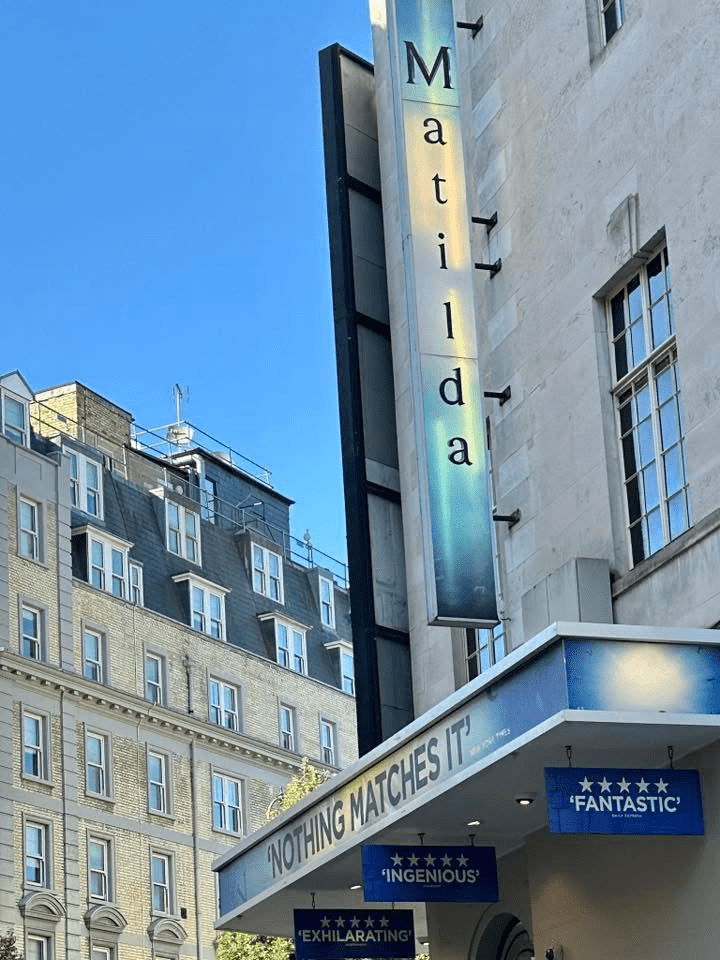
She grimaced as she nodded her head in agreement. “But they are still functional. Are you sure you want to part with them?”
There’s something poignant about leaving behind a pair of shoes in the location where they have served me best, an act I commemorated in my blog as I rode my bicycle across America.
These boots as well as my down parka had taken me across several miles along the Colorado Trail and had been with me on my first solo backpacking excursion, journeys that had helped me heal well enough from my brain injury to have allowed me to visit so many locations I include in my novels. “Yes, but perhaps you are right,” I said as we dashed across the street toward a waste bin. Someone had left a few potential treasures for someone in need sitting beside the receptacle. I placed my boots, which still had many miles of tread remaining on the ground beside their items and folded the very warm down jacket on top, turning away with only a small measure of regret.
”Is there a chance you would be willing to reconsider and return next year?” the administrator asked with a reconciliatory tone. I was fresh out of college, and he had found himself needing an English teacher only a few days before school was set to begin. Throughout the year I had been called into his office on numerous occasions, once to serve as second witness to corporal punishment for one of my female high school students who had been overheard cussing in my classroom prior to the start of the day.
He was a retired military officer who prided himself on “running a tight ship,” and he was the master of empty cliches, one of the Colorado Core Standards my students were tasked to learn to avoid while writing. At one point, the librarian, who was known to lock her students in the audio visual closet when she was unable to control them, had gone to him to complain of the noise we generated in the classroom while loudly chanting “Twinkle, Twinkle,” a simple poem that introduces the concept of trochee, another item included in the Standards. After explaining what we had been doing, he issued another one of his readily available platitues from his limited repitoire, “Remember, keep your friends close, and your enemies closer,” followed by a wink.
I’d remained at the workplace to wrap up the last of the yearbook production after he had, on the last day of school, called me into his office with two sheets of paper: a pink slip and an intent to resign contract. After he advised me it would be difficult to find employment in the field if I chose the pink slip, I signed the latter.
Within a week, the Colorado Core Standards results had been published, and his “well disciplined” students had jumped from “Does Not Meet” category to “Exceeds Expectations,” and he deeply regretted his decision.
”My daughter had struggled initially understanding what you had wanted from her,” a mother informed me at our first Parent Teacher Conferences, “but she has learned to love your class,” she concluded. She was one of my colleagues, teaching an upper grade school level class located at the other end of the rural K-12 building. “I know you have limited resources,” an understatement on her part since we were unable to afford textbooks at all, “but your use of material that no longer has a copyright is impressive.”
I hated to inform her that as a new higher, I simply was regurgitating coursework I had just completed at the college level, adapting it as best I could for my middle school students. That would have been an admission of how utterly unprepared I had felt from the first day I had walked into the classroom.
”And the way you have brought in history into the coursework,” the mother added, “is impressive. May I work with you and help my students prepare for the challenge they will meet when they enter middle school next year?”
”Of course,” I exclaimed, excited to have received such a wonderful affirmation after being called into her husband’s office on so many occasions to be reprimanded for my purported lack of discipline. I also failed to mention, as perhaps her daughter had as well, that the poem which we were reading from a critical perspective was written, as the poet himself identified in his preface, after using laudanum, an opiate-based pain reliever popular during the late eighteenth century.
The concept of automatic writing, the process of writing in a semi-catatonic meditative state, predates the surrealists, who advocated the practice. Coleridge asserts the vision of Khubla Khan came to him during the three hour period following his ingestion of laudanum, while he was in a dream-like trance from the “anodyne.”
Coleridge’s poem describes what he would have imagined indulgent excesses of Khubla Khan’s kingdom, enclosed in a protective dome, could have been, alluding perhaps to the interesting correlation between the luxury Bonnie Prince Charlie had established in Brighton at his domed palace. My seventh grade students during our first six weeks together explored the concept of how literature addresses any number of universal issues, including imprisonment, slavery, feminine representation, and even subtle political criticism.
“No,” I looked my former administrator squarely in the eye with a slight challenge when he retracted his position on my contract renewal. “I believe too much water has passed under the bridge, wouln’t you agree? But of course I won’t burn any bridges behind me. Hopefully you will be kind enough to offer me the same?” Somehow throwing a handful of trite, well-worn cliches at his feet felt highly gratifying as I handed him the keys he had given me at the beginning of my first year as educator.
Walking away is easy, though, especially if there’s something fantastic on the horizon like riding a double-decker bus!
All Things: London
September 14, 2024
I took a deep breath to steady the tremor, and turned to search for the nearest information kiosk.
”Good mmmmm——-orning,” I addressed the woman with kind blue eyes behind the counter, grasping my yellow flowered lanyard as I did. “I aaaaaa——mmm.”
I paused, took a few deep breaths, and willed myself to continue. “I am…”
”A member of the sunflower lanyard club,” she said, smiling warmly. “Are you ok?”
”Nnnnnooooo,” I stammered as tears began to well up in my eyes.
She put up a finger, walked away from the glass that had separated us, emerged from the kiosk door, and walked toward me with a calm confidence that rather than stilling made me melt more into my fears as I was able to identify that I had reached a safe place, a refuge. The sobs and stammers escaped, punctuating what I hoped to be a somewhat sensible explanation.
”I purchased these tickets in Salisbury, explaining to the ticket sales representative my final destination as well as that I was traveling with this,” I said in broken phrases as I gestured toward Matilda.
She took the pile from my hand and flipped through them before I was able to explain the latest obstacle I had encountered. “Oh. Dear. No,” she said. “You have a ticket for the…”
”Tube,” I finished between sobs. “I am supposed to meet my daughter, who will be able to help me. Bbbbbbb——-uuuuutttt.

“Bicycles are not allowed on the Tube,” she finished my statement.
”Cccccoooorrrr——ecccct.”
”Here. Let me see what we can do,” she said, retrieving a hand held device similar to the kind the young woman had used the night before on the platform in Wolverhampton.
”Nope. That won’t work since it is peak,” she mumbled to herself. “And this one is filled to capacity with bicycles, so not available,” information that set off another round of tears from me.
”I am going to step back into the kiosk and make a few calls. Will you be ok? I will be right here,” she gestured to the glass booth that had previously separated us.
I nodded, knowing that the anger that I felt directed toward myself for my weakness only served to cause another outpouring of tears.
I glanced at my phone, hoping I had missed a chime from my daughter, but was greeted by a blank screen. I flipped open FB messenger with the same response, noting that by this point she would more than likely already have already made the connection to Paddington.
I sent a quick hello, only to be notified a few seconds later, “Text not sent.”
More sobs.
”Here,” the woman said, handing me my stack of tickets with a few additional stamps. “Will you be able to follow the instructions I have written?”
I looked at them, unable to discern what any of it meant and shook my head. “Nnnnnotttt right nnnnow,” I replied, “but later, once this passes.”
She nodded reassured. “You’ve endured something much worse than this,” she said.
“You’re meeting your daughter. You survived the process of giving birth. You’ve got this,” she added, smiling.
”Ttttrue,” I stammered, laughing, knowing that healing always came with laughter. “But,” I explained, “I will need help getting to my first platform. Once I get on the train, I will be able to make the remaining connections.”
”Harold, could you please guide this woman to her platform and help her with her bicycle?”
He smiled, reached to take my bicycle, and I assured him it would help keep me balanced, a comment that struck me as deeply ironic given the battles she and I had undergone since we had met.
“You are a modern Diogenes. Not the historian. The Cynic,” he asserted in his always factual tone. “The one who slept in large pottery urns scattered across Athens, relieving himself in all ways in the marketplace, scorning even Alexander the Great, who had come to learn of his wisdom.”
Diogenes Syndrome, though not included in the DSM 5, is characterized by extreme self neglect, domestic squalor, social withdrawal, apathy, hoarding, and a marked lack of shame: contradictory to the philosopher for which it is named.
Diogenes of Sinope scorned every societal norm he encountered, sleeping and eating whenever he felt the need, intentionally exposing himself to adverse weather conditions to harden his spirit and body, wearing a tattered cloak, wielding a twisted, knotted staff, and carrying a lamp throughout day and night searching for “an honest man.”
He was highly self-sufficient, rejecting societal conventions, and considered himself to be a citizen of the world, not of a particular governing body. He embraced ascetic practices, believing that nobility belonged only to the virtuous, and that virtue could be taught, not inherited, maintaining that the path to wisdom was guided by virtue, not a prescribed set of laws.
Son of a producer of coins, he’d been exiled in early adulthood, claiming to have visited the oracle of Delphi who instructed him to “deface the currency,” which he did by skimming gold off coins as he minted them, reducing them in value. Diogenes of Sinope gained a reputation as a “Socrates gone mad,” since in many ways, a measure of madness is a requisite element of one inclined to figuratively put one’s middle finger in the air toward societal expectations.
The pastor walked from one woman to the next, a small brass bowl of oil in one hand, sanctimoniously dipping his thumb into what I assumed to be extra virgin olive oil from Sam’s Club, bought in bulk as well as every other item he consumed, judging by his voluminous girth.
”Patience,” “Kindness,” “Tongues,” “Charity,” he declared as he traced crosses upon their foreheads. I was the last to stand in line, awaiting what he had declared to be “spiritual anointing,” watching the odd procession with lifted head rather than bowing mine “in prayer” as the other leaders of the preschool organization had done.
My friend stood beside me, and even though she had bowed her head compliantly, I could hear her snigger quietly. She and I had become soulmates in our brief acquaintance, bonding over our disdain for our small community to the blind adherence to conservative conformity. I elbowed her several times to get her to stop, mostly because if I had indulged in my penchant toward scornful laughter, I would never have been as discreet as she.
I do NOT have a poker face. As I watched the feigned piety of the holy one stroking the women’s foreheads, I shuddered, the only one who braved watching his lecherous pleasure he derived from the oil against their skin.
By the time he reached me, I had a deep crease of scornful contempt etched from the left side of my chin, curling up through the right sneer of my lip and traced across the tip of my right brow, a scowl that would eventually find itself permanently marking my face as the circumstances surrounding the end of my twenty year marriage unfolded.
Faith is a precarious, ephemeral entity as fleeting as the wisps of smoke smouldering from an extinguished candle: partially sweetened scent from the wax that eventually gives way to an acrid burning sensation at the back of one’s throat as the heat fully dissipates.
“The most terrifying thing in the horror genre is an evil child,” the professor declared as he introduced Henry James’ Turn of the Screw. I had encountered the novella at the hands of my beloved professor at the community college I had attended, so I was familiar with the tale, as well as the particularly disturbing representation of childhood malice.
”That’s why The Exorcist remains one of the most terrifying movies and novels within the genre,” he added. “Tradition holds that poltergeists are born of sexual assault at a young age, one of the universal taboos, which also include incest and bestiality,” he continued.
While the two children in James’ most famous ghost story are not clearly established as victims of pedophilia, they do have a preternatural uncanny awareness of human sexuality, which typically comes at an early age to those who have been vicitimized.
My Path began very, very early, and each step along my life has only proven to wear the abyss deeper and deeper.
He dipped his finger in the pale green oil, paused, then dipped it again. “Cynicism,” he stated. “Your gift is cynicism,” he repeated with his pruriently husky voice as I stared accusingly into his aroused dilated eyes.
My scorn eroded into contempt as he wiped his oil drenched hands on the small white towel thrown over his left arm.
I wore his anointing throughout the day with a deep sense of pride.
I have not worn the other title with as much dignity. “Permanently Disabled” glares from the court order finalizing my two and a half year journey, haunting me often as I close my eyes to sleep.
The plan was to meet at St. Pancras. In a perfect world, I would have proceeded there to meet her after dropping off Matilda where our worlds had collided two weeks earlier. And the awareness that the latest challenge presented upended those plans only added to my debilitating, usually invisible disability.
The steps filled a whole page, and after having a few moments to apply the lessons learned in biofeedback (Inhale, hold, exhale, hold. Inhale, hold, exhale, hold.), I was able to execute them and successfully maneuver the streets of London for my last trek with my uncooperative companion.
No, parting was NOT sweet sorrow. It was simply sweet.
”I want your sixtieth to be at least half as wonderful as your fiftieth had been,” she implored. “Something worthy of your last epic ride from Chicago to Colorado.”
We started with the idea of a bicycle ride.
Then it grew from there. Beaches, trains, planes.
Then it escalated. Mountains. Volcanoes. Castles. Cathedrals. Cuisine.
And to it, I added the adventure of a lifetime, a dream come true.
Or, as it happened far too often as I succombed to the limitations of my second anointing, my disability, my journey had become a nightmare.
”How was your ride?” he asked as I nonchalantly scattered the contents of Matilda’s bags across the rental office in an attempt to allow my still drenched camping equipment to dry.
“You are going to complain once you return the rental, aren’t you?” many had suggested along the way as they helped me out of one conundrum after another.
”Wonderful, though I could have used these,” I laughingly noted as I extracted the pack of hand warmers from the backpack they had kindly stored for two weeks.
“Yes, the weather did take an unexpected turn for the worse, didn’t it?” he noted wryly.
”Perhaps that is an understatement,” I challenged, the only one I offered as I happily watched him return Matilda to the line of other unwieldy cruisers. “You’ll find that battery to be fully charged,” I informed him as he began to plug in the spare I had extracted from one of her saddlebags. “Although it may have been helpful if I had been given two charging cords instead of one. It would have perhaps allowed me to have a bit more sleep since I found myself constantly awaking throughout the night to switch the cord once one of them had become fully charged,” I added, the only other objection I mentioned.
Even free of her awkward bags, as he rolled Matilda to join the line, she tipped belligerently toward them, seemingly overlooking the kickstand intended to keep her aright. “Oh, glad to see she is as disinclined to stay upright for you. She was a bit unsteady,” I offered.
After a laughter tinged with chagrin, he finally admitted, “Yes, these cycles are not quite the best for the type of journey you just completed.”
”No, perhaps not,” I retorted as I began slowly sorting through my possessions, stalling for time to allow my gear to dry as much as possible before packing it away.
Then came the chime: “Can I call?” my daughter asked.
I stepped out of the rental office in what I had hoped to be interpreted as an act of politeness, but I knew that I was in a weakened enough state to not hold my tongue, or worse yet, potentially slip into another episode. After only a few moments of trying to explain where I was and how long it would take me to arrive where we were supposed to meet, my daughter, who before this had been one of the few people outside of the medical field to have seen the full onslaught of my symptoms, uttered the most comforting words I have heard in years. “No, don’t worry. I will come to you.”
An invisible disability is wrought with anxiety.
“Oh, you could work if you would just settle down long enough to find a job,” a friend recently asserted.
”I am sure you could handle a part time job,” I have been told.
”I don’t understand how you are able to hike, bike, write and plan all your trips but aren’t able to work,” a relative has noted.
”Well, now that your IQ has dropped, perhaps you will be on the same playing field as the rest of us,” another one noted.
”Welcome to my world,” another one said, then when I challenged her, realizing in the text informing them of my newly assessed numbers I had transposed a 1 and 2, an outcome of the injury, she simply replied, without an apology for her harsh criticism, “Huh. No, you are right. One hundred and twelve is substantially lower than mine.”
Meeting me, understanding me, accepting me at my own level, at my own place, is the most gracious offering one may ever make. No judgment, no challenge, no questions, no placating, empty words of comfort.
Just an acknowledgment of who I am, who I have become, and a willingness to work with “the new me” is the best way to help me learn to accept, work with, and grow from my disability.
“Good news,” she said after the sobbing had stopped. I had stepped outdoors to greet her, watching her icon on the FindMy iPhone app, knowing that I would potentially have another onset when she arrived. “I have found somewhere to store your backpack so you won’t have to carry it over the next few days or take it to Spain,” she assured me. “Can you manage to carry it well enough to take a train?” she asked as she reached to help lift it onto my shoulders. I cringed slightly, feeling the soreness I’d observed earlier in my right shoulder. “Dear god this is heavy,” she noted before I could respond. “I’ll request a Lyft.”
More very welcome words.
I breathed a sigh of relief as I lowered my backpack into the trunk of the vehicle, realizing for the first time in two weeks, I not only was free from the weight of my own luggage, but also the weight of Matilda.
”She was worse than your pictures had indicated,” my daughter laughed as she joined me on the leather seat. “I am impressed you stayed with her and took her as far as you did,” she added as London sped past at what seemed like an unnaturally quick speed.
I smiled, knowing I was ready for my next adventure, whatever it may be.
i
Singing in the Rain
Break These Chains: Stonehenge
September 14, 2025
The haunting earthy rhythmless wail echoed across the stones, a free-flowing, uncomposed, spirited and spiritual tones of a wooden flute wafted around us as we circled in reverential awe.
Greatness does that: it silences, soothes, succumbs. Surrounds. Encompasses. Possesses.
His warning echoed falsely across the miles. “They say it is smaller than you would imagine,” he declared long before I had set upon my two-week journey.
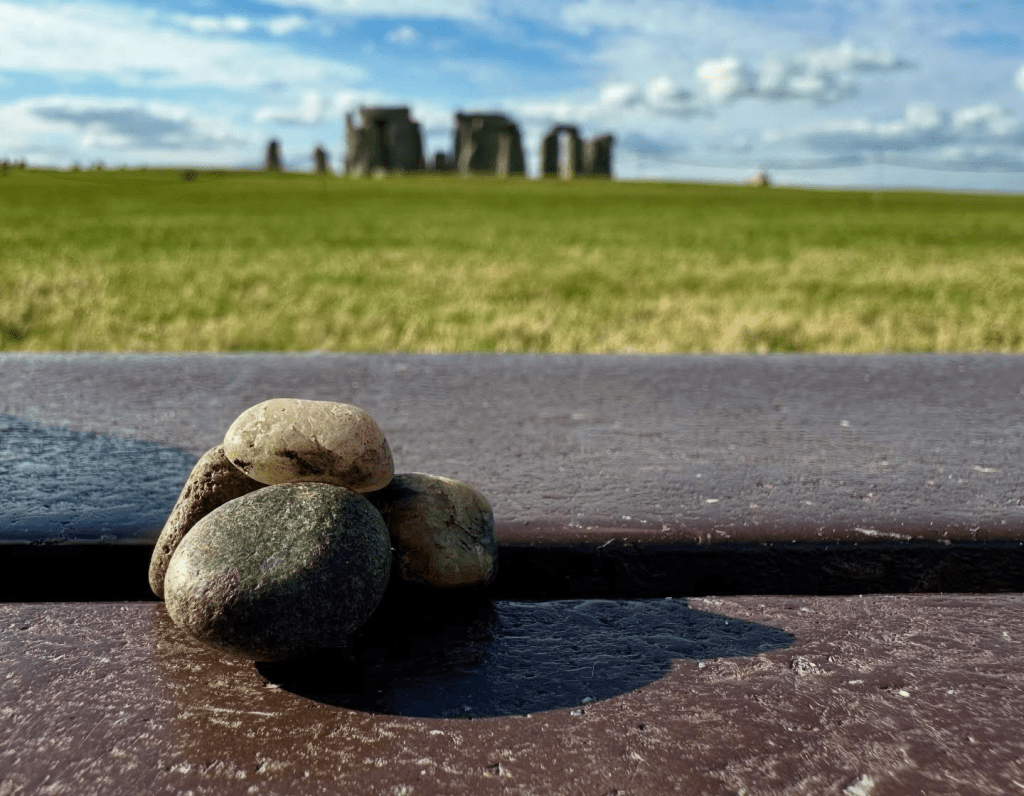
He was wrong.
Its monumental size in no way disappoints.
It inspires.
It awes.
It. Is.
Free of her bags, Matilda was far easier to navigate, never tipping, and even willing to stop when asked. For the end of my journey, she proved to be the perfect companion: compliant, powerful, hospitable.
Nearly magical.
But only almost, since we had at last encountered true magic.
We wound our way back to the campground, navigating rush hour flawlessly.
And for a moment, I actually appreciated the miles she had traveled alongside me.
“Please, sir, I need to purchase tickets from here to London’s St. Pancras. I will be traveling with this,” I added, pointing to my companion.
After punching a few buttons and the obligatory tap on my end, I walked away with a stack of tickets, overcome with relief that this would be our last stretch before meeting my daughter for…another long bicycle ride.
But not without a few more adventures.
“I just landed in London,” my daughter texted me as I stood beside Matilda, swaying beside her with the rhythm of the train, thankful she would soon no longer be my burden. Tears of relief welled up in my eyes. “I will see you at Paddington within an hour,” she added.
”Um… I thought we were meeting at St. Pancras,” I responded.
At times dots on messenger can seem to last an eternity.
Dots. Pause… Dots…
Then. Nothing.
Minutes and miles later, a chime.
”I can’t seem to send messages. Let’s try Facebook.”
”Ok.”
”Message not sent,” my iPhone informed me.
”Duh,” I reminded myself. “That’s what she just warned me. Of course it wasn’t sent,” I chided myself, calming the wave welling up inside me with a few measured breaths.
The problem with Facebook messenger: It doesn’t reliably inform the user if the message is sent. It just notifies once it is read.
Minutes and miles later, still no response.
”Delivered,” my iPhone moments later informed me. But no confirmation, “Read.”
Minutes and miles passed.
At least we were nearly in the same city, I assured myself while Matilda gently rocked against my hip, behaving very nicely under the circumstances.
We emerged from a tunnel. Chimes.
”My bad,” she wrote. “Sorry for the potential meltdown. You were right. St. Pancras.”
I sighed with relief and began concentrating on the stops, counting down how many more before my connecting train to meeting her.
”I am sorry, ma’am, you can’t take that on the Tube,” the vested man informed me as I wrestled Matilda to a halt on the platform.
”But the man at Salisbury assured me…” I began, frustrated with the tremor in my voice, the one that always precludes a more frightening stammer.
”No. Bicycles are not allowed on the Tube,” he asserted as he walked away.
Before each onset of a full-blown incident, my temperature plummets. Then the room begins to swirl. I took an assessment, realizing I was somewhere in between.
”Breathe,” I reminded myself, pausing long enough to close my eyes, shut out the motion and noise around me, counting. “One. Two. Three… Six in. Hold six. Six out. Hold six.”
“You respond very well at six breaths per minute,” my biofeedback specialist informed me as she took the sensors off my skull, my forehead and my wrists. She paused momentarily, and continued removing the ones from my chest and stomach in silence.
”Your temperature is ideal, and your heart rate is consistent at that rate,” she added as she wrapped the cords and inserted them into the crevice under the machine.
”Your session is officially over, and I believe you have the tools necessary to control an episode as long as you recognize the warning signals,” she added pensively.
We had been working for six straight weeks, attaching the sensors for an hour twice weekly. Measuring. Monitoring. Meditating. Teaching me, we hoped, how to avoid an onslaught of a post traumatic intrusion.
“Do you have a few minutes?” she asked.
”Of course,” I responded.
Another long pause.
”Under normal circumstances,” she began, hesitatingly, “I wouldn’t have this conversation with a client. But over the past few weeks, I have seen patterns in your feedback that I haven’t seen in years.”
She had piqued my curiosity.
”When I first began studying biofeedback, I went to Russia,” she continued. “At that time, biofeedback was still in its early research stages. I was a young college student,” she explained. “And their approach was slightly less…clinical. No, scientific,” she added.
She proceeded to explain that while in Russia, they had attached the sensors to mediums, those who claimed to have extra sensory powers.
”Your patterns, on many occasions, are similar to what I saw there,” she added, still very hesitant to continue.
”Since our treatment is officially concluded,” she explained, “May I explain some of the more experimental findings I have researched? They are in no way scientifically proven, but may be pertinent to you.”
She went on to describe patients who had sustained a traumatic brain injury and had professed to be mediums described difficulty controlling their gift, often slipping into realms where they no longer felt comfort, levels of spiritual perceptions that took them far deeper into supernatural spheres than they had experienced prior to their injury.
”As I have watched your results,” she continued, “I have seen indications that perhaps you are a medium.”
Silence. I’d not expected to hear the same thing from a professional that I had heard time and time again from family members, pastors, friends.
A belief that something outside of my own soul had its steely fingers grasped around my personhood.
Undercover: Salisbury
September 13, 2024
”Oh hell no,” I screamed as Matilda sputtered to a halt along the dangerously narrow, surprisingly busy lane. Google had of course done what she had done best as we had crested the last hill, telling me to make a U-turn, her answer to any peril she encountered with limited cell service.
The last time she had accurately navigated me through a roundabout about ten minutes earlier, she had also informed me I was 3.5 miles from my destination. When I refused to heed her instruction to execute the U-turn, she of course went silent, causing me to momentarily panic because I hadn’t taken note of where I should turn to successfully arrive at the campground.
Feeling particularly buoyant because I realized I could outsmart her and just follow the signs to Stonehenge where I could reroute her via their Wi-Fi, I hummed my own ditty narrating my own cunning happily to myself when Matilda began slowing markedly, then exhibiting her full weight with each stroke of the pedal.
Plains in the US are flat and barren. As I struggled to climb the hill that seemingly stretched endlessly before us, I realized that definition did not necessarily apply in the UK. Overcome by the weight, I finally halted half way up the incline, assuming that I had utterly lost the last bit of charge on the battery I had nursed the previous day, but reassured because I had reserved a fully charged one for what would be my second to last stretch before returning the beastly Matilda to her owners.
Because the batteries were the most weighty part of my too-heavy packs, they always rested at the bottom, which unfortunately meant I had to unload the contents on top. Spare bungee cords, various charging cords, tool bag (yet unused, thankfully, since they had warned me that should I need to break the sealed bag, I would be charged an additional fee), spare tire pump…all spewed onto the ground, some rolling frustratingly just out of reach, which meant I would have to rest Matilda on the ground as well to retrieve the items since I knew she would never consent to staying aright with just the support of her worthless kickstand.
I pulled out the used battery and slammed in the one that was supposed to be fully charged.
Nothing.
On the outside chance, I popped it out and slammed it back in as her owner had instructed me on the second day of our trip.
Still nothing.
I traded out the battery to the one I had just removed, hoping maybe perhaps in the wrestle with the rolling objects I had accidentally switched them.
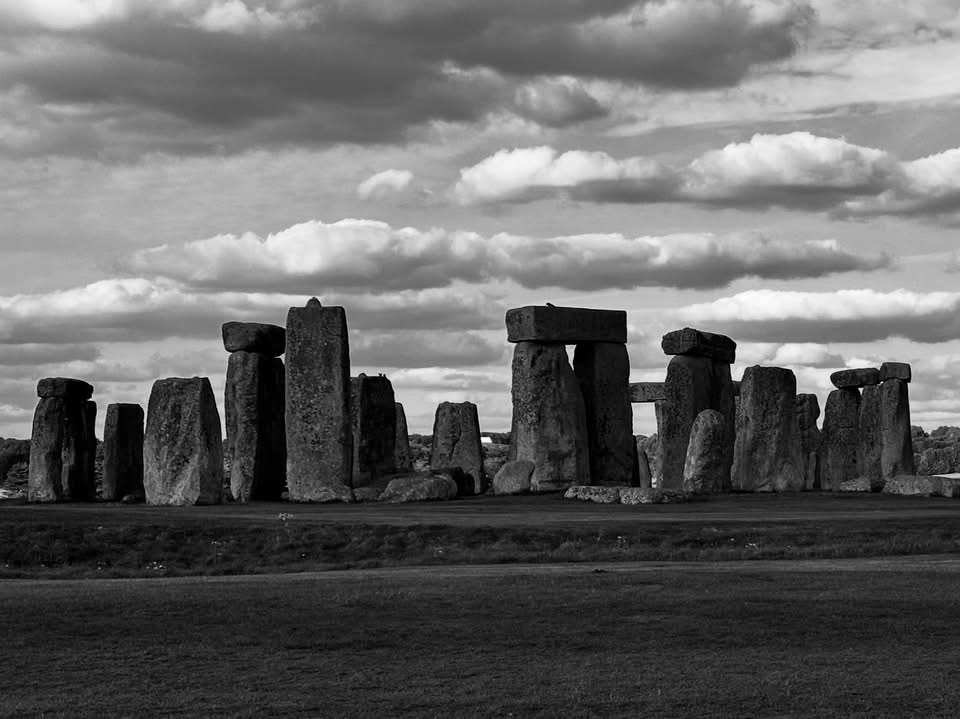
Same result.
Switch. Slam.
Nothing.
So we began walking the ascent.
And walking. And walking.
Then tipping, just because Matilda longed to assert herself into the equation.
So we stopped and tried to reinsert both batteries.
Still nothing.
Normally when on a long walk or bicycle ride, when I reach 3.5 miles, I assure myself that I am fully confident I can complete the journey with one final push, even when I was towing a 36 pound trailer loaded with 50 pounds of art and camping supplies and an 86 pound dog.
I continued pushing uphill, reassuring myself that with every ascent, a descent would soon follow. Then I remembered that Google had decided to be as stubbornly difficult as Matilda had become. I had absolutely no idea where to turn to reach the campground, the closer of the two destinations. Stonehenge, I remembered with despair, was an additional 3.3 miles.
I reached what I thought would be the crest of the hill only to discover it had just been a wooded bend that had been occluded…the remainder of the hill.
The battery slamming started again, with the same result.
So we kept pushing, staggering, falling. And calling into question the nature of the gods, their purpose in our journey, and Matilda’s relationship to them. As well as the own nature of my parentage, sanity and mental acuity.
Then we crested the hill. I mounted Matilda, pedaled for everything I was worth, gaining as much speed as possible, because another hill immediately followed.
We continued the battery slamming, cursing, questioning, pedaling for three more hills.
And suddenly, Google sprang to life. “Turn left,” she intoned, and for the first time ever, her voice sounded like the voice of God accompanied by a host of angels.
We hit the graveled drive of the campground. Literally. As soon as we made our final turn, Matilda tumbled, taking me over with her, and when I came up laughing, the camp host greeted me, jovially shouting from across the wide expanse of freshly mown, very green grass.
Not only had I reached my destination well before they had rolled up the welcome mat, I had an answer to the question that had been at the back of my mind for days.
Yes, all those expansive fields of green grass I had seen since embarking on my journey, truly DOES have to be mowed by someone.
The sun shone warmly upon us as I extracted my black speckled gear, spreading it upon the picnic table, the first I had encountered at my sites throughout my two-week journey. I plugged in what I had believed to be my fully charged battery, only to learn that once again, I was right. All the lights blinked green. Fully charged, indeed.
I slammed it into Matilda, and all the lights on the power indicator came to life.
She had tested my determination to reach our destination.
And her wont to test me was rewarded with another string of disgusted expletives.
I emerged from my warm cocoon covered in very welcome sweat, something not even the most ferocious menopausal hot flashes could produce.
I unzipped the flap of my tent, basking in the sun that streamed through.
The contents of the picnic table quickly were tossed into the tent opening, and a fully charged Matilda and I set off for my final destination: the magical circle of chalk, sarsen, and bluestone.
Win. Lose.: Bristol Cathedral
Sept 13, 2024
Tourists are a silly lot. Too often we overpack what we don’t need, and leave behind the essentials. And there is something about a bulging suitcase, or in my case a bulging pair of panniers, that draws them together, inciting easy conversation among them as though they were all members of an exclusive social club.
She took a remarkably swift swig from the frightfully empty bottle she had extracted from her very large suitcase, mumbling something indecipherable to her companion. Her hand shook violently from the cold.
”Any idea what time they will actually unlock those?” I ventured to ask, nodding toward the large glass entryway a few feet away. Like his companion, he was shivering, wearing nothing but a pair of shorts and a short sleeved shirt sporting a tropical, bold print.
”No idea,” he stammered as he pulled a beach towel from his suitcase to throw over the recumbent figure who had slumped back into a drunken stupor at his feet. “Not soon enough,” he added, using another one as a makeshift shawl.
”My train leaves in fifteen minutes,” I noted, “and I struggle to maneuver through these damnedable stations,” I added. I had refreshed the app listing the train departures repeatedly with shivering fingers, hoping at some point I could at least begin to identify in advance which platform I needed to rush toward. “I honestly didn’t expect them to wait until the first departure time to allow us indoors.”
”We left for Turkey two weeks ago. I had no idea we would be returning to winter conditions,” he offered, his congeniality in part inspired by a need to distract himself from the biting cold. “If we had known the station was closed, we would have stayed at the airport terminal. At least they allow travelers to remain in the building overnight,” he added sardonically.
Several of the benches nearby were occupied by lightly dozing figures who had an arm or a leg draped across their luggage in an attempt to secure it while huddling under whatever warm layers they had been able to extract. Although by this point I was stupidly exhausted and even more frightfully cold, I was thankful I had passed the hours wandering through my unplanned destination, but I couldn’t help but watch with a measure of envy as the members of the huddle I had past early in the night tumbled drunkenly out of a limo with a “for hire” sign in it’s back window. They had wisely pooled together and had obviously engaged in a night of frivolity.
As they stumbled toward us, those attempting to sleep on the benches began emerging slowly from their cocoons, hastily jamming their layers of clothing back into their suitcases.
My companion’s partner raised herself from the cold ground, reached her shaking hand deep into the suitcase searching for the bottle again, only to begin stumbling toward her feet. The keepers of the warmth had suddenly unlocked the glass doors we all had been longing to enter. As he walked away, a pidgeon who had been sleeping on the tiled floor inside the station, an irony not lost on my companion as he exchanged glances with me before scurrying toward the screen posting departure times.
I withdrew the bright yellow sunflowers from under my down hood and haltingly addressed the first vested person I found, thrusting my ticket toward him and asking him which platform I would need to rush toward. This time my stammer was from cold, not an onset of anxiety.

I maneuvered Matilda successfully to the platform, which was located on a stretch in the open cold morning air. “Delayed,” the sign blinked passively at me.
Too exhausted to move, I braced Matilda against my shivering body.
Sun rose on the Salisbury Plain as the train pulled into the station. Too excited to sleep, I had watched the horizon for a single glimpse of the top of my bucket list: Stonehenge. As the fog moved across the vast expanse, the sting of the very costly ticket faded a bit. Another vital impression to be stored away for my novels. More often than not, the cost of research, whatever form it takes, is a worthwhile investment.
I meandered slowly through the sleepy streets, shivering too much to dare mount my erstwhile companion, searching for nothing in particular, but when I turned the corner onto what appeared to be a primary plaza, I found it: a delightful coffee shop sporting a French name. I tethered Matilda to a nearby bench, walked in, and fell in love.
The croissants were fresh, uncoated with sticky sweetness too commonly slathered upon any I had encountered on my trip to this point, and the freshly roasting coffee beans were sharply pungent.
It had taken over one thousand miles and thirteen days to find it, but after placing my order in broken French, I stood and relished the hiss of his espresso machine. He turned, and in equally broken English, assured me I could take a seat wherever I wished and he would bring my café. I nodded, saddened that politeness dictated I followed his instructions, longing to watch him create my perfectly prepared latte.
Heaven at last, discovered in the shadow of the Druid’s Circe.
Midnight Train: Bristol Temple
September 13, 2024
”Excuse me, ma’am, may I help you?” he demanded more than asked, push broom in hand.
I had learned early to search for whichever platform I would need to depart the station.
”I catch the first train in the morning to Salisbury,” I told him, flashing both my lanyard and the ticket toward him.
”They won’t post that until morning,” he informed me, “and you’ll have to exit the station through those doors. We don’t allow people to remain in the station overnight.”
”May I at least use the toilet?” I asked as he shrugged begrudgingly, nodding his head vaguely in the direction I assumed would be where I would find it. “And I will have to leave this,” I gestured toward Matilda, at which point he softened a bit and began walking alongside me, assuring me he would keep an eye on it as I did. Relief.
I caught my breath as I stepped outside of the warm station. I knew it would be cold, but as a semi-arid desert dweller, I hadn’t quite anticipated what felt like daggers entering my lungs. Thankful for my layers, I pulled my down hood over my head, frustrated that it blocked so much of my peripherial vision but welcomed the warmth it provided.
I’d had the foresight of keeping my long-fingered riding gloves when the bicycle rental owner had chided me for overpacking when I had stupidly left my two weeks supply of hand warmers behind in my backpack in London. My cold fingers served as a reminder not to give into male peer pressure in the future, a lesson I so dreadfully fail to learn time after time.
Religious edifices draw me irresistibly, and once I had activated my hiking app, which I rely upon to navigate safely any time I wander where I have not already mapped on Google, I pushed Matilda toward the towers peering above the station, passing a group of people huddled together on the walkway as they, too, awaited the first train departures in the morning. I knew if I had attempted to ride, the cold air would pierce through my layers, and I wanted to preserve the fully charged battery for my ride to the campground once I arrived in Salisbury. “Ironic,” I thought as their breath rose from the tight circle in the cold air, “during the day, ticketed passengers linger for hours awaiting their respective trains, but aren’t allowed to do so when protection is most needed.”
My characters continue the tradition of making their seasonal treks only through my fourth novel because one of the women, who historically had done everything she could to preserve the family’s heritage from a hostile takeover, including marrying a man with a sordid reputation for anger, in my novels intentionally obscures the hoards from future generations. When I had discovered how corageously she had fought alongside her father to maintain the heritage of her young son, I knew these were the types of women across the ages who need to be celebrated, and she became the archetype for character development throughout my series: the defiant, determined, bold women willing to fight for their rights and that of their progeny.
Because the hoards become obscured before the Tudor reign, I was unable to include any abbeys that had been destroyed in the purge under King Henry VIII, a lamentable decision given my fascination with the broken edifices signifying a male’s egotistical, sexually driven dominance over everything a country had once held dear. As I had watched city after city pass by me on the train, I ticked off the destinations I’d hoped to see along my journey: Molyneux Stadium, Lady Wulfrun, Shakespeare’s birthplace, Holy Trinity Church, Meon Hill, Rollright Stones, Uffington White Horse, Wayland’s Smithy; many locations that had included both historical and literary significance outside of the purview of my protagonists journeys but would be included in cameo appearances throughout my plots.

Locating the looming towers had been more of a challenged than I had anticipated, and I circled around them entirely before finally finding the entrance: a small, unimposing yet unsecured gate, an unusual corridor, I surmised, for such a remarkable edifice.
”Huh, not sure where I landed,” I texted my daughter, who fortunately was tracking my progress during her daylight hours, “but holy f—-!” I wrote as I sent photos of a once majestic place of worship hollowed by man’s wont for destruction.
She replied a few minutes later with a wiki link informing me the gutted structure hadn’t been destroyed by a king with a vendetta generations ago, but instead had been gutted by forces led by a different sort of maniacal male during a war in which my own father and step-father had fought. The Templar’s Temple, one that had suprisingly withstood not just King Henry VIII’s malice, but also that of Black Friday two millennial before his tyranny, had been destroyed by Germany under Hitler’s regime.
The skeletal remains of arches once bearing what would have been masterfully wrought stained glass reached vainly into the sky, persevering the heat that had melted the glass into sand, the triumphal entry arches bereft of wooden doors that would have desinigrated into piles of soot stood gaping open, allowing the bright lights of Bristol to shine through in haunting slits of sodium yellow glares, interrupted by splotches of red that shone like a dragon’s eyes in the dark expanse of the extensive nave.
For the first time ever, I had a better understanding why Virginia Wolfe would have stuffed the pockets of her long skirt with stones and waded into the ocean during Germany’s relentless nightly bomb raids of England.
Indescribably horror at the hands of an angry, small but influentially persuasive man who had deified himself as an all-powerful god.
I walked around the majestic stone carcass for over an hour, shooting far too many photos, fascinated by the play of light and shadow, comfortable inhabiting the same space occupied by a homeless encampment spread in the dark corner of the plaza, exchanging greetings with a group of college students who were brave enough to cross the darkened threshold, as amazed by their discovery of the artifact of war as I had been, lauding them for their bravery and playfully asking them not to disturb the demons enough to chase them from their hiding places within.
With deepest reluctance, I turned away from the scar upon history and began searched for another diversion to keep my mind off the cold, and Google taunted me with another destination: Bristol’s St. Mary Redliffe.
Knowing Hitler had brought the French to their knees very quickly by inflicting a similar atrocity upon Paris, I wasn’t certain if I would find yet another similar ruined edifice. A few blocks later as I saw the gleaming towers illuminated brightly by the unearthly glow of LED spotlights, I was relieved to know I wouldn’t be faced with another gloomy reminder of humanity’s utter depravity.
The gargoyles and wedding-cake frosting finials rose above my head, illustrating why Queen Elizabeth I had decreed it to be “the fairest, goodliest and most famous parish church in England.” Matilda had consented to lean contentedly against one of the ornate gates, which, as with those outside the Temple, were unlocked.
The church, established by a charter in 1158 by King Henry II, unlike the Temple, had withstood the shifts in power, quickly shifting from Catholicism to the Church of England during the reign of Elizabeth’s egocentric father, a transition my family had resisted, an act of defiance which would later be the driving force behind my great-great-great-great grandfather’s immigration to the United States, a narrative that shapes the plot of the seventh of my eight novels.
After standing (and kneeling, for the sake of a photo or two, an act of contrition I take to honor artistic expression more than the driving force that had inspired it) in awe at the base of glorious human endeavors for yet another hour, I glanced at the time, chagrined to note that I still had over an hour to kill before my train’s departure. So, in best transient fashion, I laughed at myself as I curled contentedly onto a cold sidewalk wrapped warmly in yet another layer: my sleeping bag.
I’d taken the precaution of setting an alarm, an unnecessary step given Matilda’s propensity: as soon as I had become warm enough to begin dozing, sensing my comfort, she threw herself to the ground with a clatter raccourious enough to waken the dead sleeping in the nearby ancient cemetery in which I had sought refuge in the shadow of its dark wall.
Knowing she had probably managed to awaken the living residents across the secluded street, I mumbled a few choice curses upon her and her owners and begrudgingly wended my way back toward the station, grateful to have passed the coldest hours amongst the generations who had fashioned such remarkable works of beauty
Fall Apart: Wolverhampton
September 12, 2024
I’d experienced the joys of effective European transportation system twice previously in my life, so when a former student posted on social media how amazed she had been that she had been able to take a train to wherever she would like in England, I wasn’t surprised.
”Good news. Looks as if you are unable to ride as many miles as you have planned, you can always catch the train,” my daughter had texted me when she had mapped out my entire trek on Google.
”Thanks, but I am remaining optimistic that I will be able to achieve my goals.” Silly me. I should know goals are not my forte.
The bicycle rental company, which caught my attention because it had been one of the few that allowed their bikes to be ridden outside of London, assured potential clients that taking bikes on public transportation was easy.
It isn’t.
Moreover, while trains may be readily available from one major destination to the next during peak hours, taking a bicycle on a train during those times is forbidden.
I’d not intended to make my train ride an alternative to avoiding the severely dipping nighttime temperatures, but I welcomed it as a possiblility as I wove my way through heavy traffic toward the train station.
”Have you heard of the Sunflower Lanyard?” my daughter had asked a few days before my departure. “And please, I don’t want to offend you by bringing it up, but I have heard very good things about it from others who have traveled with disabilities.”

That word hangs about many of the conversations I have, sometimes with varying nuances.
When she uses it, I appreciate her input since far too often I have met with levels of scorn. Invisible disabilities are often met with resistance. “Well, you LOOK fine,” we often hear.
Yes, at this particular moment, anyone with a disability may LOOK “normal.” But that isn’t always the case.
“You may want to keep the lanyard out of sight until you need it since there may be scammers around who are likely to target you,” she suggested, but please don’t hesitate to rely on it if you need additional help navigating public transportation.”
”Hurry up,” the security guard at Denver International Airport had shouted at me while I retrieved my belongings from the plastic crate.
“I am sorry, sir,” I retorted, “but I am disabled, and hurrying is something I simply unable to do,” while the kind couple behind me helped me secure my items from the bins.
“No one should be spoken to that way,” she offered as she handed me my iPad. “We’re not in a hurry,” she assured me, glaring at him with the sharp disdain he deserved.
I’d successfully maneuvered through London’s Tube from the airport, and had even managed to work my way through Nottingham while balancing Matilda with the help of a few people willing to wrestle her girth.
When I arrived at the station in Liverpool, I balanced Matilda long enough to snap a selfie near a neon self-affirming sign appropriately declaring, “You Made It.”
Indeed, I had! Matilda and I hadn’t come anywhere close to the originally planned 750 miles, but we had seen enough of the land to be able to write knowledgeably of England, especially since I had Google Earth to walk me through the list of eight remaining destinations I had longed to visit. I’d have to content myself with fulfilling two thirds of my trek.
I reached for the green lanyard with bright yellow flowers that dangled from my neck, extracting it and the medical ID tag with my deceased dog’s ashes and rabies tag from underneath my yellow and blue rain jacket and determinedly headed toward the ticket counter, assured by Google and an app that I could catch a train from Liverpool to Salisbury, my final destination on my trip, with one more scheduled, brief stop at Wolverhapton where I hoped to secure a Wolf rugby hoodie from the stadium named for my family for the same friend who had encouraged me to drop my name to see where it may take me.
After carefully explaining my inability to follow prompts on a screen or negotiate turnstiles without assistance, the ticket salesperson handed me a stack of tickets, briefly explaining which trains I would catch to reach my destination. Smiling and confident that I would happily find myself in Salisbury the following morning, I boarded the train to Wolverhampton.
”I am sorry, ma’am, you can’t leave your bicycle there,” a staffer warned me as I headed toward the exit.
Relieved that he had informed me of my error, I thanked her and explained my disability and asked where I would be allowed to leave it for a few moments, adding that I would return shortly to catch the next train toward whereever my second ticket had listed.
Her eyes widened a bit, and she pointed toward the departing train. “That’s the last one tonight,” she said.
I had walked out of the toilet in Newcastle Upon Tine train station, slightly disoriented because even navigating the complex maze of finding my way out of a public restroom can be challenging. As I stood on the platform where I believed I had secured Matilda, I realized she was no where to be seen. I walked back into the toilet to look for a different exit, reminding myself to breathe, an essential part of controlling the adrenaline that potentially results in an onset of PTSD. I turned around, horrified to learn that had been the only option.
When I exited the second time and walked slowly around, hoping maybe I had secured her to a post a bit further than I believed, I was shaking. A woman wearing a burka in broken English, words I would have by this point been unable to process even if she had spoken them with a full American accent, I would have struggled to comprehend. She pointed, and I staggered to follow the direction she indicated.
”Please, I am ddddd——iiii——sssssa——-bled,” I stammered, tugging at my lanyard. “Mmmmmm——yyyy b———iiii——kkkke. It’s ggggg——-one,” I informed someone wearing the same blue and yellow vest the person who had instructed me where to leave Matilda when I had arrived at the station had worn.
”Security must have taken it. You cannot leave bicycles on the platform.”
”Bbbbb——uuuuu———-t ssssss——ommmmme oooooo——-ne tttt——ollllll———d me…..” I managed to shrug before breaking into sobs.
”This way,” he instructed me, leading me down the platform. “It’s the first…” he added, providing information I was unable to comprehend.
I continued staggering in the direction he had pointed, trembling from head to foot, grasping my lanyard in desperation, searching for another yellow and blue vest.
”Ssssss-ecurrrrrr——ity, pppppllll——-ease,” was all I could muster when I approached the next vest, thrusting my lanyard toward her in desperation.
Rather than pointing, he walked ahead, guiding me into a glass enclosure, where I grasped the lanyard and started screaming hysterically.
”Breathe slowly,” she instructed me as I began becoming cognizant of my surroundings some time later.
”Mmmmm——-y bbbbbbb——-iiiii,” I attempted to say, which set off another episode of pulling at my own hair and sobbing uncontrollably.
”Yes, we have your bicycle. It is safe,” she assured me. “Breathe,” she reminded me as I grew paler because of hyperventilation. “You are fine. Just listen to my voice. Breathe in. Exhale. Breathe in. Exhale,” as I struggled to focus on her words, but gave in to another series of sobs, this time from relief.
Two hours later, I had successfully found my way to the bike path along Hadrian’s Wall with a newfound determination to avoid taking a train, but inclement weather and Matilda had different plans.
As the young lady who had informed me that had been the last train toward my destination began frantically searching for alternate routes, I realized how mistaken those who had reassured me I could always take a train if my plans didn’t materialize as we all hoped they would.
”Mike,” she shouted across the rails, “is the ticket counter still open?” After receiving a shout of confirmation from her coworker, she hastily instructed me how to get across the tracks to exchange my tickets for a different course. “You have forty minutes before the train you need departs, so if you secure your bike to this post, I will watch it for you.”
”I don’t see what the staff member saw,” the woman at the counter informed me. “Let me search again. Oh, yes, but it will take you well out of your way, and you will have several hours to pass in Bristol before your last connection. It is a larger station than ours and is enclosed, so it may be an easier area to overnight,” she added, ringing up the total cost of the tickets. “But it will cost you over 300 pounds,” she explained with a tinge of surprise in her voice. Not even she was comfortable with the vast increase in price. ”Let me see if waiting here until morning would cost you less,” she offered as I patiently awaited an alternative.
“No,” she said with trepidation. “Since you have a bicycle, we can’t book a morning train into Salisbury in time to avoid the rush hour ban,” she added apologetically. “And even if we could, the price wouldn’t drop enough to justify waiting here.”
I tapped my card against the machine, aghast that this would now take all my transportation costs above what my entire budget for my trip had been when I initially booked it. I thanked her, turned around to orient myself, and heard the announcement: “Last train departs in two minutes.”
The panic began to well. It had taken thirty-eight minutes to secure the new stack of tickets, which would become invalid if I were unable to successfully negotiate the station.
I ran up one set of stairs, only to realize I had gone to the wrong platform. I turned, ran down and back up another set of stairs to hear, “Train departing.”
”Wait, please,” I yelled at the only person on the platform, “that’s my bicycle,” I shouted as I nodded toward a very well secured Matilda, “and I need to catch that train.”
”Then you’d better hurry,” was all he offered as I struggeled with the lock.
And of course, Matilda used the opportunity to throw herself belligerently onto the ground twice before I had finally boarded.
I sat beside her, balancing her upright with my leg, sobbing with relief that we had caught the last available train to somewhere I was in no way prepared to go.
“Yes, at this moment, I MAY look fine NOW,” I feel like shouting at those critical of my need for special accommodation, “but at any given moment, I may not be.”
Bright Eyes: Croxteth
September 12, 2024
“Excuse me,” I asked the neatly dressed, uniformed woman, hoping she was part of the staff, “how much do I need to concern myself with the time on the gate, and is there any other place I may exit if I stay too late?”
She looked at me with a bewildered expression that I had met often since I had launched what was now over 400 mile bicycle journey around the UK, an expression I never knew if it was borne of disdain for my bedraggled appearance, disgust at my possible odor from my long day, mistrust because of the angst perpetually pinned to my face because I feared at any point Matilda would hurl herself upon anyone who happened to be standing nearby, or confusion because of my very obvious American accent.
“Which sign?” she asked, and I breathed a sigh of relief that her bewilderment was founded outside of my own self-image perception.
I had been aware from my near obsessive stalking of Croxteth Manor Facebook pages that pedestrians did, indeed, visit the estate past five o’clock in the evening, and that they also were allowed to walk the grounds at sunset. I had also been aware that they were actively hosting a film crew, so when I had followed Google’s instructions toward the manor and had seen camera equipment, I wasn’t surprised, but I had been a bit disconcerted with the neat, modern homes circling a cultisac since I knew the project was, as are my novels, based upon historical fiction.
”Do you happen to know where the manor is located? Google seems to have led me astray,” I asked the person who seemed to be the director. The crew was much smaller than I had anticipated for a Netflix production, but I assumed perhaps they were just filming a short take.
”Oh,” he responded as his cameraman zoomed in on a bicyclist riding past, “you’re still several miles away,” an answer that once delivered didn’t seem to be particularly surprising.
“I gather you are NOT part of the Netflix project,” I asserted as they tracked another turn of the bicyclist.
”No, not at all. Are they filming at Croxteth?” he asked, not waiting for an answer. “This young man,” he explained, “recently wrote a poem criticizing Mereyside law enforcement, so we are featuring him in our own small production,” a snippet that froze the information I was about to offer that I was distantly related to what had once been the lord of the manor.
“Identify your audience,” my daughter had reminded me when I discussed some of the hesitance I have been experiencing regarding my novels. “To whom are you writing?” she challenged, echoing one of the first lessons my own instructor had taught me early in my academic career and one I repeated the first few days to my composition students.
”I am not entirely certain,” I replied. “Although that is one of the first steps in writing, I hate to confess I have never taken my audience into consideration as I write. I just write for the sake of writing.”
”May explain why you are floundering,” she retorted. “I don’t need the answer, but perhaps it will help keep you focused.”
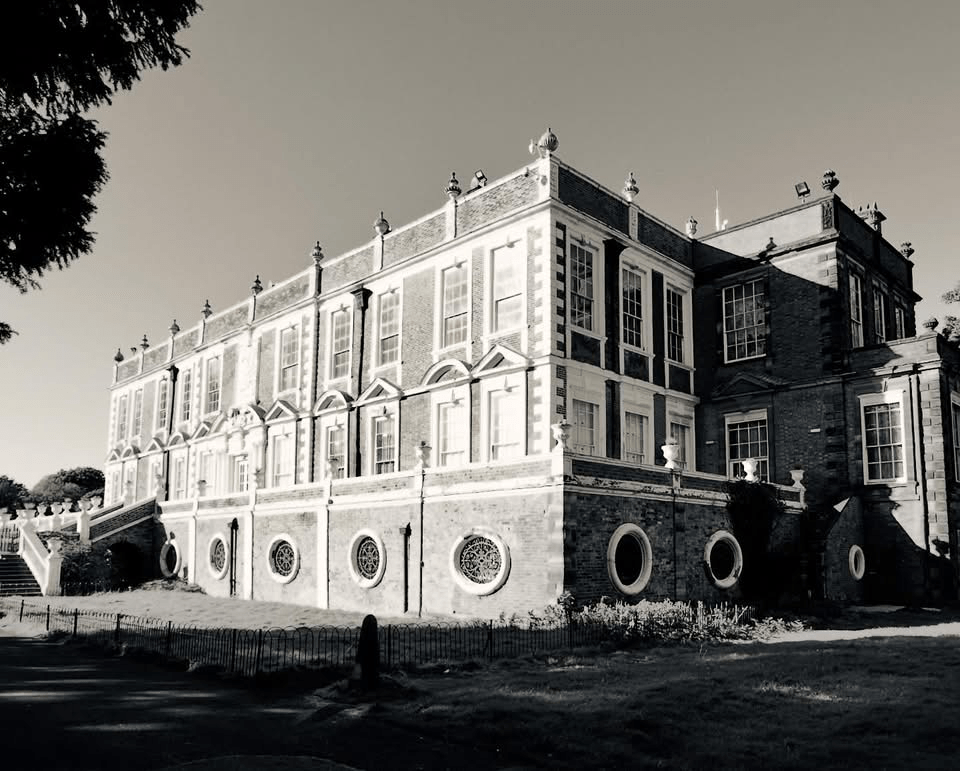
My broken brain is rarely focused. It spins into a million facets, some far brighter than others, and, admittedly, I understand far too many cuts in what had once been the gem of my brain that are also pitch black worm holes of self-doubt.
As Americans, our careers define who we are. Our entire lives, we consider who or what we will “become” when we “grow up.”
”Becoming” and “growing up” are two phrases I had not often considered to be my forte. I fly freely, resisting both concepts, quickly silencing the my own thought processes when I begin to question whether or not I am in my current financial and physical insecure predicament in which I now inhabit. “No,” I remind myself, “if I had spent my life goal oriented, I would have never had the wherewithal to reshape who I am with the bizarre sets of circumstances I have met.”
Yet even now, society’s voice echos back, “But how many of those circimstances would you have avoided if you HAD been goal oriented?”
Anyone who faces retirement struggles with the same issues. Once a career ends, whether through intentional design or unintentionally abrupt circumstances, the doubt creeps in: “What next?”
For the first three years following the traumatic cessation of my career, the answer had been simple: “Recover as much as possible within the short window medically allowed.”
But then what? With any injury, does healing stop once the surgeries, hours of physical and occupational therapy, consultations with various specialists cease?
At two years, that magical number when I had reached “Maximum Medical Improvement,” I had progressed from third grade to middle school reading level. I still struggled to walk much further than a few blocks. My speech was still halted, marked by long pauses as I attempted to force myself to remember a particular word, or even remember what the topic of conversation had been in the first place. I still found myself randomly throwing whole gallons of milk across a kitchen because my thumb had suddenly decided it chose not to work. And formation of letters and numbers faltered because I struggled to remember which direction to take the curve of the number 2, for example.
No. Goals, whether those intended to be inspirational or limiting, cannot be what defines me, even if it is as simple as identifying to whom I address my rambling prose. But in this case, as the small film crew signaled the young bicycling poet toward them, indicating they had a wrap, I was thankful I was thinking clearly enough to simply thank the director for providing me with directions, hop back onto Matilda, and head toward my destination.
”The gate at the archway indicates it is locked at 5 p.m.,” I informed the woman standing too near to the always belligerent Matilda for comfort.
”Hm. Perhaps those are our off-season hours,” she asserted, looking toward a gentlman walking past for enlightenment.
”No,” he assured us, “but I am afraid you’ve missed the opportunity to view the manor,” he added.
”Just passing through the stone arch and seeing my family crest is enough,” I replied with a tone of reverence.
”You should exploit your name,” a friend had suggested before I left the states. “Drop it wherever you go and see where it will take you,” instructions I didn’t feel comfortable following until I actually saw the rusted blue and yellow cross-like image on the first wrought iron I had initially leaned Matilda near on the first full day of my journey, the same one that towered above our heads now as we discussed when or if the grounds actually closed.
A few minutes later, I followed the man into the back entrance to the manor as he secured the gate with a precariously balanced Matilda resting inside.
I had come home.
”You have done extensive research,” he praised as we stood overlooking the grand staircase. I have forgotten what tidbit I had offered to elicit the generous praise, instead pleased that he had extended it. We’d encountered a number of locked doors as we had progressed, but just being able to walk through the halls, pace the same steps as those who had born my name in the past, run my hand along the same bannisters they once did, was more than enough.
“Energy,” one colleague had explained why trying to justify his belief in ghosts, “never disappears. It simply transforms. When we die, the energy our body possesses goes somewhere. I don’t know where it lingers, but it is still there, filling space that we are unable to see.”
”The Gregorian walls of course were not marble, but plaster. The film crew has installed a facade far more elegant that what is there,” he informed me, “but it is just sticky paper,” he laughed.
”And what of the curtains?” I asked using my best Monty Python impersonation, a bad joke and dreadful accent that fortunately hadn’t been lost in translation.
“The curtains are ours,” he chuckled, explaining the number of ways Hollywood had transformed the manor into a far more luxurious home than it actually was, including a number of imitation sculptures.
”Ah, but these are original,” I noted as we passed a number of finely executed equestrian paintings casually leaning against the wall on the floor as we walked down one of the long hallways. “And this beautiful piece is also original,” I admired, reminding myself I shouldn’t take the liberty of running my had along the richly ornate, dark wood armoire.
“As you leave, exit toward West Derby,” my very kind, generous guide directed me. “You’ll be able to experience a bit of what the manor had once been like.”
While conducting research for my honor’s thesis on Henry James depiction of the fictitious manor in his novel Portrait of a Lady, I had sought to find an inventory of which works of art had been owned by my family in an attempt to identify how the characters had been molded by actual works of art. I had hoped to be able to at last find my answer as my guide walked me through the halls, but even he had been unable to identify what pieces may have been donated to the various institutions across the UK. The sale of the estate had been somewhat hasty and piecemeal, enough so that even if they could manage to finance a full reconstruction of the original grandeur they would only be able to guess at which pieces may have once graced the 200 plus rooms of the manor. If HJ had been able to wander at his leisure through the home before its dissolution and use a series of specific works of art as inspiration for his Isabella Archer, scholars, try as they may, will never know.
Sometimes, with fiction, fact becomes a barrier to one’s imagination, the primary hurdle I have faced as I pen my own books.
No, no audience as I write. In many ways, my fiction is nothing more than an exercise as I fight against the limitations of my own broken brain, a way of weaving the facts with the echoes of memories and words once so clearly embedded in my memory.
My guide secured the gates behind me, and as I wrestled to keep my dignity intact by keeping Matilda upright, I glanced over my shoulder for one small glimpse of a ghost in what was the oldest Tudor period tower, but the dark shadows from the setting sun was all I could see.
Time in a Bottle: St. Helen’s, Sefton
September 12, 2024
The clock withers upon the rock like molten metal or a scarf abandoned upon a table, malleable, pointless, nonsensical.
I don’t recall the first time I saw Dali’s “Persistence of Memory,” but I can’t remember life without the image imbedded in my mind. Perhaps it had been an article in a magazine, an early childhood textbook, an album cover, though my search for any such album has netted zero results. It wasn’t until earning my master’s that I discovered a deep connection with not just Dali’s painting, but with all surrealist philosophy.
It is a movement that challenges authority through an odd melding of rational and subconscious thought: tapping into what lies underneath the surface of one’s psyche. André Breton, said to be the founder of surrealism, states that surrealism is “pure psychic automatism, by which one proposes to express, either verbally, in writing, or by any other manner, the real functioning of thought. Dictation of thought in the absence of all control exercised by reason, outside of all aesthetic and moral preoccupation.”
“You’re bleeding,” my niece exclaimed, horrified that I was unaware of the blood I was shedding on the vegetables I was preparing for Christmas dinner. I glanced at the white cutting board, slightly surprised to discover she was correct.
The process of delving into one’s thoughts to produce art and literature came easily for me prior to my brain injury, particularly on my bike ride across the United States. I was so utterly fatigued from the sheer exertion of the stroke of the pedal while towing my 90 pound dog that I was no longer conscious of extraneous stimulation: the ache of my back, legs and arms as I wrestled to reach my next destination. But in spite of the physical fatigue, my brain still would spin, so creative spontaneity came easily.
Not so with my journey across the United Kingdom. My broken brain no longer spins as it once did, a loss I mourn deeply. Since my injury, it is often the very first part of my body to exhibit exhaustion, shutting down often when my body is still crying out for more miles, more stimulation, more of life. Yet I know that if I follow the whims of my body, my brain rebels in a far more powerful exhibit of its lack of strength when compared with my body. If I push it, it will stop every other part of my body: my hands, my feet, my tongue. And it will torment me with excruciating pain that since my injury, the rest of my body no longer feels.
It wasn’t particularly surprising, then, as I lifted the heavy bags back onto Matilda that I failed to have the strength to do so. I had been lifting her weight often, then keeping my arm stiff and at an odd angle to keep her upright as I rode. The absence of strength in my right arm indicated that I may have at some point pulled a muscle while wrestling with her, then the unfortunate position had essentially created the same type of musculature atrophy I had following an injury two years previous.
We had launched into our bizarre transient lifestyle in Campulance just before the COVID pandemic had hit America. I’d gone off grid for approximately six weeks, only to emerge in New Orleans shortly after Mardi Gras, which had hosted the first super spreader event.
Within the three months during the lock-down, I’d sheltered in place in South Carolina, watching my niece suffer via FaceTime through an illness that kept testing negative for the virus but that left us on many evenings wondering whether or not she would survive the night. Her cough was persistent, but not enough to send her to the hospital, especially since they were full of intubated patients. Her dizziness was debilitating enough where she was unable to rise out of bed, her digestive system sensitive enough that she was unable to eat and successfully keep it down, but her oxygen levels were still high enough not to warrant a trip to the emergency room.
But her symptoms persisted for months.
As soon as the lockdown ended, we rushed to her house to help her with her three children, taking them for long walks, short hikes, fixing meals, and even designing the covers for my eight novels.
It wasn’t until three days into our visit that she disclosed that she still had a low-grade fever, and it wasn’t until my first hike up Mount Baldy a week later in a very deserted Smoky Mountain National Park that I began to realize I had contracted whatever she had. I was slightly short of breath, slightly more exhausted than the easy hike should have produced. Then it hit. The cough was manageable, but my digestive system and vertigo mimicked hers. Debilitating.
Knowing my insurance was only available in Colorado, I rushed across the country, unfortunately making it only to central New Mexico, where I would spend almost a month in a desert spinning, puking and pooping, a blur of color and motion that would make any surrealist artist green with envy.
The concept of “Long Covid” was yet to be discovered, as was the realization that it struck more than the lungs and manifest itself in a number of forms. Once the spinning began abating, I began the slow process of healing, forcing myself to eat and take one step at a time until I had reached a modicum of functionality. After six weeks of hell in one of the most beautiful places I have ever been, the desert home which had inspired much of Georgia O’Keeffe’s art, I believed I was perhaps ready to begin my journey the last few miles to Colorado.
I’d taken to sleeping with my windows down to allow my cat free access to the desert, a space large enough for her to jump in and out at will, so when we first heard the crashing noise in the cab of my vehicle, both Lumi and I had assumed it was Kitten scurrying in with some half-dead gift. But when I heard the engine of my vehicle turned over, we realized it was NOT Kitten in the cab.
I threw the back door open, trying to decide if I wanted to bail, then realized that if I did, I would be left alone in a desert wearing nothing but the sheet I had thrown over my body.
Lumi’s decision was much easier: she bolted immediately.
So much for the protection of a dog.
After unleashing the same types of threats upon the naked, mud covered man sitting in my driver’s seat that I would later use on Matilda, he grabbed a Dr. Pepper from my driver’s side pouch and bolted into the desert…the same direction Lumi had gone.
I sat wrapped in my sheet, cursing dog and man alike, tempted to slam the doors and leave them both as far behind me as possible.
I didn’t. I followed the advice of the police, who suggested I climb back into my vehicle, lock the doors, and await both them and my dog, a decision I would deeply regret two years later.
She has been serviceable as a service dog, and behaves perfectly while in her harness. But outside of her harness, she is a mess: fearful, reactive, unpredictable. And after being chased through the desert by a naked man suffering through what I was to later learn was a psychotic schizophrenic episode, terrified of schizophrenics, who emit a very specific scent associated with the hormonal imbalance.
As a service dog trained to be receptive to things unseen to most observers, in those few moments in the desert, she learned a very indelible lesson: schizophrenia is terrifying. So any time we encounter someone suffering from schizophrenia, which sadly is far too often because mental healthcare is abysmal in the US, she reacts the same way she did in the desert: she flees. Regardless of what, or who, may be trying to persuade her to do otherwise.
I knew one of the persons at the park we frequented suffered from schizophrenia because of her propensity to react when we passed by the portapotty he/she used or walked through the area he/she was most likely to frequent.
The night had been particularly cold, but we proceeded to the hill in the park, a necessity for her because she refuses to relieve herself unless she is at least a quarter of a mile away from her living space. She had just undergone yet another dental procedure and we had been instructed to minimize her physical activity, but she hadn’t relieved herself for over three days, that magical number which post-surgery information sheets list as being potentially too long to be healthy.
We crested the hill, she lifted her head, took a deep breath, and bolted. With me secured to the other end of her leash by what was supposed to be a quick-release leash designed to be worn around my body for hands-free dog walking or mushing, which was the original design for the leash. In my case, as it turns out, I happened to become the sled which she had suddenly decided to pull. She dragged me for over twenty feet, stopping only after breaking my left arm in two places and dislocating my shoulder.
We went for several days without being on speaking terms, but since I am a sucker for bad relationships, we are still relatively inseparable. For better or for worse, with most of it being the latter rather than the former.
As I looked at the heavy bag that my right arm had been unwilling to lift, I sighed as I picked up the bag with my now rehabilitated left arm and knew that once I returned to America, I would at least have a working knowledge of how to rehabilitate an injured arm thanks to the same dog that had financed my research trip.
I climbed gingerly onto Matilda’s seat, determined to at last visit the second family manor that had shaped my dreams for over two decades.
He reached into the trunk of his car where he had already stowed his camera gear in the rental car, pulling out a brand new Rand McNally Atlas. “You’re going to have to make yourself useful as copilot on our trip,” he laughed, and I immediately responded by pointing to the navigation system on the dash. “I think she will work better than I do,” I said with a shrug, not willing to reveal to him anything about my past, a habit I had quickly acquired in the first few days of my long but tumultuous marriage.
“How well we survive a road trip is a watershed in our relationship,” he had insisted as we made plans to drive from Chicago to the Florida Keys, visiting friends and family along the way.
The trip was to be the first time I had seen my siblings for decades, relationships that had been seemingly irrevocably severed decades before, a painful reality of my life that had just begun healing following my divorce a few years earlier. I honestly had no idea what to expect with the reunion, but he had gently insisted we include them in our itinerary.
To be honest, the butterflies in my stomach as we started down the highway on our nearly 2,000 mile trip were not just from the budding romance.
“Here,” my brother instructed me as he handed me our well worn Atlas. “It’s your turn. I need a nap.” He’d insisted upon my learning to read a map very early in life, and we would spend hours pouring over a collection of perfectly folded city and state maps, with the first lesson including how to fold the unwieldy things.
As we began our transient lifestyle with our new step-father, our eyes sparkled delightfully when he introduced us to our first Rand McNally, informing us that we would have to provide him with details like exit numbers, highway numbers, and Cardinal directions as we drove from one home to another, countless treks that would take us from our home state of Colorado, to Texas, Oregon, and Washington through Oklahoma, Wyoming, Utah, Idaho, and Montana, places he and I had only previously studied on our precious collection.
Maneuvering through closed highways due to flooding, ice, and excessive heat warnings became second nature to us, but when asked to play the same role on the proposed road trip designed to allow us to get to know one another better left me cold. How could I even begin to explain without alienating him that I had spent much of my adolescence navigating my unstable mother and her new husband across the country while eating cold soup and sandwiches out of the back of a pickup we often called “home?”
My novels are all about travel, time and the passage of seasons: the characters take journeys that correspond with the eight pagan celebrations marking them: Yule, Imbolc, Ostra, Beltane, Litha, Lughnasadh, Mabon, Samhuinn. Christmas, St. Bridget’s Day, Spring Equinox, May Day, Summer Solstice, Reek Sunday, Autumn Equinox, and All Saint’s Day: the quarter-days marking the changing of the seasons.
A year has past since I completed my journey through the UK. Yet try as I may, I simply cannot recall anything about the morning of the last leg of my journey to my family’s manor. Nothing. No skirmish with Matilda, no misdirection from Google, no frightening encounter with miniature vehicles with angry drivers.
I do recall rounding a corner, spotting the steeple, and realizing I spied on the horizon the chapel my family had erected a century after cruelling destroying the culture which had once inhabited the same land upon which the edifice was erected. And I distinctly recall greeting the two women who were standing at the gate to the chapel while simultaneously hoping we wouldn’t have a repeat encounter of their unleashed dogs dashing in front of us and wreaking some form of havoc resulting in either their injury or mine.
We arrived well after lunch, and the aroma from the tavern next door smelled heavenly, especially since I knew I was down to my last packet of tuna.
I walked slowly through the gravestones, looking for a familiar crest or name, curious that none were there, but knowing that more than likely, as at Teversal, those bearing my name would be interred in the crypt below the chapel.

The door was locked, but I peered in through the keyhole, spotting a spider that more than likely would have had forebearers occupying the same space for far more generations than my family had since the manor had shifted from Sefton to Liverpool about 200 years after the chapel had been erected. After the bells had tolled the hour, Matilda and I exited the wall surrounding the graveyard beside the edifice my family had erected, feeling absolutely no sense of connection to the land that had occupied a predominant place in my brain for over two decades.
The space and time was as malleable, pointless and nonsensical to me as Dali’s persistence of memory.
“Excuse me,” I pleaded as we both stood waiting for the light, “could you perhaps direct me toward Liverpool?”
She looked at me, a bit confused. “You’re several miles away,” she offered.
“Yes,” I responded, “and I have traveled several hundreds of miles to find it, riding ten days from Nottingham on this,” I added, pointing to Matilda as I did. “But for now, I seem to have utterly lost my GPS signal and have no idea which way to go.”
The walk sign had changed. She shrugged her shoulders and proceeded across the street, leaving me behind to wonder which way I should turn, perplexed because once again, I was absolutely lost. Ironic since I knew I was only a few miles from my destination. I shook my head, climbed onto Matlida’s seat, and pedaled in what seemed like it should have been the right direction.
Our memory is comprised of “…dreams, fantasies, and other exceptional states of mind [that] appear autochthonously at any time, often, apparently, as the result of particular influences, traditions and excitations working on the individual,” Jung explains, describing his concept of collective unconscious as “anything but a tabula rasa,” the clean slate embraced by Aristotle, St. Thomas Aquinas, Descarte and John Locke, more closely aligning himself with Plato and St. Bonaventure, who believed a child’s mind to be shaped by predetermined influences.
When first introduced to the concept of tabula rasa as a college student in my thirties, I fully embraced the ideology that I was free to color my own canvas at will, changing what had been a very dark one to something with large swatches of bright, broad luminous hues.
I had begun pursuing my secular education after a severe mental breakdown, caused in part by the hormonal upheaval of being pregnant and/or nursing for five straight years. Once my youngest son had been weaned, I entered into a period far darker than what I had even experienced as an early adolescent, primarily because this time it affected not just myself but my three toddler children.
Valentine’s Day, a particularly emotionally charged day for far too many people, found me curled up in bed after my then husband had chosen to have lunch with his colleagues rather than spending it with me as he had promised. I faced the purple wall, staring at the lace curtains, a vision that still remains very vivid in my mind. Toward late afternoon, he entered the bedroom we had occupied in his parents’ house for a month and a half. Under pressure because my youngest son kept awaking my in-laws each night to nurse, we had decided to wean him a month earlier in hopes that for the first time in his life he would perhaps begin sleeping through the night. My hormones were raging, and my parents-in-law and I had gotten into a tussle when my eldest son had hit his grandfather’s foot when he had used it to prod him (gently, but in a disrespectful gesture) with his foot to cajole him into eating his breakfast. Being a true victim of abuse myself as a child, the motion sparked a very visceral cord in my own psyche, and something in me snapped. I respectfully picked my eldest son up off the floor, quietly explaining that no, I would not spank him for striking his grandfather because I did not believe in corporal punishment, a retort that elicited a heavy, burdensome silence throughout the day.
I secured the children in their respective cribs shortly after they had eaten lunch (yes, all three were all still young enough to be in cribs), and after some comment had been offered again criticizing my position on child rearing, I walked toward the room, slammed the door, and turned toward the wall, where my husband would later find me curled into a fetal position.
When he touched me, all I could do is scream. For several hours.
As I sat in the psychologist’s office staring into space, I heard him say, “Under the circumstances, she should be admitted into Pueblo’s psyche ward for evaluation, but because of your position in the community, we won’t take that measure.”
I can’t help but wonder how differently my life may have been shaped if it hadn’t been for my husband’s newly launched career as the small community’s Deputy District Attorney?
Within a few days, we moved into his grandmother’s home, a beautiful Victorian, which had recently been vacated when she had been housed in the nearby nursing home.
The numbness continued, perpetuated by the daily dose of Prozac, and I recall sleeping as much then as I did the first few months following my brain injury decades later. But the sleep was different. It was dark, senseless and oppressive, unlike the healing sleep following the injury. I don’t recall cooking, and I have no concept of what my children, unsupervised throughout most of the day since my mother-in-law had made it very clear that under no circumstances would she care for my children, a stipulation she had firmly established during the early weeks of my first pregnancy.
I awoke mid-morning about two months later, staggered into the kitchen, and found my two year old daughter standing precariously on the counter, the diaper she had worn overnight bulging with excessive moisture as she methodically took bowls out of the tall glass cabinets, the same one from which the crystal serving tray that had been gifted to me by the venerated matriarch of the family had been extracted a few years earlier. I watched in horror as my daughter carefully set each delicate China bowl beside the open box of cereal resting upon the counter, afraid to approach her, fearing if I did she may lose her balance. She carefully stepped around the bowls toward the nearby stool, indicating her prowess at the activity she had enacted far too many times while I had been sleeping through a two month long drug-induced haze.
“It’s ok, mommy,” she told me. “Go back to sleep. I am just getting breakfast for us.”
After lowering her small body from her precarious perch on the top step of the stool, changing three very wet diapers that their father had not changed before he had left for work, and serving them cereal with a slice of buttered toast, I walked into the bathroom, dumped the Prozac down the toilet, showered, and took them for a long walk through the small town which we would call home for twenty years, admiring the first signs of spring with all three of them as they rode in a single stroller.
The long walks through what I had always perceived to be my own version of hell in his oppressively conservative, overly gossipy and far too small home town were never as delightful as our long walks had been along the creek in Boulder, Colorado, where they had all been born, but the thousands of miles I spent pacing my domestic cage had always been what had kept me putting my foot forward every step of my life thereafter.
“Don’t be so stupid,” had been one of my mother’s favorite phrases, right behind, “You are such a dummy.”
In high school my junior year, just after the death of my step-father, we had moved from Seattle back to my home town, and my mother, fearful of the heavy Hispanic influence, had insisted I attend the private school associated with the Baptist church we had attended when I was a child. Before being admitted, I had taken an assessment to determine whether or not I would qualify to attend. A few days later, the results were tallied, and the only career recommendation for me had been to shoot toward becoming an officer in the military. And with that explanation, I of course had been admitted into the school.
It wasn’t until decades later when I had begun taking classes at the community college upon the suggestion of my therpist that I learned what had been revealed in those tests: “You do realize you are a genius, right?” my sister had informed me. “I had access to your records when I worked at the school,” she explained. “Your IQ results were off the chart,” she added, using a cliche that made me cringe.
Breaking away from whatever my past had held had been a very welcome philosophy. While I was painfully, realistically aware that my tabula was anything but white, the artist in me knew that any canvas, even the dark ones, could be reworked into something beautiful.
The collective unconscious, Jung asserts, “is not immune to predetermining influences. On the contrary, it is in the highest degree influenced by inherited presuppositions, quite apart from unavoidable influences exerted upon it by the environment,” stressing that one’s being is shaped by hereditary experiences. “The collective unconscious compresses in itself the psychic life of our ancestors right back to the earliest beginnings,” Jung adds, a process not dissimilar to orphaned birds who fly the same migratory paths each generation without receiving specific lessons from their parents: it is imprinted upon their genetic constitution. The collective unconscious, he explains, “is the matrix of all conscious psychic occurrences, and hence it exerts an influence that comprises the freedom of consciousness in the highest degree, since it is continually striving to lead all conscious processes back into old paths.” Conscious and unconscious entities both strive toward circling, endlessly, back into the very core experiences of our earliest progenitors.
“Merseyside,” the sign read as Google suddenly pinged to life, telling me where to turn, a trek I had traversed for over an hour without any guidance whatsoever.
For the first time in what seemed to be an eternity, my instinct had been correct.
I hauntingly knew the path I had ridden from the land first granted to my family nearly a millennial before I had been conceived to the town which they would lord over well into the twentieth century, a peerage that died a decade after I was born.
Free Falling: Pendle Hill
September 11, 2024
The Weather Channel sylph hadn’t lied. Within a few miles of Giggleswick, the heavy clouds that had begun shrouding the hills the previous day descended first as a fine mist, then as heavy rain, which gave way to stinging little pelts of ice. I began shivering again, but not because of the complex emotions of visiting a landscape that perfectly aligned with my imagination.
Because I had altered my travel plans substantially, the next two days unfolded with uncertainty. As the sleet stung my exposed hands and face, I faced the reality that climbing up the steep side of Pendle Hill was unrealistic, especially since I had spent far too much time contemplating the human psyche beside the rushing waters of Scaleber and had decided for the first time since leaving London to let fate decide where I would pass the next two nights.
Camping sites had been plentiful up to this point: every lane I had traversed seemed to have a plethora of farms offering available space for hire, and since I was traveling well past typical holiday season, I made the untoward assumption finding a place to plug in and set up a tent would be easy, a conundrum that weighed even more heavily as the shivering intensified.
Reassuring myself that at least I was within train distance now that I had descended from the more isolated Lake District, I pedaled onward as Pendle Hill grew larger and larger upon the horizon, no longer fully relying upon Google to direct me since I had opted not to climb its sloping sides.
I knew my next destination to be concrete: St. Helen’s, the old church in Sefton erected by my ancestors in the twelfth century, so Google and I began the process of bartering with one another regarding the best way to navigate toward what had once been my ancestral home.
For those unfamiliar with the bartering process, it entails numerous nags from her telling one to make a U-turn, zooming in and out of the limited map she offers, placing pins in random areas to get her to redirect along what would seemingly be safer lanes to navigate. And of course very crucial battery power.
When I had been wending my way across America, the task had fallen to my daughter specifically because we recognized battery power while biking across the countryside is a valuable commodity. When wending my way across England, however, the time change meant she was no longer always available since my mornings and afternoons were her nights.
In the process of bartering, Google, Matilda and I managed to circle nearly three fourths of Pendle Hill’s circumference, and in the end, it may have just been easier to ascend and descend her seemingly insurmountable slopes. But captain hindsight is almost as sentient as captain obvious. Irregardless of whichever position on the compass Pendle Hill occupied, the pelting sleet seemed to follow, or at least until Google, Matilda and I came to a quaint little village, which of course was positioned at the bottom of a hill.
As we had zoomed down the hill, distracted by the bright ball of sun that had suddenly emerged from the grey clouds that had been following us for miles, I had caught a glimpse of something I hadn’t seen so far on my journey: alpacas!
In the heart of the village, I stopped to barter once again with Google, realizing I had yet to eat anything, so decided to see what happened to be nearby, a luxury I had only availed myself the previous time I had found myself shivering from England’s torpid weather.
Yes. Of course. There was exactly ONE source of sustenance: and yes. Of course. It was at the top of the hill we had just ascended. But the added enticing feature: it would have a view of the alpacas!
Rather than afford Matilda the opportunity to literally dump me on my head again, we slowly trudged our way up the hill side by side, an insult which led her to promptly throw herself to the ground. Disgusted, I let out a string of curses that may or may not have impressed the witches that had burned so many centuries earlier and left her exactly where she had fallen, which happened to be in the middle of the cafe’s carpark.
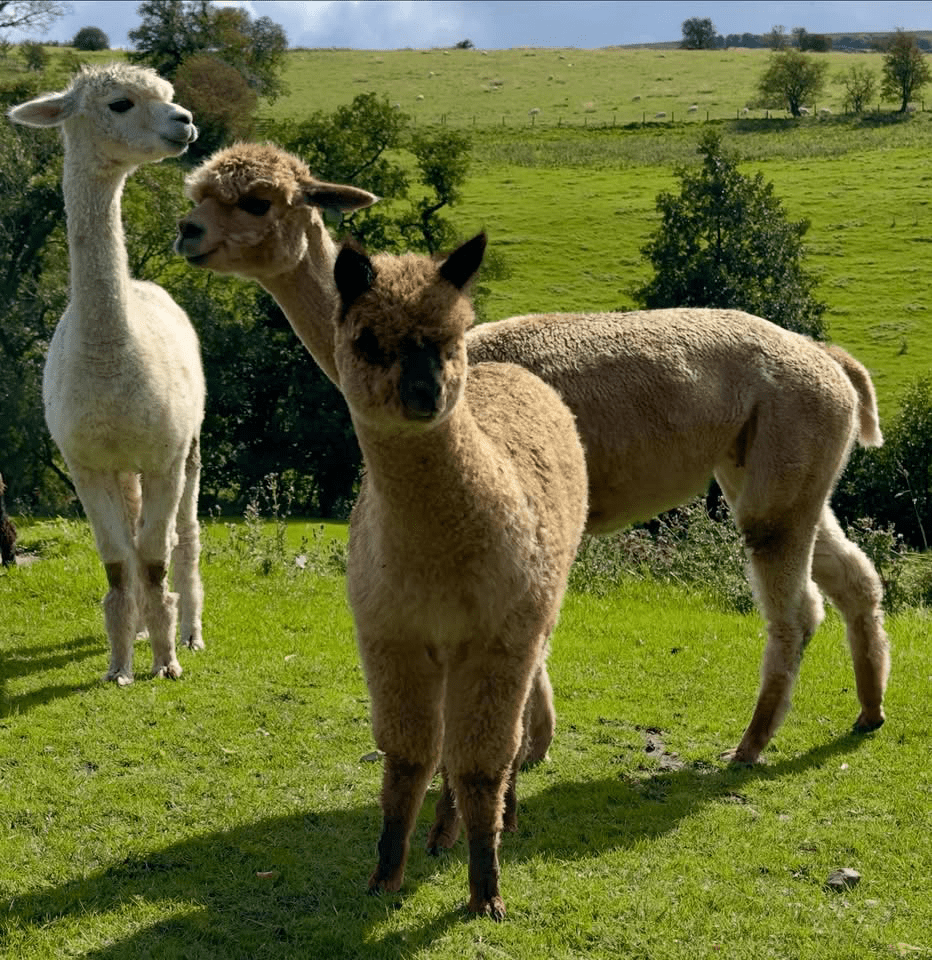
”Are you ok?” a voice queried from a nearby bush.
“I’ve been asking myself that for about eleven days. No, maybe twelve. I am no longer sure,” I responded laughingly to the face that had appeared above the bush, adding the description of how far I had ridden, as well as the bizarre weather through which I had just passed.
“Yes, we never get sleet this early in the season,” he offered consolingly.
”Perhaps we can blame the witches,” I said, nodding toward Pendle Hill, which now was behind the alpacas.
The cafe happened to adjoin a kennel specializing in non-surgical approaches to ailing animals, and as I munched on my frittata and sipped my tea, my hand kept slipping toward my throat where the pendant containing a few ashes of the companion who had accompanied me on my American bicycle trek hung.
The longer I sat on the bench overlooking Pendle Hill, recovering from my harrowing ride around Pendle Hill, the more I felt the emotions welling up inside, a sign I knew to be a dangerous omen because of my brain injury, a usual result of utter exhaustion, compounded, undoubtedly, by Matilda’s thirst for power and the uncertainty of not having secure reservations for the night.
Knowing I needed to reach my destination, whatever it may be, I reluctantly yielded my view of Pendle and the warm sun and clambered onto Matilda.
She had been particularly tricky the first few push of the pedals, in part because of her excessive weight, but as I put my weight behind the initial thrust which should have easily directed us back down the hill we had climbed an hour ago, nothing happened. She refused to move.
The curses suddenly became even more vehement than they had been when she had fallen as we arrived. Flummoxed, I did what was most reasonable. I walked to the alpacas, which of course were part of the kennel, who surprisingly walked willingly toward me. Magic!
After spending a few moments running my hand through their thick, warm fur, I spied the sign indicating they were there specifically for the purpose of being pet. Magical AND therapeutic!
I walked toward Matilda, and as I had done while walking up the slope toward Carlisle Castle, I calmly asked the unseen powers that be, “What am I supposed to see?”
Her chain had come off, and if, for whatever reason she hadn’t been kind enough to refuse to budge, we would have ended in a crumpled heap at the bottom of the hill.
I flipped her over, fumbled a bit, cursed a bit, and finally set her aright again, knowing that we could safely continue on our journey. The same person who had spoken to me from the bush walked out to again question whether or not I was ok, this time extending an offer of water, not tea, and began explaining the history of the farm, directing me to look into the rafters. “You’re not the only one slightly suspicious regarding them,” he informed me. “When the building was constructed, they included a broom to ward off evil.”
It was reassuring knowing that the horror of the trials had not just lingered in my own imagination, but still shaped those fortunate or unfortunate enough to live within the shadow of the flat-topped hill that dominated the horizon for miles.
The cafe had recharged my battery, but not Matilda’s. Nor my phone’s.
Google and I had compromised on a lightly trafficked roadway that seemed a rather direct approach to Sefton, but the further we rode, Matilda and I, the fewer farms we saw and the more residential complexes we encountered, drastically reducing the possiblility of finding a Caravanning site. As the sun, which was quite welcome after the sleet earlier in the day, began sinking lower and lower on the horizon, which was finally no longer dominated by Pendle Hill, the traffic began picking up momentum: Rush hour.
Exaperated, I sat down on a bench on a busy corner to begin bartering with Google once again, only to realize that I had less than 10 percent remaining on my phone. The sense of being overwhelmed that had begun building before the alpaca therapy welled up sevenfold. I clicked the power button on the side of my phone, knowing that with the traffic, I wouldn’t be going anywhere any time soon even if I DID have a specific destination in mind.
Rush hour behavior is as ubiquitously universal as beer and energy drink cans: it appears to be the same nuisance wherever one happens to travel.
As the sun crept lower and lower on the horizon, I couldn’t help but smile in spite of the conundrum in which I currently found myself. Horns blared, angry gestures were thrown, brakes squealed, rights of way were denied: exactly the same as what I would have observed if I had been sitting in Chicago, New York, Los Angeles or Denver on a busy intersection during rush hour. Except the raccouse behavior was being carried out by people driving teeny tiny cars that resembled wind-up toys. As I watched, amused, I felt the tension slipping away, somehow comfortable with my lack of preparedness. After all, I wouldn’t have to deal with the angry stares of a camp host who felt I’d somehow violated his or her sense of comfort by being tardy.
Once the tiny wind-up cars had dwindled and the angry shouts and squealing brakes and tires had subsided, I powered up my phone, did a quick search to locate the nearest Caravanning site, and discovered I was exactly 1.5 miles from one. Relieved, and looking a bit like I had perfectly planned my destination, Matilda and I headed into what we believed would be a perfect sunset.
Upon arrival, I wandered around a bit, looking for an office where I could inquire after a site. Nothing. I leaned Matilda against a wall and began meandering through the well manicured grounds, spotting several vacant sites. I returned to the wall, which had a neatly hand printed sign with a phone number. Given my history of failed phone calls previously, suddenly my sunset seemed a bit less sunny.
After hearing the formal female Verizon voice informing me what I already suspected to be true, I decided to take a photo of the sign and send it to my daughter, who could call from the US to enquire after a reservation at one of the vacant spots. As I awaited my daughter’s response, relishing my clever approach to the situation, a woman emerged from a nearby home. “May I help you?” she stated accusingly rather than questioned.
Another ubiquitous element: arrogance, and how easily it is conveyed.
”May I make a reservation for the night?” I asked, attempting to overcome my mounting trepidation.
”I’m sorry,” she retorted with the same tone that in no way conveyed an apology, “we don’t allow tents.”
”I will only be here for one night,” I responded, adding, my phone battery as well as my e-bike battery are frightfully low, and we have ridden over forty miles today through the inclement weather,” I offered, hoping to impress her if not with my desperation and diligence than at least with my vocabulary.
“I am sorry,” she repeated with the same non-apologetic response. “There is a site a few blocks away that allows tents,” she said with an added emphasis of disdain. “Good luck,” she threw snidely back at me over her shoulder as she turned away.
Matilda and I rode the few blocks back up the same street we had just pedaled down, but this time the sun didn’t seem to shine quite so brightly. We maneuvered our way through a gate, where I abandoned her to repeat the same process I had just done a few blocks away. The field was covered in muck, and the few posts with electricity dangled frightfully lopsided as though they had been struck by camper vans repeatedly. The sites with posts still intact were all occupied by bedraggled mobile homes that would make a site in America recently struck by a tornado look safe.
A man with a scruffy beard exited one of the desolate structures, scratching the holey, stained t-shirt straining to cover his emaciated belly, and a cigarette dangled precariously out the side of his mouth. “What can I do for you?” he said with an odd echo of the former campground host’s arrogance.
”I was hoping to secure a place for the night,” I informed him, but added with a sense of relief, “but I see you don’t have any sites available,” I threw over my shoulder as I mounted Matilda, willing her to cooperate and comprehend my urgency to flee as quickly as possible. For the first time in days, she willingly complied to my desires.
WIthin less than thirty minutes, well before darkness had settled, Matilda found herself unceremoniously attached to a pole, front tire dangling, at last utterly freed from all her excessive weight, while I contentedly trudged into the lobby of a hotel, a twinge of fear resting in the back of my mind at the slight pull I had felt while hefting her bags off the ground, a familiar warning that I had pulled a muscle doing so.
Yet another regret lingered in my mind: each day, I had pulled into camp so utterly exhausted I had quickly succumbed to sleep after downing whatever meager dinner I had scrounged either at the campsite food cart or from the dwindling supply of tuna packets nestled at the bottom of her overstuffed saddle bags, neglecting to stretch my right arm after keeping it tensely frozen in a single position as I grasped tightly to her handlebar, precariously maneuvering the fine balancing act between keeping her aright, pacing the stroke of my legs, constantly shifting her gears and power output in an attempt to maximize her battery life, and too often tightly gripping the lever of her non-extant brakes. I shrugged as I hefted the bags after checking in as I followed the hotel’s very accommodating front desk attendant, marveling that for the first time in my life when offering my name, I didn’t have to begin rattling off the alphabet soup of letters of which it is comprised. “Oh, no, I got it,” she had pleasantly informed me as I had begun the decades-old, familiar cadence. It was only then, in the shadow of the dark hill that had haunted my horizon for nearly two days, that I realized I perhaps had come very close to being “home.”
Having a service dog is a mixed bag. She literally has taken me to heights I simply cannot go, providing the balance to ascend and descend paths I could not have followed without her assistance, the grounding necessary when my post-morbid vertigo rears its ugly head. For the first year and a half, I relied upon a walker for mobility, stuffing it into the back section of my tiny Fiat and extracting it when I knew I was most likely to experience vertigo.
”Whoa there,” my physical therapist had exclaimed as she reached for me to help me off the floor about three months following my injury. We were slowly walking around the facility, working on side steps, line steps, and high steps, toe-to-heel steps, slow motion exercises of the running ones I had performed often during Tae Kwon Do warmups the years I had dedicated working toward my red belt, the highest level I had achieved. The physical exercises had followed the initial challenge of learning how to manipulate stairs, an important aspect of healing since at the time of my injury, I occupied a bedroom on the second floor, while the kitchen where I prepared basic microwaveable foods (I’d not been released to using a gas or electric stove because of the risks entailed).
The first six months of recovery is a drug-induced haze in which I had been instructed to avoid bright lights, so even emerging outdoors wasn’t permitted unless I was on my way to PT or my physician. I’d been released to drive only after my physician realized as a single woman with only adult children who were unable to care for me with the caveat that I never drive after dark and that I choose a route with streets where the speed limit did not exceed 35 miles per hour, an easy task since both the brain injury recovery facility and my physician were luckily only a few miles from home.
Sleep, they said, was essential for recovery, so the meds kept me rather sedated, with scheduling specifically timed around the three appointments I had throughout each week. So I slept. And slept. And slept. And went to therapy, where the slow process of recovery began.
”You seem to struggle most with ‘dg’ and “tch” blends,” my cognitive therapist had noted, handing me a several page long list of words with that particular sound. “Judge,” ”trudge,” “budge,” “nudge,” I would recite aloud to myself, thankful that the only sound accompanying my chants was the screaming parrots in the next room, a sound that would make me clench my eyes closed tightly with the subsequent pain echoing through my head it produced.
”Son of a bidge,” I would begin after taking several deep breaths to block out the pain, knowing I was as stubbornly determined to regain as much of my broken brain as I possibly could in the two year window the physician had told me I had following my injury.
”Well, you look fine,” I would often hear when trying to explain why I was no longer working or interacting socially as I had once done.
An invisible disability is often met with what people believe to be words of comfort that only serve to enrage or frustrate. No, I didn’t have any visible scars, any outward sign to others that I was broken. They could hear it if they listened carefully, but most humans are too self-focused to pick up nuances like a slower pattern of speech, a slight hesitation before speaking, a pensive scowl that accompanies the process of word finding. Or the slow gait, the slight stumble, the tight grasp on a grocery cart that keeps a customer aright: all traces of a brain reeling from a barrage of sounds, sights, smells and textures the brain is no longer capable of filtering out. Symptoms that resemble a person who is slightly buzzed.
”A newborn is unable to see clearly for months,” my physical therapist informed me. “In part, it helps preserve their brain from processing too much information. As their vision clears, their brains begin absorbing more information, and at that early stage, they begin learning the process of filtering out stimuli that is not crucial for survival: the motion of a falling object that is out of the range of striking them, the sound of a closing door that doesn’t bear any consequence on their immediate safety, the things that you will find your brain no longer is able to filter.“
Because of the trauma from my injury, I was hyper sensitive to those types of stimuli because my own sense of safety had been violated, and my weakest field of vision, the one that had been over stimulated by an innocuous office door sign that driven me to drop suddenly to the ground, mirrored the upper left segment of my head that had been struck by the hydraulic lift.
Even a decade later, I still am unable to see whatever may appear in that upper quarter of my left field of vision, another symptom for which I have adapted. And must continue to accommodate.
I sobbed uncontrollably as my physical therapist helped me to my feet, shaking, unable to walk for several minutes. “We’ll begin treatment for Post Traumatic Stress Disorder next week,” she calmly mentioned, adding to my growing list of specialists and appointments. “And perhaps for now we will continue working in the gym where you are more familiar with your surroundings rather than attempt the hall.”
Shaken, I entered the cognitive therapist’s office, thankful I had another gruelling appointment before attempting my prodigiously slow, cautious drive home.
”Let’s work on blends,” she instructed, handing me the familiar list of words with “tch.”
”Witch.” “Snitch,” “Flinch,” I recited ad infinitem with relative success.
”Good. Now for the ‘dg’ list,” she said, noting that I had done so well with them the previous visit.
”Bri—-dsge,” I slurred. “Lug—gggu,” I stammered as tears streamed down my face, a process of mourning the loss of the very thing that had become my refuge: words, accompanied by the angry realization that that these blends comprised the very objects I which had surrounded me at the moment my life had forever changed.
”Perhaps that’s enough for today,” she said when I had been unable to continue, nonchalantly handing me a box of tissue. “Take a few minutes to recover in the waiting room, please,” she coldly instructed me as I stumbled toward the door. “Don’t attempt to drive until you feel ready,” she reminded me.
Two steps forward, five steps back.
As I stumbled up the stairs toward my hotel room, the saddlebags pulled at my right sore right shoulder. I understood the respite was much needed. I had taxed myself too hard that day, knowing I had only three more remaining of my trek that had been abbreviated by Matilda’s reluctance to travel as far as I had mapped.
I emerged from the shower, dripping wet socks, pants and shirt in hand. I’d prolonged the warm spray as long as possible, using the opportunity to hand wash the two outfits I had been wearing over the past eleven days, wringing them as well as possible while keeping everything but my arms under the refreshing stream running down my body, thankful for the warmth, especially with the realization that the temperatures were predicted to plummet into the twenties over the next two nights, something I hadn’t anticipated.
I toweled off, shivering in the cold bathroom, believing it to be a response to the drastically unfamiliar warmth of the protractedly long shower.
Within a few minutes, my hotel room looked like the backyard of my childhood with clothing draped on every possible surface to aid in drying.
I continued to shiver, placed my hand on the still cold heater, and crawled under the welcome clean linens, a welcome indulgence given the moldy stench that had begun to follow me like Charles Schulz’ dust cloud surrounding his well loved character, “Pig Pen.”
”Um. If I were looking to escape the dropping temps tonight by checking into a hotel,” I texted my daughter on my phone still attached to one of the many cords our tech-driven civilization requires, “I seemed to have failed.”
The anticipatory dots of a text being composed blinked under my message, then disappeared without producing a response. I began surfing social media, and a few moments later I got the happy ditty announcing a message from her.
”It appears a number of patrons have made the same observation the past few nights,” she explained, adding the latest reviews of the overpriced room all mentioned a lack of heat. The hotel had obviously been as unprepared for the cold snap as well, and hadn’t been able to transfer the system from air conditioning to heat.
Suddenly I was a little less impressed with the front desk receptionist who had successfully spelled my name as she juggled reservations to accommodate me in what she had identified as a fully booked hotel.
I pulled the comforter a little closer to my chin, then frustratingly threw it aside, pulled my moldy, dank sleeping bag out of the heavy saddle bags, threw it over the top of the clean linens, sighed, and promptly fell asleep.
Setting an alarm is rarely necessary because of the unusual sleep patterns I have had throughout my life. Excited for the day’s journey, which would take me to the chapel and manor I had spent over two decades studying, I rose early and reached for my riding outfit.
Sleeping in a cold room is one thing. Drying wet clothes is something far different altogether.
Every item of clothing I had brought with me was nearly as wet as it had been the night before as I emerged from the shower. And since public display of nudity is frowned upon by all cultures, I realized I had made the dreadful mistake of not even being able to inquire about possibly accessing a hotel laundry facility.
”Train up a child,” I recited to myself, remembering the numerous times I had relied upon a blow dryer to dry the only pair of jeans my conservative mother had allowed me to own in high school. As I awaited my weak hotel coffee to brew, I began the arduous process of blow drying my clothes, humored by the way my lightweight thermal shirts waved in the blast like a Tall Boy air dancer, but rather than advertising cheap tires, it heralded my lack of foresight.
As the steam began to rise from my clothing and the hotel room began to warm from the condensation, I appreciated that I had solved two of my dilemmas at once. Now if only I could somehow magically make the hotel coffee a bit more palatable. As I sipped the slightly tepid, light brown liquid, I better understood the English obsession with tea. The coffee I had rolled upon since crossing the pond had been simply dreadful, and the hotel coffee was not an exception. But caffeine fuels my post-morbid life.
”Your lack of concentration and focus is symptomatic of brain injuries,” my physician had explained after I had complained of an inability to focus long enough to complete a project. “While it is still in experimental stages, some patients benefit from the same types of drugs prescribed to ADD or ADHD patients,” he added, “but your heart palpitations on both Ritalin and Adderal, given your father’s early death due to a heart attack means we will have to address it differently.”
The solution: more cognitive therapy, and, far less odious, caffeine! “Don’t expect to be able to function until you’ve had your morning coffee,” he advised, laughing when I pointed out many Americans found themselves living by the same mantra even though they hadn’t sustained brain injuries. “True, but at least now you may say it is medicinal. But sadly your dependence upon Starbucks is not tax deductible.”
As I had ridden across America a decade earlier, creating art and writing three 800-word blogs each day had been easy. My girl and I would start early in the morning, then as temperatures would begin soaring, we’d find a cool tree to pass away several hours before the cool evening, when we would hit the pavement again. She’d contentedly sleep beside me while I would sketch, paint, and write. Those hours had been the most creatively productive in my entire life, which may be why they are also among my most happy.
Between my need for sleep and caffeine, coupled with my post-morbid lack of attention span, even though I had the beautiful journal and my iPad on hand, my time in England was dedicated entirely to two things: keeping Matilda upright as we rode far fewer miles than I would have liked and sleeping. As for blogging, even now I am astounded that a full season has passed and I am still slogging away at recording my thoughts and experiences. No amount of caffeine or cognitive therapy will ever fully restore my ability to concentrate on a single goal the way I once had, another skill I mourn regularly.
As I began unplugging my fully charged batteries, the dog tags I had worn on my trip fell to the ground, jangling with a tonal value I had hidden deep in my subconscious. Tears welled as I reflected fondly upon our trip together. I slipped my medical ID tag identifying me as a TBI patient, an identity I will never escape, over my head, and as the cold tags hit my chest, I gasped, not just because of the temperature, but because of the visceral reminder of how much I missed the old girl, as well as missed who I had once been. Her rabies tag and the metal identification tag they had included with her ashes when they had been returned to me after her cremation rested against my heart.
I reached for the other chain that had fallen to the ground, a silver one with a blue crystal heart shaped pendant dangling from it that contained a small amount of her ashes. I had wanted to take her along on this journey.
A service dog, while it comes with added mobility and freedom, also comes with a remarkable burden.
Like my medicinal caffeine, any expenses she incurs are not tax deductible, including even her vet bills. Anyone with a pet understands the time, emotional and financial committment that comes with the fuzzy companionship. But a service dog is even more of a committment than just normal upkeep. Mine has undergone three separate periods of training, and as a service dog, other than an hour or two at a time prior to my trip to England, she has perpetually been at my side.
As a two year old, I left her in the care of someone for only a few hours. Against my wishes, he crated her. When we returned, her paws were bloody and she had gouged deep gashes in the plastic bottom of the crate. After that fateful time, I have rarely entrusted her care to anyone else. She rides, eats, sleeps and walks beside me nearly everywhere I go, including restaurants, art museums, grocery stores. And when she isn’t with me, her white fur is a constant reminder of her presence in my life, an absence on my trip for which I had found myself to be oddly relieved.
She had in her own way, though, financed my trip.
“We are going to have to extract a few teeth,” her vet advised me when she had just barely finished growing her permanent molars. “Some breeds are more genetically inclined toward tooth decay,” she explained when I expressed surprise. “Normally we see it in terriers, but it isn’t uncommon.”
Five years, seven teeth, over two dozen scans and biopsies, and thousands of dollars later, we finally discovered the root cause: as a four month old puppy, she had swallowed a large ear of a stuffed animal, which had continued to fester undiscovered in her stomach. She is fully insured, but the points on the credit card while we awaited reimbursement netted a substantial number of travel points. As I fastened the pendant around my neck, I felt a twinge of guilt knowing how much I had enjoyed the time away from my great white beast who had helped me so much the first several years following my injury, especially since I still rely heavily upon her when the vertigo strikes, a common occurrence when we attempt to traverse areas with deep crevices.
Like all of my lingering symptoms from my TBI, she is my constant companion, for better or for worse, in sickness and in health, a slightly painful reminder as I began packing the saddlebags and again felt the twinge in my right arm from failing to stretch as much as I should after the long days of wrestling with Matilda. At least my great white companion weighed less, I reminded myself as I hefted the bags onto Matilida’s rack, and was usually more inclined to keep me aright rather than doing whatever she could to throw me to the ground. But their similarities were noticeable: both had been the means for taking me to heights I had only dreamed of going, so in the same way I had reflected upon the benefits of my service dog, I offered Matilda a measure of praise for the journey toward my family’s manor upon which we were finally embarking.
No Foot Shall Slide: Giggleswick
September 11, 2024
Dragons, princes, myths, legends, ghosts and gargoyles. Growing up feasting upon the literary offerings of Hans Christian Anderson and Brothers Grimm, fairies, elves, trolls, and even talking animals have populated my imagination from my earliest memories. One of my sisters had struggled academically in grade school, so her chore had become reading to my brother and I while the other sisters did mundane housework or cooking.
Baby Feet. The multi-volume collection we had been gifted by an elderly neighbor was far from what would be considered politically correct, including controversial tales like Little Black Sambo. Every afternoon, she would reach for any one of the many volumes of stories, and I would excitedly run to her, curling up beside her, relishing whatever world into which she would guide us, accompanied by the delightful illustrations that brought the stories more vividly to life. For me, the greedy griffins, misunderstood ogres, evil queens, wicked wolves, cunning foxes and daring dwarves were as real as the baby Jesus and stately magi contained within the créche we religiously set up every Christmas.
Angels, witches, demons, prophets and saints were no different in hierarchy than the characters that inhabited enchanted forests within those stories we escaped into each day, so as the opening chapters of my first and last novels unfolded, the inclusion of all types of grumpkins seemed a natural progression.
“Swyrd,” the name borne by the first woman progenitor who married into the Molyneux family, my research has revealed, has several possible origins, including the Celtic term for “spell.” The opening of my novels unfold in a dense forest where the protagonist, ill from drinking water an albino moose had led her to, hunkers down, prepared to meet her fate. The bells from a nearby village peal out the warning of the pending attack by the marauding Norman forces that had spread like a cancer across England after defeating Harold Godwinson. She had escaped from her own village atop Pendle Hill, fleeing with the treasure her grandmother had entrusted to her. Sure of foot, she had fled north loosely following a trek she knew well because of the numerous times she had taken it throughout her earliest childhood, one of the eight journeys she would take each season with her grandmother: a pure flight of fantasy grounded in the harsh reality of history.
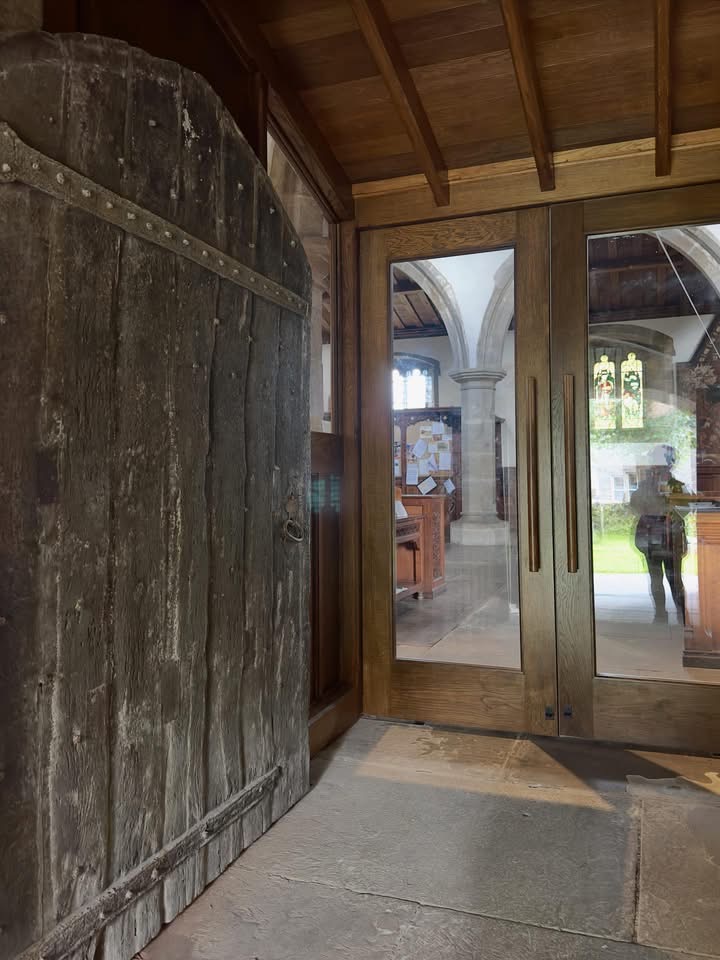
The Force, a substantial waterfall, is where she takes shelter, hoping to escape the invaders burning their way across the land.
The scenario unfolded naturally, as swiftly as the current itself, influenced by the geography and the uniqueness of the village below.
The old chapel is dedicated to Alkelda, an obscure saint venerated only in England, with only one other site bearing the Saxon princess. Like many of the sacred sites across the world, it has been assimilated by each new religion that has passed through the area, which in this case has been Pagan, Catholic, and now Church of England, the official government sponsored organization predominating most places of worship across the country, though since the Protestant Reformation, an increasing number of sects have been allowed, though they are still, as with the Salvation Army, legislated by Parliament and the Crown.
Unable to locate it in spite of the captain obvious “Church Street” because Google had done what Google does best, I stopped and asked the only person I saw on the street where it may be located. I had described it as “the church which had been built upon an old Pagan site,” realizing only afterward that descriptor could apply to nearly every place of worship across England.
“Oh,” he exclaimed, “it is in the next town over from here, Giggleswick.”
Confused because I believed that to be the town I was in, he chuckled and said, “Giggleswick is about three blocks away,” then kindly advised me to drop by the museum, which had a coffee shop, a sad addition to his invitation since it seemed to be the selling point for visitors over being able to explore the unique history of the area. “At the church, if you are able, make sure to step indoors for a glimpse of the blocks that had once been part of the original sacred temple,” he added as I mounted the seat of Matilda, returning to the small independent half mile village through which I had just passed.
St. Alkeda Church celebrates assimilation throughout time. Its richly dark oak pews have runes carved upon them, and the stones originally used in the Pagan place of worship sit side by side with the sanctified Christian font, details of which I was unaware when I placed my opening scene at the nearby waterfall, a perfect symbolic backdrop for my first novel which emphasizes the process of a Pagan woman as she attempts to navigate the tumultuous waters of a marriage to the very people who would have subdued her clan.
The waterfall itself is situated up a small lane with a steep grade. Matilda and I coaxed ourselves up as far as we dare, but given our mishap a few days prior, when she refused to climb upward even with electric assist, I wisely stopped and she contentedly stayed propped against a stone wall while I continued the climb on foot. About a mile above where she stayed perched, I heard St. Alkeda’s bells toll.
”Excuse me,” a woman shouted with an Australian accent from a vehicle climbing the same narrow lane, startling me from my quiet reverie. “Is there a car park near the waterfall?”
I had stopped my slow ascent to enjoy a bald spot on the hill nearby, which appropriately had the shape of a dragon’s claw. I smiled, answering with my very American accent, “Yes, I believe there is space to park beside the road,” proud that I had been mistaken for someone local enough to have the werewithall to provide driving instructions, an odd sensation that would be repeated several times over the remainder of my excursion.
I’d taken exactly two pairs of footwear for my month long trip: a pair of heavy hiking boots and a pair of winter white canvas tennis shoes, opting to wear only the hiking boots and leaving the lighter tennis shoes with my backpack at the e-bike rental shop in London, a choice I never regretted in spite of the very soggy feeling with each step I took as I trudged up the hill because once I began the quick descent toward the force, I needed the traction, which had also come in quite handy while pushing Matilda through the numerous cow pastures to which Google had directed us.
The location was even far more perfect than I would have ever imagined. The sister villages spread out below, and, unexpectedly, Pendle Hill was faintly visible upon the horizon. My research had disclosed it would have been from another site which my protagonist visits atop one of the nearby white dome capped hills, but I had been unable, until my trip, to discern whether or not my protagonist would have potentially seen the smoke rising from her own village on Pendle Hill.
Trauma, as both Wordsworth and Keats acknowledged, shapes one’s perception even when one intentionally tries to subdue the event or events that caused the trauma, a process explored by Freud and Jung a generation later.
Jung believes the human psyche to be a collection of memories passed from one generation to the next through collective memories, sensations, experiences and reactions that shape one’s descendants, a belief shared with Indigenous Australians.
As I stood near the waterfall, I felt a sense of Deja Vu, a feeling I had been at the very same location. I sat for awhile at the cusp of the ravine, listening to the water rushing below me, the call of the birds nearby, the chittering of chipmunks, undoubtedly angry I had intruded upon their autumnal task of storing away morsels in the niches formed by the knotted roots of the ancient tree upon which my back was resting. Is there a collective memory? Have the experiences of the past shaped who I am today? Are curses spewed by angry family members generations ago still a power which forms one’s fate? Do the sins of the father visit upon the seventh generation?
Or had my research been thorough enough, my homework completed so adequately that I had merely mirrored what I had found on the interwebs and my own novel had shaped the reality which I was currently experiencing.
The Romantic poet in me knew otherwise.
Reluctantly, I trudged back down the steep lane toward Matilda, feeling an increased sense of fondness for her with the knowledge that she had allowed me to once again visit a place I had only previously traveled to in my imagination. I glanced to my left at the flat topped, treeless hill on the horizon and wondered how long it would take me to reach my next destination?
March Winds: Scaleber Force
September 10, 2024
The blustery sendoff after a few hours eventually gave way to mild weather, and the all-pervasive stone walls and grassy fields gave way to stone-clad villages with quaint ivy and moss covered homes. The villages, from a very practical perspective, were usually located either on top of a hill where the occupants could observe and approaching enemy, or at the bottom of a hill near a conveniently located stream. Either way, Matilda and I balked at the antiquated placement since it meant extra battery drain.
America is transient: families scatter across the vast continent, requiring hours and even days of travel for reunions. As I rode through England’s midlands, I couldn’t help but wonder if the homes had been passed from one generation to the next where each stone had born the touch of a myriad of ancestors, a thought driven home when I encountered a picturesque scene in which an elderly gentleman with gnarled fingers stuffed mortar between the stones on his house, sealing up the cracks and crevices in preparation for the onset of winter?
Earlier in my journey, toward the evening as I had passed one of the hundreds of villages which would color my trek, I encountered a thatched roof, but because I had to hasten to my campsite, I had been unable to snap a photo of it, convincing myself that since it had been early along my designated route, I would be fortunate enough to see more than just that one. Each village I passed, though quaint and oddly similar to the next in layout and overall design with an old church, a pub and a small market in the center, to my deepest disappointment, I never spied another such delight.
The geography of this segment of Yorkshire differed drastically from anything I had seen along my journey thus far. Rather than being lush, the white sandstone yielded dry, tall tufts of yellow grass, and the domed hills dropped precariously into what would be considered mesas in America’s Southwest. Yet the walls continued to run up the steepest of inclines, demarcations dividing the landscape into clear “yours” and “mine” segments. Like the stone residences in the quaint villages, I couldn’t help but wonder how many generations were represented in the dark snakes that slithered through the fields? And had some of the stones once protected sacred sites both to the original Pagan inhabitants and to the conquering Catholics that too, had eventually been eradicated?
As I pedaled along, I regretted the time constraints I had placed upon myself, longing to seek out at least one of the abbeys that had been dismantled by King Henry VIII, a crumbling edifice among “lofty cliffs” steeped in “thoughts of more deep seclusion” than anything I had yet encountered. Yet I knew that would have to perhaps be scheduled for a return trip, should I have the good fortune to do so.
Clouds once again gathered over the tops of the domed whitened hills as the afternoon unfolded, and I knew once again I would be packing wet equipment in the morning. By this point, the dampness had nearly chilled my soul. But only nearly, because I knew sunrise would see me at one of the most significant sites of my sojourn.
”Ah, yes. The knight,” the host said with an odd tinge of boredom in his voice. “They say you can hear his footsteps in one of the wings of the house,” he added, nodding toward the substantial edifice perched above us on the hill, but the building wasn’t established until long after he died. I suppose I may be one of his descendants, but his significance has faded over the years. I do know my family has been farming this land since the seventeenth century. London is encouraging us to plant trees rather than crops in an effort to return the area into what it once was, but we would cut into our profits, though the restaurant has helped a bit,” he nodded toward the other large building across from the manor with increased animation, and the resentment in his voice indicated the more threatening presence in his life was not one of his deceased ancestors but the lawmakers living in a world well distanced from his own.
After explaining what had brought me to his farm, I asked, “How far to the force?” and his eyes widened with interest.
”You HAVE done your homework,” he observed. “It is one of my favorite places to visit. You’ll see a picture of me and my grandfather in the campground clubhouse where the showers and laundry are located. Though since my brother and I started the restaurant, I haven’t made the time to go there,” he added with the earlier resentment tinging his voice. “Oh,” he added nonchalantly almost as an afterthought, “I hope you have a bit of change on you. The showers and blow dryers are coin operated.”
The clouds amassing above the white hills had not yet unleashed their fury, and warm sunshine poured upon the hedge enclosing my campsite, allowing me to hang my lightweight tent, awning and footprint tarp from the bungee cords that hold my life together on my bicycle treks. “Ah, you are prepared after all,” Matilida’s owner had noted once I had pulled out a number of them from my weighty backpack, a voice that echoed through my brain with the satisfaction of knowing that yes, I did indeed know what I was doing when I set off on my journey. I had in many ways done my homework. I just hadn’t expected what the Weather Channel sylph now showed on my phone: freezing temperatures! I glanced with deepest gratitude toward the warm setting sun that allowed my equipment to thoroughly dry before nightfall.
”We should have known better,” my son had said laughingly as I crawled out from under my collapsed tent in the morning.
We’d plotted out our backpacking expedition along the Colorado Trail since his birthday the previous autumn, using both Thanksgiving and Christmas to pour over the two editions of the guidebooks, determining which segments would best suit our needs because of the pack of dogs that would accompany us. We’d been perhaps a bit too eager to test our equipment, which included my still untested year-old backpack, tent and sleeping bag. Heading into the Rocky Mountains in early spring the first weekend that seemed temperate enough to do so had been foolhardy. Because snow lingered on the ground, we had felt comfortable sitting around a campfire because the ubiquitous fire restrictions weren’t yet in place. We’d hoped to trek further into the woods to our favorite perch above a substantial wood of aspen, but we made it only as far as the still closed, snow-covered campground before setting up camp, unwilling to plough our way through the crusty snow covering chest-high drifts.
The fire had sputtered and spat, angrily protesting our strong wills to recapture what had been the most significant part of his youth: bonfire-like incendiary exercises in annoying our neighbors with raucous parties that lasted well into the early morning. After a few hours of shivering backs and melted shoes, we succumbed and threw water and snow on the embers and clambered into our separate tents.
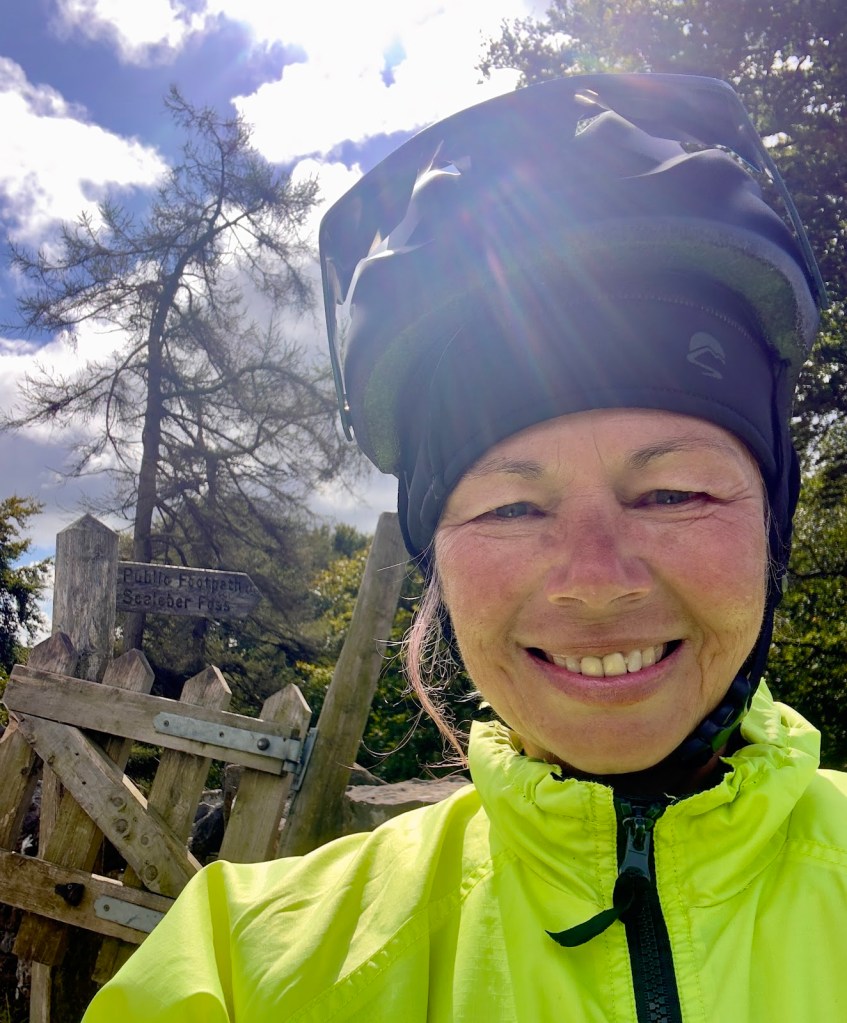
Then the wind picked up.
“Geoff! Geoff!” I shouted, rousing him from his sleep. “The campfire!”
The reluctant embers had burst into a flame far brighter than it had been throughout our evening of diligent prodding, fueled by the oxygenating wind. Begrudgingly, we threw more snow and most of what remained of our drinking water onto the flames, reassuring ourselves that the dogs could eat snow on the return hike in the morning.
A few hours later, we repeated the same motions, this time uncharacteristically sacrificing even the water we would have used to make coffee in the morning.
Assured the embers were entirely extinguished because we had made a grey soupy paste with water, snow and soot, we climbed back into our tents, snuggling underneath the warmth of our dogs.
Then the wind REALLY picked up, and within minutes, I deeply regretted being unable to drive my stakes into the hard, frozen ground. The tent, in a particularly strong gust, toppled on top of me, snapping a pole in the process. Defeated, I assured the Great White Wolfdog all was well, rolled onto my side, and finally fell asleep.
As I set up my now nine-year old tent with one eye always turned toward the clouds amassing power on the hilltop, I drove the stakes into the ground with extra precaution. One of the reasons I relished the opportunity to follow a few of the journeys my protagonists make in my novels was the chance to gauge whether or not they were feasible given the topography and climate, something no amount of online research could ever reveal. With the clouds churning nearby, I knew I could withstand even a cold freak spring storm in the Rockies, but I wouldn’t relish the cold ride the following morning if I had to wear a sopping wet tent on top of me throughout the night.
Amazing: Grasmere
September 9, 2024
The long delay in Grasmere set me back, and as I pedaled furiously alongside the heavy traffic toward my next campsite, I knew once again I was pressed for time. When I had hastily made reservations a few days earlier to accommodate my slower pace, I had been rather certain I had chosen a location that was on the northern edge of the last town bordering the Lake District, but as I left Ambleside, Google directed me to the southern edge.
Trust comes far too easily for me, but I had at least learned to no longer rely upon her suggestions for accessible bike paths, opting instead to risk traffic by selecting the “avoid highways” option accompanied by the automobile icon. I was expecting to share the road with cars. But not during rush hour.
Flustered because I was still apprehensive about being directed to the south part of town rather than the north, I stopped to check my destination, confirmed it was Kendal Caravanning Site, and pressed onward, willing to second guess Google and take a short cut that led me straight toward a dairy farm. This time, however, my choice potentially shaved off an hour, so I trudged through the muck, and breathed a sigh of relief once I hit the pavement of a quaint tree-lined lane that led straight to my destination.

“I’m sorry,” the camp host explained as he glanced at his computer screen for the second time, “I can’t seem to find your name on our reservation list.”
I pulled up the confirmation email, and he grimaced. “Oh, this happens all the time. Your reservations are for a different site. It is only about eight miles north of us.”
Eight miles. After riding forty.
“Please,” I implored, “do you have any sites available? I just rode from Carlisle…”
He cut me short. “Oh, you’re the one who just pulled in on a bicycle. I am sorry. We don’t allow tents, ma’am,” he immediately informed me, and promptly began telling me the quickest way back toward the other campsite. “It’s just a short drive,” he said, then realized his mistake, “but you’re the first one I have had to direct that way who has been on a bicycle, so I may not even be able to direct you there. I think there’s a bikeway that cuts straight through town, though,” he added as I pulled up Google on my phone. “It is paved, so it shouldn’t take you too long,” he assured me.
Defeated, exhausted, and hungry because the delicious gingerbread indulgence had been hours ago, I climbed back onto Matilda’s seat and headed the opposite direction we had just traveled.
The bikeway, other than the annoyingly thin entrance railings mounted at the start of every bikeway in England, was initially just as he had promised, and I began to hope we would make it to the campsite before the threatening clouds that had begun forming on the horizon released their contents, and maybe even before our mandated five o’clock check-in time.
Then it happened.
Bikeways in England are shared paths, and very few pedestrians seem to understand the importance of keeping a dog on a leash when they are enjoying them. Cute, tiny white Fido dashed in front of me as I was approaching a very steep hill, which also featured the dreaded railings at the top. I slammed on my brakes, or what little was left of them, swerving precariously to avoid cute little Fido, dumping Matilda in the process, while Fido’s owner looked on, appalled that I dared to ride a bicycle near her precious.
From previous experience, I knew I should have walked her up the steep incline. Instead, I dared to back away from the base several feet, determined to ride her up since it was, after all, asphalt, not dirt which yielded very little traction.
I made it up exactly one third of what looked like Mount Everest from my perspective, and a young child dashed down toward me. I braked, and this time, rather than dumping to one side or the other, Matilda decided to flip backward. With me on her.
Thank goodness for helmets, because after tipping us upside down, she also of course landed right on top of me, and my head hit the ground with all her weight behind the impetus of the backward fall.
The child’s dad was kind enough to help me to my feet and attempted to upright Matilda, a task, given her substantial weight combined with the steep incline, that took both of us working together. After several incidents of her stubbornly throwing herself back to the ground, between the two of us, we finally got her to the top of the hill.
Fido’s owner, after watching the entire exchange, simply exclaimed, “Oh my,” and turned the other way with her fluffy creature tucked securely under her arm.
I resisted my usual American retort, “Leashes are a good thing,” aware that I may or may not have been directing it toward either the man or the woman.
”Um, you may want to check my dot when you awaken tomorrow to make sure it is moving,” I texted my daughter after erecting my tent at the correct campsite. “We had a bit of a mishap, and I may or may not have done what my doctor had always advised me against.”
”How did you sleep last night?” my neighbor asked when I emerged from my tent the following morning.
“Very well, thank you,” I responded, ready at last to engage in the typical small talk my new acquaintances seemed to relish. “And you?”
“The wind didn’t keep you awake?” he asked. Suddenly I became a bit apprehensive regarding a potential injury from yesterday’s incident and began silently taking inventory: I was able to understand and respond to his questions, I was able to stand without swaying, I was able to see only two of him instead of three or four, and my head felt like its normal size. So far, so good.
“It kept me and my wife up all night long. I kept watching your tent at any moment expecting it to collapse. Or take flight,” he laughed. “You’ve got a very sturdy piece of equipment,” he added with admiration, turning back into his van as I began my morning routine of packing Matilda’s bulging panniers, thankful once again for how remarkable waterproof they were, but realizing I was, after all, thankful I would have to ride through Kendal a second time because I finally would have the opportunity to replace my rain jacket. And I knew just the place where I could do it!
”You should reach out to her,” a friend suggested when he learned I would be passing through a town with a Salvation Army Church. “Perhaps you could at least get a free meal,” he added, knowing that toward the end of my trip across America, I had managed to snag several free meals purchased by the locals who had heard from their friends that I was passing through.
He had learned of my first long bicycle trek across America a few days before I had launched, and was surprised and skeptical when I had informed him of my latest proposed journey around England. “Are you sure you are ready for it?” he challenged as I began making my plans, knowing the limitations I have since sustaining my injury.
”No,” I would always resist responding. And after the past ten days, I still wasn’t certain I would have ever been ready for my journey. Not just because of the challenges presented by my difficult, weighty companion, but because of the magnitude of the experiences I had encountered.
The red journal with the shield he had given me by this point was soggy and smeared, utterly unused because unlike my first epic bicycle ride, I had been too weary at the end of each day to even avail myself of the warm showers I had carefully booked, much less pick up a pen to write. And posting a blog three times each day as I had on my trek across America was unheard of: every bit of electricity had to be reserved for charging my phone and feed Matilda’s addiction to sucking down her battery power.
And although the Salvation Army officer had been unavailable even for brief visit, much less the free dinner he had taunted me with, there WAS a thrift store where I could perhaps find an inexpensive rain jacket!
I leaned my companion against a bench, not bothering to secure her, and continued walking nonchalantly away in spite of the resounding, anticipate crash of her falling to the ground.
“Ma’am, I think your bike fell,” a kind bystander informed me.
“Yes, she did,” I responded without turning around, daring any passerby to pick her up and ride her away after her antics on the hill the previous evening.
I walked straight to the back wall where men’s clothing hung, picked up the huge fluorescent yellow and blue jacket, and turned toward the register, pausing abruptly because a stroller had been placed right behind me.
“It is only a few pounds,” the child’s mother compellingly pleaded to her companion as the curly haired child looked up at me.
“That’s not bad,” her father replied. “Do you see anything else she may need?” he asked as his wife placed the adorable child-sized rain slicker onto the counter.
I gingerly stepped around the stroller, placed my rain jacket on top of the brightly colored garment, and paid for both, informing the cashier as I did, “It’s England. Everyone needs a rain jacket here,” and turned back toward Matilda, who was unfortunately still splayed on the sidewalk near the bench where I had left her. As I zipped up my new waterproof human traffic cone, the blustery wind that had blown all night long unleashed it’s storm.
A fitting farewell from England’s Romantic poets.
My Way: Ambleside
September 9, 2024
Although I have seen a number of Roman ruins on three different trips to Europe, the thrill, I hope, will never fade. This time, though, they were to be even more vividly memorable since they were coupled with the crags which had filled pages of treasured literature, some of the sparkling shards in the kaleidoscope that now comprised my once excessively pedantic storehouse of trivia.
As we would begin our descent down any number of hills across Illinois or Iowa, my old girl would sit up, stick her head out of the opening at the top of the trailer, and let out a howl of delight that lasted until our terrifyingly excessive speed returned to our normal prodigious six miles per hour. On our descents, we were clocked at 54 miles per hour, a speed I simply was unable to control because if I were to apply my brakes, the weight of the trailer would begin pushing me from behind, threatening to fishtail at best, overturn us at worst.
And I hated every second of it.
Ironic since poor Matilda wasn’t equipped with brakes so once again I was cursed to travel at dangerously high speeds as we descended.
Once again, against my will, we literally threw caution to the wind. But oddly, with Dunmail Raise behind me, Windermere beside me and Ambleside in front of me, this time the speed wasn’t unnerving but exhilarating.
”You will reach what we call MMR, Maximum Medical Recovery,” my physician had informed me, “after two years. While you may still continue to see improvement after that time,” he added, “it will be minimal. The first two years are the most important,” a warning that was received with tears since my progress had seemed frightfully, painfully slow.
Little did he know he had just thrown down a gauntlet, and I stubbornly resolved to continue pushing myself well beyond the allotted two year window.
“May I be released to ride my bicycle?” I pleaded, repeating the question each time I returned to my physician’s office.
The answer had always been the same, but I stubbornly insisted upon posing it anyway.
”Muscle memory,” I insisted him, reiterating what both my physical therapist and trainer had informed me, “is one of the strongest mnemonic devices, which is why the specialists began reteaching me how to manipulate steps before placing me in speech therapy,” the final argument which at last persuaded him to allow me to begin riding, especially after I reminded him that just the previous summer, I had ridden over 725 miles, writing as I had travelled, and that maybe exerting the muscles would help me a bit with word recall.
“Please use caution,” he advised. “The last thing you need to do is reinjure yourself.”
After assuring him that I would restrict myself to paths rather than taking on the challenge of traffic and that the bike trailer served as training wheels and helped stabilize me, I walked out of the office for the first time since my brain injury with a broad smile. Cycling has always been my favorite form of escape, and I was certain it would help me regain at least a small measure of the balance I had lost.
My mentor knew long before the scientists revealed their recent research regarding the power of physical stimulation as one of the best ways to stimulate memory. She had learned it from those who walked the earth before her. “I want you to keep a journal this year,” she said on the first day of class, explaining that Dorothy, William’s sister, had joined her brother and Coleridge on a number of their walks. “One of our primary texts this semester will be her journals, and I want you to emulate them by journaling after walking for at least a half hour. You will need to complete three entries a week.”
Her assignment remains one of my favorites I have ever encountered as a student: it combined my love for nature, my love of walking, and my love for writing; a passion shared by Romantic authors and artists alike. One of my biggest regrets as an educator is that while I always assigned journaling, I never coupled it with walking as she had done. She had been able to justify it because it tied into her course work. Only within the past few years would I have had the research to back the value of walking and writing.
“Looks like you have put on a few miles,” the man standing next to me in the queue for Grasmere’s famous gingerbread said as I glanced worrisomely toward Matilda, fearful that at any moment she would throw herself into the traffic speeding near the wall upon which she had precariously been perched outside The Storyteller’s Garden.
I shrugged, smiling wryly and simply responded, “Yes.”
The Lake District is nothing like what it had been when it was populated by the English Romantic Poets. What had been their refuge, their escape into nature was now a tourist trap teeming with signs touting hotels, cafes, churches and cemeteries they had once haunted.
Toward the end of the eighteenth century, perhaps in part because England’s beloved Poet Laureate’s Preludes touting the healing serenity he had found within his childhood had been published, perhaps because the silver rails of Turner’s famous painting had finally reached the formerly isolated gem, the area had become overrun with adventurers. The gingerbread shop had opened only four years after Wordsworth’s poem chronicaling his childhood had been published. And I was just one of the throng of tourists, indulging in the only touristy thing I had done so far on my journey.
“Did you train for your trip?” he asked, insistent upon engaging in small talk.
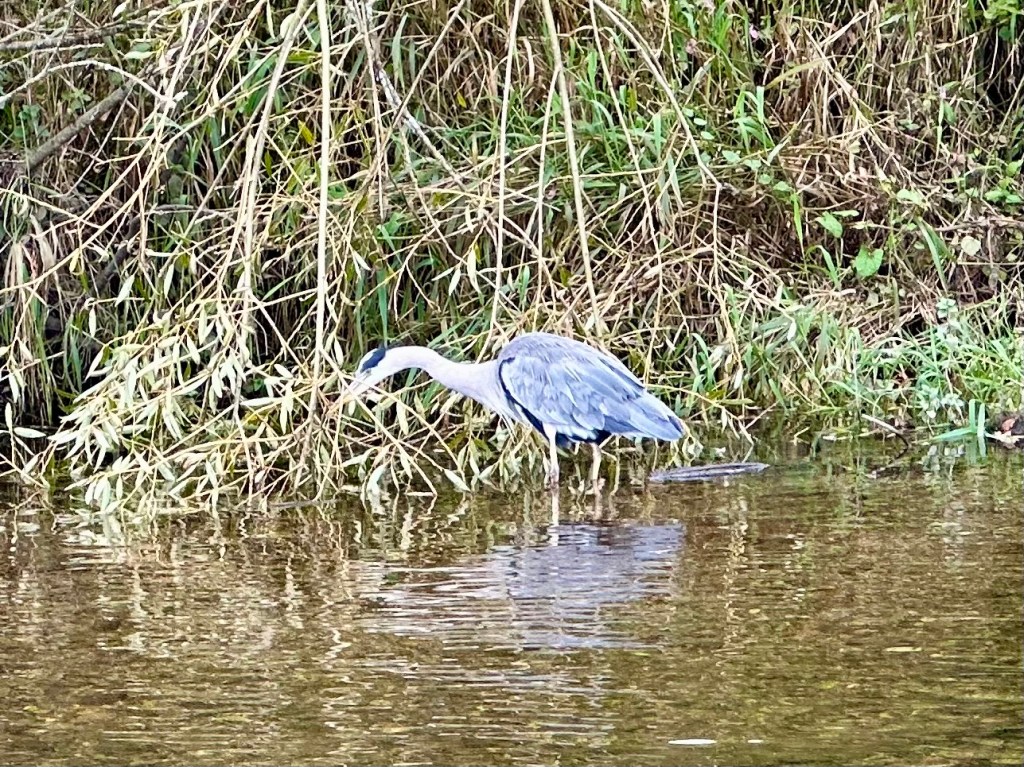
I smiled, nodding slightly, not interested in the interruption to the memories I was storing away.
“I think the intense riding I have done the past few weeks here in Buena Vista have actually helped my brain,” I told my daughter before departing for England. Word finding had become oddly less tedious, my stammer had subsided remarkably and my vocabulary was closer to the level it had once been.
Unlike my trip from Chicago to Colorado in which I hadn’t trained at all, this time I knew I would have to condition myself. As soon as I had begun mapping my ride and plotting my reservations in January, I started the slow canter, “shmuffling,” as I have dubbed it, the very sloggish jog I have resumed, a mere echo of the faster one I had been able to engage in prior to my brain injury.
Then as the soil had become soft enough to till, I spent the first part of the spring engaged in the physically challenging landscape project for my sister, which, once completed, left me confident I had dug my way into developing enough stamina for my potentially gruelling trip.
And within a few weeks, the pink stripes appeared on the Covid test. And reappeared six weeks later when I admitted myself into the emergency room because I was still coughing. I had lost everything I had gained, and I had only six weeks before my planned departure.
”I refuse to cancel,” I stubbornly informed my daughter after leaving the ER.
The great white wolfdog, who has been beside me for six years now, helping me hike steep precipices, guiding me across high bridges, providing balance when I have needed it the most, had been trained to ride in the trailer from the first few weeks she had been part of my life. She quickly outgrew the confined space, who, unlike my old girl who needed frequent breaks from jogging alongside me because of her arthritis, quickly tore her way through the mesh enclosing her. As I dilligently trudged the backroads of my favorite camping spot near where my father and I used to fish when I was a child, the wolfdog set a steady, lengthy pace, encouraging me with each stroke of the pedal.
“Yes,” I begrudgingly offered to the companion beside me. “I rode about 1000 miles at 8000 foot altitude in the Colorado Rockies,” information that had fortunately stunned him into silence.
I may not have appreciated the touristy stop and the small talk it entailed. But the gingerbread, was, indeed, delicious as I followed up my usual packet of tuna with the sweet dessert while sitting in near isolation upon a stone that had once been part of Ambleside’s Roman Fort with a remarkable view of the lake and the crags that had been the backdrop for English Romantics.
The blue heron fishing alongside me on Windermere’s bank was a particularly welcome gift.
Misty Water: Dunmail Raise
September 9, 2024
“Thither I repaired up to the highest summit. ‘Twas a day Stormy, and rough, and wild, and on the grass I sate half sheltered by a naked wall.”
All the English Romantic poets had found inspiration in England’s Lake District. When I drew my imaginary lines, I was thrilled by the possibility of virtually and creatively revisiting the area which had been vividly brought to life through the authors and artists in which I had specialized during my eight years of formal education.
My undergrad honors theses mentors literally glowed when they spoke of it: one had visited often to persent at conferences and colloquiums ranging from Wordsworth to Austin, and the other had grown up near the area, experiencing many of the same sensations the poets and artists depicted while he himself was on school holidays.
To meander breathlessly through the hills and lakes which many of them, including Henry James, had once walked is indescribable.
The first time I glanced through the syllabus, I was inclined to withdraw. Memorization, particularly of very long passages in the Bible, had come easily to me during my formative years, but to do so in my thirties was daunting since as a non-traditional college student I was so often utterly overwhelmed I could scarcely recall my own name, much less tackle the required FORTY LINES of poetry recitation the professor was requiring.
I stayed in the class, in part because I adored the instructor, the one who would later encourage me to visit Europe in order to conduct research for my theses. I choose my passage early, working diligently to commit the lines, employing as many techniques I would later introduce to my own students as they studied material for their own exams.
”If you believe yourself to be an experiential learner, pace as you study, or tap your foot to a specific rythm, then on exam day, establish the same cadence as you recall the information,” I would instruct them. “If you are an auditory learner, chant the material out loud to yourself, or better yet, make a recording of the chant and follow it along as you study. If you are a visual learner, perhaps draw diagrams or doodles as you recite, replicate that on a scratch sheet of paper during the exam, and use it as a cue for recall. If touch seems to be your forte, study the material while caressing a worry stone, and bring it to class on exam day. If your forte is the sense of smell, which, by the way, experts say is one of the strongest memory stimulants, wear a specific scent or drink a particular coffee or tea, and rely upon that as your memory cue. And if,” I would conclude, “you are absolutely terrified of exams entirely and want to do everything possible on earth to not freeze on exam day, incorporate them all.”
Laughter, “the best medicine,” always ensued.
So I meandered around campus that semester with a very measured gait, drinking strong coffee, caressing my warm cup with a doodle on the lid muttering to myself. It’s amazing I wasn’t detained as one of the intrusive schizophrenic creek dwellers. Many of my peers And relatives still question whether or not I may be numbered among them, especially since I have taken to permanently living in a van down by any body of water I happen to be able to find.
Perhaps that is why, when I am feeling most anxious on any of my treks, I belt out poorly remembered tunes: I taught myself to relieve anxiety in the most bizarre ways possible.
Wordsworth in his 9000 line, heavily revised Prelude of 1798, 1805 and 1850 recalls how trauma and nature’s soothing properties shaped his sensibilities. The passage I chose spoke to me on a number of levels. As a feral child of nature whose happiest hours were spent digging worms for my father alongside whatever lake or stream we happen to be camped beside, Wordsworth’s deep appreciation for the misty crags in which he grew up sang compellingly to me. His understanding that his excursions (easily a five mile hike as a child before being called to breakfast) through a dense line of trees that formed an archway overhead possessed a peaceful repose from his troubled childhood touched a chord in my heart. But his experience of losing his father during one Christmas break, as well as the “single sheep, A whistling hawthorn” that had kept him company as he had awaited with deepest anticipation the holiday, struck to the depth of my soul: both my father and my step-father passed near Christmas holidays, one in early high school, the other in my junior year of college.
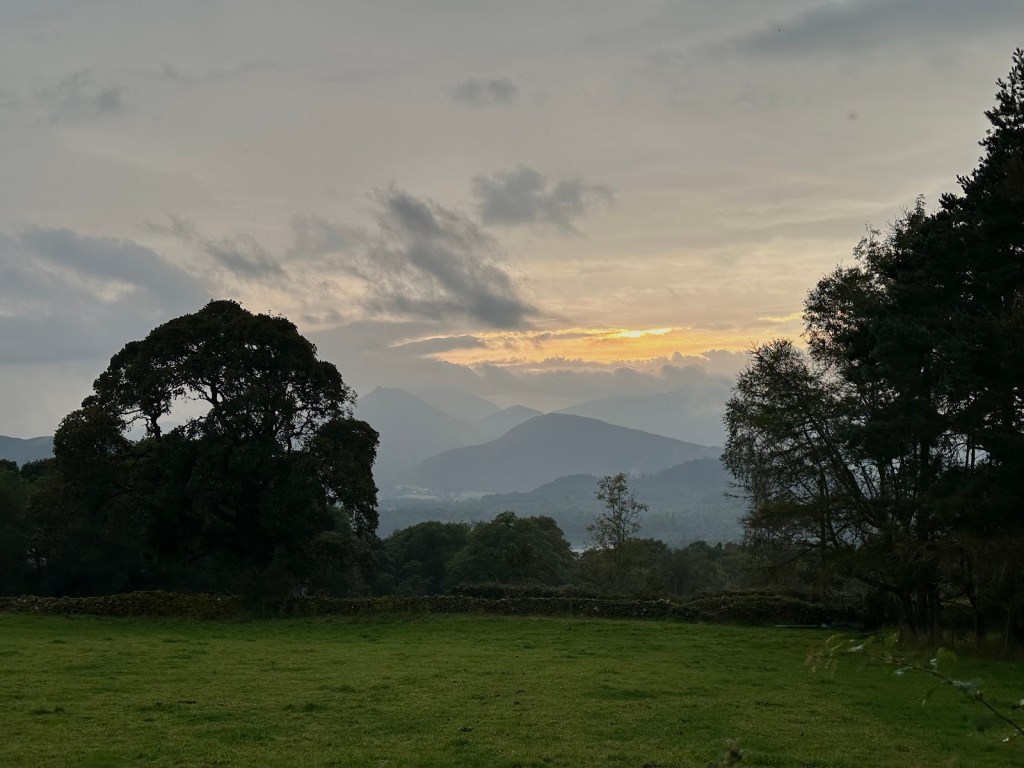
He had never intended his oppressively long endeavor to be published, but it was post-mortem and has become one of his most definitive works.
While I didn’t dare divert to the very crag upon which he sat while “feverish, and tired, and restless” while awaiting “the sight of those three horses which should bear” him home for what would be the last time, simply skirting along the numerous lakes he had so often rowed as a young child was enough.
”I am glad you have slowed your pace,” my daughter told me after I had informed her that I was tracing the very steps one of my protagonist makes. “This seems like it is why you wanted to make your trip in the first place. It wasn’t just the steps of my protagonist I was taking, but that of William and Dorothy Wordsworth, Samuel Taylor Coleridge, John Keats, Mary Wollsentcraft, Mary and Percy Bysshe Shelley, and Henry James, a plethora of ghosts which at any moment could have emerged from the trees along which I passed.
In spite of my slower amble, however, as soon as the road upon which I was traveling reconvened from its split as it had climbed the previous hill, I knew I had missed it. I had been distracted from the site, fascinated by hikers who had paused from their clamor up a barren hill to picnic in a verdant green copse. I stood at the crest, precariously balancing Matilda with my legs, wondering if I should take the time to turn around, knowing that if I did, I would have to give shorter shrift to the other destinations that lay before me in the valley below. I contented myself with stopping to capture a wall climbing straight up the very steep hill and a whimsical Green Man staring up at me from the ground, and began my descent from the highest pass in England.
”Mnemosyne! Thy name is on my tongue, I know not how; Why should I tell thee what thou so well seest?” Keats questioned after writing of the fallen Titans. “I strive to search wherefore I am so Sad, Until a melancholy numbs my limbs?” he ponders. “And then upon the grass I sit, moan, Like one who once had wings. I have heard the cloudy thunder,” which echoes the voice of the fallen ancient gods. “Where is power?” He implores. “Knowledge enormous makes a God of me.” The poet himself becomes the supplanting reigning god with the vast green forested hills and sparkling lakes his own majestic kingdom.
On the Road Again: Thrilmere
September 9, 2024
Knowing that my life is transient, my brother usually begins most of our conversations with his own tribute to Willie Nelson. The miles we had been dragged by our contentious mother and step-father have shaped our psyche, and we are both entranced with road trips. His now are limited to the miles he clocks while on the clock, short stints across Florida Panhandle to visit his dying patients, while mine are slow meanders from one National Park site to the next, mapped out only by the quotient of how far my limited income will take me with the fluctuating price of gas. Our conversations, random stream-of-consciousness exchanges ranging from music to art, philosophy to religion, pop-culture to high culture, always center around our shared experiences and are determined by the length of time we are driving.
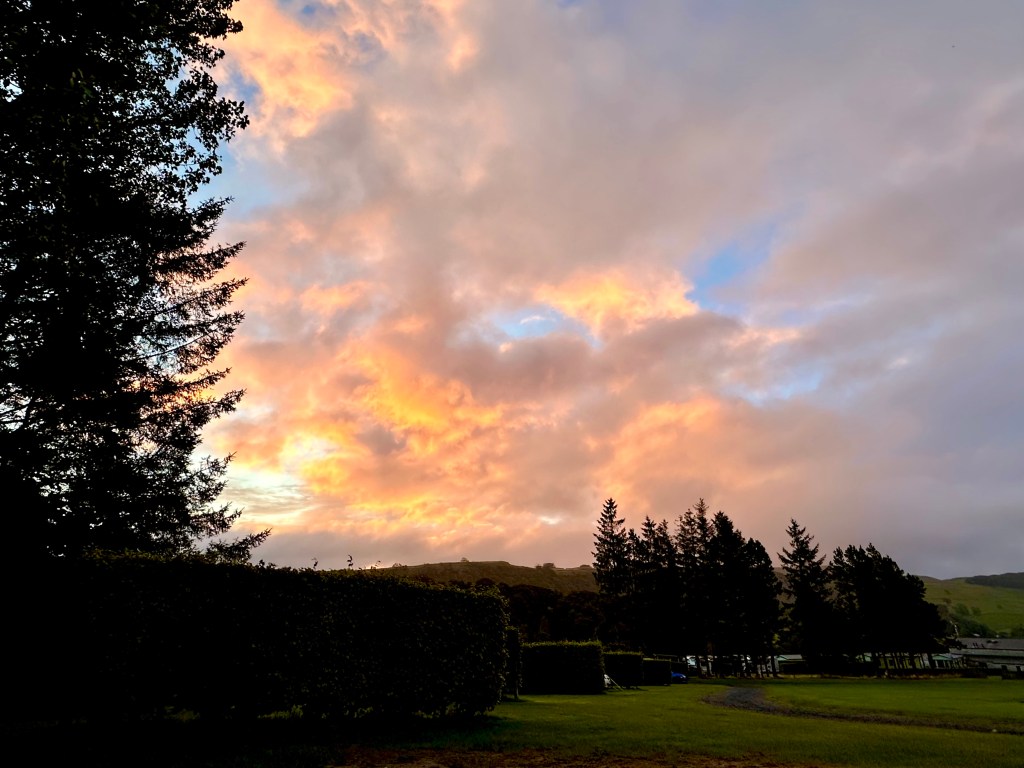
Traveling across England bi-pedally, I mistakenly believed, would have allowed me increased freedom as it had done on my journey across one third of America.
“Please let me know approximately where you will be traveling so I will know where to find the body if I stop hearing from you,” my daughter joked as I prepared for my ride from Chicago to Colorado over a decade ago.
She had discovered a fantastic app, “Findmy,” the one that would later become a primary function of Apple’s way of allowing its users to keep track of the numerous devices they make their customers believe they simply cannot live without: our tethers keeping us tied to Musk, Bezos, Zuckerberg or Pichai.
When my sister expressed extraordinary concern regarding my first protracted journey, my daughter encouraged her to virtually join along, and before I knew it, I had several relatives watching my blue dot on a screen to make sure I am still moving, the only thing, I am sure, that has kept a number of them from yanking my freedom and declaring me to be unfit to make my own decisions. While not all who wander may be lost, in many cases, my family knows that half the time I am exactly that: irretrievably, irrevocably lost, on so many levels. Yet plotting my many adventures is one of the pleasures of my very transient lifestyle, which spilled over into planning the plots of my novels.
”Reading to Write,” an essay by Peter Elbow, encourages authors to read profusely from an array of authors, a process that will eventually produce one’s own voice: an eclectic fusion of material gleaned from a number of genres.
As it turns out, leaving the proverbial contents of one’s brain on a tarmac as hot as the one which grabbed Joan Didion’s stiletto heels will do the same, primarily because I cannot remember much of what I have spent hundreds of thousands of dollars to acquire. Dates, names, images, locations, events and memorized passages have become a kaleidoscope of color rather than concrete minutiae necessary to teach at the higher ed level.
The Pendle Hill witch trial was in part a roundup of impoverished distant relatives of the Molyneux clan who had taken up residence on a significant geographical locale visible throughout most of Lancashire. Undoubtedly, the hill had been stripped of its original forest during the 1068 Hazing of the North, and after six centuries, it had once again become a dense forest where inhabitants eked out a meager living, whether tending small parcels of land upon which they had settled. Perhaps some occupants had turned to menacing travelers who dared to pass through the trees, but thievery wouldn’t result in a terminal sentence. Witchcraft, however, would, so as Judge Molyneux rounded up those who inhabited land that would eventually become profitable farming and grazing territory, those were the most effective allegations castigated upon distant members of his own clan.
The trials as well as the Hazing played large in my imagination as I formulated my novels. What had drawn the seventeenth occupants to the area? As a good day’s travel from where the Molyneux family originally settled following the Conquest, could it have been the homeland where Swyrda, the first pagan woman who married the progenitor of the line would have resided prior to the Hazing?
That’s the joy of historical fiction: the author is able to take known facts and weave their own narrative, a useful tool for one whose memorized facts have been transmuted to mere colorful fragments of inspiring beauty comprised of disjointed snippets of literature, history, philosophy, religion, social sciences, music and fine arts, the programs over which I had once been appointed.
Working from a history book on witchcraft in England I discovered while visiting one of my former students who is now a physician in New Orleans, I started at Pendle Hill, which physically happens to be near the center of England, and drew eight lines which stretched toward some of the oldest sacred landmarks across the land: Jarrow Abbey, Rudston Monolith, Loudon, Rollright Stones, Stonehenge, Garway, Arthuret, and Saint Cuthbert’s, many of which had been included in my original art history, humanities or English lectures. The geographical lines became the treks taken by my female protagonists and correspond with the eight celebrated seasons in Paganism: Yule, Imbolc, Ostra, Beltane, Litha, Lughnasadh, Mabon and Samhain.
Another perk of writing historical fiction: I am able to choose from which fragments to draw, which is why hoards found scattered across England are able to play an equally important role in my novels, as do Notation Knives, carved objects dating back at least to the sixteenth century which depict short songs comprised of poems or prayers recited during traditional feasts. My fictional set of Notation Knives correspond with the celebrations and delineate the eight treks the characters make in preparation for the seasonal feasts as they collect treasures from the hoards scattered along the lines circling outward from Pendle Hill: a compass of knives, if you will, passed from one generation to the next, the same way that art, literature, music, philosophy and religion becomes the purveyor of culture. The characters themselves are not the primary focus of the series, but the adventures and stories they tell and hear as they make their journeys to the 64 locations they visit throughout the eight books in my series.
In order to traverse the lines drawn on my map as my characters do, I would have to stay a year in England. I had two weeks, and I was finally tracing the steps the protagonist in my fourth book takes, and doing it during the same season she does. The breathlessness wasn’t just because of the 6000 foot ascent, but because the land was rich in undiscovered potential and imaginative possibilities.
Black Magic: Hull Pot
September 9, 2024
”Would you like more raincoats?” the gregarious host asked me when I informed me I was departing. “I am sure we can spare a few,” he added with playful laughter.
As I had checked into the campsite office the previous evening so much water was dripping off me I left puddles on the floor as he confirmed my reservation, which had been delayed by a day. He had been only one of two campsites who had been willing to shift my reservation to a later date, a kindness that sparkled in his eyes and exuded with his free laughter.
I’d arrived wearing a black trash bag with holes torn to accommodate my arms and head, one scrounged from the bottom of one of the numerous litter receptacles I had found along the way, a trick I had learned years ago while helping my mother perform her duties as a member of the hotel housekeeping staff where we lived when I was in sixth grade. An efficient housekeeper always keeps a few extra bags at the bottom of a can to save steps while emptying a wastebasket, a technique I was grateful that had transcended beyond my own borders.
After declining the ubiquitous offer of tea, opting for my preferred hot water instead, we waited for the storm to pass with small talk about the henge he had informed me was nearby. “Oh, that’s precisely why I am here,” I replied, letting him know I’d already communed with the old (and new) souls that frequented UK’s lesser known but older stone circle, asking if the landowner for whom he worked perceived herself to be a witch.
“No, I believe you have the wrong letter,” he laughed. “And you?”
“Oh, I have been called both, and proudly wear the “B” with honor since it is undoubtedly how my former students still referred to me. But I am comfortable with either adjective,” I added, “because I have lived with the former accusation for much of my life.
“Writing,” I would inform my English composition students on their first day of class, “should feel a bit like a therapy session. If it doesn’t, you aren’t doing it right,” I would add, introducing them to my favorite Joan Didion essay, “Why I Write,” in which she describes that the summer she was working on her doctoral thesis, she remembers nothing of the content of her pendantic paper, but can still recall the feel of her heels sinking into the hot tarmac of an airfield and the rancidity of the butter on a train she rode toward Budapest where she conducted a bit of her research. “Good writing is about the details,” I instructed, reminding them to include an appeal to all five senses.
”Our nursing students don’t need to write poetic prose in their reports,” the Anatomy and Physiology instructor criticized as I introduced the rubric we should adopt for our accreditation packet. My last year as an instructor had been marked by sharp criticism, and I couldn’t help but wonder in retrospect if it had been fueled behind the scenes by undermining animosity that ultimately led to the elimination of my position.
”Ah, but are you sure?” I challenged. “Doesn’t profuse bright red blood flowing from a wound differ from deep red blood with a distinct smell of rust? Isn’t a wound more hazardous if it is accompanied by the smell of putrification? Isn’t a swollen limb more acutely dangerous if it is hot to the touch?”
A few hours later, my rubric was included in the packet, but a day after the following Spring Break, I received my pink slip nonetheless.
The previous week, we had attended a required staff-wide meeting, which in part had been dedicated to encouraging us to participate in a rice bag stuffing event. No, it wasn’t for a wedding, but a humanitarian aid effort which literally entailed stuffing rice into paper bags, a project endorsed by the President of the college who had introduced a fifteen-minute long presentation advocating the endeavor. A presentation that opened with a number of religious figures and philosophers throughout history compelling humans to extend kindness. While attempting to be inclusive, in reality, it was not. It excluded writings from the Book of Mormon, Jehovas Witnesses, and any Pagan or Satanic Bible, to list a few. An egregious oversight since freedom of religion is one of the foundations of the United States and the Constitution specifically states that no single religion is to be supported by governmental institutions over another.
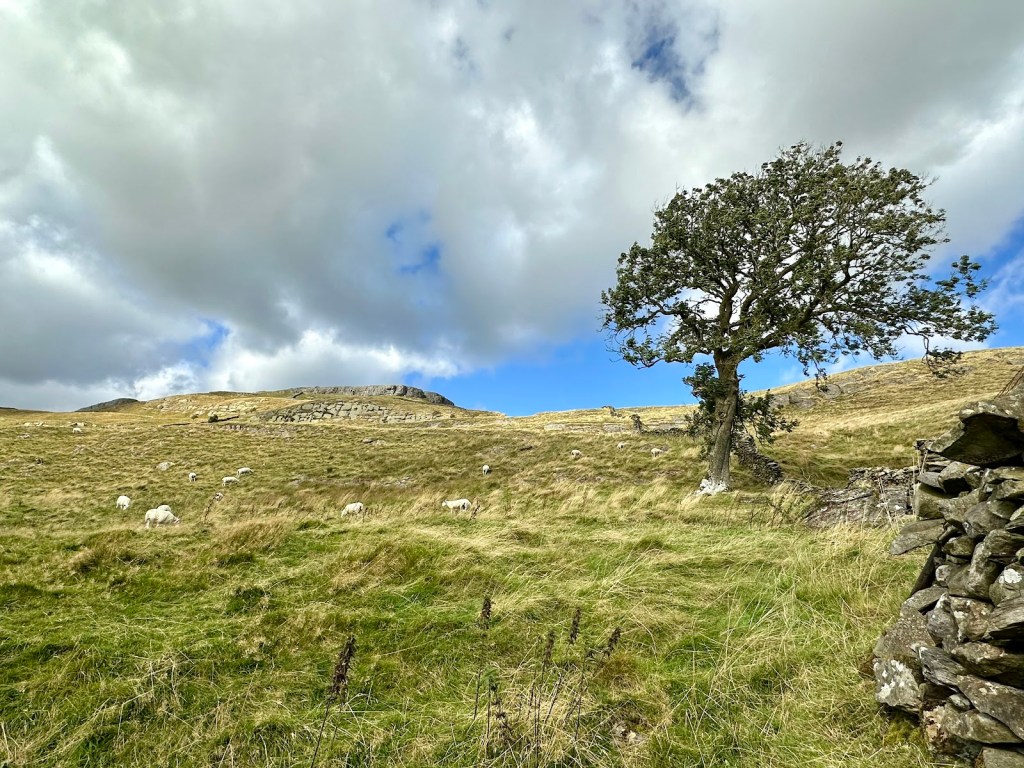
The second part of the meeting was the Community College Human Resources department educating us on ethics regarding, among other things, dating in the workplace.
Guilty as charged. I was the unofficial head of the liberal arts department, charged with developing curriculum, choosing textbooks, and vetting adjunct faculty. And while math no longer falls under the wide umbrella of the liberal arts, when I had arranged him to pick up a Logics class as additional coursework in which he would receive the adjunct instructor’s stipend, my new relationship with the math instructor was problematic.
After the presentation, I approached the HR representative and explained the dynamic and was assured I wasn’t in breach of any policy. Whew.
I also then explained that I had found the presentation regarding the outreach project to be problematic. “You see,” I explained to her, “I had a student recently come to me telling me that as a member of the pagan community, she had felt oppressed by a number of faculty members.” The student had taken her complaint through all the right hierarchal steps, first addressing it with the individual instructors, taking it to their department head, then appealing to the college president. The presentation specifically underscored how problematic the student’s complaint had been.
The student had confided in me after feeling as though there had been no satisfactory resolution, careful not to use names of those who had acted most egregiously. “I feel you are the only one most likely to understand,” she explained. “You seem a bit more open-minded than most of your colleagues,” words that brought a deep sense of gratitude since equality in every way and respect of individual personhood in the classroom had always been my upmost goal.
And within nine days after speaking with the Colorado College Human Resource representative, my position had been eliminated, which meant I wouldn’t even qualify for unemployment benefits.
My complaint hadn’t fallen of deaf ears. A few years later while applying for another position at a community college in a different state, on a whim I visited the National Community College webpage to tailor my letter of intent to apply. I discovered the exact same presentation I had seen prior to learning of my termination, with all the problematic quotes strategically edited. And with the discovery, I also believed I had suddenly understood why the college I had taught had eliminated the crucial full time position of English Instructor, as well as why I had been unable to easily slip into another position at any other community college across America in spite of my experience, my nearly perfect transcript, and my very expensive Master’s Degree. Equality for all came at a high price.
I’d hoped to steal one last glimpse at the solstice phenomenon at the nearby henge, but when I awoke an hour before sunrise to the sound of rain pattering against my tent, I knew that at least this time the Weather App sylph hadn’t erred. Disappointed, I pulled my sleeping bag higher around my shoulders and fell back asleep, offering a prayer to the gods of nature that the weather clear for the next leg of my journey.
Black Sheep: Casterligg Stone Circle
September 9, 2024
They lay prostrate, dying in the same formation they had fought: a small defensive circle overtaken by their foes, the armies gathered by their own sons and daughters. Darkness had descended the hill upon which they had been defeated, an impenetrable black night because the purveyor of the sun itself had been slain in the battle.
The commander’s sister, who had valiantly fought along side him, bent over her brother, whose right, nearly lifeless hand grasped the earth, his final plea to his mother to spare him from every being’s destination, man and god alike.
Sensing her presence, he weakly compelled her to look at him so he could see the destruction of his kingdom through her eyes. He rose to his feet for the last time, circling through his dying tribe, stumbled into the center of the circle they had formed, let out a final powerful wail, willing himself to be capable of creating as he had once done, but at last succombed to his final death.
Memory alone had survived, and she walked the crags whispering of the long ago battle, reminding every conqueror that they and their kingdoms, too, would eventually suffer the same fate: obliteration at the hands of the younger, stronger force.
His cat possessed the space like a confident god, lacidazically stretching as we approached, huge, black, imposing. Disdainfully, he curled into my lap as I sat beside the one’s whose name is writ in water, enjoying my repose as much as I did. We’d come because it was recommended by my favorite travel writer, Henry James.
The cemetery outside the city limits was easy to find: the imposing pyramid emerging from the old city wall. The day before, insistent we begin our tour immediately, we made haste to the steps, climbed up only about a third of them, and felt compelled to rest, turning to watch the other tourists bustle on the street below. “If you ever lose me,” I told him, “you’ll always find me here,” I mused as we enjoyed the shifting colors of the brightly illuminated fountain below. It remains my favorite place in the world: the Spanish Steps in Rome. It wasn’t until years later that I realized I had been as drawn to where he drew his last breath as intrinsically as I had been drawn to his cat guarding his grave.
HJ’s first fictitious heroine of note had been buried in the Protestant Cemetery, alongside many other famous artists: Percy Bysshe Shelley, Joseph Severn, William and Emelyn Story, Constance Fenimore Woolson, and of course John Keats.
We walked in silence reading the names, taking photos as we did. My research had left me so distracted with my hasty scrawls in my journal that he had assumed the role of photographer, but when we came around the corner and found the very bench HJ had written of, I took the camera, shooting it as well as a number of frames with the wild daisies which grew nearby. Numerous photos shot, but once the film was developed, all oddly superimposed upon each other in a single frame, the only time the camera had malfunctioned on the ten-day journey, producing an odd image of daisies floating ghost-like through the space surrounding the bench where HJ had passed long hours while formulating his novella.
As we approached his grave, the black god rose, greeting me by nearly tripping me with its affection. The nuns in a convent nearby, a sign informed us, cared for the cats, who according to Egyptian tradition accompanied the dead. This one looked particularly well indulged by his caretakers.
We sat in the quiet cemetery for several minutes enjoying his kingdom, and when I attempted to rise, his cat firmly placed his sharp claws against my mouth, a seeming benediction, but with an edge because any time I attempted to move, his claws dug deeper into my lips. My companion reached toward the cat to help extrapolate me from my captor, who turned and hissed vehemently warning him to keep his distance, clearly establishing his supreme rein in his grey tombstone lined principality. So we sat for awhile longer.

Finally content with my obedience and satisfied with my abeyance, he eventually stared deeply into my eyes, removed his paw from my lips, and nonchalantly walked away.
Druid Cirque: that is what he had called it in his elligaic poem to the fallen Titans. And for the first time since my arrival, Google hadn’t led me astray, nor did Matilda balk when I leaned her against a nearby post.
Bubbles arose from the stones as I crested the hill, and a child’s laughter filled the air, a laughter marked by joy not dissimilar to the one I had left behind a few hours previous. The perfect, colorful translucent spheres rose into the mist covering the hillside, never bursting until well out of sight.
Ethereal magic: perfectly appropriate!
It is said that one may never count the stones in a henge, but the child delighted in the challenge offered by his mother, skipping around the circle, counting (incorrectly) as he did. Like the child, I lost interest in the numbering, so neither of us reached forty, which is the official count.
”Widdershins,” I reminded myself.
Even when circling Buckingham Fountain in Chicago, I always go counterclockwise, not knowing until I began my research into Paganism for my novels that is the same direction paced during rituals.
The child had begun his numbering spontaneously going the same direction I purposefully walked.
After completing the circle, I reverently stepped inside, walking to the center, admiring the sacrificial items: a damp, dark feather; a handful of berries; a smooth, round stone; a small piece of cloth.
I transected the cirque, disappointed the mist covered the mountain to the east upon which the autumn solstice sun would appear, already aware that the following morning’s sunrise would be obscured by rain clouds, something earlier worshippers would never have been able to predict with the same accuracy as the Weather Channel App: a form of magic in its own right, and equally as unreliable as a sylph’s prophecy at times.
I’d spotted the hole with its unassuming object on my first meditative round, knowing that was where I would enjoy my simple lunch of packaged tuna: the stone fruit, shriveled and dry, offered by someone seeking a child of their own.
Another child ran toward the circle, shouting petulantly at his companions: “I want to climb each one,” he insisted, scrambling, clawing, kicking them angrily when he was unable to stand atop the tallest ones because the surfaces had been weathered to a sheen by millennia of mists and sun. The child’s guardians didn’t bother to quiet his shouts, stop his disrespectful behavior, but instead bribed him away with a promise of an ice cream cone.
”Kum-by-ah,” a man jested with his companion, taking her hand as he danced her toward the center, proclaiming, “Oh, look, the center altar stone isn’t missing, it’s just sunk a bit,” referring to the sacrificial stone someone had offered.
The magical bubbles that had greeted me initially had long disappeared.
The mist broiled darkly, growing heavy, and the crags surrounding the stones became darkly foreboding, and when they released their angry pelts of cold rain, the crowds scattered, leaving me alone to enjoy Keats Titans.
The single black sheep in the nearby field bleated farewell as I turned to go, compelled to arrive at my next destination before darkness overtook us.
“Yes, sir! Yes, sir!” I responded quietly to him as I walked across the forlorn moor, rain dripping from my drenched hairline, streaming in rivulets down my face. “One for my master, one for my dame. And one for the little boy who lives up the lane.”
High Hopes: Threlkeld
September 9, 2014
“Why do I bother listening to you?” I chided Google for sending me along a path which I had shared with a herd of sheep while the soft jangle of cow bells echoed nearby. I looked up the steep hill we had encountered at a small village about 300 yards behind us, a sleepy little town where the only fiberglass the passersby possessed happened to be their walking sticks.
Knowing it was more than likely pointless to seek a public restroom, I had been relieved at the first sign of ferns, hoping they would provide some protection. I stepped into a substantial swath of them, nearly falling into the crevice their lush fronds hid from view. I laughed as I more carefully descended deeper into their deep green tendrils, expecting at any moment to see a wide-eyed naiad peer at me from the rivulets that tumbled down the crevasses in the rock. Even in rainy Pacific Northwest in America, the ferns didn’t reach much higher than two feet, whereas these lovely companions stretched well over my shoulders. Protection, indeed! So very different than the often arid areas where I spend the majority of my time during winters in the United States where barely even a sagebrush grows tall enough to hide me when nature calls.
As I dusted the fern spores from my clothing, I couldn’t help but wonder if a bit of fairy wing dust had fallen upon me.
”The forest fire two decades ago burned so hot even the seeds had been destroyed,” a ranger informed us at Jewel Cave in South Dakota. “The ecosystem has begun to recover through the natural process of regeneration, which initially was entirely dependent upon birds. The hills were so stripped of protective vegetation that no other animal is willing to cross it, so animal fur, the usual conveyance for seeds, isn’t part of the initial revegtiation.” Hiking across the barren hills had been profoundly disturbing because even though the fire had occurred over a decade ago, there were even few insects in the scorched areas, which were marked by a profound, deathly silence. Every adventure I have had since launching Campulance in many ways has become research for my novels.
Resisting the urge to curse Matilda for her wont to throw herself to the ground any time we attempted to successfully walk up the sharp cutbacks, I glanced up the steep fern-laden craggy hill and even felt magnanimous enough to thank Google for the first time for leading me to yet another cow path. Or in this case, it appeared, a sheep path.
The hills rising above me as I pushed Matilda upward were barren enough that I could see a steep path scratched into the deep green that covered them, and I hoped that would not be where my trail led me. The mist, though, enshrouding the highest points rising above me, was definitely going to affect my very near future.
We rounded another switchback and came wheel to nose with a single obstinate sheep with an adorably black, bleating face. He refused to budge in spite of my singing one of my favorite tunes regarding bags of wool, but Matilda’s determination to follow gravity’s inevitable pull startled him into a quick retreat.
I picked green fronds from her spokes, I breathing a sigh of thanks that fate had directed her toward the ferns she had fortunately chosen to fall into along the slope beside us. Pulling her upright was much easier than if she had chosen to tumble down the steep rocky precipice looming below the opposite side of us, the one I had intentionally avoided looking down because of my extraordinary fear of heights.
As the Romans had settled across England, many of their roads transected forests dense enough that warnings to travelers were etched in Latin along the crossroads against straying from the designated walkways. The absence of forests as I journeyed from Nottingham had screamed a subtle reminder of the devastation enacted by the Norman conquerors during the Hazing of the North, atrocities so heinous their ravaging fires had decimated the dense forests where the original inhabitants had once resided. And my male progenitors had been numbered among those invaders who perpetrated the horrific acts.
”The sins of the father are visited upon the seventh generation,” words that have resonated across my siblings for years. “When will we reach that generation?” my sister mused. “I would like to hope our children will be part of the eighth generation,” she added, “but the struggles my daughters have encountered help me understand more than likely they are not.”
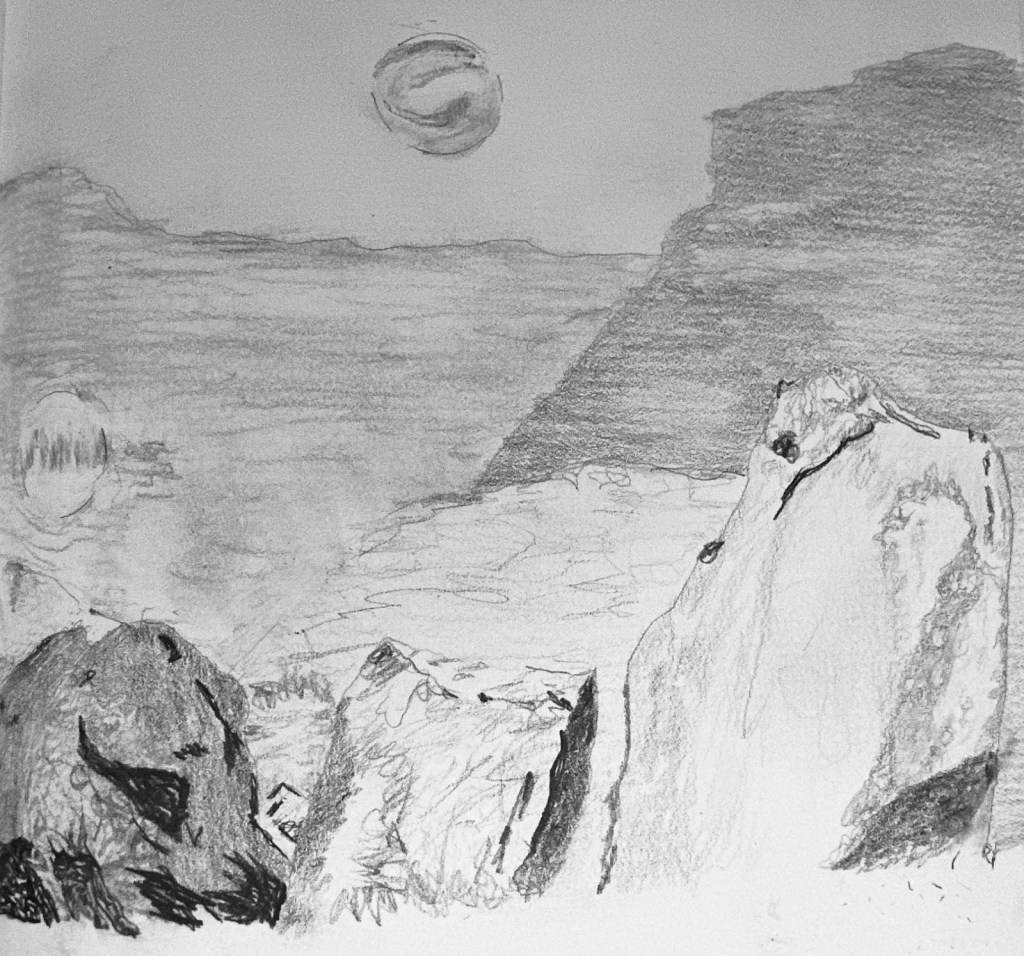
”You are the spawn of Satan,” my daughter’s substitute teacher screamed at her for correcting him on an erroneous fact he had shared with her middle school peers during history class. She had laughed off the incident, but when I had been accused of being possessed at about her age, I hadn’t the same level of resilience. She had encountered her first experience women have been exposed to throughout time: an association with evil flung their direction any time they have the audacity to question a man’s authority, an common allegation against women that has shaped the female characters that trod their way through the plots of my novels, strong women who are willing to defy the tales they are told to keep them under male-dominated subjugation.
“Jean, come here,” my brother’s voice came to me from about twenty feet away, echoing slightly through the cement corridor, tinged by the authoritative tone he used when telling me it was time to turn off the television and begin our whirlwind cleaning frenzy before our mother was scheduled to return home from work. It had been the first time I had heard what my siblings all identify as his aloof “hospice chaplain voice,” the one he adopts when he has intentionally separated his emotions from his pain, a necessary part of his profession steeped in terminal illness and death. From my perspective as I perched atop the railing of the fourth floor of our apartment building, his voice sounded as though it came through a long, dark tunnel. When I felt his arm on my shoulder, I shrugged, nonchalantly climbing off my perch and compliantly followed him down the poorly lit corridor.
The darkness had descended months earlier after the first accusation had been hurled at me. I had been standing beside a window overlooking the swimming pool in our apartment in Seattle when a plant had mysteriously fallen to the ground from its macrame hanger. She had of course angrily insisted I clean the damp soil from our white carpet, berating me continuously as I did, critical that I had not done the job well, her signature insistence upon perfection that would scar each of us in different ways. “Look!” she insisted as she waved the macrame in my face. “The hook is fully intact. Your demon must have done it,” she had hissed venomously at me. I whirled around, astounded at her condemnation, unable to utter anything in my defense, knowing that if I had, she would have unleashed a far more brutal attack on me. The tongue lashings at least didn’t leave welts.
It was an indictment that had been hurled at me by my mother several times throughout my adolescence, one that at times angered me, at times made me resentful, at times set off deep enough despair that I became suicidal. And one that has been repeated frequently by far too many other people in my life.
A few weeks later, I found myself on an airplane beside her, heading toward Colorado, where I would experience one of the darkest periods of my life, period of months-long hallucinations of darkness debilitating enough to keep me from attending school for nearly a full semester. And I was only a child.
The deeper I have delved into my ancestry, the more I believe we will be paying the price for far longer than merely seven generations, especially since the atrocities appear over and over again throughout the annals of time, and the first known record of my family extends beyond twenty eight generations and include events like the Hazing and the Pendle Hill Witch Trials.
The mist initially had been gentle enough to ignore, but by the time we returned to the highway Google had kindly allowed us to traverse, it had become a pelting torrent. We stopped, and I began shuffling through Matilda’s bags seeking my bright orange oversized rain jacket. It was only then that I realized the loud thud along the trail a few days earlier when my water bottle had skittered across the path must have been my rain jacket falling into the deep grass growing along the path.
There are moments of exhaustion in life when one doesn’t even have the energy to muster a curse. And even if fatigue had not stopped the words of frustration and anger, the astounding beauty through which I had just passed would have driven them to silence.
Tear Down the Wall: Carlisle Castle
September 8, 2024
“You’ll love it,” a member of the group I had met while training for my trip reassured me. Six couples had stopped at the same restroom I frequent while riding my bicycle near one of my favorite Colorado camping areas. They had passed me and my Great White Wonder Wolf, who runs at the perfect speed, their electric assist motors whining noisily, drowning out the song I had been singing to her, a nonsensical ditty praising her for being such a lovely, luminous companion.
Renting an E-bike had terrified me. Riding at high speeds on my bicycle has never been my forte. I prefer a more leisurely pace because even though my rig with my 86 pound companion would push me upwards to 55 mph on the downside of a steep Iowa hill as we pedaled toward the Colorado border, my typical pace for pedaling averages somewhere between 6-12 miles per hour on a good day. The prospect of whirring through the UK anywhere between 18-30 mph, the speed I had optimistically calculated would be necessary to complete my full journey, scared the daylights out of me.
On the fifteen mile train ride from Durham to Newcastle-upon-Tyne while I braced the blessedly slow Matilda with my feet as I sat perched on a stark, small bench, I admitted we would never complete our proposed trek covering 745 miles, which meant I would be unable to conduct all the research for my novels I had dreamed I would. I booked two additional campsites in the locale closest to where my family had settled after participating in the horrors of Norman Invasion and the even more heinous Harrying of the North, thereby slowing my pace to a more manageable 25-35 miles per day rather than the hoped for 55-75. I was saddened, but for the first time ever, I was grateful to the blue beast in front of me for her penchant to trundle rather than fly.
The slower pace we were able to take after resolving to reduce the overall length of our trip netted additional benefits: more photos and fewer topples. We began to learn of one another’s subtle quirks.
”I am not one for aerobic workouts so much as strength,” my daughter later observed when she and I had met in Spain for continued self-inflicted E-bike torture. Recent studies reveal children inherit their energy levels from their mothers, which plays into my novels nicely since all the journeys made by my characters are female. The more research I have conducted on witch trials is that more often than not, those accused have been among some of the wisest, most outspoken and strongest women throughout history. My writings are a tribute to these types of women.
Molyneux Miles: my son-in-law has coined a phrase that all who have the misfortune of taking a walk with my family members have come to detest. “Let’s walk her to the lake,” I had suggested after my graduation ceremony from the School of the Art Institute of Chicago. It had been the first protracted encounter I had with him once he had started dating my daughter. They had flown out for the event, and she and I had excitedly shared the city we both loved with him, dragging him mile after mile around the Loop, retracing steps she and I had walked many times over since her earliest childhood.
”How far is it?” he asked warily.
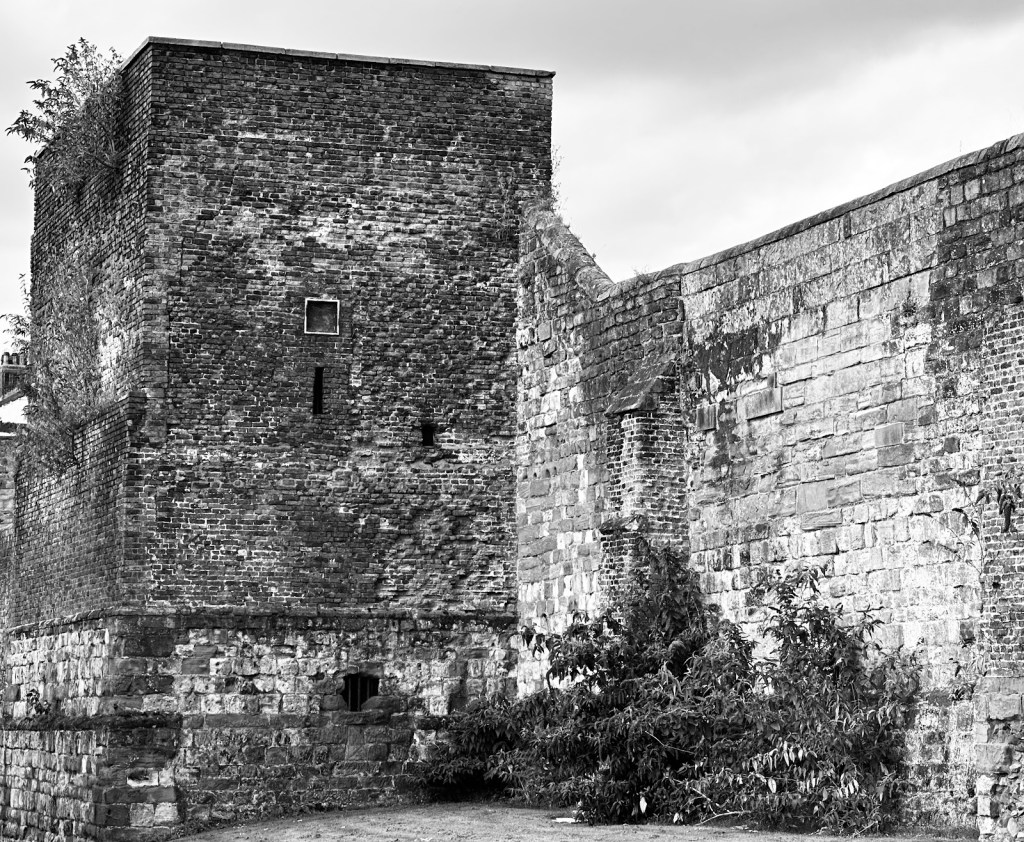
”Oh, just a few blocks,” I responded, unaware that she and I had just inflicted the most miles he had traversed on foot in a single day.
An additional six miles later, we returned to my small ground level studio apartment, and my very happy girl curled up contentedly smelling of wet dog. I had supposed his silence was born of contentment as well.
Years later, I learned of his phrase. It was perfect. Counting miles has never been my forte. I am more inclined to count vistas and monuments, whether man-made or natural.
My daughter has obviously learned to power through from her mother. She cries infrequently, and like me, when she does, she mourns for everything that she has faced with stoicism. Psychologist may perceive it to be a mentally unhealthy approach, but one that for us produces a more physically healthy lifestyle since we take the adage “walk it off” to a whole new level. And if my approach to therapy happens to entail seeing much of the world one step or one pedal stroke at a time, I’m doubly content since I am a travel junky.
”You’d get free flights,” my niece had reminded as she encouraged me to apply for the summer job at the airport. That had been the clincher. The following morning, I trudged four miles through snow and ice to attend the job fair that would eventually change my life forever.
My wont to wander, my need for new experiences, truly will be the undoing of me, but at a slower pace, the likelihood of Matilda being its cause had been minimized.
And it allowed me to linger along my beloved wall.
And the knowledge that our slower pace would perhaps allow me to fully explore another potential first along my trip: a castle where I could potentially arrive before it closed.
Day six of our journey had dawned brightly, following upon two full days of welcome sunshine after the blustery weather that had forced us to rely on trains to catch up to our proposed schedule, but rather than rushing through an additional 27 miles to reach our next destination, I had cut our distance in half. And allowed me to understand the rhythm of Matilda’s motor.
The first time I had heard the squeaky grinding on the wooden porch of the Victorian home, I fell in love. Generations had found contentment upon his seat, and the hard rubber front tire had long since decayed entirely. A back wheel was missing as well, and he was so cumbersome parents never had to worry that his passenger would wander too far from great-grandmother’s home.
In spite of the missing rubber, undoubtedly cracked and worn from too many summers in the scalding Southeastern Colorado desert sun, his paint had weathered nicely, exposing far less rust than the noise of the squeaking pedals had hinted. He was a beautiful blue that matched the sky that had worn away his rubber.
“Wait,” my daughter texted me. “I caught a glimpse of your bike’s handlebars in your last post. Please tell me you haven’t done all these miles on a cruiser.”
I began sending photos of Matilda I had gathered along the wall.
”Stop!” she demanded. ”That’s hilarious. This is worse than you riding an overweight mountain bike across the US,” she added.
Indeed, it was. Matilda had made my elongated, oversized rig with my 86 pound dog seem heavenly. Powering through would not have been the issue, even a decade later, especially since I had already trained intensively before my journey, fearing the decade following my first trek, as well as my brain injury, would have made my proposed voyage across the UK impossible.
I stepped out onto the wooden porch assuring the in-laws I would watch the children as they rode up and down the street, not revealing my real motive. Like all old tricycles, he was large enough to accommodate my small albeit very pregnant frame. That Thanksgiving when I had first seen him, I knew I wanted only one object to become mine when the time came, though the crystal serving dish great-grandmother handed me as I left as a token of appreciation for my floral-carved radishes was a nice gesture as well.
Long after all the great-grandchildren had outgrown him, he became part of my garden, and every once in awhile, I would take him out onto my large concrete driveway and let him know he would always be loved, leaning precariously to one side, his perpetual squeak setting the rhythm as I pedaled like mad to propel him forward because of his bald front tire, careful not to push too hard because I had learned years ago if I did, the bare metal of his hub would spin in place.
“Remember riding great-grandmother’s tricycle?” I asked her. “Matilda is like that. She requires a consistent, awkward stroke, and if I pedal too hard, she actually loses momentum, which is good to know since she has no brakes and we have frequently encountered very steep hills.”
”Oh dear god,” was my daughter’s only response.
The tower loomed in a vacant field with numerous informational signs. In spite of my working truce with Matilda and our slower pace, I knew reading the signs would be impossible, but a quick glimpse explained how Roman towers were built and what their purpose had served, so I snapped a photo. Later research revealed it wasn’t an artifact at all, but a folly of a wealthy banker, whose land reverted to a substantial green space east of Carlisle.
Instinctively, as we rode along the river I knew we had neared a manor. As we rode past equestrian riders, I felt a bit more at home since we often encounter horseback riders at our isolated camping spots in the US. The lanes were neater, the fields were more pristine, and the forests had become more dense. The ground tended by those in subservience are often more well kempt than those tended for one’s own sustenance. There is an odd sense of pride that comes out of obeisance.
Conservation of a castle is one thing: it is part of history preserved by a ministerial department of the UK. But an actual working manor is different. It is a pillar of the bygone days of feudalism, a vestige of the controversial aristocracy, and a mausoleum of patriarchy.
The land that stretched before me had once been a manor, and like most aristocratically held lands, had fallen into deep enough financial despair that it had been parsed to numerous other owners, only to eventually be returned to the city which had grown up around it, the same fate my own family manor has experienced.
This particular tract had been purchased by a banker during the last few decades of the nineteenth century then slowly sold in segments with the majority of the parceled land becoming a lush green space possessing paths, playgrounds and pedestrians.
”Tear Down the Wall” screamed through my brain as I rode toward Carlisle, regretting the extra cup of coffee I had indulged in before leaving the fort. The pristine landscape didn’t seem the best place to precariously balance Matilda against a fence post, especially since even still today there is a remarkable absence of trees in the Harried North. And the constant reminder that cameras provided security surveillance didn’t encourage a sense of the type of relief I needed. Alzheimer’s and dementia specialists are now saying music often soothes the patients who can’t be reached as the darkness builds in their brains.
I drove down the highway with tears streaming down my face, the brisk wind blowing against my skin from my convertible top being lowered dried them immediately. I’d always loved the anonymity that comes with speed, loud music and heavy traffic, shouting and head bobbing along with the loud music because one could never mistake my raucous vocalizations for singing or dancing.
I’d just been released to drive, primarily to allow me to transport myself to my numerous therapy appointments. Without thinking during a traffic jam, I flipped on my music, an eclectic array of rock, pop, heavy metal, opera, jazz and folk. The realization was almost as brutal as the one I would face a few months later when I learned I could no longer read. Lyrics were gone.
Initially I thought it was perhaps just Danny Carrey’s polyrhythmic time signatures that impeded recall, so I skipped to the next song. Styx, REO Speedwagon, Pink Floyd, Journey: All gone. “Crooners,” I assured myself. Surely I could still belt to Sinatra. Same result.
I’d literally survived during one of the darkest periods of my life, the first few years of transience my mother and step-father had inflicted upon me with John Denver assuring me that Colorado was only a guitar strum away. Even he was gone.

Stunned, I turned off my music, the sound of the cars surrounding me the only thing that echoed through my very empty head as the pain in my heart swelled up through my eyes and penetrated my very broken brain.
The process of reintroducing music into my life was almost as arduous as learning to navigate stairs and enunciate phonic blends.
It began with combining soft non-vocalized jazz and classical music while exercising on my stair stepper. After a few months, I stepped it up and added macrame, then combined all three in a bizarre dance type performance art, all the while thanking the gods I had never formally mastered dancing because it would have resulted in the same frustration I had initially encountered during the arduous process of teaching myself to read.
Learning something that had once been second nature is like being lost in a favorite neighborhood that had replaced open spaces with skyscrapers: there are moments of recognition, only to find a deeper sense of confusion because nothing is where it once had been.
Once the steps were mastered without lyrics, I added increasingly more complex combinations. In the same way that I have yet to make the jump from compound sentences typical of tenth grade reading levels into a higher plane comprised of complex sentences, the lyrics combined with simple rhythms come back in snippets, casual phraseology murmured or belted, whatever the circumstance allows. I may never achieve Danny Carrey or Pavarotti appreciation again.
Sometimes a shadow of what once had been is enough.
I’d spent my earliest years distracting myself from my tormented, abusive reality with visions of fairies, sugar plums and castles. By the time I finally passed the Victorian Folly and crossed the aptly named footbridge “Empire“ in the green space, I was desperate on a whole new level.
“I can make it, I can make it. I. Can. Make. It!” I reassured myself with a staccato chant, distracted even from Matilda’s unique rhythm and balance.
I hastily fastened her to the first post I could find, wanting to jog up the long path toward the huge edifice rising above what once would have been a water-filled moat but knowing that the traumatic jolt of an unmeasured step would wreak havoc.
It was the second time I was disappointed by the realization that in the UK, spending money does not buy a ticket to a toilet.
”Please, I have just ridden 15 miles on a very full bladder,” I informed the very formal gift shop docent.
”I am sorry,” he explained politely, every word dragging out of his mouth like the teacher in a Charlie Brown special, adding words I simply could not comprehend.
I turned away from the imposing gate abruptly with his utterances dangling over his head like a cartoon character and mumbled my own response, “I suppose public urination is a thing.”
His companion, a young man, jogged after me, reminding me my admission allowed me to visit the museum, a directive I followed and deeply appreciated a few moments later.
Somehow the prospect of visiting the castle had lost its magic.
World of Magnets and Miracles: Carlisle
September 8, 2024
“You won’t get it in time for Mother’s Day,” he informed me, adding, “but it will be there for your birthday.”
Receiving packages is a challenge with my lifestyle. “You can order it online,” I am often told by merchants who seem to be decreasing their in-stock merchandise at an alarming rate.
“No, actually, I can’t,” I usually respond. “You need a physical mailing address, and I return home twice a year, so my fuel for my stove won’t do me much good there, will it?” I retorted.
When a package or a Christmas card arrives within a few months of its intended date of receipt, it’s like my birthday and Christmas all at once! I opened it with trepidation, and was relieved to learn it was nothing more innocuous than a bright red journal with its soft leather embossed with a familiar shield.
As an artist and author, the blank canvas of a journal is intimidating. For years, I collected them, works of art in and of themselves, beautifully bound pages of unrealized potential left blank, too intimidated of mark making on any level, knowing they would be a permanent record of my own ineptitude.
That changed with my first whirlwind trip to Europe, taken long before the advent of voice to text capacity, and thoughts regarding art and locale through the lens of Henry James filled the large, heavy black leather bound pages. His notebooks have become fodder for endless tomes of academic naval inspection. For the first time as I walked the streets of Paris, Florence, Ravenna and Rome; revered the hallowed halls of the most famous art collections across the world; stood in awe of the vast expanse of domes and naves alike; I didn’t have time to be intimidated. I needed research to fill chapters of my two ongoing theses.
“Honor thy father and thy mother,” the instruction from the book echoed through my brain as I first entered the lofty edifice over two decades ago. The unseen choir echoed through the pointed arches while light from the Lenten setting sun sparkled through the beautiful stained glass, sending a rainbow of color across my hand as I touched the foot of the crudely sculpted figure of St. Thomas, worn smooth with other generations who had passed before me, reaching toward him for a tangible sign to confirm their own doubting faith.
”Show me,” had been his words, a sentiment I have often found myself repeating, sometimes with tangible answers, but never as vivid as the reflection of heaven currently penetrating my senses: the dank aroma of rocks and aging wood, the ethereal intonations of the choir rehearsing for Sunday Mass, the smooth wood under my fingertips, the glint of rich pigments illuminated by sun, the acrid taste of tears running down my cheeks. “Thank you, mom, for instilling the strong work ethic in me that has enabled me to press toward this life-long goal,” I whispered, smiling wryly knowing how deeply she disdained secular higher education.
The first step away from those self-doubts she had also deeply instilled toward being able to finally begin filling the blank pages that stretched ahead.
”Take selfies with it every time you pass a Salvation Army,” he had instructed me.
At the top of the green hill surrounding the castle, I had instructed Google to lead me toward my first unplanned camping destination, one of the two that would allow me to slow my too-rapid pace. As I began the decent, the bright red sign combined with an unpassable, steep foot bridge and particularly heavy flow of rush hour traffic set off her usual nag, “make a u-turn.” By the time I snapped the photo, no journal in hand because just keeping Matilda upright, much less retrieving the journal from its secure location in one of her overstuffed bags was enough of a challenge, the familiar voice had silenced altogether: Google is notorious for giving me the silent treatment if I ignore her.
”Location not found,” the screen silently informed me, accompanied by the infuriating whirling wheel.
After sharing some of my pet phrases that I had normally reserved for my heavier companion, I shrugged and began trodding slowly back up the steep hill in search of a stronger cell phone signal, whispering to a higher power, “What am I supposed to be seeing?” the question I always ask when I am forced to retrace my steps. The answer came in a niche in the wall that had not been visible as I had descended the hill away from the castle: a marker significant enough to be distinguishable throughout the ages, a location as clear as a treasure seeker’s “x” on a map handed from one generation to the next.
I smiled, glanced at Google to see if she was once again responding, turned Matilda around, and began fighting my way alongside much more manageable parade of mini-vehicles that had previously been an angry riot of fiberglass and horns.
Google is much more user friendly in America, in part because department of transportation is fearful of the US penchant toward litigious action, so they are quick to alert her to any detours. That’s not the case in the UK, so as I navigated my way moment by moment seeking forgiveness for any offense I may have recently spewed during my last rampage while avoiding wind-up cars on lightning-speed acid, I realized the odd hour-long delay because of the photo had more than likely saved my life.
The slog from the farm animals combined with their welcoming cackles, braying and bleats brought a sigh of relief after the shouts of angry passersby along the detour. Sounds of nature are always comforting: the sound of childrens laughter, however, has always been haunting, and it elicited its typical cringe. “Oh, dear gods, please don’t let this go on after sunset,” I murmured.
“Don’t ever pack wet gear,” my father had shouted at me and my siblings after we had arrived home following one of our Rocky Mountain two-week camping vacations.
Balancing obedience with speedy execution of our appointed chores on those trips had always been challenging. If we were too slow rolling our sleeping bags and folding the heavy canvas tent, we were at risk of invoking parental wrath, yet if we packed gear with even the slightest hint of morning dew, we would be met with anger as well. So all eight of us learned to spy out our own tree limb or warm rock as soon as we set up camp, searching diligently for the spots most likely to receive the dry kiss of wind and sun, an odd lesson in accute awareness of sun angles and directions throughout the seasons, and we were never allowed to bicker over who had the best spot since silence reigned supreme in everything we did. “Children are to be seen, not heard,” the mantra we all learned very early lest we be beat, pain that would be followed by the added instruction, “if you cry, I will give you something else to cry about.”
For the first time as I arrived at a campsite in the UK, I hadn’t been greeted by a dour host reminding me I was late, but instead was instructed by a fellow camper that there didn’t appear to be assigned spots so I could choose whatever site best suited my needs, so I paced out my steps and determined my site by the area least marked by the quish under my hiking boots.
By day seven on my trek across the UK, everything, including my red leather journal, was growing mold. I grimaced again at the shouting children as I unfolded my black-spotted overpriced lightweight equipment, but couldn’t help but smile as the raven-haired child ran across the field to help her mother erect a tent very similar to my own: a small half-dome that the two of them shared. Her friends ran across the field to join them, and for the first time in ages, I began to smile as I heard the children’s joyful camaraderie. They were not shouting at the adults demanding the latest shiny object in a disposable world or angrily demanding that the server had brought them the wrong food, but laughing with one another about who could drive in their stakes the quickest, the type of competitive challenges that had driven all of my siblings toward lofty goals that helped many of us transcend our abject poverty.
As my tent unfurled, it grabbed the wind, becoming airborne and sailing to the center of the green field, and it was oddly dry by the time I reached it, and it bellowed behind me as I hummed quietly, “Beyond the horizon of a place where we lived when we were young…” as the sky began tinging itself pink in the glorious sunset.

“Would you like a piece of pizza?” the raven haired beauty offered as I returned to my site. “It’s my birthday,” she added with a shy smile.
“There is a hunger still unsatisfied,” the lyrics echoed across the sky as the flaps of our matching tents flapped in the strong breeze as I thanked her for sharing her special day with me.
”Have you had breakfast?” the landowner shouted across the field the following morning, lifting a bale of hay high over his head.
Laughingly I replied, “Yes, I have had my fiber for the day,” pleased with my witty repertoire.
”I was talking to them,” he chided me coldly, nodding toward the group of children circling outside the birthday girl’s tent.
“I had promised her a horse ride,” the girl’s mother told me quietly as we all walked toward the horses, “but he ended up canceling our reservations,” she explained. “I guess this is his way of trying to make up for her disappointment. We’re walking across England raising funds for a non-profit sex slavery shelter and I was hoping to reward her on her birthday with something special. Where are you headed?” she asked as I murmured my apologies that her daughter’s party plans had been spoiled.
The woman watched her daughter with a loving smile tempered by a deeper emotion as she went on to explain she had spent many years as a sex slave and that her daughter had been conceived during that time. “But,” she added excitedly, “right before I began my journey, I found out I am pregnant!” Once she had escaped the abusive relationship that had been instrumental in keeping her bound and began healing, as a form of therapy, she had committed to her endeavor. “My current partner follows me in a van as often as possible, but she,” nodding toward her daughter, “has walked along with me the entire way.”
The delightful squeals of the children rang across the field as they stuffed hay into the horses eager mouths. Suddenly my long trek with the trials Matilda and Google seemed far less significant.
Feelin’ Groovy: Birdoswald Roman Fort
September 6, 2024
“Grow where planted!”
I don’t know where I learned the phrase, or if somewhere in my history I coined it, but given the permanent transience I’ve experienced throughout life, it has kept me sane.
Averaging three schools each year through middle and high school because my mother and step-father could never agree where we should live, near family where she could get help (or more often than not, help them) or in a thriving economy where he could be gainfully employed had been both challenging and stimulating for me and my brother. We developed a closeness that kept us moving forward each time we relocated and attempted to put down very shallow roots, building new friendships, and even new identities, a deep friendship that continues even now as we enter the autumn of our lives.
”I need 21 miles over 31 days to meet this year’s bicycling goal,” he informed me recently. Though I have made longer purposeful rides than he has, he freely admits his best therapy found on the seat of his bicycle, an important daily session to help him cope with his job as Hospice Chaplain while juggling the challenge of a severely disabled adult child.

“Keep riding,” he chided me after knocking me off my red Stingray. “You need to keep pedaling whatever happens.” A neighborhood bully had begun tormenting his peers, pulling up behind them and bumping their back tire with his own front, laughing maniacally as those he tormented would fall to the ground.
He had fallen victim of the bully but was determined to stay aright after his first skinned body. After several repeated assaults, my brother learned that as soon as he felt the bump from behind, if he continued pedaling rather than swerving, stopping or speeding up, the friction of the tires would actually throw the aggressor down rather than having the opposite effect.
I angrily stared at my brother after brushing the asphalt from my skinned knees and mounted my bike, setting my comfortable speed, this time anticipating the bump. He was right; it sent him to the ground rather than me, and I came to a comfortable stop a few feet away, smiling a bit as he brushed the asphalt from his knees.
”Our sister threatened to hop in her car and force you and your dog into it a decade ago,” he reminded me as I began revealing my plans for my UK trip to my family. “Good thing you are going across the pond,” he added laughingly. “The miles may deter her from making the same threat.”
In reality, the plan had been hatched at her kitchen table with her husband encouraging my endeavor, in part because he is excited that all the hours he spent researching our genealogy may eventually become something more tangible than line after line of vacuous names and in part because he had discovered he had become “famous” because I had given him credit for a photo he had taken while I was conducting research for my Master’s degree at the School of the Art Institute of Chicago and my webpage had generated such a large number of hits. They supported my trip so thoroughly that the two of them had generously offered to purchase me a folding E-bike for Christmas but realized that although it would have been lightweight and easily transported, it may have different specs than what were required for England’s trails, including the one that I was now traversing, one that I had been told never fully intersected Hadrian’s Wall.
As Matilda and I huffed and puffed toward the crest of yet another steep hill, I bemoaned our trepidation regarding the smaller, more powerful E-bike once again.
The breathlessness came not just because I had walked the 200 pound Matilda up a 40 percent grade, but because this time, as soon as I saw it, I knew I had at last fulfilled another dream.
The fort spread across the green hill, a shadow of the power it had once projected to the conquered people, yet a visible testament to history in spite of the centuries of decay.
Although the phrase regarding growth had become a life-long mantra, the first time I had seen plants springing from Roman ruins, I have spent decades collecting photos of them, whether they be dandelions peeking through cracks in a sidewalk to centuries old trees balanced precariously above a wall.
Over the past decade following my injury and the homelessness it has created, the irony has often hit home: I am not planted, but in spite of my transience, abject poverty, and remarkable losses of mental, physical and spiritual well being, I have never in my life been more grounded.
Daddy, What Else?: Magna Roman Fort
September 6, 2024
”How’s your wall?” my daughter texted me some time after my disappointing midnight snack.
I’d awakened abruptly to the braying donkey and crowing roosters, an interesting change from the coyotes or cows that normally greet me in America, smiling as I suppressed my inclination to belt yet another familiar ditty I’d learned in elementary school.
After explaining my immersive lesson in the contents of an English breakfast, she responded, “So not one of your better days?”
Actually, it had been fantastic.
The black stone snakes slithered sleekly up and down the brilliant green landscape, rising and falling with the undulating hills populated by friendly, curious wooly sheep; inquisitive, diminutive horses with hairy hooves; crows calling cacophonous songs from rare tree branches; grunting, snuffling pigs hungrily searching for snacks secured under the verbiage; dairy cows gently mooing as their udders swung heavily in the setting sun.
Perfect, Pastoral Beauty I had anticipated, the awe inspiring landscape evocative of the English Romantic poets and artists I’d specialized in studying so many years ago.
Hadrian’s Wall. It had been among the first works of art introduced to me in my very first college course: that great span of rock historically separating classic Rome from Early Christian, the periods bookending the first and second semesters of the three semester Humanities courses. It had also become one of my favorites to introduce to my students.
“No, Tj,” my father would often say as we were out in a field, “that’s not the shade we need.”
Sunday afternoon had always been spent at their home, first in Blende, a small farming community on the plains, then on a farm located on a dirt road seemingly far away from everything with an unrestricted view of the purple mountains, an isolated dusty piece of land that I would later learn was still within the city limits.
Warm sunshine, cool shade, bright colors, fried chicken, roasted peppers and the best refried beans I have ever had the pleasure of consuming. And many times throughout the summer, Tiajuana Brass blasting loudly with dancing punctuated by clapping and laughter. And my diminutive, darkly tanned mother, who possessed a sense of motion and rhythm I have always envied, would always be at the center, ceaselessly whirling and sacheting, executing moves I have never seen replicated even by the most proficient professional dancers I have had the pleasure of knowing.
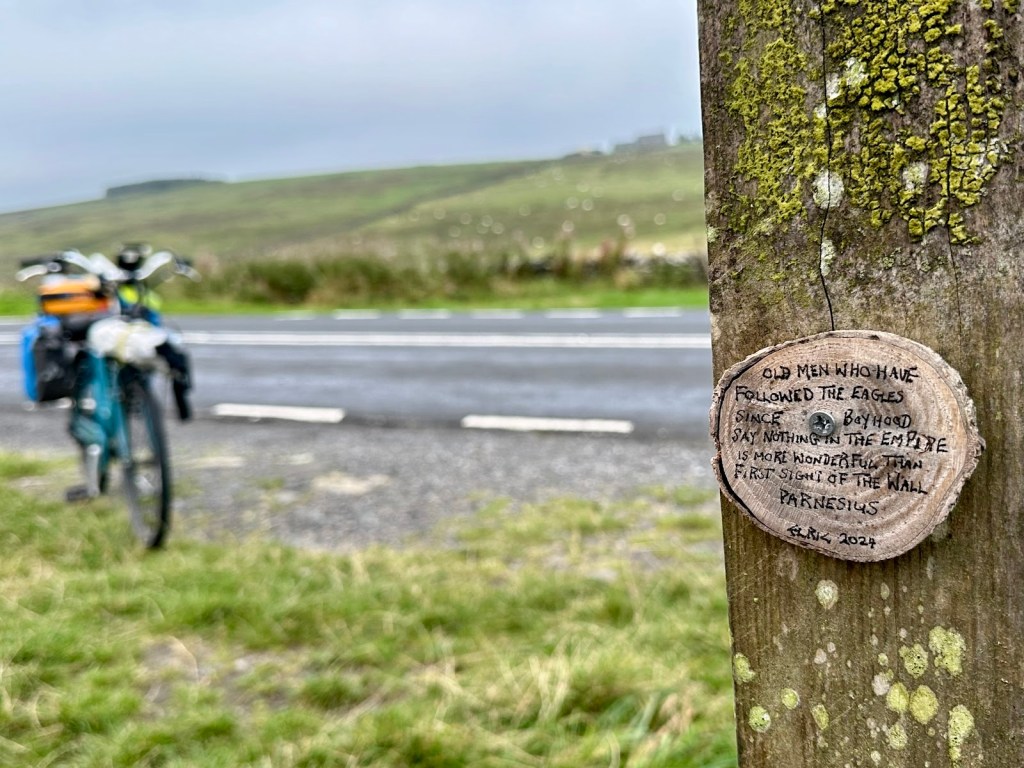
I have only seen my mother truly happy while dancing.
My father was short, and the hours he spent in the sun gardening or working on our tattered station wagon, the only vehicle large enough to hold me and my other seven siblings, had burnished his skin a dusky brown, pigmentation for which I have always been grateful. His full lips added to the overall picture which often allowed him to pass as Hispanic, another trait I’ve gladly inherited.
Blende, as I would later learn, abuts the same small town in which my father passed his childhood days, and both Boone and Blende would be one of my father’s favorite rockhounding sites, my favorite pastime even still today, though my range has expanded well beyond the few miles surrounding my home town. Their farm was never as fascinating to me as the home in Blende had been. The isolation meant the weekly colorful festivals drew to a close, but the quiet Sunday afternoons still sparkled brightly.
Mr. Godinez had the most well rounded collection of semi precious and precious stones I have ever had the pleasure of viewing, and each time it would grow, my brother and I would take pride in it since we were among the primary contributors: deep greens, brilliant reds, glowing purples, cool blues, soft browns, oranges and yellows that once polished gleamed like autumn leaves: all ugly stones we had gathered transformed into smooth gumdrops of shining beauty he would later fashion into ornate jewelry, belt buckles, or leather bags.
Unrealized potential housed in the most drab, dirty nuggets one may find on any trail: the promise of undiscovered beauty.
The Godinez family subsisted on what they produced on their property, so tending the animals and crops had been his primary occupation. Creating art had been relegated to only a hobby, but what a hobby, one that has kept me more focused on the potential gems upon which I may be walking than any gleaming skyscraper or renowned work of architecture under which I have ever passed. He crafted beauty from stones discovered in the soil he worked long before it became trendy to seek the hidden wealth of healing properties contained therein. Rich red, honeyed amber, deep green, brilliant blue, soothing purple, cool jade, warm rose: the colors of earth enshrouded in dull, dry brown dust, waiting to be discovered and cherished if diligently sought.
Our past rockhounding has shaped my current prose.
“Campulance would weigh less if you would stop collecting rocks,” my son-in-law said with a playful scowl when I had mentioned her gross weight. My fetish with rocks continues, and while I am not convinced of the restorative powers of crystals or gems, I am still as fascinated by them as I was as a child.
“Call me when you are there,” my brother texted, “and I will give you payment information.” He lives in a sandy beach area where rocks simply do not exist, and the massive diesel I drive can easily accommodate an extra ton or two, even if it means they occupy my passenger seat during one of my cross-country expeditions.
We grew up skipping endlessly in a circle, jumping from one boulder to another on the ring around a rose garden, skills that have served my wont to wander well throughout my entire life since I often have to scramble up or down fields of similar boulders on my hikes. While out rockhounding, when we would stumble across some particularly unusual boulder, my brother, my father and I would heft it into the back of the rumbly station wagon to later add it to the rose garden. “Do you remember the massive lepidolite?” he asked during one of our rambling stream of consciousness conversations.
We’d stumbled upon it somewhere between our dusty home on the plains and Telluride, gleaming brightly in the sunrise. My father, who loved careening around sharp switchbacks while we white-knuckled the front seat cushions, came to a screeching halt, threw us into reverse, and withing an hour, the nearly half ton prize was ours. “I wonder how much it would be worth in today’s market?” my brother asked after I had secured him a pink agate and a blue lazurite from a local rock shop, both about the size of our lepidolite we had loved as children.
Each of my novels features an animal or flower, a musical instrument that produces a specific tonal value, an herb, and a semi-precious stone, each perceived to have specific restorative properties. After all, once broken, one can’t help but try whatever means may be available to aid in healing. As I write, I wear a strand of the stones, douse myself in oil derived from the herb and play meditative tonal music, not because I necessarily believe they may be curative, but because the assault on my senses helps keep me focused upon my task.
”I don’t think I have actually seen my wall,” I responded to my daughter.
The trail from Stoke-On-Trent train station had been easily accessible, and unlike any other bike path Google had suggested so far, completely navigable. The day had passed quickly, pleasantly and without too many tips, other than one in which as I passed two pedestrians, a maneuver that resulted in a resounding thud which drew me to as close to an immediate halt given Matilda’s lack of brakes. Fearing I had perhaps hit them with my oversized saddlebags, I hastily dismounted and turned while Matilda upturned. The male pedestrian kindly helped me aright her while the woman handed me my water bottle. “The noise indicated you had dropped more than this,” he said, “but we didn’t see anything else.”
After assuring myself that the thud hadn’t been one of them and thanking them for retrieving my water bottle, I mounted Matilda and trudged onward.
The day had been perfect in every way. Well, other than the very disappointing box of meat.
Toward sunset the previous day, Google had directed me off the trail and onto a roadway with enough traffic to require intensive concentration to avoid Matilda necessitating another encounter with kind (or perhaps not quiet so kind) drivers, but given my weakness for sunsets, when I crested a particularly challenging hill, I couldn’t resist risking her belligerent opposition. “There was a crooked man,” I whispered as I encountered my first English style. I had seen them on many walls as I had explored the setting for my novels, and the thrill of seeing one was heightened by the stunning pastel colored sky casting deep shadows upon the rich green fields.
The perfect English composition, whether recorded in paint, poetry or photo.
She must have appreciated the view as well because for the first time ever, she stayed aright without balancing against some sturdy support, consenting to a photo I had snapped while standing at the crest of the stile.
”Google says you are camped under it,” she informed me. I emerged from my tent, frustrated with my inability to discern north from south, compounded by the mist that rose above me on every side, spreading along the steep hills all with walls wending along them.
Hadrian’s Wall, the seventy-three mile stretch separating “barbarians” from Roman civilization, the 8-10 foot wall dotted by forts and watchtowers, was constructed by soldiers who also served as surveyors, stone masons, and engineers, bits of history I once stored in my brain, which because it is broken, I now have to research, a bittersweet reminder of why my career in education has ended.
At its epoch, over 10,000 troops occupied the wall, adopting and assimilating the culture of the women they eventually would love and marry: inspiration for the relationships built between the characters of my first novel. In the way the Romans had assimilated and repurposed the materials upon which the local inhabitants had built their culture, later progeny would likewise repurpose the stones those who had once been their conquerors had left behind, constructing homes, walls, silos that would sustain them for generations.
I bid farewell to the farm animals that had greeted me even before I emerged from my damp tent and returned to the fabulous bike trail, fearing I may never be able to see my beloved wall, but content that I had at least spent the night in its shadow.
It wasn’t until I edited the photo a month and a half later that I took time to read the hand written plaquared affixed to a post and understood I had seen Hadrian’s Wall far earlier than I had realized, and that my first crooked stile hadn’t contained a sixpence, but had retained a priceless slice of history. It had called to me at sunset even before I had been fully aware of its significance and had somehow momentarily tamed my unruly companion. We had “followed the eagles” and had unknowingly experienced our “first sight of the Wall!”
Ah, Sugar Sugar: Herding Hill Farm, Haltwhistle
September 5, 2024
The smiling camp host handed me a box as I dragged Matilda to a standstill, balancing her as best I could against the wooden picnic table. For the first time, I had successfully sent an email warning them I would arrive later than their required check-in time. “Here’s your breakfast,” she exclaimed after explaining where I would find the showers, which were next to the kitchen which included a microwave and electric tea pot.
It had been the only campground I had found that offered breakfast with its registration. I had looked forward to it for months. I was confused, but since I was famished, I had no objection to eating a traditional English breakfast for dinner, so I opened it with enthusiasm, only to immediately look crestfallen.
The box contained copious amounts of protein, exactly what I had anticipated. But it was all raw.
Sensing my confusion, she asked, “You do have a stove, don’t you?”
I slowly shook my head, then hesitatingly added, “But everything these days may be cooked in a microwave, right?” I sensed her extreme disapproval of my suggestion that the pork belly, plump sausage, two eggs and pork and beans be subjected to electronic rays instead of a sturdy frying pan over a stove, which the camp did not have.
”I’ll ask your neighbors if they could loan you a stove,” she explained, graciously hiding her scorn.
Following a recipe has never been my forte. I had been as creative with my cooking as I had been with my art: untrained, unwilling to follow a specific style, a specific directive.
”Take copious notes in the margins,” I had instructed my students, a lesson I had learned as a student. My library consisted of hand-me-downs from my two favorite professors who chose to retire shortly after I began teaching: a collection of well worn college texts marked in the hand of the characters I had seen them scrawl upon the chalkboards throughout the years under their tutelage. I had inherited not just books, but the thoughts, lectures and lessons outlined by them in the margins, a priceless cache of information to anyone launching their career in education.
”Here,” she said with a smile as she handed me a book with a perfect binding revealing that it had not become one of her favorites. “Perhaps it will serve you better than it ever did me,” she laughed, adding “I never had the good fortune of being an artist.” I flipped the book over in my hands and the title, “Drawing from the Right side of the Brain” jumped at me off the cover. I hesitatingly opened the cover and cringed as soon as I saw the first lesson.
The objects stared accusingly, mockingly at me from the table in class: an apple, a cylinder, and a cube. “Start with the basic shapes,” my elementary art teacher instructed us. To me, I could not separate an apple from an apple, a cylinder was not two oval joined by two lines, and a cube was not two squares connected by two lines. “The shadows they cast mirror the objects themselves,” she went on to explain while my brain focused on the brightness of the light behind the objects, the varying shades of red, yellow and green upon the shiny, smooth surface of the apple, and the hue of blues found upon the cylinder: nuances of the objects that could never be reduced to simple shapes. I was incapable of drawing in shades of gray the beauty of the objects in front of me. Stymied, I vowed to never pass myself as an artist.
No one was more surprised than me when I received my letter informing me I had been accepted into the prestigious School of the Art Institute of Chicago, a necessary step toward continuing my career as a college instructor since I had yet to complete a Master’s Degree, a requisite for my position, an education that by the end of two years had left me even more cynical than ever.
“Are you able to safely prepare yourself a meal?” my occupational therapist asked.
I grimaced, knowing that as with many single women my dietary approach was hardly healthy. “I can put a prepackaged frozen meal into a microwave and usually not burn it or forget that it is in there,” I responded, not willing to disclose how poorly my nutritional intake had been. Dinner often had been comprised of a glass of milk slammed down after I had already gone to bed and realized the numbness in my limbs was probably a result of not having consumed anything since breakfast.
That’s the conundrum that comes with a disability: when someone loses a loved one, the mourning period, which consists of an initial prolonged period of denial, lasts for years. When the loss is one’s own self identity, the steps are the same, so the initial diagnosis, interpreted through the representation of selfhood through the patient’s narrative, is colored, especially if the patient lives alone. The patient, undergoing denial, is unable to adequately assess what all has changed, and is often unwilling to admit the truth because by vocalizing it, the process reveals the reality of the loss.
A survivor following death finds themselves unintentionally speaking of the loved one in present tense, or choosing to use the euphemism of “passing” rather than dying. Those subtle cues to friends, relatives and therapists are clear road signs that the bereaved is denying the reality of death, and of their sense of loss. But that process of denial is deemed normal or healthy following the death of a loved one. When one’s loss encompasses one’s identity through a disability, it is like looking at the cadaver of one’s own body and soul in a casket.
“By the way,” my niece informed me during one of those rare evenings when she was home from work before I had fallen asleep, “I came home the other night and found the gas on the stove. Fortunately the flame was still on as well, but you need to be more careful,” she advised.
No, I realized with a jolt, I suppose I am NOT capable of safely preparing myself a meal, but I still was unwilling to verbalize it to my occupational therapist. Reality hurts.
I had experimented with living alone a few months after my injury, only to realize that on several occasions I had compromised my own safety because I no longer functioned normally: forgetting to shut a door when leaving for a walk, leaving water running after washing my hands, walking away from frying food to work on my 18 canvas project based upon my ride across America, again the type of activities that I could have performed if I had a partner, but not those I was able to do as a single person. Realities that coincided far too closely with the realization I had the reading level of a third grader.
Defeated, I eventually returned to live with my physician niece in exchange for light duties, mundane activities that filled enough of my time that I would fall into bed by 7, utterly exhausted and incapable of engaging in my ongoing therapies.
”Patients who suffer brain injuries often fall into deep depression and have suicidal ideations,” my mental therapist had warned me, a reality too vividly embedded in my life when I lost a nephew to suicide this year. He had been victim of a hit and run accident. He had been treated for his severely broken arm, but not for his severely broken brain. Often at the end of the day while living with my niece as I would drag myself up the stairs with my glass of milk, I would envision my body dangling over the stairs from a rope secured to the railing. Death to the body that housed a dead shell of what had been my once creative, intelligent mind. The “new normal” all my specialists reminded me I should embrace.
I had always embraced life, its adventures, its challenges.
The warning saved my life, and I knew change was an integral part of my “new normal” because the old me haunted me, taunted me.
”Perhaps you should try van life,” my daughter suggested. I knew the corpse hanging from the stairs was my broken brain trying to defeat me, so I had never disclosed to her, my physician, or any of my therapists how often she haunted me, taunting me with my post-morbid insufficiencies. It wasn’t until years after launching into my retirement on the road that I had the courage to tell her why I had been so compelled to renovate the wheeled beast I now call home.
“You aren’t truly homeless,” a friend often reminds me. “It is a choice you have made, unlike most who are on the street.”
Yes. A choice that saved my life. And more than likely continues to sustain it. But not one I would have ever made if I hadn’t sustained my injury.
My life in Campulance is simple: I am able to wash all my walls, cabinets and ceilings in under an hour. Since food doesn’t last well in my cooler, I often eat cold soup straight from a can. Coffee is frequently cold French press brew: no ice, and often slightly sour milk since boxed milk is outside of my price range with my limited EBT funds. If I choose to cook, more often than not my small butane canister runs out even before I finish preparing a meal, so inadvertent fire isn’t as likely. Since we choose isolated areas, those free spots scattered across the vastness of America, I shower infrequently and wear the same clothes for days in an effort to save water. And for the sake of safety, we are usually tightly tucked into bed around sunset.
A simplicity almost as satisfying as the one I found while pedaling 825 miles across America towing my 86 pound soulmate with nothing more than a down comforter, a computer, a camera, and a few art supplies.
“You brought everything except the kitchen sink,” the bike rental technician laughed as I began sorting through my backpack in an attempt to lighten Matilda’s precariously balanced load.

I have learned the art of looking down to hide my grimace since I have always displayed my emotions on my face.
”Be aware that you will no longer have filters,” my therapist had also warned me. “You will be more inclined to blurt your thoughts, and your emotions will be heightened.”
Her warning increased a sense of dread since tact has never been my forte and I speak fluent sarcasm.
“Do you ever get lonely?” people often ask when they learn of my lifestyle.
“Absolutely not!” I reply, unwilling to disclose that I fear what kind of monster I may have become since my injury, knowing that holding my sharp tongue between tightly my clenched teeth often cuts deeply, a wound I never have to inflict upon myself or others during my weeks of isolation.
Rather than retort, “I can’t even begin to imagine you would have success spending a month in a foreign country with nothing more than three outfits, a tent, a sleeping bag and 30 pairs of socks,” I extracted those few items I felt I could sacrifice: 3 pounds of hand warmers my brother-in-law had gifted me for Christmas when I had spent the winter parked in his driveway, a lightweight mug, my swimsuit, my spare raincoat, and my 2×3” compact camping stove.
As I continued looking into my box containing the raw ingredients comprising the perfect English Breakfast with dismay while precariously balancing Matilda, I again regretted many of the choices I had made a few days earlier in London.
After glancing in the box and spying what appeared to be a sealed container of lovely round chocolate brownies, I smiled, thanked her, and started trudging toward the mapped site she had designated to be mine for the night.
This time when Matilda fell as I attempted to walk her toward my campsite with a box of raw meat in my hands, I didn’t even have the energy to curse her.
The ravaging hunger often hits about the same time as the hot flashes: a perfect combination because escaping my warm cocoon to grab something to eat is most welcome.
”I have brownies,” I excitedly reminded myself, covered in drench in spite of the freezing temperatures.
Dinner had consisted of several more pouches of tuna, and since I had been hangry from the disappointment of the raw meat, I had indulged in cold pork and beans, the tomato, and the raw mushrooms that had come in my box. I had intentionally reserved the dark brown circles knowing the hunger would hit.
Cultural shock hits hard at the most unexpected and inconvenient moments. And usually in the middle of the night.
In my dark tent, I excitedly unwrapped the soft morsels and took a huge bite, only to immediately retch.
Note to self: some English breakfasts also include blood sausage, not brownies.
Sitting on the Banks: Durham
September 5, 2024
We had circled twice around the hills, crossing the same bridge each time we did. Our destination, Google informed me, was three miles away. Since Matilda’s batteries were both well below low, we had walked the past hour.
”That’s an impressive distance,” my fellow passenger had observed after he and his partner had kindly helped my hoist her onto the train. “But your biggest challenge may yet be ahead,” he warned. “Durham is quite hilly.”
”I spent the past two weeks training at over 8,000 feet, riding over 500 miles,” I boasted as they exchanged smirking glances. “But nothing could have prepared me for her,” I added. They knew how much she weighed and how unbalanced she was and nodded in agreement.
Truly NOTHING could have adequately prepared me for the sopping steep hills combined with the antics of Matilda and Google.

As I walked down a market lane that under other circumstances would have been delightfully picturesque, I halted as quickly as possible to avoid striking someone emerging from a shop. “I am so sorry,” I hastily explained, acknowledging I was THAT bicyclist blocking the sidewalk, “but she’s a rental determined to kill me, and Google isn’t helping.”
”Where are you headed?” he asked. “I ride a bit, so maybe I can help.”
After giving him my destination and studying my Google map for about a minute, he scowled, admitted I was well off course, and began pointing and explaining how to best reach my goal.
The ten mile train ride, the weather, the batteries and the darkening sky had defeated me so thoroughly my lower lip began to quiver, and I cursed my brain injury once again. Not only did tears fall more frequently because of it, following instructions and understanding directions were difficult at best, and exhaustion, I knew, worsened all my post-morbid symptoms. Especially since his first instruction was to walk back over the same bridge I had crossed numerous times.
He glanced at me, smiled, and said, “Here, let me walk with you a bit to show you the way,” he kindly offered.
His route resembled NOTHING like what Google had suggested, but I arrived just as the lights flickered on across the campsite. After erecting my small tent and plugging in my very dead batteries, I contentedly ripped open and devoured several pouches of tuna, laughing at what my equipment smelled like between my meals and the perpetual dampness.
I grimaced at the pervasive odor as I placed my very wet hiking boots under the rain flap, and promptly fell asleep to the quiet bleating of the sheep grazing in the nearby pasture that had greeted me when I arrived.
In the desert or mountains, I know better. The following morning as I squeezed my feet into the boots, I felt a wet blob saturate my clean socks and scooped a very large slug out of one of them. “I know, they smell of something decaying that needs to be processed by the likes of you,” I told him, “but trust me, this much salt from my sweat isn’t good for you,” reminiscing on the morbid trick my step-father had taught me when we had lived in the Pacific Northwest.
Normally he was a very kind human, teaching me patience as he would unwind the tightest knots I managed to achieve in my fishing line, the valuable lesson to not scorn any homeless person we met, and the ability to laugh at myself for my utter lack of coordination or rhythm on a dance floor. As I had watched with horror as a slug seemingly melted and squirmed in pain after he poured salt upon it, he explained that they were capable of quickly destroying our garden after a rain.
Not all lessons are easily learned, but since this one had only momentarily settled on my boot rather than a leaf of lettuce, I didn’t malign his existence.
Grateful the visitor in my boot had been neither scorpion, snake or spider as he may have been where I normally camp, I gently carried him toward the pasture, greeting the sheep who didn’t need counting to assure I fell asleep quickly last night, taking in the view that unfolded before me.
Covered in verdant green shrouded with shifting mist split by brilliant rays of sunshine, the hills I had cursed last night suddenly seemed far less sinister.
I said a sad farewell to the spirit of my World War II veteran step-father who had once sailed into Durham’s harbor as a young man.
”And that leavin’s gonna get me down,” I whispered reverently as Matilda and I began to wend our way back to the River Wear to catch the last train that would be accessible to us for the next several days.
Future Shock: Darlington
September 5, 2024
Two nights earlier, their joyous laughter had attracted me like a moth to a flame. They sat around a fire pit, laughing, conversing, enjoying one another’s company. I had arrived at my destination late, and was despairingly exhausted. Their laughter drew me toward them, and I ducked around a dark hedge to find the source. They later revealed they have dubbed me the “American Ghost,” a title I embrace because it sounds like the perfect title of a yet to be discovered Henry James short story. The warm flames were welcome in the damp night air, as was the unfettered affection only a dog comfortable with a new friend is capable of extending.
“Oh, you will find the further north you travel, the friendlier people will be,” they noted once I had explained how far I had intended to ride. I had doubted I would ever find any group to be more affable than they had been, a huddle of gregarious women my age enjoying a short vacation together.
After declining their usual offer for a spot of tea (or wine, an offer they equally generously had extended), the camp host appeared. I left them with sad but weary reluctance.
American camping is much different than English Caravanning. In the US, you use an app to make reservations and pay, one quick, easy step. And you arrive any time you please, relying upon a previously downloaded map since Wi-Fi is usually not available. Blissful anonymous isolation. Well, other than the fact that the campers are packed in tightly enough to hear their own neighbors fart.
In the UK, however, the camps are privately owned, lorded over by smiling (or frowning, depending upon whether or not you had bothered to read the copious rules and confirmation emails that I had long since relegated to spam). The first night, I had used the Wi-Fi to carefully comb through the long welcoming letter, looking in vain for the check-in time that had resulted in me slipping past a heavy locked gate, an easy enough task in spite of Matilda’s girth. “Did you visit your webpage?” she had chided haughingly when I had pointed out the initial letter had failed to mention the gates were locked well before sunset. I tipped my head downward, a gesture normally associated with shame, knowing it politely hid my smirk.
I had met with the warmest hospitality two nights in a row, and none of it had been extended by the campground hosts. Knowing I had deeply offended my first night, as darkness had begun to descend, I carefully balanced Matilda against my body and rang the number I had found at the bottom of the email from the second campsite, only to be greeted by a cold female warning me that Verizon could not complete my call as dialed.
“My Apple Watch will allow you to navigate without looking like a tourist checking your phone,” my daughter told me the night before my flight to London. “And you will be able to tap your phone to board a train.”
I wrinkled my brow in protest, reminding her I struggle to learn new things, especially under stress. She has been remarkably patient with me over the years, stepping into the role of caregiver far sooner than what should be required of an adult child. We carefully went over each step, complete with walking through the gestures, with the bicycle that serves as decor in her dining room serving as a mock turnstile.
She had been to London the previous week on a business trip, walking through many of the processes she was now teaching me in an attempt to make my journey easier.
After hours of practice, we were comfortable believing I had learned how to board a train or pay for purchases without relying upon a card, which she and I both realistically acknowledged would quickly be misplaced as I juggled what are normally simple tasks like keeping track of glasses or cell phones.
”Everyone in England relies upon this app to place phone calls,” she noted.
I frowned, shaking my head, stammering slightly as I warned that I would be unable to learn yet another lesson. She recognizes the stammer as a precursor to a complete Post Traumatic Stress Disorder meltdown and smiled patiently as I made my way out to Campulance for what would be my last snuggle with my fuzzies for a month.
We were naively certain the bike ride would be the easy part of my trip. We had never imagined I would be united with the likes of Matilda.
“You’ll probably have to go through the process three times,” the woman behind the glass pane had warned me. “No one receives approval the first time they apply,” she added as she stamped the large documents I had passed to her with an official looking seal, to which she affixed a date.
Following my injury, my full time low wage position at the airport had morphed into two jobs: my full time attempt to fight for money from an insurance company and my full time work toward rehabilitation. Eye charts, word games, yoga-like stretches while firmly planted on a chair, breathing exercises, counting backward and forward by twos, fives and tens: all an attempt to help me find my “new normal.” Fighting to stay afloat financially, emotionally, spiritually, physically, making one step forward while slipping further and further under with each passing moment.
”From a physical perspective, other than the vertigo and weight limits, you have recovered well,” my new doctor informed me after a quick physical. “Your application will be determined more based upon the cognitive test,” he added, slipping the results into a folder that had grown to be well over four inches thick.
”I’ve seen this image before?” I asked with astonishment. The battery of tests were undoubtedly similar to the ones I had undergone about two years earlier, those funded by the corporation’s insurance company determined not to pay for my long term disability claim. After only a few more attempts, the cognitive assessment drew to a close.
“You cannot learn new things,” she informed me once I asked the outcome. “Your short term memory is gone. You’ll be hearing from Social Security within four to six weeks,” the specialist added as she inserted a few more centimeters to my file while I turned away from the desk and exited her office.
“We haven’t issued you a disabled plaquared?” my physician had asked with astonishment when I had presented the completed form for approval.
“No, and since I am going to Chicago for the art teacher conference, the city requires a permanent plate in order to park at McCormick Place,” I informed him as he signed the form, “so a plaquared won’t suffice.”
He and I had agreed the conference would be an interesting test of whether or not my recovery had been successful enough to ever return to a classroom. The drive along the highway I had traversed for most of my bike ride had been leisurely enough, well off the interstate. “If the traffic along the old Lincoln Highway had been sparse enough to safely ride a bicycle, it would surely be sparse enough to endure the slower speed I now had to drive because of the double vision,” I had convinced myself.
It was, but as soon as I hit the outskirts of Chicago with its swirling buildings, I knew my vehicle would have to remain safely ensconced in the overpriced hotel parking garage. Confident I could maneuver the city’s trains that had been my secondary form of transportation behind my beloved Molyneux Miles, those miscalculated lengths stepped out on my very worn tennis shoes, I set out for the lectures offered by my former mentors and peers.
McCormick Place had two events at once: art educators and Comic-Con, a colorful, creative combination that within moments of my arrival began spinning as precariously as the buildings had on the outskirts. “Whatever you do, don’t skip the swag,” I had been advised by others attending and presenting. “Free stuff almost makes the conference fee worthwhile.”
I expected to see multiples of R2D2 and C3PO, but when Darth Vader loomed over me in triplicate as I stood behind him on the escalator, I knew I would be lucky to make my mentor’s single presentation, much less gather swag.
”I am currently curled up in the parking garage,” I informed a friend after the lecture, deeply regretting the pride that had dictated my leaving my walker in my hotel room. “I have thrown up a few times already, so I don’t think I will leave any contents of my stomach on the seat of your car,” I attempted to laugh as I dropped into his vehicle.
Unable to take me any further than the nearest El stop, he glowered, angry that I had disrupted his day, honking impatiently at slow traffic that had impeded his illegal turn outside the station. The sound of his squealing tires as he departed reverberated in my spinning, aching head as the train slowly wavered back and forth as I gripped the shard of paper he had thrust into my hand with the name of the station where I would need to exit. As the built-up bile in my gut hit the station landing, I admitted my career was over, and I was so exhausted and sick, I didn’t have the energy to care. But I had seen a few of my cohorts, hugged my mentor, and planted a seed that would give me hope to continue pressing forward more vigorously than ever with my therapies: the chance to further explore lifelong learning, a subcategory within my Master’s Thesis, which had already begun to grow cold.
The Social Security approval came as an oddly small amount that hit my bank account a few weeks later: the sum of what others deemed to be my monetary value; a few thousand dollars that would become the seed money for my ambulance conversion, my future home.
The bus finally arrived. My companion boarded, and I imploringly looked at the bus driver and asked if e-bikes were allowed. “Not unless it folds,“ he informed me. I shook my head, fighting back the tears, and resolutely hopped onto Matilda’s seat, angry that the rain, the sandwich, the dead batteries and the prolonged wait for a bus that would not accommodate me would force me to forgo visiting one of my destinations. Additionally, I would have to do what my daughter and I had always assured one another to be an option.
More than rain streamed down my face as I trudged Matilda the ten miles toward the nearest train station. Future Shock: Darlington
September 5, 2024
Two nights earlier, their joyous laughter had attracted me like a moth to a flame. They sat around a fire pit, laughing, conversing, enjoying one another’s company. I had arrived at my destination late, and was despairingly exhausted. Their laughter drew me toward them, and I ducked around a dark hedge to find the source. They later revealed they have dubbed me the “American Ghost,” a title I embrace because it sounds like the perfect title of a yet to be discovered Henry James short story. The warm flames were welcome in the damp night air, as was the unfettered affection only a dog comfortable with a new friend is capable of extending.
“Oh, you will find the further north you travel, the friendlier people will be,” they noted once I had explained how far I had intended to ride. I had doubted I would ever find any group to be more affable than they had been, a huddle of gregarious women my age enjoying a short vacation together.
After declining their usual offer for a spot of tea (or wine, an offer they equally generously had extended), the camp host appeared. I left them with sad but weary reluctance.
American camping is much different than English Caravanning. In the US, you use an app to make reservations and pay, one quick, easy step. And you arrive any time you please, relying upon a previously downloaded map since Wi-Fi is usually not available. Blissful anonymous isolation. Well, other than the fact that the campers are packed in tightly enough to hear their own neighbors fart.
In the UK, however, the camps are privately owned, lorded over by smiling (or frowning, depending upon whether or not you had bothered to read the copious rules and confirmation emails that I had long since relegated to spam). The first night, I had used the Wi-Fi to carefully comb through the long welcoming letter, looking in vain for the check-in time that had resulted in me slipping past a heavy locked gate, an easy enough task in spite of Matilda’s girth. “Did you visit your webpage?” she had chided haughingly when I had pointed out the initial letter had failed to mention the gates were locked well before sunset. I tipped my head downward, a gesture normally associated with shame, knowing it politely hid my smirk.
I had met with the warmest hospitality two nights in a row, and none of it had been extended by the campground hosts. Knowing I had deeply offended my first night, as darkness had begun to descend, I carefully balanced Matilda against my body and rang the number I had found at the bottom of the email from the second campsite, only to be greeted by a cold female warning me that Verizon could not complete my call as dialed.
“My Apple Watch will allow you to navigate without looking like a tourist checking your phone,” my daughter told me the night before my flight to London. “And you will be able to tap your phone to board a train.”
I wrinkled my brow in protest, reminding her I struggle to learn new things, especially under stress. She has been remarkably patient with me over the years, stepping into the role of caregiver far sooner than what should be required of an adult child. We carefully went over each step, complete with walking through the gestures, with the bicycle that serves as decor in her dining room serving as a mock turnstile.
She had been to London the previous week on a business trip, walking through many of the processes she was now teaching me in an attempt to make my journey easier.
After hours of practice, we were comfortable believing I had learned how to board a train or pay for purchases without relying upon a card, which she and I both realistically acknowledged would quickly be misplaced as I juggled what are normally simple tasks like keeping track of glasses or cell phones.
”Everyone in England relies upon this app to place phone calls,” she noted.
I frowned, shaking my head, stammering slightly as I warned that I would be unable to learn yet another lesson. She recognizes the stammer as a precursor to a complete Post Traumatic Stress Disorder meltdown and smiled patiently as I made my way out to Campulance for what would be my last snuggle with my fuzzies for a month.
We were naively certain the bike ride would be the easy part of my trip. We had never imagined I would be united with the likes of Matilda.
“You’ll probably have to go through the process three times,” the woman behind the glass pane had warned me. “No one receives approval the first time they apply,” she added as she stamped the large documents I had passed to her with an official looking seal, to which she affixed a date.
Following my injury, my full time low wage position at the airport had morphed into two jobs: my full time attempt to fight for money from an insurance company and my full time work toward rehabilitation. Eye charts, word games, yoga-like stretches while firmly planted on a chair, breathing exercises, counting backward and forward by twos, fives and tens: all an attempt to help me find my “new normal.” Fighting to stay afloat financially, emotionally, spiritually, physically, making one step forward while slipping further and further under with each passing moment.
”From a physical perspective, other than the vertigo and weight limits, you have recovered well,” my new doctor informed me after a quick physical. “Your application will be determined more based upon the cognitive test,” he added, slipping the results into a folder that had grown to be well over four inches thick.
”I’ve seen this image before?” I asked with astonishment. The battery of tests were undoubtedly similar to the ones I had undergone about two years earlier, those funded by the corporation’s insurance company determined not to pay for my long term disability claim. After only a few more attempts, the cognitive assessment drew to a close.
“You cannot learn new things,” she informed me once I asked the outcome. “Your short term memory is gone. You’ll be hearing from Social Security within four to six weeks,” the specialist added as she inserted a few more centimeters to my file while I turned away from the desk and exited her office.
“We haven’t issued you a disabled plaquared?” my physician had asked with astonishment when I had presented the completed form for approval.
“No, and since I am going to Chicago for the art teacher conference, the city requires a permanent plate in order to park at McCormick Place,” I informed him as he signed the form, “so a plaquared won’t suffice.”
He and I had agreed the conference would be an interesting test of whether or not my recovery had been successful enough to ever return to a classroom. The drive along the highway I had traversed for most of my bike ride had been leisurely enough, well off the interstate. “If the traffic along the old Lincoln Highway had been sparse enough to safely ride a bicycle, it would surely be sparse enough to endure the slower speed I now had to drive because of the double vision,” I had convinced myself.
It was, but as soon as I hit the outskirts of Chicago with its swirling buildings, I knew my vehicle would have to remain safely ensconced in the overpriced hotel parking garage. Confident I could maneuver the city’s trains that had been my secondary form of transportation behind my beloved Molyneux Miles, those miscalculated lengths stepped out on my very worn tennis shoes, I set out for the lectures offered by my former mentors and peers.
McCormick Place had two events at once: art educators and Comic-Con, a colorful, creative combination that within moments of my arrival began spinning as precariously as the buildings had on the outskirts. “Whatever you do, don’t skip the swag,” I had been advised by others attending and presenting. “Free stuff almost makes the conference fee worthwhile.”
I expected to see multiples of R2D2 and C3PO, but when Darth Vader loomed over me in triplicate as I stood behind him on the escalator, I knew I would be lucky to make my mentor’s single presentation, much less gather swag.
”I am currently curled up in the parking garage,” I informed a friend after the lecture, deeply regretting the pride that had dictated my leaving my walker in my hotel room. “I have thrown up a few times already, so I don’t think I will leave any contents of my stomach on the seat of your car,” I attempted to laugh as I dropped into his vehicle.
Unable to take me any further than the nearest El stop, he glowered, angry that I had disrupted his day, honking impatiently at slow traffic that had impeded his illegal turn outside the station. The sound of his squealing tires as he departed reverberated in my spinning, aching head as the train slowly wavered back and forth as I gripped the shard of paper he had thrust into my hand with the name of the station where I would need to exit. As the built-up bile in my gut hit the station landing, I admitted my career was over, and I was so exhausted and sick, I didn’t have the energy to care. But I had seen a few of my cohorts, hugged my mentor, and planted a seed that would give me hope to continue pressing forward more vigorously than ever with my therapies: the chance to further explore lifelong learning, a subcategory within my Master’s Thesis, which had already begun to grow cold.
The Social Security approval came as an oddly small amount that hit my bank account a few weeks later: the sum of what others deemed to be my monetary value; a few thousand dollars that would become the seed money for my ambulance conversion, my future home.
The bus finally arrived. My companion boarded, and I imploringly looked at the bus driver and asked if e-bikes were allowed. “Not unless it folds,“ he informed me. I shook my head, fighting back the tears, and resolutely hopped onto Matilda’s seat, angry that the rain, the sandwich, the dead batteries and the prolonged wait for a bus that would not accommodate me would force me to forgo visiting one of my destinations. Additionally, I would have to do what my daughter and I had always assured one another to be an option.
More than rain streamed down my face as I trudged Matilda the ten miles toward the nearest train station.
Show Tunes: Dalton-on-Tees
September 5, 2024
By day four of both my journeys, the sheer adrenaline necessary to propel the bicycle forward had waned, leaving me alone with one thought: “What in hell was I thinking?” an echo of the conversation my niece had with my daughter when she had learned of my first journey. My daughter, who as an adult had never spoken with her cousin, had been initially outraged by my niece’s indignance, then amused.
“I am guessing she doesn’t know you well,” my daughter had laughed, admitting the futility of my niece’s suggestion that she stop me from doing anything I stubbornly set my mind to undertake.
Day four of my English trek brought much more than rain. It had brought a torrential downpour with headwinds that sucked the life out of both of Matilda’s batteries within just a few hours. Yet I trudged forward, determined to arrive at my next location.
”I’ve gotta leave old Durham town,” Roger Whitaker’s voice had echoed through my head since adolescence. My step father had been old enough to be my grandfather, but he had been beloved by me and my brother. His gentleness, humor, patience and generosity had been antithetical of everything our mother was. And he had impeccable taste in music, even if it was from a previous generation.
Confession: I sing almost perpetually as I ride my bike. It distracts me from hills, sore muscles, traffic. And rain.
No. I don’t sing. I belt whatever happens to come to mind, which, since my brain injury, happens to be only short snippets of outdated ditties ranging from elevator music to nursery rhymes to show tunes. And nonsensical narrative of my life, which may or may not later be repeated in my stream-of-consciousness style of prose.
“Let the stormy clouds chase everyone from the place,” I shouted at the top up my lungs as I attempted, once again unsuccessfully, to navigate a damnable roundabout, laughing maniacally as I went down with the full weight of Matilda resting on top, offering the habitual wave and grin at the cursing drivers who screeched to a halt behind me. They angrily swerved into the other lane of the roundabout while I squirmed my way out from underneath my cruiser, uprighted her, and headed toward the nearest curb, only to have her topple once again to the ground, where more cars swerved around me as I arighted her but unsuccessfully pushed and cajoled her into submission atop the seemingly insurmountable 6” obstacle.
”I can’t believe no one has stopped to help,” the very kind driver of yet another miniature vehicle asserted as he unfolded himself from his tiny conveyance to help push my unwieldy beast up the seemingly ten foot high curb. “Gentlemen simply don’t exist any longer, do they?” he added. I hastily shouted thanks as I waved then quickly turned away, my grateful grin quickly turning to a grimace at his words.
“No, chivalry thankfully has died,” I sang uncharacteristically quietly as I walked my hefty companion to safety, adding, “but kindness has not.”
My companion and I had been sitting in a shelter for over an hour, laughing but grateful for the respite from the weather’s onslaught, both of us relieved that we didn’t speak the native language, British English. When we struggled to understand one another because both of us spoke a foreign language in the land we currently found ourselves, it didn’t seem inappropriate to ask for clarification.
”I have lived here for 20 years and have just begun to pursue my driver’s license,” he explained with his heavy Polish accent as he looked up the village street for the hundredth time, seeking the bus that his app assured us would have arrived an hour ago.
“Oh, thank you,” I exclaimed! “English traffic is an absolute nightmare,” I added, explaining how my awkward bicycle had frequently dumped me in the center of numerous roundabouts. “And their parking is abysmal,” I added as he laughed about how they didn’t seem to park but instead abandoned their miniature pieces of fiberglass wherever they happened to choose.
“You had survived 825 miles across the US on convenience store fare,” my son-in-law had joked as he watched me pack my hoard of tuna into my backpack. “And isn’t half the fun of visiting a foreign country exploring their local markets,” he chided as I scornfully looked at him with another stack of tuna in my hand.
”Yes, but does England even have convenience stores?” I challenged.
”Of course they do,” mocking words that echoed mile after mile as my hunger built into ravenous grumbles that nearly drowned out my coaxing pleas to Matilda to at least get me to the next campground.
Turns out, no, England does NOT have many convenience stores, and markets always seemed to be closed as I pedaled my way from village to village.
The tempting fruit of a local market beckoned to me, but since Matilda and I were struggling up yet another steep hill, I kept pedaling, then realized I was shivering so much it was time to give into the temptation.
By day three of both journeys, I knew locking my bike was pointless. As I journeyed across America, if someone had approached my bicycle with my 86 pound girl attached, she would have warned them not to touch the only thing that seemed to be propelling her toward what she hoped would be some semblance of sanity. As for Matilda, by this point I would have welcomed the theft of my two outfits and ridiculously overpriced moderately lightweight and thoroughly drenched camping equipment. I abandoned her half way up the hill.
As I had done in America, I hastily washed down the dry sandwich with milk, cold, high in protein, slightly sweet after the salty processed meat slammed between two stale pieces of bread. But on my American journey, I had basked on a curb, soaking in the warm summer sun with my dog hungrily looking on, knowing she would always get the last two bites.
“May I eat in here?” I implored the cashier after tapping my phone against the reader, my hands shaking from the cold, finding comfort in the beer aisle standing near a few cases of Coors beer, warmed by the sight of mountains covered in snow.
Homesickness is usually foreign to me.
“Have you encountered any of the corn fairies?” the Nebraska farmer had joked after extending the offer to allow me to camp in his backyard when he had met me chugging my milk on the curb of a convenience store.
I laughed, adding that I had had a number of occasions in which to do so, and he was amused I knew to what he had referred.
”A couple in Iowa educated me,” I explained, adding, “like us, they bicycle frequently so knew of the necessity of exploring the solitude of a cornfield when an outhouse isn’t available.”
I had left the concrete jungle of Chicago on my bicycle seeking to reconnect with humanity, and everywhere I had turned, my natural cynicism had melted in the warmth of midwestern congeniality.
“There IS such a thing as too much fiber in one’s diet,” I had texted my daughter early in the day when I had taken the time from fighting the headwinds to check Google satellite for a bike path that wouldn’t be ankle deep in sopping cow dung. The only solution seemed to be a busy thoroughfare with a frightfully narrow shoulder, and wide semis seemed welcome respite from a mud covered tipped Matilda.
As I headed further north across the industrialized spanses of England reminding myself I would soon fulfill another bucket list of seeing Hadrian’s Wall, I bemoaned the fact that there simply were not enough corn fields dotting the lush green landscape.
Wiping the dregs of milk from my face, I turned to the kind cashier’s replacement, a dour woman who had stared suspiciously at me as I had found solace among the cases of Coors. “Please, may I use your restroom?” a convenience extended to any traveler who makes a purchase at an American gas station.
“Sorry, luv,” she responded, “but it is a bit full right now,” waving her arm in a sweeping gesture toward the boxes she had begun unloading to restock the already full shelves.
This time I was unable to hide my grimace, knowing that my ride in the driving rain would be even more uncomfortable than it had been before I had taken the time to eat my stale sandwich.
Tea For Two: Devil’s Arrows
“I don’t know how to set up a tent, but I do know how to make tea,” she said as water dripped down my helmet onto my rusty orange oversized rain jacket. “Would you like some?”
My destination was England. I had of course expected rain.
“You could use it as a tent,” my son-in-law had laughed when I forwarded the picture of me wearing the XXL REI rain jacket he and my daughter had received months before my arrival at their home. It met the criterion to become part of my overpriced camping gear: lightweight, compressible, brightly colored, and on sale. “And it could serve as a tent for you, wolfdog, and Kitten,” he added.
”And probably Campulance,” I thought as I, too, laughed at my image. “Hey, you just helped me turn myself into a human traffic cone,” I texted my sister, thanking her for the birthday money that had financed my investment.
I had wanted a super large, compressible rain jacket since planning the backpacking trip along the Colorado Trail with my son and his wife, but my budget hadn’t stretched quite as far as I had hoped. My equipment had been purchased only a few years after I had sustained my traumatic brain injury with another very generous birthday gift from my niece, who had patiently helped me through the tedium of the first two years of recovery, and weight had been a crucial component because I could no longer lift more than 25 pounds.
As I had begun teaching myself to climb stairs, the next step of course seemed logical to my broken brain: hiking! What better way to learn to place one foot above the other and shift one’s weight upward than a challenging hike through the Rocky Mountains?
”I am glad you were able to catch the leaves,” I texted my sister. She is less than a year into her grieving period for her husband who had finally succumbed to his five year battle with lung cancer.
I had made a few suggestions for leaf peeping this autumn, somewhat longing for her to join me in my golden haven, but knowing that the five hour drive to my favorite camping spot near Denver would be too many miles for her to drive.
Our texts began reminiscing fondly upon our own camping experiences, both the ones we shared with our family, as well as those we had made in adulthood as our marriages had begun to crumble.
We had spent the spring reviving our friendship, one that had blossomed during the troubling times of our marriages, developing from the “big sister, little sister” one that had marked our early years because of the ten year difference in age, by undertaking a massive landscaping project in an attempt to make her large yard in arid Southeastern Colorado a bit more sustainable.
”The leaves lingered long enough for you to see them,” I texted, adding that the ones on my horizon had mostly been battered overnight by strong gusts of wind. “I am currently thinking of you as I rock slowly in my hammock in the same way you spent so many hours watching me transform your front yard from the glider on your porch.”
As a new widow, she had a limited budget, and she and I had repurposed as much of her yard ornaments and lawn furniture as possible, even creating new tabletops from leftover tiles I had from renovating my ambulance into an RV, combining them with small pieces of driftwood, shells, and pebbles I have gathered over the years since launching into full time vanlife.
The glider had come to her the same year I had purchased my lightweight camping equipment, the first summer following my brain injury. It had been my mothers, who had been diagnosed with cancer the Friday before Mother’s Day, a difficult time for all of my siblings for a number of reasons. That summer, the glider, and my mother, changed my plans for the first time in decades. I was unable to do any backpacking, but spent my time walking hesitantly across bridges I had long since burnt.
My sister, the one who has recently lost her husband to cancer, had volunteered to help my mother as she underwent treatment, believing that my mother’s colon cancer would not be fatal. She and her husband had collected a few treasures my mother had wanted to take with her, including the glider so she could sit near my sister’s rose garden as she rehabilitated.
Hopes for rehabilitation died as painfully as my sister’s optimism, and my mother, who, in her own particular fashion, even in her final hours did what she did best: shop, offend, endear, and alienate.
A few months later, my sister’s husband received his own diagnosis, a four year battle, unlike the quicker, more merciful one my mother had lost.
”Let me try some oil,” I had said to my sister the first day we had moved the glider to her recently constructed, still unfinished porch, not adding, “the squeaking is an awful reminder of mom’s voice that still echoes through my head.” Hiding tears of anger, frustration, bewilderment, sorrow, and mourning that so often became a confused spill of grief for both of the people who had died in my sister’s home, I walked toward my home on wheels, reached into a crevice where I knew the oil would be, offered a small prayer of gratitude that I had my own place to call home, and returned to the glider to silence the rhythmic screech of rust grinding against rust.
Day three of my journey from Chicago to the Colorado border had taken me only a few miles outside of Chicagoland and ended in what I imagined to be a forest of fairies. My old girl and I had struggled to escape the city, but by nightfall, we found ourselves bottoming out on the old railroad bed that had been converted into a bike trail. Exhausted, I had fallen asleep exactly where I no longer had the energy to pull us to navigable land, contentedly gazing at the entrancing flicker of fireflies glowing on the path with the overhanging trees forming a dark archway overhead. Enchanting.
The following morning, we had awakened to scornful shouts of recumbent bicycle passersby who dispariaged our existence and lack of pride for falling asleep in the middle of the trail…right next to a rather substantial pile of horse dung.
The fairyland in which we had fallen asleep immediately become the harsh reality of what we had attempted to undertake: an 825 mile magical journey along cornfields, wheatfields, thorns, lakes, streams, rivers; an adventure across only one third of the vast expanse of America, whereas my proposed 745 mile trek around England encompassed nearly the entire country.
As I left the witches cave on day three in the UK a soft rain began falling at about the same time as the uniformed children exited school. Reassured I was only a few hours from my destination, I donned the human traffic cone and pressed onward toward another site featured in my novels: the largest prehistoric menhir in England. No, not the ones that come to mind. Those are part of a henge, which is distinctive from a menhir, an upright stone slab that is not part of a circle.
Toward what I knew would be the next designated site, I rode past several campgrounds, wondering if I had been foolish not to stop? Google informed me I was near my destination, so I pressed onward in spite of the rain.
Admittedly, both awe and disappointment swept over me as I gazed toward the monolith towering overhead. I knew there were three, but only one was visible, enclosed in a small fence separating it from the private property beyond. The other two sisters, as they were sometimes called, were tucked away behind a vast plot of very tall corn stalks.
The sisters are etched with deep grooves, as well as petroglyphs or graffiti, the term we loosely apply to any human-made marks on public space applied within the last century. In this case, the human markings were runes, only a smattering compared with the scars created by nature itself. I walked counterclockwise around the menhir, affording myself the opportunity to touch the piece of history, reveling in the shudder that may or may not have been caused by the cold rain dripping from my helmet and trickling under my raincoat.
A small offering of blueberries lay at her feet, and I plucked a few of the wild blackberries from a bush growing nearby, shared my snack with the sister looming over me, and turned to Matilda, who oddly had chosen to stay upright. Google circled me back around to my campground, which happened to be one I had passed only moments ago. I knew setting up camp in the rain would not be a challenge, and I was relieved for the first time since arriving I wouldn’t have to awaken a grumpy camp host to be led to my reserved spot. Instead, I was greeted by a wonderful woman extending the hospitality of traditional English tea.Tea For Two: Devil’s Arrows
“I don’t know how to set up a tent, but I do know how to make tea,” she said as water dripped down my helmet onto my rusty orange oversized rain jacket. “Would you like some?”
My destination was England. I had of course expected rain.
“You could use it as a tent,” my son-in-law had laughed when I forwarded the picture of me wearing the XXL REI rain jacket he and my daughter had received months before my arrival at their home. It met the criterion to become part of my overpriced camping gear: lightweight, compressible, brightly colored, and on sale. “And it could serve as a tent for you, wolfdog, and Kitten,” he added.
”And probably Campulance,” I thought as I, too, laughed at my image. “Hey, you just helped me turn myself into a human traffic cone,” I texted my sister, thanking her for the birthday money that had financed my investment.
I had wanted a super large, compressible rain jacket since planning the backpacking trip along the Colorado Trail with my son and his wife, but my budget hadn’t stretched quite as far as I had hoped. My equipment had been purchased only a few years after I had sustained my traumatic brain injury with another very generous birthday gift from my niece, who had patiently helped me through the tedium of the first two years of recovery, and weight had been a crucial component because I could no longer lift more than 25 pounds.
As I had begun teaching myself to climb stairs, the next step of course seemed logical to my broken brain: hiking! What better way to learn to place one foot above the other and shift one’s weight upward than a challenging hike through the Rocky Mountains?
”I am glad you were able to catch the leaves,” I texted my sister. She is less than a year into her grieving period for her husband who had finally succumbed to his five year battle with lung cancer.
I had made a few suggestions for leaf peeping this autumn, somewhat longing for her to join me in my golden haven, but knowing that the five hour drive to my favorite camping spot near Denver would be too many miles for her to drive.
Our texts began reminiscing fondly upon our own camping experiences, both the ones we shared with our family, as well as those we had made in adulthood as our marriages had begun to crumble.
We had spent the spring reviving our friendship, one that had blossomed during the troubling times of our marriages, developing from the “big sister, little sister” one that had marked our early years because of the ten year difference in age, by undertaking a massive landscaping project in an attempt to make her large yard in arid Southeastern Colorado a bit more sustainable.
”The leaves lingered long enough for you to see them,” I texted, adding that the ones on my horizon had mostly been battered overnight by strong gusts of wind. “I am currently thinking of you as I rock slowly in my hammock in the same way you spent so many hours watching me transform your front yard from the glider on your porch.”
As a new widow, she had a limited budget, and she and I had repurposed as much of her yard ornaments and lawn furniture as possible, even creating new tabletops from leftover tiles I had from renovating my ambulance into an RV, combining them with small pieces of driftwood, shells, and pebbles I have gathered over the years since launching into full time vanlife.
The glider had come to her the same year I had purchased my lightweight camping equipment, the first summer following my brain injury. It had been my mothers, who had been diagnosed with cancer the Friday before Mother’s Day, a difficult time for all of my siblings for a number of reasons. That summer, the glider, and my mother, changed my plans for the first time in decades. I was unable to do any backpacking, but spent my time walking hesitantly across bridges I had long since burnt.
My sister, the one who has recently lost her husband to cancer, had volunteered to help my mother as she underwent treatment, believing that my mother’s colon cancer would not be fatal. She and her husband had collected a few treasures my mother had wanted to take with her, including the glider so she could sit near my sister’s rose garden as she rehabilitated.
Hopes for rehabilitation died as painfully as my sister’s optimism, and my mother, who, in her own particular fashion, even in her final hours did what she did best: shop, offend, endear, and alienate.
A few months later, my sister’s husband received his own diagnosis, a four year battle, unlike the quicker, more merciful one my mother had lost.
”Let me try some oil,” I had said to my sister the first day we had moved the glider to her recently constructed, still unfinished porch, not adding, “the squeaking is an awful reminder of mom’s voice that still echoes through my head.” Hiding tears of anger, frustration, bewilderment, sorrow, and mourning that so often became a confused spill of grief for both of the people who had died in my sister’s home, I walked toward my home on wheels, reached into a crevice where I knew the oil would be, offered a small prayer of gratitude that I had my own place to call home, and returned to the glider to silence the rhythmic screech of rust grinding against rust.
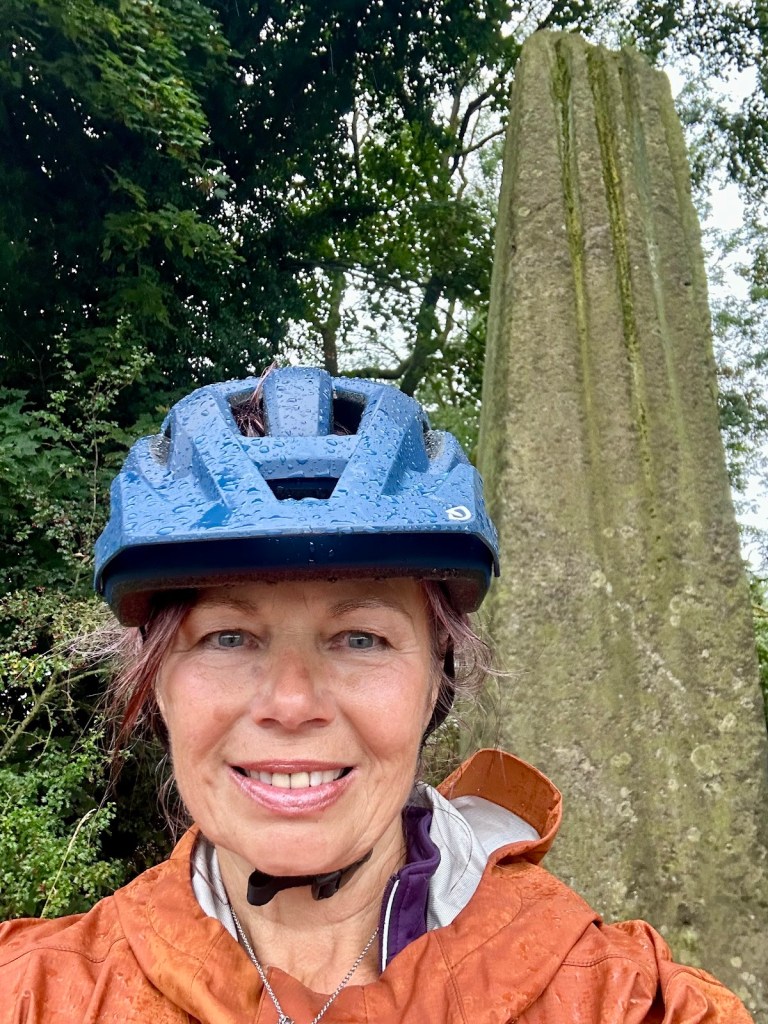
Day three of my journey from Chicago to the Colorado border had taken me only a few miles outside of Chicagoland and ended in what I imagined to be a forest of fairies. My old girl and I had struggled to escape the city, but by nightfall, we found ourselves bottoming out on the old railroad bed that had been converted into a bike trail. Exhausted, I had fallen asleep exactly where I no longer had the energy to pull us to navigable land, contentedly gazing at the entrancing flicker of fireflies glowing on the path with the overhanging trees forming a dark archway overhead. Enchanting.
The following morning, we had awakened to scornful shouts of recumbent bicycle passersby who dispariaged our existence and lack of pride for falling asleep in the middle of the trail…right next to a rather substantial pile of horse dung.
The fairyland in which we had fallen asleep immediately become the harsh reality of what we had attempted to undertake: an 825 mile magical journey along cornfields, wheatfields, thorns, lakes, streams, rivers; an adventure across only one third of the vast expanse of America, whereas my proposed 745 mile trek around England encompassed nearly the entire country.
As I left the witches cave on day three in the UK a soft rain began falling at about the same time as the uniformed children exited school. Reassured I was only a few hours from my destination, I donned the human traffic cone and pressed onward toward another site featured in my novels: the largest prehistoric menhir in England. No, not the ones that come to mind. Those are part of a henge, which is distinctive from a menhir, an upright stone slab that is not part of a circle.
Toward what I knew would be the next designated site, I rode past several campgrounds, wondering if I had been foolish not to stop? Google informed me I was near my destination, so I pressed onward in spite of the rain.
Admittedly, both awe and disappointment swept over me as I gazed toward the monolith towering overhead. I knew there were three, but only one was visible, enclosed in a small fence separating it from the private property beyond. The other two sisters, as they were sometimes called, were tucked away behind a vast plot of very tall corn stalks.
The sisters are etched with deep grooves, as well as petroglyphs or graffiti, the term we loosely apply to any human-made marks on public space applied within the last century. In this case, the human markings were runes, only a smattering compared with the scars created by nature itself. I walked counterclockwise around the menhir, affording myself the opportunity to touch the piece of history, reveling in the shudder that may or may not have been caused by the cold rain dripping from my helmet and trickling under my raincoat.
A small offering of blueberries lay at her feet, and I plucked a few of the wild blackberries from a bush growing nearby, shared my snack with the sister looming over me, and turned to Matilda, who oddly had chosen to stay upright. Google circled me back around to my campground, which happened to be one I had passed only moments ago. I knew setting up camp in the rain would not be a challenge, and I was relieved for the first time since arriving I wouldn’t have to awaken a grumpy camp host to be led to my reserved spot. Instead, I was greeted by a wonderful woman extending the hospitality of traditional English tea.
Witchy Woman: Mother Shipton’s Cave
“Yes, but did you make it to your witch’s cave before they closed?” my daughter asked.
”No,” I texted back, knowing that the time difference meant she had stalked me upon waking while I had spent most of my day furiously pedaling and cajoling Matilda to stay upright. “Although the cave is the oldest tourist attraction in England dating from the eighteenth century, my characters would have visited it long before it had been commercialized,” I explained. “I don’t want to see what I am able to research online. I wanted to experience the geography around the site.”

Throughout the journey, I had realized three things are universal: beer and Energy drink litter, misdirected teenage testosterone, and tourist traps. They line the roadways across America, the UK, France and Spain.
The ride through the limited access, posh neighborhood near what had been touted as a cave where a renown seventeenth century witch had lived was stunningly beautiful. The cliff overlooking the river was steeper than I would have ever imagined, and the gentle breeze passing through the leaves overhanging the water lulled me into complacency. I stopped to snap a photo, vainly encouraging my recalcitrant companion to kindly not dump me, then walked away from her with disgust as she lay supine on the gravel near an alcove.
The characters in my novels make their eight annual journeys to help support the village that grows up around them following their marriages into what would have been an already a wealthy family.
Purportedly, the first woman who married a Molyneux was a pagan who would have had a very high rank in one of the clans that had been decimated by William the Conqueror’s Harrying of the North, a scorched earth military campaign during the winter of 1069-70 resulting in utter destruction of crops, herds, food and villages, leaving vast scars of destroyed land all across York. Over half the population of the north had been killed.
As art historian, I have been fascinated by the Viking hoards scattered across Europe: those piles of wealth left behind by marauding forces, later uncovered by unsuspecting treasure hunters ranging from road construction workers to hack explorers wielding metal detectors in green fields. When I read of yet another new discovery, I can’t help but wonder under what circumstance the hoard had been buried? Why would the marauder never return to claim the rich cache of gold, silver, vessels, coins and cloth, treasures stolen from local villagers, hidden away in shallow holes, covered by generations of peat, moss and leaves, only to be discovered centuries later?
One such treasure piqued this author’s imagination. The Cuerdale Hoard, as it would later be dubbed, had been uncovered near a Molyneux property by the aforementioned road construction workers in 1840. The wealth of objects, the largest hoard discovered in England to date, became property of the crown and is proudly displayed at the British Museum, with, as expected, only a pittance of a reward offered to the crew who had uncovered it.
Speculation, as well as possible claim to the goods, immediately hit the media upon its discovery. Could it have been one of my ancestors, compelled to fight a battle for Henry I, who buried what would have been the funds sent to finance the battle?
My brother-in-law’s initial research into my ancestory was founded upon an impressive tome compiled by the wife of a Molyneux dating a few years after the treasure had been found, an endeavor on her part to perhaps establish why she, as his widow, had a right to claim the treasure as her own.
As both cynicist and author, though, the plots of my imagination had taken seed: my novels are not necessarily about specific characters, but about the existence of a series of imaginary hoards hidden across England, gifts to an illegitimate daughter by a Viking marauder stolen from lands his daughter would eventually populate with the proviso they be used to protect the generations she would birth. Utter fantasy, based upon a string of names another author had strung together in an attempt to claim a real treasure.
No, I had no desire to visit a tourist trap, but instead seek out a niche in a wall, a small cave, a long-since decayed edifice, in which one of the eight imaginary hoards would have been hidden by a protagonist who was nothing more than a filament of my own creation.
As I snapped the photo, I cursed Matilda for her unreliability as a dependable travel companion, pulled her upright, and headed to my next destination, one marking the trek of my characters journeys as they traveled from one place to the next, preserving and sharing a treasure, not of gold, but of the experiences and knowledge that comes with a relative life of transient exploration.
Morning Light: Teversal
September 3, 2024
“Teversal Hall,” I had muttered years before as I awoke with a start.
As I booked my campgrounds for my upcoming bicycle excursion around England to conduct research for my historical novel series, Compass Of Knives, I hadn’t given much consideration to the significance of the spot until months later. I had chosen locations close to sites rich in history, but my first campsite astounded me when I realized its history.
Given my penchant for odd adventures, it seems appropriate that each of my female protagonists in my eight novels embark upon journeys taking them in eight different directions across England, creating spokes in a wheel drawn from the center of the country, which happens to be near the location where several members of my family had resided before being tried and burned as witches by one of their own relatives in the sixteenth century: Pendle Hill.
Book four of my series features Nottingham Caves, the first destination on my proposed 745 mile ride, and a nearby campsite coincidentally happened to be within shouting distance of what was once a manor owned by my family.
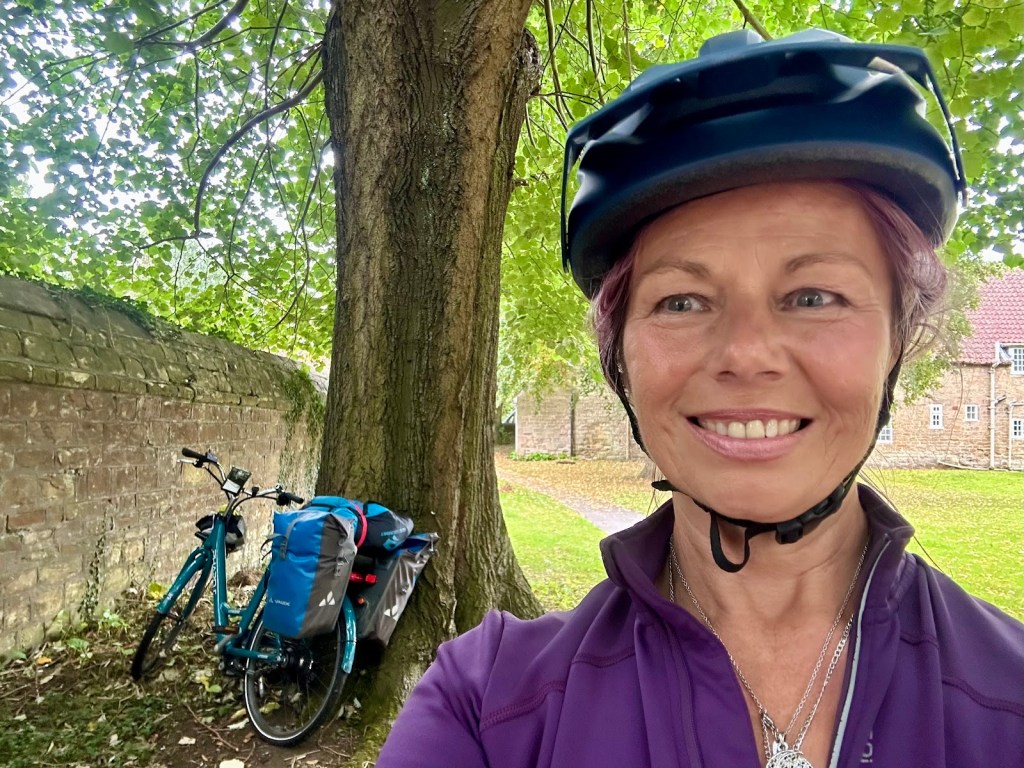
As Google directed me toward Teversal Hall chapel, St Katherine, I gasped with wonder as I saw my family crest on a number of buildings.
“You have arrived,” Google informed me as I precariously balanced my unwieldy electric bike against an old tree standing near a stately wall.
I’ve always adored old cemeteries, but this one held a special significance for me. It was located outside the church I knew housed several baroque marble cartouches bearing my name.
The sign informed me the church was closed, but after wandering around the cemetery taking photos, I happened to spy an open door, and hesitatingly walked into the old stone edifice dating from the twelfth century.
I was quickly greeted by a number of very kind, informative people who graciously allowed me to tour and photograph the building.
The interior was far brighter than I had expected, with rich, dark, heavy beams bracing the high ceiling, each bearing intricate rose carvings. The beams supported a lofty height financed by my family that had been constructed with clerestory windows during the sixteenth century.
Old stone and wood evokes thoughts in which I ponder the satisfaction the artist may have felt when he or she completed the work, and the detail of the rosettes carved into the heavy beams were worthy of deep pride.
Henry James had described the canopied Molyneux family squires pew, appreciating its twisted Solomon columns and dark, aged wood. Imagining the sermons the earliest occupants may have heard while their servants sat in a box pew behind them, I can’t help but consider if the Baron looked upon the villagers in much the same piously pompous and haughtily benevolent way he stares down upon the altar from his cold, white marble memorial.
“The red hand on the hatchments indicate the title of Baron,” my guide informed me, pointing toward the painted wooden square that would have been displayed above the door of the manor after one of the Baron Molyneux’s deaths, then later hung permanently under the light of newly constructed clerestory windows.
Generation after generation had lived, bred, died, been interred in the crypt under the chapel floor, then commemorated in marble or a delicate enamel.
“The Dowager Lady Carnavron contributed the della Robia, my guide added with combined pride and admiration, followed by a tinge of surprise when I expressed appreciation for the Florentine’s exquisite work.
“I had encountered his enamel roundels years ago in Firenze and loved including them in my art history lectures,” I added, explaining how amazed I was to find one in the Teversal chapel.
Sometimes stumbling upon your own history is startling. And humbling. Turns out what I had for several decades perceived to be a nightmare was a dream come true!
Summers of Discontent: Snaith
September 2, 2024
“How will you celebrate your sixtieth?” my daughter challenged me about two years before the looming event. “You need to do something at least as memorable as you did for your fiftieth,” referencing the epic 825 mile bicycle ride I had taken from Lakeshore Drive in Chicago to the Colorado border while towing my twelve year old 86 pound Great Pyrenees, German Shepard dog behind my used Trek mountain bike.
The six week journey I had taken as a birthday gift to myself in 2013 after graduating with my Master’s Degree from the School of the Art Institite of Chicago had become the highlight of my life, peaceful days pushing myself physically, emotionally, spiritually and artistically toward a specific destination: a husband I no longer hoped for, a home I no longer had, a job I had lost, grown children who had moved on with their own adulthood. An identity I was willing to discover, explore, embrace. A new me, one I met somewhere between the vast empty nest of Illinois plains, the mercurial post-menopausal Iowa hills, the sprawling loneliness of Nebraska fields. A new me painfully and joyously documented in personal vignettes through the blogs I had penned along the way which had somehow garnered over 28K hits by the time I crossed into my home state.
My daughter’s question stung. Sharply. It was an unintentional barb that pierced the recesses of my broken brain.
“Just be careful,” my brother-in-law had warned me when he had taken me to he airport in our hometown on my flight back to Denver. “Airport workers sustain very high numbers of on the job injuries,” he informed me.
I laughed it off, reminding him I had survived far more dangerous things the year before on my bicycle ride, then jokingly pointed out I loved the 10 to 12 hour workout I got slinging luggage as a ramp rat, a far less strenuous workout than my ride had been.
Hubris is an ugly thing, and the new me wasn’t quite what I had expected.
Within less than a month of our conversation, I found myself needing to relearn how to talk, walk, climb stairs, those elemental things one takes for granted after the second year of one’s life. And six months later, I was faced with the painful reality that not only was I unable to live on my own, I had lost over thirty measurable IQ points and had the reading level of a third grader, a painful lesson I had learned following a cognitive test taken in the same city where I had once earned a few Greek letters following my designation of with distinction affixed to my two diplomas.
I had the painful discovery of realizing that even though I had once taught my students the joy of Shakespeare’s genius, I was no longer capable of reading his works, much less comprehending them.
“What about Harry Potter books, mom?” my daughter had suggested after I had shared my discovery. I had worked my way through Dr. Seuss, stumbling upon the rythm and rhyme as she had once done when she had begun reading, reciting them aloud to no one but myself over and over again to challenge my tongue to follow the words on the printed page, staring intently at the letters as the jumped from one position to another, stacking themselves at varying degrees one upon another in a way didn’t even know how to identify, much less articulate as the post Traumatic Brain Injury symptom of double vision.

”Things look prettier,” I had often explained to my physical therapist.
“What do you mean?” she asked after I had repeated the phrase several times during my three-times weekly appointments.
”Objects have a strange glow about them,” I explained. “They shimmer, and sometimes glow or have very distinct shadows surrounding them. Life is prettier, but confusing at the worst times, like when I am trying to drive.”
”Most people call that double vision,” she informed me, laughing playfully at the creative way I had identified that particular aspect of the “new me,” a phrase she, my cognitive therapist, and my physician had too frequently used, a phrase I had learned to despise as much as the faltering steps and stammer I had acquired since losing much of the use of three of my four lobes.
The following visit, I was informed I would have yet another set of appointments to fill my week: adding “ocular” and “occupational” to my long list of specialists.
”I am not sure I want to add anything else to my schedule,” I told my daughter when she had made her suggestion, masking the fact that I struggled to admit I wasn’t ready to tackle anything but single-syllable words written in a very large font, much less be able to afford any books I couldn’t find on the bookshelves of her long disregarded childhood books that also contained my substantial collection of college texts ranging from Homer, Socrates, Freud, Benjamin, all the way through Žižek, texts that only tormented me with their inaccessibility. Not even Henry James made sense, though literary critics have been arguing that point for over a century.
“By the end of the day, my eyes are so fatigued from driving that I can’t concentrate on letters, much less words,” I finally admitted to her after my physical therapist had assured me that my vision was part of my new normal. A few days later, my daughter arrived with a Kindle, patiently instructing me how to turn it on, access her books, and, most valuably, increase font size. Although the double vision persists even a decade later, I have learned that larger font decreases ocular fatigue, a post-morbid game changer.
As college instructor, guiding my students through their faltering steps toward the world which had saved me never failed to excite me. But the process of learning to read was one I never thought I would have to apply personally. Yes, I had learned the art of highlighting and taking copious notes in the margins of my texts when I first embarked on my college career, but since I can’t remember not knowing how to read from my earliest childhood memories, reading had been an easy acquisition for me.
”Context helps you understand the meaning of new word,” I would explain to those college students who had tested into my beginning reading course. “Look at the words in the surrounding sentence and paragraph, and guess what the meaning may be,” I would patiently explain. “More often than not, you will be able to come close to understanding the new word. Once you have done contextualization, feel free to look up the word since authors parse their words carefully, intentionally choosing them because of their nuance, a step which will allow you to have a closer reading of the text.”
”But as you read, if you don’t feel compelled to do a close reading because of the sheer volume of the assigned text, feel free to read passages in chunks. In other words,” I would explain, “use the overall context to do a quick skim of the less important sections of an assignment. Logic will allow you to grasp the basic concept being presented, and will save you hours of tedium!”
The brain is considered to be one of the most plastic organs in the body. It naturally makes connections between synapses, rediverting thought processes through different avenues should the old ones no longer be receptive. The shortcuts described above, unfortunately, are the bane of someone recovering from a brain injury. Because the brain is likely to fill in the damaged gaps, it has a vicious propensity to complete thoughts, phrases, and words that aren’t on a written page or in spoken conversations, which leads to flailing comprehension, something which often frustrates caregivers because the patient’s misperception becomes their reality. “I explained this to you only a moment ago,” a caregiver will assert, then proceed to repeat exactly what had already been spoken. Yet the gaps persist, and the distorted reality remains fast in the patient’s mind.
That is true of reading as well, which is why a TBI patient struggles to follow written instructions. The brain, once capable of distinguishing tablespoon from teaspoon in a recipe, for example, is likely to fill in the gap with TSP rather than TBS, small nuances that alter the final outcome.
Contextual reading following a brain injury, alas, produces the same result.
As I returned to any of my previous texts upon my shelves, the process of contextualizing coupled with my brain’s plasticity, its wont to fill in the blanks, resulted in utter confusion. Precious passages that had once touched my soul, favorite, boldly highlighted phrases of prose and poetry alike, became angry, strange words that offended me, reminding me of how utterly broken my brain had become, and the shadow filled pages of transecting letters from my double vision became even more blurred by the tears that would fill my eyes.
“I need new material,” I explained to my daughter, “because the old familiar books are strangers to me now.” So she began downloading her own reading choices, ranging from the more simply written but engaging Harry Potter to George R. R. Martin’s Game of Thrones, then slowly morphed into more challenging books like Water for Elephants and Map Maker’s Daughter, a world outside of my own.
Yes, the words still blurred, faded and collided on the page, but for the first time since my injury, they began jumping off the page, taking me places they always had: unexplored vistas, exciting adventures, new horizons: the very thing that had helped me escape my reality throughout much of my troubled childhood.
“Will this be another cornfield night?” my daughter asked, referring to the many times on my 825 mile bicycle ride from Chicago to Colorado when I would drag my bike, my dog and her trailer into a cornfield, hope the farmer had already run the irrigation system for the day, and curl up beside my huge fuzzy girl to enjoy the sound sleep that accompanies physical exhaustion. “Sadly, that’s not an option,” I reminded her. “I need to recharge.” Frustrated, angry, cold and a bit terrified, I had resorted to choosing the car icon on Google, clicking the “avoid highways and tolls” option around rush hour of the second day of my journey.
While my unwieldy electric cruiser bicycle was as wide and heavy as a cow, Matilda simply could not navigate the muddy, overgrown, washed out cow paths that England has identified as bicycle routes.
On my trek across the US, I had two freedoms I didn’t have on this trip: I had a large buffoonish dog to protect me, and I didn’t have a means of transportation that was as hungry for electricity as my converted ambulance is for gasoline.
I had hit a very busy thoroughfare at dusk, and as a not-so-kind passerby had pointed out, my bicycle lights were not working. Believing the error may have been related to the very low battery power, I had pulled out what was supposed to be my fully charged backup, slammed it into the back of the bike as the rental company had advised me to do earlier in the day, flipped the switch, only to find….absolutely nothing. No power, no lights. And Matilda was far too heavy to push, shove or cajole her the last four miles to the campground.
“I will just have to wait until traffic dies down and stumble her through the last few miles,” I told my daughter, reminding her that the light of my phone would be enough to potentially attract unwanted attention from the vehicles speeding past.
“I am glad you are able to make this trip,” she had informed me as she drove me to the airport. “It will bring your books to life. You will be able to include sights, sounds, smells in your novels.”
After the nervous shivering stopped, they began penetrating my senses. The acidic, slightly sweet smell of the decaying vegetation in the freshly harvested fields. The chirup, chirup of the crickets. The contented coos of the birds as the breeze ruffled through the trees in which they slept. England.
About an hour later, traffic had subsided. I gave a final shove of the battery into its case, and lights and pings of the awaking motor filled the air.
Thirty minutes later, I got the ping from my daughter: “How’s your cornfield?”
My response was a photo, and the simple words, “I guess some things were just meant to be. I am walking through a dark, old cemetery, and the church is illuminated magnificently. All is well.”
Part Time Lovers: Nottingham
02 September 2024
Pinned under the weight of the 200 pound cruiser, I was thankful the roundabout had two lanes. Drivers of the miniature vehicles speeding around honked angrily, their horns sounding like toys compared with the ones I had heard as I had made my trek across America a decade before. I smiled and waved sheepishly from beneath Matilda, struggling to lift her weight enough to squirm out from underneath her, a motion that had become far too familiar over the past few hours.
I had picked her up in London, rushing toward St. Pancras through the stifling streets with a confidence that would soon be quelled: she had seemed a bit unruly once I had packed her small frame with the heavy panniers containing her spare battery, my two outfits, and my lightweight camping supplies, testing her balance as I circled slowly around the courtyard outside the rental shop.
I had chosen her sight-unseen, a vast mistake I would soon regret.
She and I circled around the pavement a few times, and since I had managed to successfully pass the car parked in the enclosed area without ramming into it, I felt ready to take on the world. Or at least London, and much of the the UK.
Navigating busy streets of London on my rented electric bicycle, as it turns out, was the easiest part of my journey.
As I squirmed far enough out of the predicament she had placed me in, I waved aside the usual exclamation, “Are you okay?” from a concerned bystander.
Shrugging, I responded, “Yes, it’s a rental. And she hates me,” longing to add, “I have embarked on a two-week, 745 mile journey with a death wish because of my ignorant choice of bike rental companies,” knowing the horrified onlooker wasn’t interested in knowing that by this point, I was, indeed, questioning whether or not I was ok on many levels, including my own sanity.
After only a few hours together, we’d become quite intimate, Matilda and I.
The brief and blissful honeymoon had lasted only those few kilometers we had shared through London, ending in the first of several times she would dump me throughout the course of our relationship as I attempted to stop our forward progress in front of the bright red telephone booth outside the brick edifice best known as the gateway to Hogwarts, where she unceremoniously directed me straight into the very latticed red edifice I had longed to photograph. I struggled to upright her, thankful she hadn’t broken any of the glass panes into which she had crashed, and walked away without the photo, a disappointment that would often be repeated throughout our tumultuous relationship.
By the time we had attempted to scale the monumental concrete mountain leading to the booth where I had intended to purchase my ticket for Nottingham, the first destination of our journey, I had begun whispering sweetly to her in an attempt to cajole her into staying upright. By the time I pushed and shoved her from the platform onto the train with the assistance of two frustrated fellow passengers, I had called her a number of choicest names, offending both Protestant and Catholic alike with my colorful religious epithets.
And by the time we finally reached Nottingham only a few hours before sunset, she had fallen more times than I had imagined myself to have fallen for all my perceived suitors combined that I have had throughout my sixty-one years of life.

But as the bells of my first English Cathedral rang out five history-laden peals as I precariously held her up to photograph the castle of my childhood’s favorite animated movie, I forgave her, at least for a moment as I imagined spying a fox, a bear and a few church mice scampering across the intensely green grass, peering shyly out at me through the bars of the just-closed English Heritage Site.
We hadn’t journeyed this far to see sights easily explored on the interwebs, but to record sensations: smells, sounds, atmospheres, perceptions; the subtle, sublime research necessary to write my novels that cannot be gleaned from a cold, blue screen glowing during the long hours of my insomnia.
I turned away from the cobbled stones, wobbling excessively as I tested Matilda’s weight, pedaled past the high school tour group emerging from the yellow hued castle, determined to make our encounter fulfilling, assuring myself that my unsteady tipping and toppling was only part of our budding relationship: learning moments in which we would work through the issues confronting us that had arisen throughout the day.
”Turn right,” Google instructed as we sped through a picturesque arch of trees shielding me from the rain that had begun to fall.
Of course I veered left, attempting to make a sharp U-turn as Google had instructed us and immediately felt the bite of the gravel as Matilda angrily pinned me to the ground for expecting her to maneuver the move in spite of the wet, slippery surface upon which we were moving at a far too-high speed.
After assaulting her with another string of religious phrases that she seemed to not appreciate in the slightest, two young men on far more agreeable e-bikes than I had came to our rescue, gallantly arighting us, warning us to perhaps move at a slightly more manageable rate, wise words followed by an appreciative laugh as I introduced them to a few other phrases describing her unwillingness to help me guide her through our troubling first few hours, praising them for their wisdom in purchasing their own bikes rather than blindly renting one.
I begrudgingly followed their instructions, resolving myself to the fact that I would more than likely reach my first campsite well after dark.
“Teversal Hall.” The phrase had haunted me for well over two decades, one I had screamed out while recovering from my first manic whirlwind trip to Europe followed by 36 hours of whipping out over 400 pages of my two Honors Theses I had written to complete my two undergrad degrees at the University of Colorado. My brother-in-law had just sent me a missive tracing my genealogy to an old aristocratic line in England, and my exhausted brain had latched upon the name of the ancestral hall.
While reading Henry James’ Portrait of a Lady earlier in the course work as assigned reading by one of my favorite professors, I stumbled upon what had been to me my very unique maiden last name. I was to learn later that my name was not unique at all, at least not in Europe.
The description in the novel had been humorously accurate of me and my sisters: quiet, somewhat plain, short and indecipherable backdrop characters. We’d been trained to be submissive wall flowers, demure pawns in a patriarchal world. But the sisters Molyneux, as Henry James identified them, came from a seemingly different socioeconomic perspective than that shared by my impoverished family. They were accoutrements to Lord Wharburton’s Hall, where they played the role of the perfect chaperone, protecting their brother’s honor as he courted the far more spirited Isabella, the protagonist who would later suffer the consequences of her willful self-destructive tendencies.
Their socioeconomic position, however, in many ways resembled mine. As females in a patriarchal society in which only the firstborn son has any real monetary value, their reduction to mere plot development had been appropriate, a pattern echoed in many ways in the culture I encountered in England.
The discovery of my name in the novel, and in such a noble setting, piqued my interest, and a quick search revealed that in typical HJ fashion, he had created his characters from old cemeteries and historical edifices he had visited as he had walked across England penning his travel notes.
Someday exploring the ancestral Molyneux manor, its splendor, its lovely green grass and sprawling gallery filled with canvases painted by the masters as his heroine had done seemed as distant from me and my personal experiences as the fairy tales that had once entertained me as a child: elusive yet distracting, but never attainable.
I had lost several valuable undergrad hours as I had written my analysis of the assigned novel researching the art that may have been hung in the Warburton Estate, hit several brick walls, resorting to analyzing how the characters in the novel had been shaped by the art they may have encountered from an abstract rather than concrete perspective, believing the art to be as untraceable as the potential link between me and the unremarkable sisters.
It is said that opposable thumbs separate humans from most other species, and we are unique because of our bipedal posture. Her brain injury required teaching herself how to walk, and her thumbs remain stubbornly unpredictable. And those were the easy lessons!
About the author: It’s Like Riding A Bike”
Journeys are the essence of life, but a decade ago Roberta was forced to undertake one that has been unimaginably nightmarish. After sustaining a traumatic brain injury that affected three of her four lobes and has been tasked with recreating herself on every level.
The building blocks were there, but basic skills like reading, speech, mark making and writing remain an ongoing process.
Please join her on her progressive journey!
Roberta earned her Master’s in Art Education from School of the Art Institute of Chicago
and her Bachelor of Arts in Humanities and English Literature,
With Distinction, Magna Cum Laude from University of Colorado, Boulder.
 Roberta Molyneux